Bulb · Primulaceae
Florist's Cyclamen
Cyclamen persicum
Keep it cool, bright, and watered from below, and cyclamen carries a room's color all winter.
Bright indirect
Every 5–10 days
50–64°F · 10–18°C
420–540 days
Overview
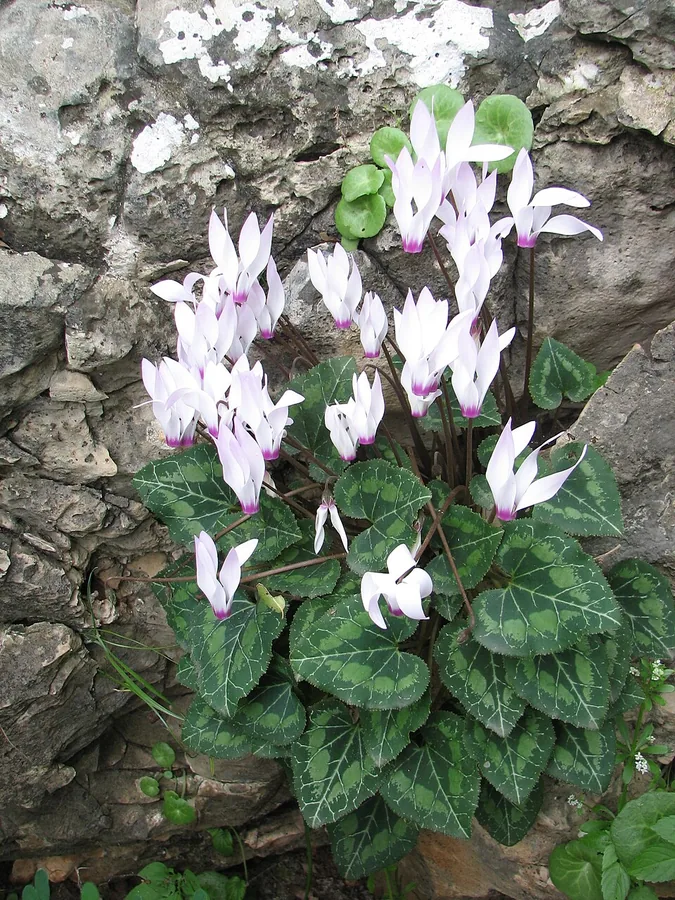
Cyclamen arrives just as the season turns quiet, bringing color to a windowsill when most plants have gone to ground, its upswept flowers holding from late fall into spring. A member of the primrose family, it grows from a flat tuber resting at the soil surface and lifts heart-shaped leaves marbled in silver and green that suit a cool, considered interior. Most homes welcome it as the florist's cyclamen, the tender hybrid offered in pots through the colder months.
What it asks of a home runs against the usual houseplant rhythm. Cyclamen prefers things cool and bright, not warm and snug, and a heated sitting room dims its mood the way a draft unsettles tenderer company. Set it to water from below so the crown stays dry, give it a chilly window to call its own, and it returns weeks of bloom that earn it a place in any winter scheme.
By late spring the leaves yellow and fade, and a newcomer to the plant often clears it away, certain it has had its run. It has not. The tuber is only easing into dormancy for the summer, a quiet interval before cooler days call it back to take up its place again.
Care
The short version: keep it cool and bright, water from below whenever the surface dries so the crown stays dry, feed lightly through the growing season, and let the tuber rest dry through its summer dormancy.
Light
Give cyclamen bright, indirect light, the soft kind a window offers once the midday glare has passed. It tolerates a little partial sun or shade, yet direct sun scorches the leaves and deep shade quiets the flowering, so the gentle middle ground keeps a display at its best.
Water
Water only when the surface feels dry, about every 5 to 10 days through the growing season, and always from below so the crown and tuber stay dry. Water resting on the crown is what undoes the plant. Once the leaves yellow for summer, draw the watering right back and let the tuber rest.
Soil
Set it in a rich, light, well-drained loam that lets water move through quickly rather than pool around the tuber. A pH anywhere from 5.5 to 7.0 suits it well, so slightly acidic to neutral ground asks nothing extra of you.
Temperature
This is the detail most homes overlook. Cyclamen wants it cool, between 50°F and 64°F (10°C to 18°C), and a warm living room hurries it into decline. A bright, chilly windowsill is precisely the setting it longs for.
Humidity
Aim for 40% to 60% humidity, the easy middle of an ordinary home. Skip misting, which only wets the crown and invites rot, and where the air runs very dry, rest the pot on a tray of damp pebbles to lift the moisture around it.
Feeding
Feed monthly from fall through spring while the plant is in active growth, using a dilute balanced or low-nitrogen houseplant food. Set the feeding aside once the leaves begin to yellow and the tuber turns toward its summer rest.
Pruning
There is no real pruning to keep up with here. Simply twist off spent flowers and yellowing leaves at the base, pulling rather than cutting, which spares the plant rotting stubs and keeps it looking groomed on the sill.
Repotting
Repot every 1 to 2 years after the summer dormancy, just as fresh growth begins to stir. Roots crowding the pot, a tuber filling the surface, or smaller leaves and fewer flowers all signal that a larger container is due.
Size & spacing
Cyclamen stays small and composed, reaching only 6 to 9 inches (15 to 23 cm) tall and about as wide. That neat, mounded form is what lets it sit so gracefully on a windowsill or a side table without crowding the scene.
When to plant
Cyclamen keeps a winter calendar, the reverse of most plants and a gift to a home that wants color out of season. Seed sown in late summer comes to bloom the following winter, and indoors the flowers carry from November into April before the tuber takes its summer rest.
Northern hemisphere
Southern hemisphere
Typical months for a temperate climate: start earlier in warm zones, later where spring frosts linger.
- Sow: late summer
- Plant: after frost in zones 9-11 only
- Harvest: winter to spring (November to April)
Hardiness
USDA hardiness zones: 9–11
Temperature: down to -7°C
Troubleshooting
Most cyclamen setbacks trace to a warm room, water sitting on the crown, or a mite too small to notice. The art is telling a rotting tuber from a plant simply settling into dormancy, so you know when to step in and when to let the season run its course. Match what you see below and act early.
New growth arriving puckered and buds twisted
When fresh leaves and buds open cupped, curled, and stunted, the cause is cyclamen mites or the broad mites that keep them company, both too small to catch the eye. They settle into the growth before it opens and feed there, so the display comes in spoiled from the start. Set the plant apart from the rest of your collection at once, and part with a badly affected one rather than let the trouble spread across the room.
Fix:
- Discard heavily infested plants to prevent spread
- Isolate affected plants immediately
- Apply a miticide labeled for cyclamen mites if treating
A softening tuber and a crown that gives way
Water left to linger on the crown sets up tuber and crown rot, and a base gone soft and sour seldom finds its way back. The fault is almost always overwatering, the kind that comes from pouring straight over the top. Shift to watering from below, lift away any tuber that has turned to mush, and offer the rest the crisper drainage and open air that keep a centerpiece looking its best.
Fix:
- Reduce watering and water from below
- Remove and discard severely rotted tubers
- Improve drainage and air circulation
Foliage turning gold and quietly fading
Yellowing in late spring or summer is simply natural dormancy, the tuber bowing out as its season closes, and the moment asks for nothing but acceptance. Should the leaves yellow in the depth of winter, when the plant ought to be earning its place on the sill, it is reading the room as too warm or too wet. Carry it to a cooler corner near 65°F (18°C) and lighten the watering.
Fix:
- During dormancy, reduce watering and rest the tuber in a cool spot
- During active growth, move to a cooler location and correct watering
Toxicity
Cyclamen is toxic, and the caution is not for pets alone. The whole plant carries terpenoid saponins, with the buried tuber holding by far the most, so eating it can cause vomiting and, in quantity, heart-rhythm trouble and seizures. Place it well out of reach of cats, dogs, horses, and small children, and wash your hands after handling the root.
Toxic to
Cats · Dogs · Horses · Rabbits · Livestock · Birds · People
Cats Severe
A single curious nibble can leave a cat drooling, vomiting, and dealing with diarrhea. A cat that reaches the tuber faces graver odds, including an irregular heartbeat and seizures, and a large dose can be fatal, which is reason enough to style this plant somewhere a cat cannot wander.
Dogs Severe
A dog that tastes the plant tends to drool heavily, vomit, and turn queasy. Because the tuber concentrates the toxin, a dog that chews into the root risks heart-rhythm trouble, seizures, and, at worst, death, so a high shelf serves better than a low table in a dog's home.
Horses Severe
In a horse, the saponins prompt drooling, diarrhea, and colic, and an animal that cannot vomit has no means of clearing what it has taken in. A generous helping of tuber can unsettle the heartbeat and bring on seizures, so the plant has no place near a stable.
Rabbits Toxic
The same saponins make every part unsafe for a rabbit, with the tuber the most potent of all. A potted cyclamen belongs well above a rabbit's range, and the leaves should never sit within reach of a browsing nibble.
Livestock Toxic
Cattle, sheep, and goats that graze on cyclamen take in the same digestive toxin, and the buried tuber holds the steepest dose. The plant is best kept entirely apart from any animal that grazes.
Birds Toxic
The saponins offer birds no leniency, so a pet parrot or finch should never reach the foliage or the tuber. Place the plant where an inquisitive beak has no way to explore it.
People Caution
No part of cyclamen is meant for the table, and swallowing it can bring vomiting and an unsettled stomach, with the tuber the most hazardous of all. Handling the tuber can also irritate the skin, so wash your hands afterward and keep it clear of children.
The tuber/root is the most toxic part. Keep plants out of reach of pets and children, and wash hands after handling as the tuber can cause contact dermatitis.
Helpline numbers

United States
ASPCA Animal Poison Control: (888) 426-4435 (fee applies)
Poison Control: (800) 222-1222



Canada
Poison Centres: 1-844-764-7669
Varieties
Cyclamen spans a tender plant for the pot and a hardy one for the woodland edge. These two are the forms a home is most likely to meet.
Cyclamen persicum (florist cyclamen hybrids)
These tender hybrids are the ones dressed up for the winter shop shelf, lifting full upswept blooms in violet, lavender, pink, rose, red, and white, many finished with a darker eye at the center.
Cyclamen hederifolium
Named for its ivy-shaped leaves, this hardy species takes real cold without complaint and earns a spot in the garden as groundcover rather than a plant for the pot.
How to propagate
Cyclamen comes on slowly and asks for patience whichever way you take it. Seed is the route nearly everyone chooses, with division a long shot kept for the truly committed.
SeedModerate
Late summer · About 12-18 months to first bloom
Seed is the dependable way to bring on more cyclamen for the seasons ahead. Sow fresh seed in late summer and the plants flower the following winter, though the wait runs 12 to 18 months from sowing to that first bloom, a slow ripening that rewards a patient hand.
DivisionDemanding
During dormancy · Variable
Splitting the tuber during summer dormancy is tempting but seldom worth the gamble. The cut pieces tend to rot before they root, and recovery runs anywhere on the calendar, which is why seed stays the considered choice.
Myths
Cyclamen is safe around pets because it is sold as a common houseplant.
A place on the shop shelf says nothing about whether a curious pet can safely chew it. Cyclamen is toxic to cats, dogs, and horses, and the tuber especially can cause an irregular heartbeat, seizures, and death when an animal eats enough. Style it well out of reach of animals and children.