Tree · Cupressaceae
Leyland Cypress
Cupressus × leylandii
Given room to breathe and steady water, this fast evergreen draws a private green wall around a garden in just a few years.
Full sun
Every 7–14 days
USDA 6–10
40–70 ft · 12.2–21.3 m
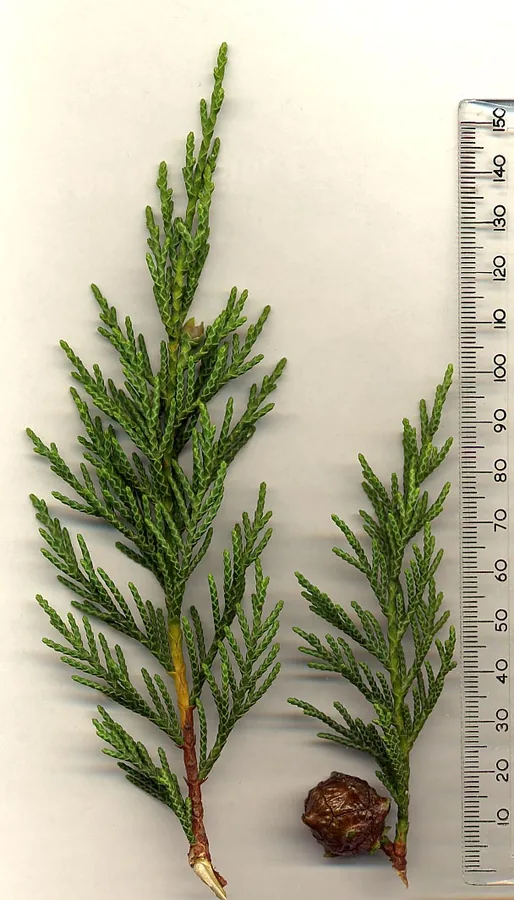
Overview
Leyland cypress is the tree a garden reaches for when a room outdoors needs its walls, and needs them soon. A fast-growing evergreen born of an accidental cross between Monterey cypress and Nootka cypress, it rises several feet a year into a dense, feathery column that closes off a view and frames a space with quiet green. That pace is the whole appeal, and it is also the source of most of its demands.
The catch is that this is a short-lived, disease-prone tree, and the tight, unbroken hedge most people picture works against it. Lined up shoulder to shoulder as a single-species wall, the trees press in, the air stills, and canker and root rot take their toll on the look of the whole planting. Give each one honest space and the screen holds its shape far longer than a crowded, neglected row ever could.
Treated as a true feature of the landscape rather than a quick partition, it earns its place. It settles into a range of soils, takes shearing into the clean, formal lines a courtyard or a boundary calls for, and asks little once established. Spacing, drainage, and steady water through dry spells are what carry a screen from merely present to genuinely handsome.
Care
The short version: full sun, well-drained soil, and generous room between plants. Water deeply in dry spells, prune only when the weather is dry, and give each tree the space a graceful screen needs.
Light
Leyland cypress looks its best in full sun, which keeps the canopy dense and even all the way around for a clean, unbroken wall of green. It will accept partial sun or light shade, but a shaded flank thins and browns sooner, and that same spot is where needle blight tends to begin.
Water
Once settled it takes drought in stride, yet drought stress is what invites deadly canker, so it should never run bone dry. Through dry spells, water deeply every 7 to 14 days, with extra care for young trees and for any plant that is crowded or already looking tired.
Soil
The tree makes itself at home in loam, clay, or sand across a wide pH of 5.0 to 8.0. The one thing it will not tolerate is poor drainage, since soggy ground invites root rot, so heavy clay is worth amending before planting.
Temperature
It is both cold-hardy and heat-tolerant, holding steady from about -9°F to 100°F (-23°C to 38°C). That range suits many gardens, though ice and freeze injury can crack the bark and open the way to canker.
Humidity
Ordinary outdoor humidity suits it, so there is no level to manage. What matters far more is air moving through the canopy, because still, damp air around crowded plants is what feeds the foliar diseases and dulls a screen's good looks.
Feeding
Feed lightly in spring if at all, using a balanced complete fertilizer. Established trees rarely need any, and forcing soft, fast growth with extra nitrogen does the planting no favors.
Pruning
Prune only in dry weather, since wet cuts spread disease, and the tree takes shearing gracefully into a formal screen. When clearing cankered or diseased branches, cut several inches below the damage and wipe your tools with 10 percent bleach or alcohol between cuts.
Repotting
This is a landscape tree, not a container plant, so it is rarely potted up. A young one held in a nursery pot should move on before the roots start circling and growth stalls, then go into the ground where it belongs.
Size & spacing
Left to grow, it rises to a commanding 40 to 70 feet (12 to 21 m) tall and spreads 10 to 20 feet (3 to 6 m) wide. Those proportions are why spacing shapes the whole look: give each tree real distance from the next so air moves through and the planting keeps its poise.
When to plant
There is no season to agonize over, since you set out a nursery tree rather than sow it. Plant in spring or fall while the soil is workable and the weather is mild, letting the roots settle into their new setting before the next stretch of heat or hard cold.
Northern hemisphere
Southern hemisphere
Typical months for a temperate climate: start earlier in warm zones, later where spring frosts linger.
- Plant: spring or fall
Hardiness
USDA hardiness zones: 6–10
Temperature: down to -23°C
Troubleshooting
Almost every fault in a Leyland cypress screen comes back to one thing: trees set too close in the wrong spot. Look to the lower and inner branches, where canker, blight, and root rot show themselves first. Match what you see below, then act early, because the serious diseases have no cure once they take hold across a planting.
A whole branch fading to rust-brown above sunken, weeping bark
A branch that fades to rust-brown over sunken, weeping bark is the mark of Seiridium or Botryosphaeria canker, the trouble that undoes more of these screens than anything else. The fungi enter through small bark wounds and settle fastest on trees left thirsty or pressed too close to their neighbors. No spray will cure it, so the answer is to prune well below each canker, disinfect tools between cuts, and keep the tree watered and generously spaced.
Fix:
- Prune out infected branches several inches below the canker and destroy them
- Disinfect pruning tools with 10 percent bleach or alcohol between every cut
- Reduce stress by deep watering during drought and mulching beyond the lowest limbs
- Remove severely declined trees as there is no chemical cure
A stunted, off-color tree languishing in soggy ground
A tree that thins and pales to yellow, purple, or tan while its roots break down is showing Phytophthora root rot, a disorder of wet, compacted ground. Young trees fare worst. Once the roots decay there is no recovery, so lift and destroy the tree, correct the drainage, and choose a fresh position rather than setting another Leyland cypress in the same place.
Fix:
- Remove and destroy infected plants and do not replant Leyland cypress in the same spot
- Improve drainage and amend heavy clay with organic matter
- Avoid overwatering and waterlogged sites
Browning that opens up deep inside the canopy and drifts outward
When the browning opens up low and deep inside the canopy and leaves only the tips green, the likely cause is Passalora needle blight. It moves on splashing rain and lingers wherever the foliage stays wet, so the crowded, shaded plantings suffer first. Thinning the planting for airflow, watering at the roots rather than overhead, and cutting out the worst branches will turn a shabby screen back toward a graceful one.
Fix:
- Space and thin plantings to improve airflow and reduce leaf wetness
- Switch to drip irrigation or water early in the morning, avoiding overhead watering
- Prune out and destroy diseased branches
- Apply a labeled fungicide (e.g., thiophanate-methyl or myclobutanil) preventively from late spring through summer if needed
Small spindle-shaped bags hanging among thinning branches
The 1 to 2 inch (2.5 to 5 cm) silk bags trimmed with scraps of foliage are the work of bagworms, whose caterpillars can leave a branch bare. The remedy is to pick the bags off through winter and early spring, before the eggs hatch. Should the larvae still be small, a spray of Bt clears them.
Fix:
- Hand-pick and destroy bags in winter and early spring
- Apply Bacillus thuringiensis (Bt) when larvae are small in spring
- Use a labeled contact insecticide for heavy mature infestations
Needles flecked yellow and turning bronze beneath faint webbing
Fine yellow flecking that settles into a bronze cast, sometimes with a whisper of webbing, is the mark of spruce spider mites. They feed in the cool of spring and fall rather than the height of summer. A firm spray of water dislodges them, insecticidal soap or horticultural oil finishes the job, and broad insecticides are best avoided, since they remove the predators that keep the mites in check.
Fix:
- Spray plants forcefully with water to dislodge mites
- Apply insecticidal soap, horticultural oil, or neem oil
- Avoid broad-spectrum insecticides that kill predatory mites
Toxicity
Reassuring news for a household with pets or children: Leyland cypress is not toxic. No part of the tree poisons cats, dogs, horses, or people, which makes it an easy choice for a garden shared with animals and young ones. The one real caution is for the hands, since the foliage can irritate skin, so wear gloves when you prune.
Safe for
People · Cats · Dogs · Horses · Rabbits · Livestock · Birds
Cats Safe
A cat can share the garden with this tree in comfort, since Leyland cypress is not toxic to cats and a curious nibble won't poison one. A cat that swallows a lot of any plant may bring it back up or feel briefly unsettled, as with almost anything leafy.
Dogs Safe
A dog is at ease around this tree, which carries no known toxin. The only note is a dog that chews and swallows a good deal of woody foliage, which can bring on mild, passing tummy trouble.
Horses Safe
Horses grazing near a Leyland cypress have nothing to fear. Unlike certain truly poisonous evergreens, this hybrid carries no toxin that would harm them.
Rabbits Safe
Rabbits are safe around the foliage, and a stray bite does no harm. It holds no appeal as food, so they rarely trouble it in the first place.
Livestock Safe
Cattle, goats, and sheep can share a pasture edge with this tree, which offers no poison to any of them. Grazing animals tend to pass over the resinous foliage and take the grass instead.
Birds Safe
Birds nest and shelter in the dense canopy with no danger at all. Nothing in the foliage or the bark they peck holds any harm.
People Safe
No part of the tree poisons people, so it is safe to grow around children. The single caution touches the skin rather than the stomach: handling the foliage can bring on contact dermatitis in some people, so wear gloves when you prune.
Wear gloves when pruning or handling foliage to avoid skin irritation.
Varieties
Most Leyland cypress offered for screening is one of a few named selections, set apart mainly by color and habit, a small palette to choose from as you picture the look you want. These are the ones you are most likely to meet at the nursery.
Leighton Green
The enduring classic, a tall, dense, columnar tree in deep green that southern gardeners turn to for a quick screen or a Christmas tree raised at home.
Castlewellan
A more compact selection whose gold-tipped foliage glows at its warmest yellow through fall, winter, and spring.
Naylor's Blue
A looser, more openly branched column dressed in soft blue-gray foliage on a slightly slower-growing frame.
Murray
A vigorous dark green form grown much like the classic for raising a quick wall of privacy.
How to propagate
Because it is a sterile hybrid, the tree cannot be raised true from seed, so every new plant begins as a copy taken from one already growing.
Stem cuttingsModerate
Late summer to fall (semi-hardwood cuttings) · Several weeks to months to root
Being a sterile hybrid, it won't come true from seed, so cuttings are the usual way to raise a matching tree. Take semi-hardwood cuttings from late summer into fall, and allow them patience, since they may need several weeks to a few months to root.
GraftingDemanding
Dormant season · Weeks to months
Some growers graft it in the dormant season, the union settling over weeks to months. It asks for skill, though, and turns up far less often than rooted cuttings for landscape stock.
Myths
Leyland cypress is a maintenance-free, plant-it-and-forget-it instant hedge.
It grows fast, but it is short-lived and prone to disease, and it fares worst when set tight as a single-species wall. Crowding and drought stress open the way to Seiridium and Botryosphaeria cankers, needle blight, and root rot, while the shallow roots leave a large tree ready to topple in a storm. Give it real room and steady water, or the elegant screen becomes a high-maintenance one.
Cankers and needle blight can be cured by spraying the tree with fungicide.
Once a canker takes hold, no spray will cure it. The only real management is cultural: prune out the diseased wood, ease the tree's stress, space the planting well, and keep your tools clean.