Tree · Pinaceae
Scots Pine
Pinus sylvestris
Sculptural, sun-loving, and at ease on lean, sandy ground, Scots pine gives a garden year-round structure.
Full sun
Every 7–14 days
USDA 2–7
30–60 ft · 9.1–18.3 m
Overview
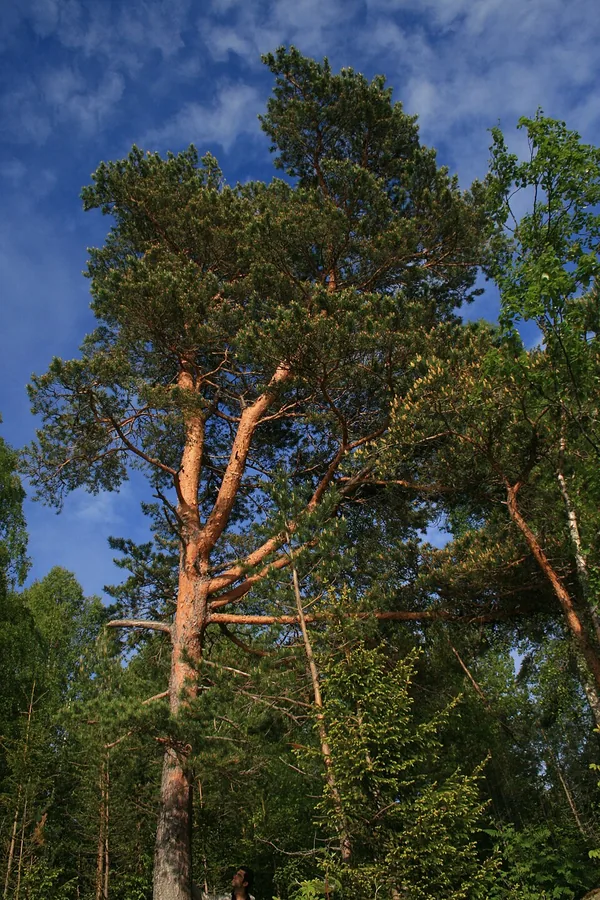
Few conifers carry a garden through winter the way Scots pine does. One of the most widely planted pines in the world, it is instantly legible from a distance, its flaking orange-red bark warming a gray season while its twisted blue-green needles soften the silhouette against the bare branches nearby. With age the crown opens and grows characterfully ragged, lending an old tree the windswept, almost drawn quality that makes it a natural focal point. A member of the Pinaceae family and native across Europe and Asia, it has long anchored North American landscapes and Christmas-tree fields alike.
Part of its appeal is how gracefully it asks for so little. It settles fast into a property, weathers cold to -40°F (-40°C), and takes to dry, sandy, unpromising ground where a more demanding tree would falter. That easy constitution is the reason it once framed so many yards and country tree farms.
The one caveat is worth planning around. Pine wilt disease has quietly pushed it out of the trade across much of the Midwest, and tip blight along with a few insects can dull a tree already under strain. Choose a site clear of established wilt, keep it in good health, and this pine will hold its place in a landscape for generations.
Care
The short version: set Scots pine in full sun on well-drained, faintly acidic sandy or loamy ground, and water sparingly once it has settled. It rarely needs feeding, prefers a dry-weather pruning, and rewards you most when given the open room a large tree commands.
Light
Give Scots pine an open, sunlit position and it repays you handsomely, since full sun is where it looks its best. It has next to no tolerance for shade, and a tree penned in by taller neighbors turns thin, leggy, and unconvincing as a specimen.
Water
Once it has settled into a site the tree is drought tolerant, leaning on rainfall even on dry, sandy ground, which makes it a low-maintenance presence in the garden. Give a young tree a drink through dry spells while it establishes, a good soak roughly every 7 to 14 days, then let it fend for itself.
Soil
Scots pine is content in well-drained sandy or loamy soil and unbothered by the poor, dry corners of a property. It leans acidic, around pH 4.5 to 7.0, yet takes slightly alkaline ground in stride, which makes it easy to place.
Temperature
Climate rarely limits where this tree will grow. It holds up from -40°F to 95°F (-40°C to 35°C), a range that carries it well into the cold of zone 2 and lets it suit gardens most conifers cannot.
Humidity
Ordinary outdoor air suits it, so humidity is nothing to manage. What counts more is open air movement around the crown, since still, damp conditions invite the tip blight that can trouble the tree.
Feeding
This is a light feeder that asks for almost nothing at the table. An established tree is happiest with no fertilizer at all, and only a single light balanced feed in spring is warranted on the rare occasion growth looks thin.
Pruning
Keep the shears mostly idle. Remove dead, damaged, or diseased branches in dry weather only, since wet-weather cuts spread Diplodia tip blight, though the tree does take shearing gracefully when raised as a Christmas tree.
Repotting
Scots pine belongs in the ground and is rarely a container plant for long. If a young one is potted, roots circling the drainage holes, stalled growth, or water rushing straight through are its cue that it wants a permanent place in the landscape.
Size & spacing
Plan for scale, because this is a large tree that reaches 30 to 60 feet (9 to 18 meters) tall and spreads 30 to 40 feet (9 to 12 meters) wide. Give it that generous stage, set well back from the house and other trees, so the crown can open fully in the sun.
When to plant
Comfortable across zones 2 through 7, Scots pine is less about a harvest calendar than about giving new roots a gentle start. Plant in spring or fall, while the soil turns easily and rain falls dependably, so the tree can find its footing before the extremes of the year arrive.
Northern hemisphere
Southern hemisphere
Typical months for a temperate climate: start earlier in warm zones, later where spring frosts linger.
- Plant: spring or fall
- Harvest: Non-flowering conifer; produces gray to light brown cones about 3 in long. Often harvested as a Christmas tree.
Hardiness
USDA hardiness zones: 2–7
Temperature: down to -46°C
Troubleshooting
The story of a struggling Scots pine tends to be written first in the needles and the new candles, and the gravest chapters belong to pests and fungal disease. The task is to read the difference between a mortal threat like pine wilt and a passing, treatable one, then respond before the season turns. Find the matching account below.
Whole branches fading to brown and a tree lost in one season
When entire branches fade and a tree is lost within a single season, the cause is almost always pine wilt disease, a microscopic nematode ferried between pines by sawyer beetles. The needles pass from gray-green to a tired yellow-brown, and a cut trunk offers up little resin. There is no remedy, so a confirmed tree has to be taken down and then burned, buried, or chipped before the beetles find the next pine.
Fix:
- No cure exists once a tree is infected
- Promptly remove and destroy (burn, bury, or chip) dead and dying trees to eliminate beetle breeding sites
- Do not leave cut pine wood on site, as it harbors the beetle vector
Pitch beading on the trunk and branches breaking at the whorls
Those sticky beads are the mark of the Zimmerman pine moth, whose larvae work under the bark where branch meets trunk. The weakened joints give way, so a limb or the leader may break clean off at a whorl. Prune out and destroy the infested wood, keep the tree in good health, and where the moth is a familiar problem, treat the trunk in mid-April and again in mid-August to reach the larvae before they enter.
Fix:
- Prune out and destroy infested, broken, or dying branches
- Maintain tree vigor with proper siting and watering
- Apply a registered insecticide trunk spray in mid-April and again in mid-August to target larvae before they bore in
White specks along the needles that lift away easily
The specks are pine needle scale, small white armored insects that settle on the needles and feed until the foliage looks bleached and thin. Address the crawlers, the reddish nymphs of late spring, with horticultural oil or insecticidal soap, then treat the second generation come midsummer. Cut away and destroy any branch that has crusted over.
Fix:
- Treat crawlers (tiny reddish nymphs) with horticultural oil or an insecticidal soap in late spring
- Repeat for the second generation in midsummer
- Prune out and destroy heavily encrusted branches
Clustered larvae grazing last year's needles in spring
The feeders are the European pine sawfly, grayish-green larvae that graze in close company on the older needles while the fresh tips go untouched. Pick or prune out the clusters and destroy them, or dislodge the larvae with a firm spray of water. Should the damage mount, turn to an insecticide labeled for sawflies, as Bt has no effect on them.
Fix:
- Hand-pick or prune out clusters of larvae and destroy them
- Knock larvae off with a strong stream of water
- Apply an insecticide labeled for sawflies if defoliation is heavy (Bt does not work on sawflies)
New candles browning and cut short at the branch tips
This is Diplodia tip blight, a fungus that kills the fresh candles and leaves short brown needles freckled with tiny black fruiting bodies, and in a long wet spell Dothistroma needle blight may add to it. Prune and burn the infected twigs and cones in dry weather only, wiping the pruners with 10 percent bleach between cuts. Where the disease returns each year, apply fungicide at bud break and on through candle elongation.
Fix:
- Prune and destroy infected twigs, branches, and cones during dry weather only
- Sterilize pruners with 10 percent bleach between cuts
- Apply fungicide at bud break, half candle elongation, and full candle elongation where the disease is chronic
Toxicity
For a household with pets, Scots pine is reassuring company: a true pine, not poisonous to cats, dogs, horses, or livestock. The only cautions are the needles, sharp enough to prick an inquisitive mouth, and the sticky sap, which can irritate skin or leave a stain.
Safe for
People · Cats · Dogs · Horses · Rabbits · Livestock · Birds
Cats Safe
Scots pine holds no poison for a cat. The only real caution is the sharp needles, which can prick the mouth, while a little nibbled greenery may bring on a brief bout of vomiting before all is well again.
Dogs Safe
A dog may mouth the needles without any risk of poisoning. Sticky sap and stiff needles can prove mildly irritating, and a large mouthful of foliage might unsettle the stomach for a short while.
Horses Safe
Horses share the garden with Scots pine safely, unlike ponderosa and one or two relatives. Nothing calls for watching beyond the plain scratch of the needles.
Rabbits Safe
The needles and bark carry no toxin for rabbits, and pine is sometimes offered as a branch to gnaw. Take care that any wood comes from untreated, unsprayed trees.
Livestock Safe
Cattle, goats, and sheep can browse Scots pine free of the pine-needle abortion tied to ponderosa pine. In any case, grazing animals tend to pass over the prickly foliage.
Birds Safe
Birds face no hazard from this pine. Many make a home in the dense crown and take the seeds straight from the cones.
People Safe
Scots pine presents no poisoning risk to people, and its inner bark and needles have a long tradition in teas. The needles are sharp, so keep a gentle watch on how young children come near them.
Sharp needles and sticky sap can cause mild mechanical irritation; sap may stain. No special handling required beyond normal care.
Varieties
The straight species does most of the work in gardens, though a few chosen forms turn up when a particular effect is called for. These are the selections worth having on your list.
Fastigiata
A slender, columnar form that rises straight as an exclamation point, made for a tall vertical accent where floor space is tight.
Watereri
A slow dwarf that settles near 10 to 12 feet, dressed in stiff, twisted blue-gray needles above bark that sheds in orange-tinged scales.
Glauca
The one chosen for color, its deep blue-green needles the bluest note among common Scots pines.
How to propagate
Almost every Scots pine comes from seed, with grafting held back for the named forms that will not reproduce true.
SeedModerate
Sow stratified seed in spring. · 2 to 3 years to a sturdy sapling
All but a few Scots pines begin as seed. The cones take two years to ripen, and the seed asks for a cold, moist rest before it stirs, so it is sown in spring after stratifying. From there, allow 2 to 3 years for a seedling to become a sturdy young sapling.
GraftingDemanding
Late winter, onto seedling rootstock · 1 to 2 years
The named forms such as Fastigiata and Watereri will not come true from seed, so they are grafted instead. The work is set in late winter onto seedling rootstock, and a good union knits and settles over the following 1 to 2 years.
Myths
Scots pine needles cause abortion in pregnant animals.
Pine-needle abortion is genuine, but it belongs to ponderosa pine and a handful of near relatives whose isocupressic acid affects pregnant cattle, not cats, dogs, or horses. Scots pine is simply not the species at fault, and the ASPCA lists ponderosa pine itself as non-toxic to dogs and cats.
Scots pine is invasive and should never be planted in North America.
The USDA Forest Service records it as noninvasive in North America, even as it has naturalized in parts of the Northeast and Great Lakes. What truly narrowed its place in the trade was pine wilt and other pests, not any impulse to spread.