
Introduction
You want privacy, and you want it soon. A fast growing hedge turns an open yard into a green wall that blocks the neighbors, cuts road noise, and gives you back your space. This guide skips the empty promises you see in most plant lists. You get honest growth rates here. You also get advice backed by university research, so you plant the right thing once.
Here is the truth about speed. The real fast growers gain about 2 to 5 feet (0.6 to 1.5 meters) per year as conifers. That is the true ceiling for a living screen. Thuja Green Giant arborvitae sits at the top of that range at 3 to 5 feet (0.9 to 1.5 meters) per year. That is why it leads almost every short list. Bigger numbers tend to come from sellers, not science, so treat them with care.
Most fast-hedge lists push Leyland cypress hard and never warn you about the catch. They skip the extension science on disease, on how far apart to space each plant, and on why a single-species row often fails. Plant Leyland cypress too close, as many people do, and you trade quick cover for untreatable disease and bare lower branches within a few years. This guide fixes that gap with the spacing math and mixed-screen advice the listicles leave out.
You will get clear plant picks for a strong privacy hedge and real growth rates you can trust. You also get the spacing numbers that keep a row healthy. We will cover mixed-hedge planting that beats disease. We will look at the fast growing evergreen options that hold their cover all winter. A climate guide helps your hedge plants match your zone. The fastest grower is not always the right one for your yard. By the end you will know which one is.
Best Fast Growing Hedges
The best fast growing hedge depends on what you want at the end. Some gardeners want a tall formal wall of green. Others want a soft, leafy screen that fills in fast and feels less stiff. The plants below cover both, with the real growth rate and one honest caution for each.
Green Giant arborvitae is the top all-round pick. Extension sources name it as the leading fast, large arborvitae that resists disease. It puts on about 3 to 5 feet (0.9 to 1.5 meters) per year. That speed plus its tough nature makes it the go-to swap for trouble-prone Leyland cypress.
Conifers like Green Giant give you a tall, formal evergreen screen that looks crisp and blocks sightlines for good. Broadleaf plants work the other way. A cherry laurel or wax myrtle hedge gives you a softer green wall that still fills in fast but feels more relaxed and natural along a fence line.
Warm-climate gardeners get less attention in most hedge guides, so two picks here are for you. Wax myrtle shrugs off heat, salt, and wet ground, which suits coastal and humid yards. Nellie R. Stevens holly is another tough, fast choice for hot southern gardens where many conifers struggle with disease.
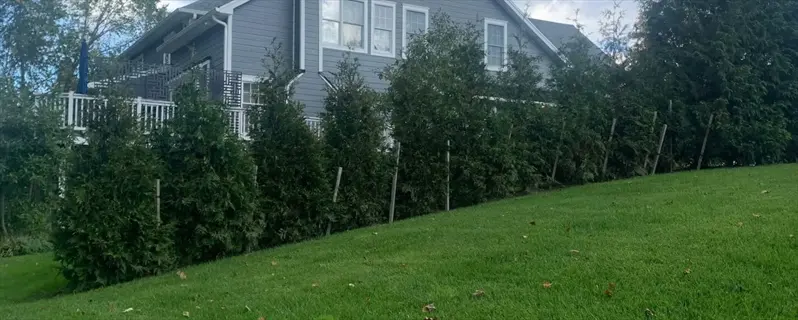
Green Giant Arborvitae
- Growth rate: Adds about 3 to 5 feet (0.9 to 1.5 meters) per year, making it one of the fastest healthy evergreen screens you can plant.
- Mature size: Reaches about 30 to 50 feet (9 to 15 meters) tall with a broad pyramidal shape, ideal for a tall privacy wall.
- Light and soil: Prefers full sun to part shade and tolerates a wide range of soils as long as drainage is reasonable and roots stay healthy.
- Why choose it: Extension sources recommend it as the leading fast, disease-resistant, large arborvitae and a strong Leyland cypress alternative.
- Climate fit: Cold hardy across much of the country and well suited to gardeners who want speed without the canker risk of Leyland cypress.
- Care note: Space generously and prune lightly once established to keep a dense, even face from the ground up.

Leyland Cypress
- Growth rate: Averages about 2 to 3 feet (0.6 to 0.9 meters) per year on typical southern sites, fast enough for quick screening.
- Mature size: Can exceed 100 feet (30 meters) tall and is often 60 to 70 feet (18 to 21 meters), with a narrow crown.
- Light and soil: Shade intolerant and grows best in open sun, tolerating soil pH from about 5.5 to 8.0 on well-drained ground.
- Why caution applies: Very prone to Seiridium and Botryosphaeria cankers and needle blight when crowded, which often makes it untreatable.
- Climate fit: Cold hardy to about zone 6, tolerating around minus 8 degrees Fahrenheit (minus 22 degrees Celsius).
- Care note: Only plant it with wide spacing and good airflow, and consider Green Giant arborvitae as a healthier substitute.
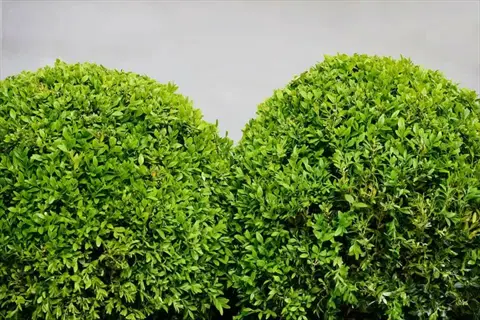
Cherry Laurel
- Growth rate: A fast broadleaf evergreen often called the fastest-growing non-conifer hedge, filling in quickly for a green screen.
- Mature size: Grows into a dense, glossy-leaved hedge that can reach well over 8 feet (2.4 meters) if left unpruned.
- Light and soil: Adaptable to full sun or part shade and tolerant of many soils, which makes it forgiving for new gardeners.
- Why choose it: Gives a lush, formal-looking evergreen wall faster than most broadleaf options and clips neatly into shape.
- Climate fit: Suits temperate gardens and milder zones where a soft, leafy screen is preferred over a needled conifer.
- Care note: Leaves are toxic if eaten, so site it with care around children and pets, and prune to maintain density.
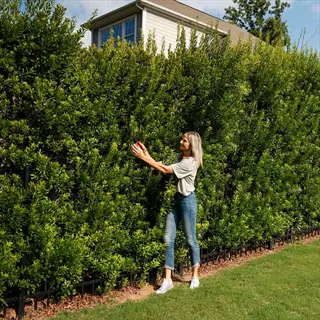
Wax Myrtle
- Growth rate: A vigorous broadleaf evergreen that fills in fast to create a soft, informal privacy screen.
- Mature size: Forms a large multi-stemmed shrub or small tree, tall enough to block most sightlines along a property line.
- Light and soil: Thrives in full sun to part shade and tolerates poor, wet, or sandy soils, including coastal and salty conditions.
- Why choose it: Extension sources list it as a dependable Leyland cypress alternative and a strong native screening choice.
- Climate fit: Excellent for hot, humid, and coastal gardens where many conifers struggle with disease and heat.
- Care note: Aromatic foliage and tolerance of tough sites make it low fuss, needing only occasional shaping.
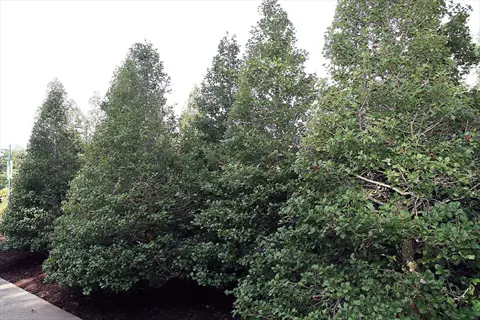
Nellie R. Stevens Holly
- Growth rate: A fast, dependable evergreen holly recommended by extension as a quick screening shrub and replacement plant.
- Mature size: Builds into a dense, pyramidal evergreen tall enough for serious privacy along boundaries.
- Light and soil: Grows in full sun to part shade in most well-drained soils and adapts across many regions.
- Why choose it: Extension sources name it as a fast, tough replacement for diseased red-tip photinia and a solid privacy pick.
- Climate fit: Performs well across warm and temperate zones and brings winter berries for seasonal interest.
- Care note: Glossy spined leaves create a secure, deer-resistant barrier that shears neatly into a formal hedge.
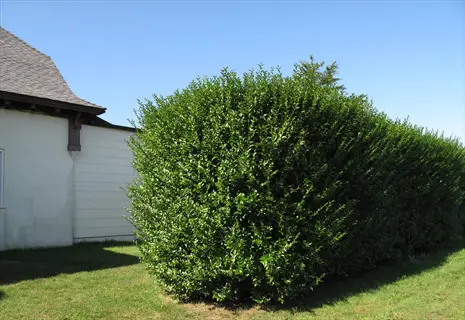
Privet
- Growth rate: One of the fastest and cheapest hedge plants, putting on substantial growth each year for quick cover.
- Mature size: Reaches a tall hedge height with ease and responds well to repeated clipping into a tidy formal shape.
- Light and soil: Tolerant of sun, part shade, and a wide range of soils, which is why so many gardeners plant it.
- Why choose it: Inexpensive and forgiving, making it a budget-friendly way to fill a long boundary fast.
- Climate fit: Suits many temperate gardens, though it needs steady pruning to stay dense and neat.
- Care note: Because it grows so fast, expect to trim it more than once a year to keep it under control.

Hawthorn
- Growth rate: A fast deciduous hedge that establishes fast, above all from inexpensive bare-root plants.
- Mature size: Forms a dense, thorny boundary hedge of useful screening height when you trim it each year.
- Light and soil: Hardy and adaptable across many soils and exposures, including windy and rural sites.
- Why choose it: A budget-friendly, wildlife-rich option that gives spring flowers and autumn berries.
- Climate fit: Excellent for cooler temperate gardens and mixed native hedgerows.
- Care note: Thorns make it a natural security hedge, and it loses leaves in winter unless mixed with evergreens.
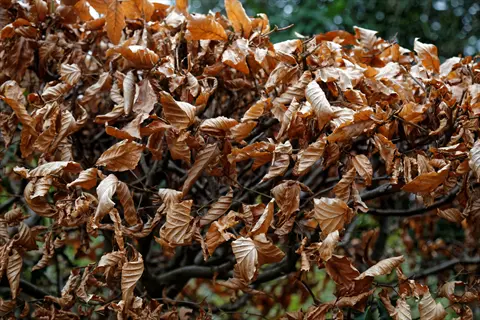
Beech
- Growth rate: A steady, fast deciduous hedge prized for its smooth, formal, layered look.
- Mature size: Makes a tall, dense screen that takes clipping well into a crisp formal hedge.
- Light and soil: Prefers full sun to part shade on well-drained ground and dislikes waterlogged soil.
- Why choose it: Holds onto coppery dead leaves through winter, a trait called marcescence, giving screening even when bare.
- Climate fit: Well suited to cool temperate gardens that want year-round privacy from a deciduous plant.
- Care note: Trim once or twice in summer to encourage the dense twiggy growth that retains winter leaves.
Honest Hedge Growth Rates
Published numbers for a fast growing hedge rarely agree, which makes shopping a guessing game. One page swears a plant adds 5 feet a year while the next caps it at 2. The honest answer is that the hedge growth rate you read is an estimate, not a promise.
Take Leyland cypress, the plant most people picture first. NC State Extension puts its growth at about 2 to 3 feet (0.6 to 0.9 meters) per year on typical southern sites. Nurseries often quote bigger numbers to sell trees. Treat anything above that range as a best case, not the norm.
Green Giant arborvitae runs faster. It adds 3 to 5 feet (0.9 to 1.5 meters) per year, and it shrugs off the diseases that hit Leyland cypress. The table below lines up the main screening plants by their growth rate per year. Now you can compare them on one page instead of hunting across a dozen tabs.
These rates shift with your conditions. The same plant grows faster in a warm, moist site than it does in cold or dry ground, so a hedge that races up in Georgia may crawl in a windy northern yard. Soil, water, and sun all push the numbers up or down.
Speed is a tradeoff, not a free win. A higher growth rate per year buys you cover sooner, but it also means more pruning later to keep the hedge in bounds. The fastest plants here will outgrow your patience if you skip a season of trimming, so pick a rate you can actually keep up with.
Spacing And Planting Right
The bare strip in the damp back corner, where my lawn meets the woods edge, is now a solid green wall. I planted that row of Green Giant arborvitae about six years ago and gave each plant real room. Before that I crowded a Leyland cypress row in the same spot. It browned out from canker within two seasons and I had to pull every plant.
That contrast comes down to one number people get wrong. Hedge spacing decides whether your fast growing hedge thrives or rots. Plants packed too tight choke off air flow, trap damp leaves, and trade a green wall for a row of dead lower branches.
So how far apart to plant a hedge depends on the plant's mature size, not the size in the pot. Tall conifers like Leyland cypress need a minimum of 10 to 15 feet (3 to 4.6 meters) apart. NC Cooperative Extension pushes that to an ideal 16 to 18 feet (4.9 to 5.5 meters). That looks like a lot of empty soil on planting day. It pays off when the plants fill in without fighting each other.
You can still get fast cover without the disease risk. Plant the same row 5 to 8 feet (1.5 to 2.4 meters) apart for a quick screen, then remove every other tree once they start to crowd. Staggered planting helps too. Set the plants in two offset rows or a zigzag instead of one straight line, and you close the gaps without packing roots together.
Keep the row off your fence line as well. A good rule of thumb is to plant about half the mature width back from a fence so each plant has room to spread both ways. And time it right. Fall is the best planting window in most climates. Roots settle into cool, moist soil before the heat of summer hits.
Match the plant to your sun, soil, and space, and plant about half the mature width back from a fence so it has room to fill out.
Set tall conifers like Leyland cypress at least 10 to 15 feet (3 to 4.6 meters) apart, ideally 16 to 18 feet (4.9 to 5.5 meters), so air moves freely.
For faster cover, plant in two staggered rows or a zigzag pattern instead of one straight line, which fills gaps without crowding.
Set each plant level with the surrounding soil and plant in fall in most climates so roots establish in cool, moist conditions.
Soak deeply after planting and mulch the base to control weeds and hold moisture during the important first two years.
Do not crowd plants for instant privacy. Too-close planting cuts air circulation and is the single most common cause of hedge disease and bare lower branches.
Mixed Hedges Beat Disease
One winter the Leyland cypress row in my damp back corner by the woods edge started to brown out. The dead patches spread branch to branch, then plant to plant down the line. Within a few months half the row looked scorched. I pulled every tree out and replanted that same corner as a mix of Green Giant arborvitae and a Pacific wax myrtle. The arborvitae filled the screen back in, and the wax myrtle held its ground when nothing got passed between two plants that share no disease.
That is the whole case for a mixed-species screen. Plant lists name single species one at a time, but extension sources tell you to diversify your living fence on purpose. A row of one plant is a monoculture. A monoculture lets one problem run the full length of the hedge with nothing to slow it down.
Mixing species does two jobs at once. It keeps a disease from spreading down the row, since a problem that hits one type rarely touches its different neighbor. It also adds texture and seasonal interest, so the screen shifts through the year instead of standing as a flat green wall. Clemson HGIC and NC Cooperative Extension both back the mix. It is the smart way to build a disease-resistant privacy hedge.
Stops Disease Spreading Plant To Plant
- The risk: A single-species hedge lets one disease move easily down the whole row, since every plant is equally vulnerable to the same problem.
- The fix: Mixing species means a disease that hits one plant rarely affects its different neighbors, so the screen survives even if one type suffers.
- The evidence: Extension sources recommend diversifying a living fence specifically to help prevent the spread of problems from one plant to the next.
Adds Texture And Seasonal Interest
- Year-round look: Combining evergreens with flowering or deciduous plants gives a screen that changes through the seasons instead of a flat green wall.
- Design value: A mix of leaf shapes, colors, and textures is more attractive in the landscape than a uniform single-species line.
- Practical mix: Pair a fast conifer like Green Giant arborvitae with a broadleaf such as wax myrtle or a flowering shrub for variety.
Supports Wildlife And Pollinators
- Habitat value: Layered hedgerows of tall trees, shrubs, and flowering plants provide habitat for beneficial insects and pollinators.
- Native options: Including native plants such as flowering currant boosts the ecological value of the screen, as noted by extension hedgerow guidance.
- Bonus function: A mixed hedgerow also acts as a windbreak and buffer while still delivering privacy.
Avoids The Monoculture Trap
- The pattern: When one plant becomes so popular it is planted everywhere, formerly minor pest problems can develop into major ones.
- Real example: Red-tip photinia was planted as a near-monoculture across the South and then declined widely from leaf-spot fungus.
- The takeaway: Spreading your hedge across several species is the simplest insurance against the same fate.
A mix also earns its keep beyond privacy. A hedgerow layers tall trees with shrubs and flowering plants. That mix gives a home to beneficial insects and pollinators. OSU Extension lays this out in its hedgerow guide. So the same row that blocks the neighbors also feeds the bees.
The cost of skipping all this shows up in the red-tip photinia story. Gardeners across the South planted it everywhere as a near-monoculture, and a leaf-spot fungus tore through the lot of them. When one plant gets that popular, a once-minor pest turns into a major problem. Spread your hedge across a few species and you sidestep the same fate.
It is important to diversify your living fence to help prevent the spread of problems from one plant to the next. Creating a mixed-species screen is also aesthetically pleasing because it offers a combination of textures to your landscape.
Fast Hedges By Climate
| Climate Or Condition | Recommended Fast Hedges | Why It Fits |
|---|---|---|
| Cold zones (zone 6 and below) | Green Giant arborvitae, beech, hawthorn | Cold hardy and reliable in freezing winters |
| Temperate gardens | Cherry laurel, privet, Green Giant arborvitae | Fast cover with broad adaptability |
| Hot and humid regions | Wax myrtle, Nellie R. Stevens holly, viburnum | Tolerate heat and resist common conifer disease |
| Coastal and salty sites | Wax myrtle, viburnum tinus | Handle salt spray and poor, sandy soil |
| Partly shaded boundaries | Pacific wax myrtle, tea olive, cleyera | Screen well without full sun |
| Always confirm a plant's hardiness for your specific zone before buying, since survival matters more than raw growth speed. | ||
The fastest grower on any list is useless if it cannot survive your winter or your summer. So before you compare speed, match the plant to your climate and your light first. Take Leyland cypress. It is cold hardy to about USDA zone 6. There it shrugs off roughly minus 8 degrees Fahrenheit (minus 22 degrees Celsius). Push it colder and speed stops mattering, because the plant dies.
Picking a privacy hedge by zone keeps you from a costly replant two years in. Cold gardeners need a tough screen that laughs at hard freezes. Hot, humid gardeners need plants that resist the diseases that thrive in muggy air. And coastal gardeners need a hedge that takes salt spray and poor sandy soil without dropping its leaves.
If you garden in heat, humidity, or salt, you have strong picks that beat most conifers. Wax myrtle, Nellie R. Stevens holly, and viburnum handle warm, sticky air and salt better than a Leyland cypress ever will. They give you a dense fast growing evergreen screen without the disease load that a row of conifers brings in a hot, wet climate.
Shade trips up most hedge lists, since they all assume full sun. If your boundary sits under trees or in part shade, reach for Pacific wax myrtle, tea olive, or cleyera. These screen a partly shaded line where a sun-loving conifer would thin out and go bare at the bottom. Use the table above to match your climate and light to a coastal hedge or inland pick, then weigh growth rates within that short list.
The Leyland Cypress Problem
"Just plant Leyland cypress like everyone else," my neighbor called over the fence. He pointed at the bare strip along my back line and told me it was the fast way to get privacy. I had already pulled out a browned, cankered row of Leyland from that same damp corner by the woods edge. The healthy Green Giant arborvitae standing there now had replaced trees I lost in under three years.
Here is the honest reality check that most fast-hedge lists skip. Leyland cypress problems are real. Extension offices have warned about them for years. The tree grows fast, but it carries a heavy disease load that catches up with you once the row fills in and air stops moving.
Seiridium canker and Botryosphaeria canker both attack Leyland cypress and cause limbs to brown and die back. Needle blights from Passalora and Cercosporidium thin out the foliage on top of that. The worst part is that these cankers and the root rots that follow are effectively untreatable, and they spread plant to plant down the whole row.
A mature Leyland cypress can top 100 feet (30 meters). At that size you cannot reach the canopy to spray or prune out the diseased wood, so treatment is nearly impossible for most homeowners. Your real defense is choosing a better plant and spacing it well from the start.
This is where the Leyland cypress alternatives come in. Extension offices point to Green Giant arborvitae and Nellie R. Stevens holly as replacements that match the speed with far less risk. Both give you a dense disease-resistant privacy hedge without the canker that ends so many Leyland rows early.
- Grows about 2 to 3 feet (0.6 to 0.9 meters) per year on typical southern sites.
- Highly prone to Seiridium and Botryosphaeria cankers and needle blight.
- Cankers and root rots are effectively untreatable and spread between plants.
- Mature height over 100 feet (30 meters) makes treatment nearly impossible for homeowners.
- Grows about 3 to 5 feet (0.9 to 1.5 meters) per year, often faster than Leyland cypress.
- Recommended by extension as a disease-resistant alternative.
- Far less prone to the cankers and blights that plague Leyland cypress.
- Reaches a manageable 30 to 50 feet (9 to 15 meters) for most yards.
When a plant becomes so popular that it is planted everywhere, formerly minor pest problems can develop into major problems.
Green Giant grows 3 to 5 feet (0.9 to 1.5 meters) a year, often faster than Leyland, and tops out near 30 to 50 feet (9 to 15 meters). That height stays in reach. Pick the resistant plant now and you skip the slow brown decline I watched happen along my own fence.
5 Common Myths
Leyland cypress is always the best choice because it is the fastest growing privacy hedge you can buy.
Leyland cypress grows fast but is highly prone to canker and blight, so extension experts often recommend healthier alternatives instead.
Planting hedge plants close together gives you a full, private screen much faster than spacing them apart.
Crowding cuts air circulation and invites disease, so proper spacing produces a healthier, longer-lasting hedge that still fills in well.
A single-species hedge is the cleanest, most reliable way to create privacy along a property line.
One disease can wipe out an entire single-species hedge, while a mixed screen spreads the risk and adds seasonal interest.
October is far too late in the year to plant a new hedge and expect it to survive the winter.
In most climates fall planting lets roots establish in cool, moist soil, often giving better results than spring planting.
The fastest growing hedge is automatically the best hedge for every yard and every gardener.
Fast growers usually need frequent pruning, so the right hedge depends on your climate, space, and how much maintenance you want.
Conclusion
You can get a fast growing hedge that gives you real privacy without the disease and crowding problems that wreck most rushed plantings. The trick is simple. You pick the right plant and you give it the room it needs to grow.
Green Giant arborvitae is the strongest pick for a fast privacy hedge that stays healthy. It can grow 3 to 5 feet (0.9 to 1.5 meters) a year. It also shrugs off the diseases that hit other conifers. Leyland cypress grows about 2 to 3 feet (0.6 to 0.9 meters) a year. Plant it with care, though. It carries real disease risk in a tight row.
Three habits decide whether your screen thrives or fails. Start with a healthy, fast plant from a trusted source. Space tall conifers 10 to 18 feet (3 to 5.5 meters) apart so air can move and roots have room. And think hard about a mixed-species screen, since a row of different plants stops one sick tree from taking down the whole line.
The best hedge balances speed, climate fit, and long-term health. It does not chase the single fastest grower on the market. A plant matched to your zone and given proper spacing will outlast and outperform a faster plant crammed into the wrong spot.
A hedge you choose and space with care rewards a little patience now. You wait a season or two longer for full cover. In return you get decades of healthy privacy with far less work and worry down the road.
Glossary
- Bare-root plants
- Young dormant plants sold without soil around their roots, a cheaper way to buy hedging in bulk.
- Botryosphaeria canker
- A fungal infection that creates dead lesions on woody stems, killing branches and contributing to dieback in stressed conifers.
- Hedgerow
- A layered row of trees, shrubs, and flowering plants used as a boundary that also provides wildlife habitat and a windbreak.
- Marcescence
- The trait of holding onto dead brown leaves through winter, which lets deciduous hedges like beech still screen when bare.
- Mixed-species screen
- A privacy hedge built from several different plant types so one disease cannot wipe out the entire screen.
- Monoculture
- A planting made up of a single plant species, which lets one disease or pest spread easily through the whole group.
- Needle blight
- A fungal disease that browns and drops the needles of conifers, thinning the foliage of trees like Leyland cypress.
- Seiridium canker
- A fungal disease that causes sunken, dead patches and dieback on the stems and branches of cypress trees.
External Sources
Frequently Asked Questions
What is the fastest growing hedge plant for privacy?
Green Giant arborvitae is among the fastest, healthy fast-growing evergreen screens.
- Green Giant arborvitae at 3 to 5 feet per year
- Leyland cypress at 2 to 3 feet per year
- Cherry laurel for a fast broadleaf screen
What is an instant hedge?
An instant hedge is pre-grown, mature hedging delivered in sections for immediate screening.
What shrub grows tall and fast for a hedge?
Several evergreen shrubs grow tall and fast for screening.
- Green Giant arborvitae
- Cherry laurel
- Wax myrtle
- Nellie R. Stevens holly
What is a cheap and fast growing hedge?
Privet, bare-root hawthorn, and small arborvitae are affordable fast hedges.
Can I plant a hedge in October?
Yes, October is one of the best months to plant a hedge in most regions.
What is the quickest way to grow a hedge?
Choose a fast plant, space it correctly, water deeply, and prune to encourage density.
What are the downsides of a privacy hedge?
Privacy hedges need pruning, can carry disease, and may cause neighbor disputes.
What are common mistakes when planting a hedge?
Planting too closely is the biggest mistake, along with poor watering and skipping pruning.
How fast does Leyland cypress actually grow?
Leyland cypress averages about 2 to 3 feet per year on typical southern sites.
What can I plant instead of Leyland cypress?
Green Giant arborvitae, Nellie R. Stevens holly, and a mixed screen are strong replacements.
- Green Giant arborvitae
- Nellie R. Stevens holly
- Wax myrtle
- A mixed-species screen