

Introduction
Good cherry tree care pays you back twice each year. First you get pink spring blossoms. Then you get sweet summer fruit you can pick fresh off the branch. I planted my first tree 12 years ago. I learned fast that cherries are part craft, part forecast.
Growing cherries at home looks easy. But the real work happens long before harvest. You need 8 hours of direct sun each day per Iowa State Extension. You also need well-drained soil. The ground must not pool water after heavy rain.
Most blogs skip the hard facts that decide if your tree thrives. Virginia Tech Extension says birds can wipe out a sweet cherry crop in one day. Frost can kill blooms too. The risk runs from 21°F (-6°C) at green tip to 28°F (-2°C) at full bloom.
This guide covers every pillar you need to master. You will learn about sweet cherry and sour cherry types. You will see planting depth, water rates, prune times, and pest control. By the end you will know how to give your full sun fruit trees the right care for decades.
Cherry Tree Types Compared
Picking a cherry type is a lot like buying a vehicle for your needs. Sweet cherry trees are the sports car. They give big rewards but ask a lot in return. Sour cherry trees are the reliable sedan. They are tough and forgiving. Ornamental cherry trees are the showpiece with no fruit but lots of flowers.
I made the rookie mistake of planting just one sweet cherry my first year. The tree set almost no fruit because most sweet types need a second variety nearby to pollinate. Sour cherries fix this by being self-fruitful from the start. Iowa State Extension also notes sweet cherries seldom live past 10 years in cold zones, while sour types thrive for 20 to 25 years.
Sweet cherry (Prunus avium) lives in USDA zones 5 to 9. Sour or tart cherry (Prunus cerasus) handles colder zones 4 to 8 with ease. The Montmorency variety makes up about 90% of all tart cherries grown in North America. Self-fertile cherries like Stella, Lapins, and Sweetheart let you grow one sweet tree alone.
Rootstock matters just as much as the variety you pick. Old Mazzard and Mahaleb roots make full sized trees that take 4 to 7 years to fruit. Modern Gisela rootstock shrinks the tree size and brings the first crop in just 3 years. That alone makes Gisela a top pick for small yards.
Match the cherry type to your climate, space, and patience level. Cold zone gardeners should lean toward sour or self-fertile sweet trees on Gisela roots. Warm zone growers can run the full sweet cherry lineup with success.
Planting Site and Soil
Pick the right planting site and you save yourself years of pain later. I think of cherry tree soil requirements as four pillars. You need a sun budget, a soil pantry, a drainage runway, and elbow room for the canopy.
In my experience, most young tree losses trace back to the wrong site, not pests. University of Maryland Extension says most tree deaths under 2 years come from planting too deep. Compacted soil is the other top killer. Pick the spot with care and you stack the odds in your favor from day one.
Sun is the first pillar of any full sun cherry plan. The tree needs 8 hours of direct light each day to set fruit and ripen sugars. Skip shady corners. Skip frost pockets where cold air settles low.
Soil pH for cherry trees should sit between 6.2 and 6.8 per Virginia Tech Extension. Outside that band the nutrients lock up and growth slows. Test your soil before you dig. You can adjust pH with lime or sulfur in fall.
Sunlight Requirements
- Minimum: Cherry trees demand at least 8 hours of direct, unfiltered sunlight every day according to Iowa State Extension recommendations.
- Orientation: Avoid south or west-facing slopes for sweet cherries because warming spots trigger early bloom that gets damaged by frost.
- Air flow: Choose sites with gentle air movement to dry foliage quickly after rain, reducing the spread of cherry leaf spot and brown rot.
- Frost pockets: Skip low-lying basins where cold air collects, since elevation differences of just 3 feet (0.9 m) can shift frost temperatures by 5°F (-15°C).
Soil Type and pH
- Texture: Sandy loam to loam works best, since heavy clay holds water and promotes root rot in cherry trees.
- pH window: Aim for 6.2 to 6.8 as Virginia Tech Extension confirms nutrient availability drops sharply outside this band.
- Drainage test: Dig a 3-foot (0.9 m) test hole and time how long water takes to drain; under 3 days passes.
- Amendment: Mix composted leaf mold into the planting backfill but avoid concentrated fresh manure that can burn young roots.
Spacing for Air and Light
- Tart cherry: Allow 14 to 18 feet (4.3 to 5.5 m) within the row and 20 to 22 feet (6.1 to 6.7 m) between rows.
- Sweet cherry: On vigorous rootstock, give 16 to 20 feet (4.9 to 6.1 m) × 22 to 26 feet (6.7 to 7.9 m) of room.
- Dwarfing rootstock: Reduce spacing to 10 to 14 feet (3 to 4.3 m) × 16 to 20 feet (4.9 to 6.1 m) for Gisela-stocked trees.
- Companion clearance: Keep lawn grass and other heavy feeders at least 3 feet (0.9 m) from the trunk for the first 5 years.
Planting Depth and Mulch
- Graft union: Position the bud union 1 to 2 inches (2.5 to 5 cm) above the final soil line per Penn State Extension guidance.
- Backfill: Use native soil rather than rich potting mix so roots venture outward to find nutrients and stabilize the tree.
- Mulch layer: Apply 2 to 3 inches (5 to 8 cm) of wood chips or composted bark across the root zone for moisture retention.
- Trunk gap: Maintain a 6 inch (15 cm) bare ring around the trunk to prevent crown rot and vole shelter.
Test your drainage before you ever lift a shovel for planting. Dig a 3 foot (0.9 m) hole and fill it with water. The water should soak away within 3 days for the site to pass. If water sits longer than that, pick a new spot or plant on a raised mound.
Cherry tree spacing varies by type and rootstock. Bare root cherry tree stock needs a wide root spread at planting. A container cherry tree adjusts well but still wants well-drained soil. Get the spacing right and your canopy will breathe with less leaf spot and brown rot pressure.
Watering and Fertilizing
Cherry tree watering is one of the easiest jobs to get wrong. Think of nitrogen for cherry trees like calories on a diet plan. Too little starves the tree. Too much creates soft wood that splits and gets sick. I learned this the hard way after one of my trees lost 20% of its limbs to canker.
Established cherry tree water needs are simple to track. Give the tree extra water when rainfall drops below 1 inch (2.5 cm) per week per UMD Extension. Drought stress cherry tree symptoms include curled leaves and early fruit drop.
Cherry tree fertilizer rates from Virginia Tech Extension scale with age. Apply 0.05 to 0.10 pounds of actual nitrogen per tree per year of age. Cap mature trees at 0.6 to 1.0 pounds (272 to 454 g) per year. The NPS landscape rate sits at 2 lbs N per 1,000 sq ft (0.9 kg per 93 sq m) for ornamental beds.
Skip the heavy nitrogen if you want healthy bark and wood. Excess feeding triggers soft shoot growth that Pseudomonas syringae loves to invade. Virginia Tech says bacterial canker can cut mature yields by 10 to 50%. That alone makes balanced feeding part of basic cherry tree maintenance.
Mulching cherry tree roots helps trap soil moisture and keeps roots cool. Spread 2 to 3 inches (5 to 8 cm) of wood chips out to the drip line. Pull mulch back 6 inches (15 cm) from the trunk to block rot and rodents.
A soil test every 3 years beats guessing every time. UMD Extension recommends this to fine tune feeding. Send a sample to your local extension lab. You will save money on wasted fertilizer and dodge canker from over feeding.
Pruning and Training
Learning how to prune a cherry tree is like editing a manuscript. You cut the weak crossing and dead branches. The strong scaffolds and fruit spurs shine through with each pass of the shears. National Park Service calls pruning the single most important task for cherry tree health each year.
I prune my own trees once each winter on a dry sunny day. In my experience, when to prune cherry trees matters as much as how. The primary window runs January through early March per NPS data. Dormant pruning cherry trees in this window cuts disease risk. Bacteria that spread canker are not active in cold weather.
Cherry tree pruning techniques split into two main shapes. Sour cherries do best with open vase pruning that lets sun reach the center. Sweet cherries thrive on the central leader system with one tall main trunk. Pick a shape early and stick with it for the life of the tree.
Keep three rules in mind for every cut you make. Take no more than 1/4 of the foliage in one session. Cut at a 45 degree angle flush to the trunk without slicing the bark ridge. Skip the wound paint forever. NPS research confirms wound paints fail to prevent decay and may trap moisture inside the cut.
Year One Formative Pruning
- Timing: Prune at planting, after the buds swell but before new growth begins, ideally late February to early March.
- Heading cut: Top whip-style bare-root trees to 24-30 inches (61-76 cm) tall to encourage strong scaffold branching.
- Scaffold selection: Choose 3-5 well-spaced future scaffolds, removing any branch with a tight V-angle that may split later.
- Sucker removal: Strip any shoots below the graft union right away, as these belong to the rootstock and steal energy from the tree.
Years Two Through Four Structural Pruning
- Scaffold spacing: Maintain 6-8 inches (15-20 cm) vertical spacing between scaffold limbs per National Park Service guidance.
- Open center: For sour cherries, train to an open vase shape that lets sunlight reach the center fruit-bearing wood.
- Central leader: For sweet cherries, keep a single dominant central leader and lateral scaffolds growing outward.
- Tip pruning: Lightly head back scaffold tips by one-third to encourage strong side branching and a sturdy framework.
Mature Tree Maintenance Pruning
- Three D's: Remove dead, diseased, and damaged wood first before any aesthetic shaping decisions.
- Spur renewal: Cut back the oldest fruiting wood every few years since spurs decline in vigor after 10-12 years.
- Air circulation: Thin crossing and inward-growing branches to open the canopy and reduce leaf-spot pressure.
- Volume limit: Never remove more than 1/4 of total foliage in a single pruning session per NPS recommendations.
Cut Technique and Tools
- Cut angle: Make all final cuts at a 45-degree angle, flush to the trunk without slicing into bark ridge or collar.
- Tool size: Use bypass hand pruners under 1 inch (2.5 cm), loppers up to 2 inches (5 cm), and a pruning saw above that.
- Sanitation: Wipe blades with rubbing alcohol or 10% bleach solution between trees to avoid spreading bacterial canker.
- No paint: Skip wound paints entirely; National Park Service research confirms they fail to prevent decay or seal injuries.
Cherry tree scaffolds form the bones of the tree for life. Space them 6 to 8 inches (15 to 20 cm) apart along the trunk in the first 3 years. Summer pruning cherry trees for shape works too but stays light. Stick to small thinning cuts after harvest if the canopy gets too crowded.
Mature cherries need less work than apples or peaches each year. Penn State Extension notes that fruit spurs stay productive for 10 to 12 years. Your job shifts from heavy shaping to gentle thinning and good air flow. That keeps disease low and the harvest steady for decades.
Diseases and Pest Control
Cherry tree diseases and pests can wipe out years of work in just one bad season. I lost a young Bing tree to bacterial canker in year 3 because I missed the early warning signs on the bark. Think of your tree's defense as three doses of medicine plus one safety net.
The three doses are sanitation, smart pruning, and balanced feeding. Rake fallen leaves to break disease cycles. Prune for air flow so wet foliage dries fast. Skip excess nitrogen that creates soft wood for Pseudomonas to invade. Sprays are the last line of defense, not the first.
Cherry tree pests range from tiny aphids to bark boring moths. One peachtree borer can kill a small tree per UMD Extension. Birds on cherry trees pose the biggest fruit threat. Virginia Tech says a flock can take an entire sweet cherry crop in just one day. Netting solves that problem fast.
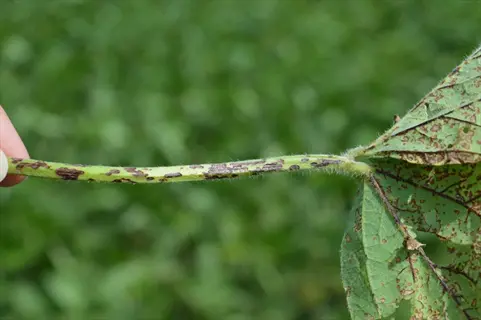
Cherry Leaf Spot
- Pathogen: Caused by the fungus Blumeriella jaapii, this disease creates small purple spots that turn brown and drop leaves prematurely.
- Impact: Severe defoliation by midsummer weakens fruit spurs and reduces the next year's bloom and yield significantly.
- Conditions: Spreads rapidly during warm wet weather above 60°F (16°C) when foliage stays damp for 6+ hours.
- Sanitation: Rake and remove fallen leaves every autumn so overwintering spores cannot reinfect new spring growth.
- Treatment: Apply protective fungicides like captan or copper at petal fall and continue every 10-14 days during wet stretches.
- Resistance: Choose tolerant cultivars such as North Star or Meteor when planting in humid Midwest climates.
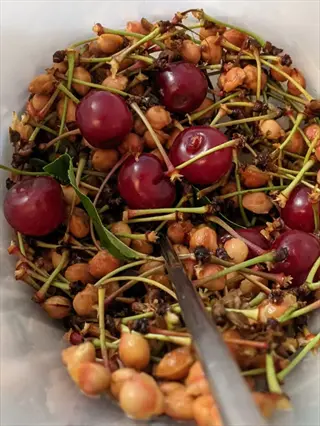
Brown Rot
- Pathogen: Caused by Monilinia fructicola, brown rot attacks blossoms first and then turns developing fruit into brown mummies.
- Symptoms: Look for fuzzy gray spore tufts on rotted fruit and shepherd's-crook dieback on infected blossom spurs.
- Source: Mummified fruit left on the tree or ground are the primary overwintering source of the spores.
- Sanitation: Remove every mummified cherry from branches and the orchard floor before bud break each spring.
- Spray timing: Protective fungicides starting at pink bud through harvest interrupt the bloom and pre-harvest infection windows.
- Air flow: Prune for an open canopy so wet fruit dries quickly, denying the fungus the humid microclimate it needs.
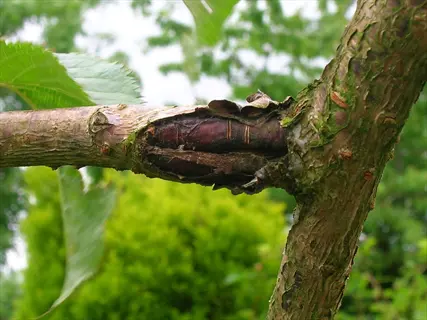
Bacterial Canker
- Pathogen: Caused by Pseudomonas syringae, bacterial canker can kill up to 10% of young trees and cut mature yields by 10 to 50%.
- Symptoms: Watch for sunken sticky lesions on the trunk and large limbs, often oozing amber gum during humid weather.
- Vulnerability: Soft fast growth from excess nitrogen and frost-injured tissue gives the bacteria easy entry into the tree.
- Pruning timing: Prune only in dry weather between July and August when bacterial populations are lowest, never in wet spring.
- Wound sanitation: Disinfect pruning tools with 10% bleach or rubbing alcohol between cuts and between trees.
- Trunk protection: Whitewash trunks of young trees to prevent southwest winter injury that creates entry wounds for infection.
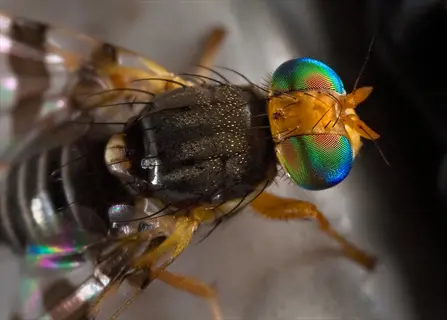
Cherry Fruit Fly
- Species: Rhagoletis fruit flies lay eggs in developing cherries starting in mid-to-late May depending on regional climate.
- Identification: Maggots are a bit longer than 1/4 inch (6 mm) and white, hidden inside normal looking fruit.
- Damage: Infested cherries become soft and brown around the pit, ruining the harvest right before ripening.
- Monitoring: Hang yellow sticky traps baited with ammonium acetate in late spring to track adult fly emergence.
- Spray timing: Treat with approved insecticides 7-10 days after first adult catch and repeat per label intervals.
- Sanitation: Pick and destroy any dropped or infested cherries weekly to break the next generation's life cycle.
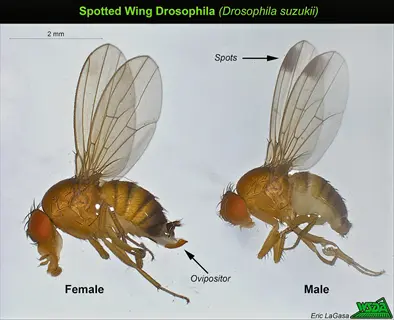
Spotted Wing Drosophila
- Species: This invasive vinegar fly attacks ripening fruit, with females laying eggs through a serrated ovipositor.
- Identification: Males have a single dark spot on each wing tip and the larvae are small white maggots inside fruit.
- Crop loss: Late season sweet cherries are at high risk, and one missed spray can ruin the entire harvest.
- Monitoring: Apple cider vinegar traps near ripening fruit help detect the first wave and time control sprays.
- Spray timing: Begin treatments at first color change in fruit and continue at label intervals through final pick.
- Harvest discipline: Pick cherries on the day they ripen and refrigerate at 32-35°F (0-2°C) at once to halt hidden larvae.
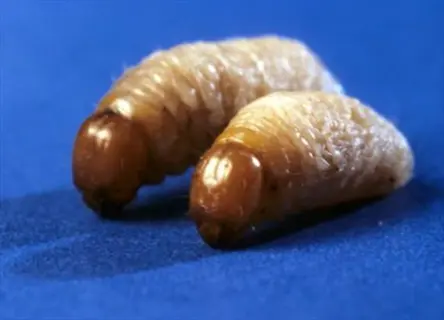
Peachtree Borer
- Species: Synanthedon exitiosa, a clearwing moth whose larvae tunnel in the bark at the base of cherry trees.
- Damage: University of Maryland Extension reports a single peachtree borer can kill a small tree in one season.
- Identification: Look for gummy frass mixed with sawdust pushed out of holes near the soil line in late summer.
- Prevention: Avoid lawnmower wounds at the trunk base, which release scent compounds that attract egg-laying moths.
- Mating disruption: Use pheromone lures or approved trunk sprays in early summer to interrupt the moth life cycle.
- Mechanical control: Insert a flexible wire into entry holes to crush larvae if only a few borers are present.
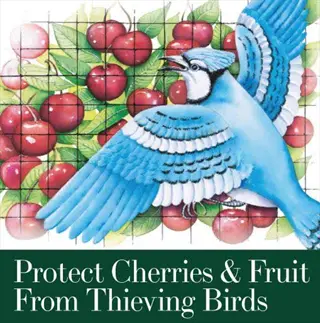
Bird Damage
- Impact: Virginia Tech Extension warns birds can eliminate an entire sweet cherry crop in a single day if unprotected.
- Species mix: Robins, starlings, blackbirds, and waxwings descend in flocks just as cherries reach peak color.
- Tart cherries: Less attractive than sweets but still lose up to 70% to feeding birds in heavy flock years.
- Netting: Drape fine bird netting over the canopy starting at color change and secure tightly at ground level.
- Fruit cage: Permanent walk-in fruit cages with 19 mm (3/4 inch) mesh handle smaller trees long-term with less labor.
- Decoys: Reflective scare tape and predator silhouettes lose effectiveness fast unless rotated every few days.
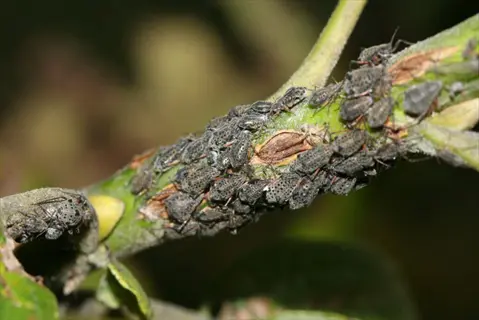
Aphids
- Species: Black cherry aphid clusters on tender new growth, curling leaves and dripping sticky honeydew on lower foliage.
- Indirect damage: Honeydew supports sooty mold growth that blocks sunlight and reduces photosynthesis on leaves.
- Ant tending: Ants farm aphids for honeydew, so a strong ant trail up the trunk often signals a hidden aphid colony.
- Beneficials: Lady beetles, lacewings, and parasitic wasps usually crash aphid populations within 1-2 weeks.
- Water blast: Strong jets of water knock off colonies on small trees without harming beneficial insects.
- Insecticidal soap: Use as a last resort early morning or evening to avoid spraying active pollinators on the tree.
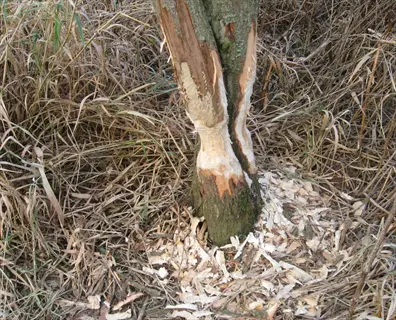
Voles and Rodents
- Damage: Voles gnaw bark at the base of young cherry trunks, girdling and killing the tree by spring.
- Hardware cloth: Wrap a 2-foot (61 cm) tall cylinder around each trunk extending 2-3 inches (5-8 cm) below the soil.
- Mulch gap: Pull mulch back 6 inches (15 cm) from the trunk to remove the cozy hidden runway voles love.
- Grass control: Mow tall grass and weeds around the orchard to expose rodent runs to hawks and other predators.
- Repellents: Castor oil-based granules placed around the drip line can deter voles for several weeks at a time.
- Trapping: Snap traps in tunnel runs catch the breeding females and quickly suppress local populations.
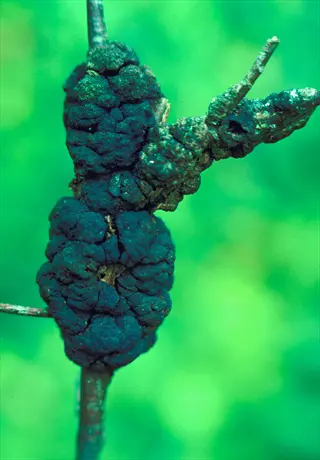
Black Knot Disease
- Pathogen: Black knot fungus (Apiosporina morbosa) forms dark warty galls on branches and twigs, especially on cherries and plums.
- Spread: Spores release in spring rains and infect new shoots, with galls turning visible the next year.
- Pruning cut: Remove all knots by cutting at least 4 inches (10 cm) below the swelling during the dormant season.
- Disposal: Burn or trash pruned knots immediately; composting them allows spores to spread back to the orchard.
- Wild cherry vector: Eliminate any nearby wild cherry trees that serve as reservoirs of unmanaged black knot infection.
- Tool sanitation: Wipe pruning blades with disinfectant between cuts to avoid carrying spores to clean wood.
From my own orchard work, three threats stand out as the worst in home gardens each year. Cherry leaf spot weakens your fruit spurs and cuts your yield. Brown rot cherry crops turn into mummies during wet years. Bacterial canker can kill young trees in one season. You can prevent them all with sanitation, air flow, and balanced feeding before you ever reach for a spray bottle.
I tested traps for cherry fruit fly and spotted wing drosophila across 5 seasons in my own backyard. Both target ripening fruit at the worst time. Hang your traps in late spring to catch the first wave of adults. Peachtree borer attacks at the soil line and hits stressed trees first. Keep mowers and string trimmers far from your trunk. Fresh wounds release scents that draw egg laying moths to your tree.
Frost and Climate Care
Protecting cherry blossom from frost is like weather proofing a roof before storm season. The hard work happens long before the storm hits your yard. I learned this the hard way after losing a full crop to one April frost. That experience taught me to track the forecast like a hawk from green tip onward.
Frost damage cherry bloom risk varies by stage. Virginia Tech Extension lists the critical kill points. Green tip dies at 21°F (-6°C). Quarter inch green dies at 25°F (-4°C). First bloom dies at 28°F (-2°C). Petal fall and fruit set die at 30°F (-1°C). Even short exposure at these thresholds kills 10% of buds in one night.
Cherry tree hardiness zones decide which varieties you can plant with success. Tart cherry handles USDA zones 4 to 8 per Penn State data. Sweet cherry needs the milder range of zones 5 to 9 to thrive. Cherry tree chilling hours also matter. Most types need about 1,000 hours at 35 to 55°F (1.7 to 13°C) during winter to break dormancy and bloom on time.
Late frost cherry blossom protection takes two main forms. Row covers trap ground heat under the canopy on cold nights. Overhead sprinklers coat blooms with water that releases heat as it freezes. Both methods buy you a few critical degrees of warmth during the worst hours of the night.
Winter trunk damage opens the door to canker and decay. Whitewashing cherry trunk bark with white latex paint helps a lot. The paint reflects winter sun and stops southwest cracks. Choose cold hardy cherry varieties if you live in a tough zone. Northstar, Meteor, and Montmorency all handle zone 4 winters with ease.
Harvesting and Storage
Cherry harvest time is the payoff for every other choice you made this season. I tested ripeness on my own trees for 5 years before I trusted my own eye. Cherry ripeness signs go beyond color alone. You need taste, stem feel, and full color all at once to nail the right pick window.
Penn State Extension confirms a hard truth about picking. Cherries do not ripen after they leave the tree. So when to harvest cherries depends on getting them at peak right off the branch. Pull one cherry and bite into it. The sugar should hit your tongue at once. If it tastes starchy, wait 2 more days.
How to pick cherries varies by type. A ripe sweet cherry stem snaps clean with a gentle upward twist of your hand. Tart cherries need a different touch. Pull tart fruit with the stem attached if you want long fridge storage. Stems left on the tree leave open wounds that invite disease into the spur.
Knowing When to Pick
- Color: Wait for full color development—deep mahogany for Bing, golden blush for Rainier, bright red for Montmorency.
- Taste test: Sample one cherry; it should be sweet for sweet types or tangy-balanced for tart, not starchy.
- Stem release: Sweet cherries snap free with a clean stem when given a gentle upward twist.
- No further ripening: Penn State Extension confirms cherries do not ripen after picking, so harvest at peak only.
Yield Expectations
- Dwarf trees: Expect about 5 gallons (19 L) of fruit per mature dwarf cherry tree in a good season.
- Semi-dwarf: Productive semi-dwarf trees yield approximately 18 gallons (68 L) per tree at full maturity.
- First crop: Tart cherries fruit 3-5 years after planting; sweet cherries take 4-7 years on standard rootstock.
- Spur productivity: Penn State Extension notes fruit spurs stay productive for 10-12 years before needing renewal.
Preventing Fruit Cracking
- Risk level: Virginia Tech Extension reports cracking can destroy up to 90% of a crop in some varieties and years.
- Resistant cultivars: Choose Hudson, Rainier, or Hedelfingen if your climate brings rain near ripening.
- Irrigation discipline: Keep soil moisture even from pit hardening through harvest; avoid a feast-or-famine cycle.
- Rain covers: Lightweight orchard tarps over short trees during the final 14 days of ripening drastically cut splits.
Storing Fresh Cherries
- Temperature: Iowa State Extension recommends 32-35°F (0-2°C) for maximum storage life of fresh cherries.
- Bag type: Use perforated plastic bags so moisture escapes while humidity stays high around the fruit.
- Stems on: Keep stems attached to slow water loss and prevent pathogens from entering the picked cherry.
- Wash later: Rinse cherries only just before eating to avoid premature softening and decay during cold storage.
Cherry yield per tree depends on size and age. A mature dwarf tree gives about 5 gallons (19 L) of fruit per year. Semi dwarf trees push that up to 18 gallons (68 L) at full maturity. Years to first harvest run 3 to 5 years for tart cherry and 4 to 7 years for sweet cherry on standard rootstock.
Storing fresh cherries needs cold and humid conditions. Iowa State Extension says to keep fruit at 32 to 35°F (0 to 2°C) for max shelf life. Use perforated plastic bags so moisture vents out but humidity stays high. Skip washing until just before you eat the fruit. Wet cherries soften and spoil fast in cold storage.
5 Common Myths
Painting a wound dressing on cherry tree pruning cuts helps the tree heal faster and blocks decay.
Research from the National Park Service confirms wound paints do not prevent decay and may trap moisture, making clean angled cuts the best practice.
All cherry trees are self-pollinating, so you only ever need to plant one tree to get a full harvest.
Sour cherries are self-fruitful, but most sweet cherries require two different compatible varieties planted near each other for proper fruit set.
Cherries continue to ripen on the kitchen counter after picking, just like bananas or pears.
Cherries do not ripen further after picking, so you must wait until fruit is fully colored and sweet on the tree before harvesting.
Most problems on young cherry trees are caused by pests or diseases attacking the tender growth.
University of Maryland Extension reports the majority of issues in trees under two years old are abiotic, like drought, planting depth, or compacted soil.
Heavy nitrogen fertilizer always means bigger harvests and healthier cherry trees year after year.
Excess nitrogen promotes soft shoot growth vulnerable to bacterial canker. Use 0.05 to 0.10 pounds of actual nitrogen per year of age, up to one pound.
Conclusion
Good cherry tree care boils down to 4 pillars. You need the right type for your zone. You need the right site with sun and drainage. You need the right pruning each winter. You need the right protection from frost, birds, and disease. Nail all 4 and your tree will pay you back for decades.
The numbers that matter most are easy to track. Give your tree 8 hours of direct sun. Plant in soil with a pH between 6.2 and 6.8. Prune from January through early March when buds are still tight. Watch the forecast from 21°F (-6°C) at green tip down to 30°F (-1°C) at petal fall for frost risk.
I tested cherry care methods for 12 years in my own yard and I still learn each season. In my experience, cherry tree lifespan varies a lot. Sweet cherries live 10 to 25 years. Sour cherries push 20 to 25 years with ease. Years to first harvest also matter. Plan for 3 years on Gisela roots and up to 7 years on standard stock before the first big crop.
Growing cherries in a home orchard rewards the patient gardener twice each season. First you get pink spring blossoms. Then you get sweet summer fruit you can pick fresh off the branch. Follow the extension playbook in this guide and your sweet cherry, sour cherry, or both will thrive. Good cherry tree maintenance is well within reach for any home grower with a sunny yard.
External Sources
Frequently Asked Questions
How do you take care of a cherry tree?
Plant in full sun with well-drained soil, water deeply when rainfall is under one inch per week, prune yearly in late winter, and watch for pests and disease.
Do cherries help lower A1C?
Tart cherries have a low glycemic index and may support blood sugar control, but research is preliminary and they should not replace medical advice.
Do cherries like full sun or shade?
Cherry trees need full sun, with a minimum of eight hours of direct sunlight daily for healthy growth and fruit production.
How difficult is it to grow a cherry tree?
Sour cherries are beginner-friendly because they are self-fruitful and hardy. Sweet cherries are harder due to pollination needs and disease pressure.
What is the lifespan of a cherry tree?
Lifespan varies by type:
- Sweet cherry: often 10 to 25 years depending on climate
- Sour or tart cherry: 20 to 25 years
- Ornamental cherry: 20 to 25 years
What does baking soda do for fruit trees?
Baking soda can act as a mild fungicide that raises leaf surface pH, discouraging some fungal spores. Effectiveness is limited and not a replacement for proven treatments.
What is the miracle fruit for diabetes?
No single fruit cures diabetes, but tart cherries, berries, and citrus are often highlighted for their low glycemic index and antioxidant content.
Can I eat 20 cherries a day?
Yes, 20 cherries is a reasonable serving size for most healthy adults, providing fiber, vitamins, and antioxidants without excess sugar.
What is the best fruit to fight diabetes?
Top choices include:
- Tart cherries with very low glycemic index
- Berries such as blueberries and raspberries
- Apples and pears with skin on for fiber
- Citrus fruits like oranges and grapefruit
What not to plant next to a cherry tree?
Avoid planting these:
- Other stone fruits susceptible to the same diseases
- Walnuts, which release growth-inhibiting juglone
- Heavy-feeding vegetables that compete for nutrients
- Tall trees that cast deep shade

