
Introduction
You almost never see a gooseberry bush for sale at the grocery store, and the fresh fruit is just as hard to find. That gap on the shelf has little to do with how the plant grows and a lot to do with an old law most people never heard about.
Here is the payoff. This shrub is one of the toughest fruits you can put in a backyard. Utah State University Extension says most cultivars shrug off mid-winter lows near -40°F (-40°C) in USDA Zone 3. That makes it a true cold hardy berry for cold gardens where many fruits give up.
Most guides cover planting and pruning but skim past two questions you actually want answered: are these things legal, and are they good for you. This guide handles both. You get hands-on steps for growing gooseberries, real USDA nutrition figures, and a straight answer on why the fruit went rare. The care tips come from university experts, not a garden forum.
The reward for a little space is bigger than most gardeners expect. The plant, known to botanists as Ribes uva-crispa, is a self-fertile fruit, so a single bush sets a full crop with no second plant nearby. One mature shrub can hand you 8 to 10 lbs (3.6 to 4.5 kg) of fruit a year. Let's start with how to get a bush in the ground and thriving.
How to Grow a Gooseberry Bush
The bare-root Hinnomaki Red went in on a gray April morning, into the damp back corner where the lawn meets the woods edge. I set it an inch below the pale nursery line on the stem and firmed the soil over that buried collar. By the next spring it had pushed up four extra canes from the planting depth I had worried was too deep.
That is the part most people get wrong. Always plant gooseberry bush roots with the collar at least 1 inch (2.5 cm) deeper than it sat at the nursery. The buried stem grows new roots and feeds stronger canes. A bare-root gooseberry makes this easy, since you can see the old soil line and judge the depth by eye.
Your site matters less than you think. Gooseberries take full sun to part shade. They even tolerate a north-facing wall, so a cool, slightly shaded corner that most gardeners skip is ideal. They do need well-drained soil at a pH of 6.0 to 7.0. Work in rich compost first, because the roots stay shallow and fibrous.
Give each bush room. Good gooseberry spacing runs 3 to 5 ft (0.9 to 1.5 m) between plants in a row. Leave 8 to 10 ft between rows so air moves through and mildew pressure stays low. Water about 1 inch (2.5 cm) per week. Then lay a 2 to 3 inch mulch layer to lock in moisture for those thirsty surface roots.
Choose full sun to part shade with rich, well-drained soil at pH 6.0 to 7.0. Gooseberries even tolerate a north-facing wall, so a cooler, slightly shaded corner works well.
Work in well-rotted compost or manure before planting. Loosen a wide area so the shallow, fibrous roots can spread easily into soft, fertile ground.
Place the bush so the root collar sits at least 1 inch (2.5 cm) below the old nursery soil line. The buried collar encourages extra roots and stronger canes.
Allow 3 to 5 ft (0.9 to 1.5 m) between bushes in a row, and 8 to 10 ft (2.4 to 3 m) between rows, so air moves freely and mildew pressure stays low.
Water about 1 inch (2.5 cm) per week, more in heat or wind, then add a 2 to 3 inch (5 to 8 cm) mulch layer to hold moisture and suppress weeds.
Letting a gooseberry bush dry out is a common error, because water-stressed plants are far more prone to powdery mildew. Keep the soil evenly moist, especially while fruit is swelling.
Best Gooseberry Varieties
In the damp back corner of my plot, right at the woods edge, a fully ripe Hinnomaki Red berry glowed deep wine-red against its thorny cane. It was warm from the sun and sweet enough to eat right there off the bush. Six feet away, the green Invicta stayed tart and firm, the kind of fruit you pick early and cook into a pie.
Color and ripeness decide most of the flavor you get from gooseberry varieties. Some cultivars are bred to ripen soft and sweet for snacking, and others stay sharp for the kitchen. Pick the wrong one and you end up cooking sugar into fruit that was meant to be eaten raw.
The split is simple once you know it. A culinary gooseberry is tart, and you pick it early and firm for pies, jams, and sauces. A dessert gooseberry is sweet, and you leave it on the cane to ripen fully for fresh eating. Many bushes can do both jobs if you just time the harvest right.
Older heirloom bushes were a chore. They had vicious thorns and caught powdery mildew in a wet summer. I scratched up my forearms for years before I switched. Breeders have since bred a near thornless gooseberry. They also bred a mildew-resistant gooseberry. A modern bush is far easier to pick and far less work to keep healthy. Here are five that earn their space.
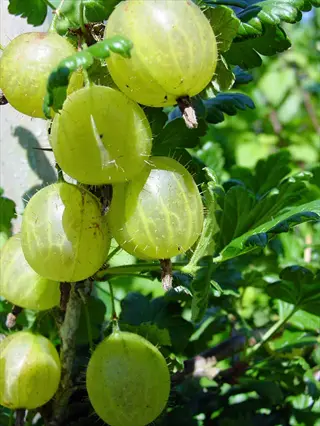
Invicta
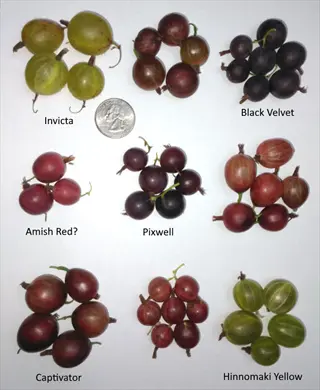
- Color: Pale green berries that stay firm and tart, making this a classic culinary type for pies, jams, and sauces.
- Yield: A heavy cropper that reliably hands a mature bush a full 8 to 10 lbs (3.6 to 4.5 kg) of fruit in a good season.
- Disease: Strong resistance to powdery mildew is its headline trait, which lowers the spraying and pruning effort it needs.
- Growth: Vigorous and spreading, so give it the full 3 to 5 ft (0.9 to 1.5 m) of spacing to keep air moving through the canes.
- Thorns: Thorny canes mean long sleeves and care at picking time, a small trade for its dependable harvest.
- Best use: A smart first choice for cooks who want volume and low disease worry rather than fresh dessert sweetness.
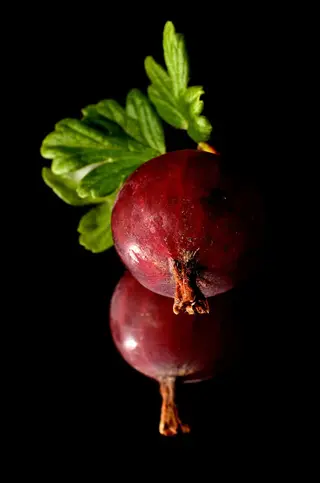
Hinnomaki Red
- Color: Deep wine-red berries that turn sweet and aromatic when fully ripe, ideal for eating fresh off the cane.
- Flavor: A dessert variety prized for a rich, almost grape-like sweetness once the fruit softens late in the season.
- Hardiness: Finnish bred and very cold tolerant, able to handle the deep winters of USDA Zone 3 gardens.
- Size: A compact, manageable bush around 5 ft (1.5 m) tall and wide that suits smaller backyard plots well.
- Disease: Good resistance to mildew keeps the foliage clean with only basic open-center pruning for airflow.
- Best use: The variety to grow if you want sweet berries to snack on straight from the bush rather than for cooking.
Captivator
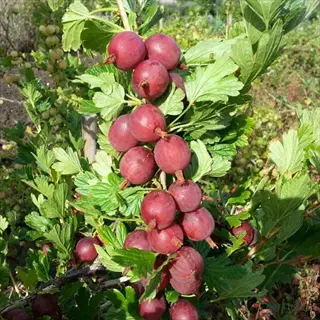
- Color: Teardrop red berries with a mild, sweet-tart balance that works well both fresh and lightly cooked.
- Thorns: Nearly thornless canes are its standout feature, making harvest far gentler on hands and sleeves.
- Disease: Notable resistance to powdery mildew and to common gooseberry leaf problems in humid summers.
- Hardiness: A tough North American type bred for cold regions, settling in well across northern garden zones.
- Growth: A moderate, well-behaved bush that stays tidy and clumping rather than sprawling across a bed.
- Best use: The friendliest pick for families and beginners who want easy, low-scratch picking with children helping.
Pixwell
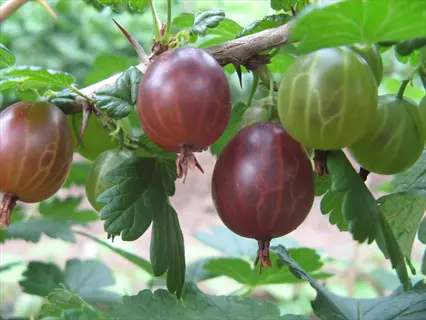
- Color: Pink to dusky red berries that hang on long stalks, which makes them easy to spot and pick.
- Thorns: Sparse, thin canes make this an old favorite for gardeners who dislike heavily spined bushes.
- Yield: A productive variety that crops well even in tough northern conditions and poorer soils.
- Hardiness: Famous for surviving harsh winters, performing reliably in the coldest USDA Zone 3 gardens.
- Flavor: Mild and slightly tart, suiting both fresh snacking when ripe and cooking when picked a touch early.
- Best use: A dependable, forgiving choice for first-time growers in cold climates who want a sure crop.
Black Velvet
- Color: Dark, dusky red to near-black berries with a deep, rich color unusual among common gooseberries.
- Flavor: A complex, berry-like taste often compared to a cross between a gooseberry and a black currant.
- Parentage: A gooseberry hybrid that carries some currant character, giving it a distinctive sweet-tart depth.
- Disease: Good mildew resistance keeps it healthy with standard open-center pruning and decent airflow.
- Growth: A productive, upright bush that fills the typical 5 ft (1.5 m) frame of a mature gooseberry plant.
- Best use: A flavorful pick for adventurous growers who want a richer, darker berry for fresh eating and preserves.
Pruning and Training
Gray mildew filmed the inner leaves of a neglected Hinnomaki Red in the damp back corner of my yard, right at the edge of the woods. The bush had grown so dense and tangled that no air moved through the middle of it. I thinned out the oldest canes to open up the center, and within weeks the trapped air cleared and the disease pulled back.
That open shape is the whole point of the prune gooseberry bush routine. Extension growers at RHS and Utah State push the same target, an open goblet shape that lets light and air reach every branch. The hollow middle is not just for looks. An open center dries the leaves fast after rain, and dry leaves give powdery mildew far less room to take hold.
Fruit forms best on 2 and 3 year old wood, so you want a steady mix of ages on the bush. Keep about 4 to 5 strong shoots each of 1, 2, and 3 year old wood, then cut out any canes older than 3 to 4 years at the base. Their fruiting slows down, and pulling them each year renews the plant. Do this winter pruning while the bush sits fully dormant, when bare canes make the structure easy to read.
The fruit rides on older wood. So this yearly cycle of clearing the oldest canes keeps a bush productive far longer than one left to grow wild. Gooseberries also take well to cordon training, fans, or standards against a wall. A single trained stem fits a tight spot and makes thorny picking much simpler.
Wait until the bush is fully dormant in late winter before making major cuts. Dormant pruning reduces stress and lets you see the cane structure clearly without leaves.
Remove crossing, crowded, and inward-growing branches to create an open goblet shape. This lets light and air reach the middle, which keeps powdery mildew in check.
Keep roughly 4 to 5 strong shoots each of 1, 2, and 3 year old wood. Fruit forms best on 2 and 3 year old branches, so a mix of ages keeps yields steady.
Cut out canes older than 3 to 4 years at the base, since their fruiting slows. Removing the oldest wood each year renews the bush and supports a long productive life.
Clear low, drooping branches and any suckers near the soil. Raising the canopy keeps fruit clean, improves airflow, and makes thorny harvesting much easier.
Gooseberries take well to training as a cordon, fan, or standard. A single-stem cordon against a wall fits a small garden and makes thorny picking far simpler.
Pests, Diseases and Blister Rust
Your gooseberry bush is tough, but a few pests and diseases still show up most seasons. The good news is that the common ones are easy to spot, and most respond to simple care rather than sprays. Catch them early and you keep your harvest intact.
Gooseberry powdery mildew is the problem you will meet first, and it spreads worst on crowded, water-stressed bushes. A gooseberry sawfly can strip leaves in days, while currant aphids curl the soft spring growth. Below are the four issues you are most likely to face.
Powdery Mildew
- Symptom: A white, powdery film coats leaves, shoots, and fruit, often worst on crowded bushes in warm, humid weather.
- Cause: Poor airflow and water stress drive most outbreaks, since drought-stressed plants are far more vulnerable to the fungus.
- Control: Prune to an open center, water evenly, and choose mildew-resistant cultivars like Invicta to keep the disease in check.
Gooseberry Sawfly
- Symptom: Small green caterpillar-like larvae strip leaves fast, sometimes reducing a bush to bare stems within days.
- Cause: Sawfly females lay eggs along leaf veins low in the bush, and several generations can appear in a single season.
- Control: Inspect the inner, lower leaves regularly and hand-pick or treat early larvae before they spread across the plant.
Currant Aphids
- Symptom: Leaves pucker and curl, often with reddish blistered patches, as aphids feed on the soft new growth in spring.
- Cause: Colonies build up on tender shoot tips, weakening growth and leaving sticky residue that can attract other problems.
- Control: Encourage beneficial insects, blast colonies off with water, and prune out badly curled tips to slow the spread.
White Pine Blister Rust
- Pathogen: Caused by the fungus Cronartium ribicola, a disease whose life cycle takes 3 to 6 years and needs two host plants.
- Hosts: It moves between five-needled white pines and Ribes plants, with black currant by far the most susceptible and gooseberry much less so.
- Control: No fungicides are labeled for it on gooseberries, so keeping bushes at least 1,000 ft (300 m) from white pines is the main safeguard.
Most everyday trouble comes down to airflow and water. Prune to an open center so light and air reach every branch, and water evenly so the roots never dry out and stress the plant. Water-stressed bushes get mildew far more than healthy ones, so this single habit prevents most outbreaks. Pick resistant cultivars like Invicta and you sidestep much of the rest.
White pine blister rust works in an odd way that explains why siting matters so much. The fungus Cronartium ribicola cannot finish its life cycle on one plant. It needs two hosts, moving between five-needled white pines and Ribes plants like your gooseberry over a span of 3 to 6 years. Break that chain and the disease stalls.
No fungicides are labeled to fight it on gooseberries. So the real safeguard is simple distance. Keep your bushes at least 1,000 ft (300 m) from any white pines and you cut the path the fungus needs. Black currant is the most prone Ribes by far. Your gooseberry takes much less serious damage.
White pine blister rust is not a serious disease of currants and gooseberries; however, it is a very serious disease of white pines (Pinus strobus).
Newer rust-resistant varieties have turned blister rust into a minor concern for most home growers. It stays a serious threat to white pine forests, which is why some states still watch it closely. For your backyard, smart spacing and a healthy, well-pruned bush handle nearly everything you will run into.
Are Gooseberries Legal to Grow
You may wonder are gooseberries illegal before you ever plant one. For most of the country the answer is no. You can legally grow a gooseberry bush in the majority of US states today. The confusion goes back to an old federal rule that you have probably never heard about.
Here is the real story behind the gooseberry ban. In 1911 a federal program restricted all Ribes plants. That group includes gooseberries and currants. The goal was to protect white pine timber from a disease called white pine blister rust. These Ribes restrictions stayed in force for decades and pushed the fruit out of American gardens.
The federal government lifted the ban in 1966 and handed the rules to each state. That is why the white pine blister rust law you face now depends on where you live. Ohio offers a clear example. State law there calls European black currant a public nuisance. Yet you can still grow red currants and gooseberries there.
So why are gooseberries rare if you can legally grow them in most places now? The ban era is the real reason, not any current law. For more than 50 years almost no one in the US grew the fruit. I planted my first bush and asked older gardeners about it, and not one of them had grown a gooseberry in their life. A whole generation learned to cook and plant without it, and that habit stuck long after the rule went away.
The good news is that things are turning around for you. The ban ended decades ago, and breeders now sell varieties that fight off the rust. More gardeners plant a bush again each year. Rules still change from state to state. So check with your state agriculture department before you plant.
Many older bans targeted European black currant, the Ribes most susceptible to blister rust, rather than gooseberries. Even where currants are limited, gooseberries are often allowed.
Nutrition and Health Benefits
A gooseberry bush gives you fruit that punches well above its weight for so few calories. The numbers behind gooseberry nutrition come straight from USDA FoodData Central, so you can trust them. One cup of raw berries runs about 66 calories, roughly the same as a small apple.
That same cup hands you near 46% of your daily vitamin C and about 7 g of fiber. The strong dose of gooseberry vitamin C is the real headline. The fiber keeps you full for longer. These berries are rich in antioxidants too. That is part of why people call them a superfruit.
So the real gooseberry health benefits come from this mix. You get plenty of vitamin C and fiber for the calories of a light snack. That makes the gooseberry a true low calorie fruit you can eat by the handful without guilt.
Research specific to gooseberries is still limited, so enjoy them as a low-calorie, vitamin C and fiber rich fruit rather than a cure for any condition.
5 Common Myths
Gooseberries are illegal to grow anywhere in the United States because of an old federal disease ban that was never lifted.
The federal ban ended in 1966. Most states allow gooseberries today, though a few keep local restrictions, so checking your own state rules is wise.
You must plant two gooseberry bushes together because a single plant cannot pollinate itself or set any fruit on its own.
Gooseberries are self-fertile. One bush sets a full crop alone, though a second plant can slightly improve fruit size and set.
Gooseberry roots are invasive and aggressive, so the bush will spread through a garden and crowd out nearby plants over time.
Gooseberries grow as a tidy clump with shallow, fibrous roots. They stay put rather than running or sending up distant suckers.
All gooseberries are far too sour to eat raw, so the fruit is only useful once it has been cooked with plenty of sugar.
Fully ripe dessert varieties are sweet enough to eat straight off the bush. Tart culinary types are the ones best cooked.
Gooseberries need a warm climate to thrive, so they are a poor choice for cold northern gardens with hard winters.
Gooseberries are among the most cold-hardy fruits, surviving winter lows near -40 F (-40 C) and actually needing a chilly winter.
Conclusion
Here is the short version of everything above. A gooseberry bush is hardy, self-fertile, and forgiving, so you can plant just one and still pick fruit. The whole job comes down to three things you now know how to do. Give it a cool spot with well-drained soil, keep the moisture even, and prune to an open center once a year.
The payoff for that small effort is hard to beat. A single mature bush hands you about 8 to 10 lbs (3.6 to 4.5 kg) of fruit every season. It shrugs off winters down near -40°F (-40°C), which makes it a genuine cold hardy fruit for tough climates. And one cup gives you around 46% of your daily vitamin C, so the berries earn their keep on the plate too.
Worried that gooseberries are somehow off-limits? For most gardeners they are not. The old federal blister rust ban ended back in 1966, and authority passed to the states. So the only homework left before growing gooseberries is a quick check of your local rules. A two-minute look at your state extension page settles it.
Gooseberries reward patience more than fuss. A new plant hits full stride within a few seasons, then keeps cropping for well over a decade with the same light gooseberry care you would give any shrub. Easier modern varieties have brought it back into fashion too. For a low-effort, high-reward home fruit, this old-fashioned berry is well worth growing. Pick your spot, get a bush in the ground, and let it do the rest.
Glossary
- Cordon
- A fruit plant trained to a single upright stem, useful for growing gooseberries in tight spaces.
- Cronartium ribicola
- The fungus that causes white pine blister rust, harmless to gooseberries but deadly to white pine trees.
- Culinary variety
- A tart gooseberry type usually picked early and cooked, rather than eaten fresh off the bush.
- Dessert variety
- A sweeter gooseberry type left to fully ripen so it can be eaten raw straight from the bush.
- Goblet shape
- An open, cup-like pruning form that keeps a bush's center clear so air and light reduce disease.
- Ribes
- The plant genus that includes gooseberries and currants, all of which can host white pine blister rust.
- Self-fertile
- A plant that can set fruit using its own pollen, so a single bush produces a crop without a second plant nearby.
- White pine blister rust
- A fungal disease that needs both white pine trees and gooseberry or currant plants to complete its life cycle.
External Sources
Frequently Asked Questions
Can you eat gooseberries right off the bush?
Yes. Fully ripe dessert gooseberries are safe and pleasant to eat raw, while tart culinary types taste better cooked.
Do I need two gooseberry bushes to get fruit?
No. Gooseberries are self-fertile, so one bush sets a full crop on its own without a second plant.
Where do gooseberry bushes grow best?
Gooseberries grow best in cool climates with rich, well-drained soil at pH 6.0 to 7.0, full sun to part shade, and steady moisture.
How many gooseberries does one bush produce?
A mature, healthy bush produces about 8 to 10 lbs (3.6 to 4.5 kg) of fruit, or up to four quarts, each year.
What is the lifespan of a gooseberry bush?
Most gooseberry bushes stay productive for 10 to 15 years, and well-tended plants can live considerably longer.
Why are gooseberries so rare?
An old federal ban tied to white pine blister rust, plus a short shelf life, kept gooseberries out of most stores.
What does eating gooseberries do to your body?
Gooseberries add vitamin C, fiber, potassium, and antioxidants to your diet while staying low in calories.
What should you not plant next to gooseberries?
Avoid planting gooseberries near white pine trees and away from crowding plants that block airflow and invite mildew.
Do gooseberry bushes spread or have invasive roots?
No. Gooseberries form a tidy clumping shrub with shallow, fibrous roots that do not run or spread aggressively.
Are gooseberry bushes worth growing?
Yes. Gooseberries are hardy, low-maintenance, productive, and supply fruit you can rarely buy fresh in stores.