

Introduction
The nepeta plant is the kind of perennial that does the hard work and asks for almost nothing back. It fills a hot, sunny border with soft mounds of lavender-blue flowers for months. Bad soil and missed waterings that kill fussier plants barely faze it. If you want color that lasts without a chore list, this is your plant.
Most people call it catmint, and that name causes a lot of confusion. Nepeta is the genus. Catmint is the common name for the tidy garden types, and catnip is just one species inside that same group. So the plant that drives your cat wild and the one lining a flower bed are cousins, not the same thing. Knowing which one you grow changes everything.
This is a tough plant by any measure. It belongs to the mint family, and it comes back year after year as a hardy perennial in USDA zones 3 to 8. It wants full sun and good drainage, then turns drought tolerant once its roots settle in. Deer and rabbits leave it alone, which is why extension offices keep recommending it for low-water gardens. The variety 'Walker's Low' even won Perennial Plant of the Year in 2007 and became a go-to swap for lavender in dry spots.
This guide covers the full picture. You will get clear steps for care and the best varieties to plant. You will learn the right way to shear it for a second wave of bloom. And you will get honest answers on two things: how cats really react and whether the plant can upset their stomachs, plus what the science says about mosquitoes. Let's start with how to plant and grow it.
How to Grow and Care for Nepeta
One wet summer my six-year-old Walker's Low catmint splayed wide open and went bare right through the middle. The plant sat in my zone 5 front border by the kitchen window, and it had looked great for years. I eased back hard on the water, and within a few weeks the mound firmed up and closed back in.
That habit tells you almost everything about catmint care. This is a plant that does its best work when you leave it a little hungry and a little dry. Learning how to grow nepeta comes down to giving it sun, sharp drainage, and a light hand with everything else.
Start with light. Nepeta wants full sun, which means at least 6 hours of direct light each day per NC State Extension. Less than that and the stems stretch, the mound flops, and you get fewer of those lavender-blue flowers. A spot that bakes in the afternoon suits it fine.
Soil is where most people go wrong. Catmint needs well-drained soil, but it is not fussy about type and handles clay, loam, sand, and even shallow rocky ground. What it does not want is rich, heavy soil. Plant it lean, because average to poor soil gives you sturdier stems and a tighter, fuller shape.
Skip the fertilizer too. Heavy feeding pushes soft, floppy growth and actually cuts down on blooms. Once it settles in, nepeta is drought tolerant and shrugs off dry spells that wilt fussier perennials. When watering catmint, soak it deep but space out the drinks, and back off the moment the center starts to open up like mine did.
Catmint is tough on hardiness zones. It lives through cold winters in USDA zones 3 to 8. That covers most of the country. The toughness makes it a top pick for dry, low-water spots. Colorado State Extension calls it a must-have for xeric areas. It even shrugs off road salt and poor soil along walks and drives.
Rich soil and frequent watering make catmint flop open and bloom less. Plant it lean, water deeply but rarely, and skip the fertilizer for sturdier, tidier mounds.
Best Catmint Varieties to Plant
Not all catmint varieties behave the same way in a border. Some stay knee-high and tidy. Others billow out into a 3 ft cloud of lavender-blue. The cultivar you pick decides whether your plant edges a path or anchors the back of the bed, so it pays to choose by the job you want done.
The benchmark is Walker's Low, named the 2007 Perennial Plant of the Year. It grows 1.5 to 2 ft (45 to 60 cm) tall with arching 2 to 3 ft (60 to 90 cm) stems and spreads up to 36 in (90 cm). The big draw is that it is a sterile hybrid. It will not set seed, so it stays compact and never turns weedy the way true catnip can. That one trait is why so many gardeners trust it.
If you garden in a small space, reach for compact catmint like Cat's Pajamas. It tops out near 12 to 14 in and flowers right down to the base, which makes it a clean choice for edging and pots. Want bold scale instead? Six Hills Giant is the tallest common type at 2.5 to 3 ft, perfect for a back-of-border drift. The award run keeps going too, with Cat's Pajamas crowned in 2021 and Cat's Meow in 2025.
Here are the four catmints worth planting first, with the size and habit notes that help you slot each one into the right spot.
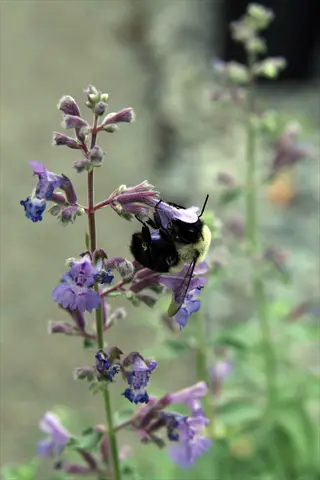
Walker's Low
- Size: Reaches 1.5 to 2 ft (45 to 60 cm) tall with arching 2 to 3 ft (60 to 90 cm) stems and a spread up to 36 in (90 cm).
- Award: Named the 2007 Perennial Plant of the Year, which made it the benchmark ornamental catmint for sunny borders.
- Flowers: Produces soft lavender-blue flower spikes from early summer into fall above gray-green aromatic foliage.
- Behavior: This cultivar is sterile and will not set seed, so it stays compact and never turns weedy in the garden.
- Hardiness: Reliably perennial in USDA zones 3 to 8 and shrugs off deer, rabbits, and short dry spells once established.
- Best use: Works as a billowing front-of-border filler, a lavender substitute, or an informal low edging along a path.
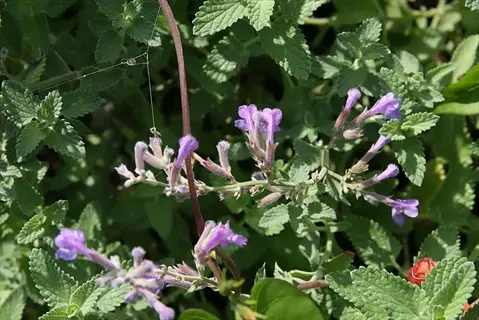
Six Hills Giant
- Size: The tallest common catmint, reaching roughly 2.5 to 3 ft (75 to 90 cm) tall and wide with a billowing habit.
- Flowers: Carries large lavender-blue flower spikes over a long season, making a bold statement in bigger borders.
- Foliage: Shows the same aromatic gray-green leaves as other catmints, giving a soft, cloud-like texture in mass plantings.
- Behavior: Vigorous and full, so it can flop without support or a hard shearing, especially in rich soil or shade.
- Hardiness: Hardy and deer-resistant like its relatives and thrives in full sun with sharp drainage.
- Best use: Best at the back of a border or as a large drift where its size and reach have room to spread out.
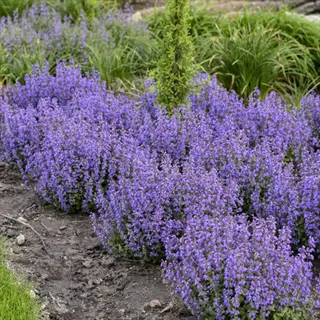
Cat's Pajamas
- Size: A tidy, compact cultivar reaching about 12 to 14 in (30 to 35 cm) tall, ideal for small spaces and the front edge.
- Award: Named the 2021 Perennial Plant of the Year for its neat habit and heavy, low flowering.
- Flowers: Blooms with deep indigo-blue flowers right down to the base of the plant, giving dense color coverage.
- Foliage: Holds the aromatic gray-green leaves typical of catmint on a rounded, well-mannered mound.
- Behavior: Stays compact and does not flop as easily as taller types, so it needs little maintenance.
- Best use: A strong choice for edging, containers, and tight borders where a larger catmint would overwhelm.

Cat's Meow
- Size: A medium, rounded cultivar reaching about 17 to 20 in (43 to 50 cm) tall and slightly wider for a full look.
- Award: Named the 2025 Perennial Plant of the Year, continuing the strong run of catmint award winners.
- Flowers: Bears clear blue flowers on a dense, uniform dome that holds its shape well through the season.
- Foliage: Carries fine gray-green aromatic leaves that form a clean mound even before the flowers open.
- Behavior: Bred for a tidy, non-flopping habit, so it keeps its shape with minimal shearing.
- Best use: A dependable mid-border or mass-planting choice when you want a uniform, polished look.
Shearing for a Second Bloom
By late summer my 'Walker's Low' in the zone 5 front border was a full mound of fresh blue flowers, buzzing with bees again. Three weeks earlier I had taken shears to that same plant and left it a stubby, bald patch of bare stems. I walked past it for days sure I had killed my best perennial. Then the gray-green growth pushed up from the base, and the whole mound rebuilt itself.
That hard haircut is the single most useful thing you can do for this plant. When you shear back catmint after the first flush of bloom fades, you trigger a second wave of flowers that carries the show into late summer. Skip this step and the plant just sits there, spent and floppy, for the rest of the year.
How far should you cut? The honest answer is a range. Colorado State tells you to shear the top growth, UW Extension says half to a third, and Purdue goes as deep as two-thirds. On a healthy, vigorous plant a moderate two-thirds cut works well and gives you the cleanest regrowth. A timid trim gives you a timid response, so don't be shy with the shears.
Once you cut back catmint this hard, the timeline is fast and reliable. Fresh growth appears within a few weeks, and a new flush of lavender-blue flowers follows soon after. The rough, bare look only lasts a short stretch, and the payoff is weeks of fresh color when most of the garden has gone quiet.
Pruning catmint does more than spark a rebloom. The same shear fixes a plant that has gone floppy and splayed open in the middle, a dual benefit that gardener Stacy Ling points to from her own beds. Heavy spring growth tends to flop after the first bloom, and a hard cut pulls the whole mound back into a tidy shape.
You can also reach for the shears between the big cuts. Light deadheading nepeta through the season removes the browning spent flowers and keeps the plant looking neat. But the real second flush comes from the one bold shear, not from picking off a few faded blooms here and there.
Let the first flush of lavender-blue flowers finish and start to brown, usually in early to midsummer, before you make any cuts.
Using clean shears, cut the whole plant back by one-third to two-thirds, removing the spent flowers and the top of the foliage.
The plant will look bare and stubby at first, which is normal; resist the urge to dig it up or overwater it now.
Fresh gray-green growth pushes from the base within a few weeks, quickly hiding the cut and rebuilding the mound.
A new show of lavender-blue flowers follows the regrowth and carries the display into the weeks of late summer.
Shear top growth as the first flush of flowers fade. Fresh new growth soon will appear. Within several weeks a new show of lavender-blue flowers will last into the weeks of late summer.
Cats, Catnip, and the Nepeta Name
The whole catmint vs catnip mix-up starts with the name. Both plants sit in the genus Nepeta, so people lump them together and assume your cat will go wild for either one. That isn't quite how it works in the garden.
The plant cats chase is true catnip, or Nepeta cataria. It packs the most of a compound called nepetalactone. That one chemical drives the rolling, rubbing, and zoned-out cat behavior you've seen in videos. Most ornamental catmints carry far less of it, so they pull cats in much less.
So when people ask do cats like catmint, the honest answer is some do and plenty don't care at all. In my own garden the ornamental clumps barely draw a sniff, while a patch of true catnip turns into a cat hangout by July. If you want fewer cats trampling your border, plant a tidy ornamental type instead of true catnip. The chart below lines the two plants up side by side so you stop confusing them at the nursery.
- Grown mainly for tidy lavender-blue flowers and gray-green foliage.
- Many cultivars like 'Walker's Low' are sterile and stay in neat clumps.
- Affects cats less strongly and rarely self-seeds into the lawn.
- Hardy in USDA zones 3 to 8 as a well-behaved border perennial.
- Grown as a herb and a cat treat with white, purple-spotted flowers.
- Self-seeds freely and can become weedy if left unchecked.
- The species most cats respond to, though it can upset some stomachs.
- Hardy in USDA zones 3 to 9 and often best confined to a container.
Now for the worry on every cat owner's mind. Is catmint safe for cats to nibble? For the ornamental types it's low risk, but true catnip can upset some stomachs. NC State Extension is blunt about how the same plant hits each cat differently.
Many cats are attracted to 'Cataria' catmint, but it can cause vomiting and diarrhea. It makes some cats sedated and others stimulated.
The takeaway is that the reaction depends on the cat and the Nepeta type, not on some fixed rule. One cat melts into a nap while another bounces off the walls, and a few show no reaction at all. Choose your plant with that in mind, and keep an eye on any cat that decides to graze.
Pollinators, Deer, and Mosquitoes
It is an August morning at my kitchen window, and the front border in my zone 5 garden is loud. My 'Walker's Low' catmint hums with bumblebees, and they crawl up the blue spikes one after another. A leaf-cutting bee works the far end while two honey bees fight over the same bloom. The plant barely holds still under all that traffic.
Catmint earns its name as a pollinator plant because it draws so many bees. The nectar pulls in mostly long-tongued bees, like honey bees, bumblebees, cuckoo bees, long-horned bees, and leaf-cutting bees. Butterflies and hummingbirds work the spikes too. The fact that catmint attracts bees for weeks on end, especially after you shear it, is what makes it such a steady food source.
The flip side helps just as much. Deer and rabbits leave catmint alone, which is why deer resistant catmint shows up on so many plant lists. The minty leaves taste wrong to them. So rabbit resistant borders stay whole while deer strip the plants nearby. NC State also notes that catmint repels aphids and squash bugs, so it earns a spot near roses and vegetables.
Now for the question people ask most. Does catmint repel mosquitoes? A 2019 study put it to the test. The oil from the plant kept off more than 95% of them. That oil is nepetalactone, and it even beat DEET at the lowest dose. But the win came from the oil, not a plant in your bed, and it lasted only about 2 hours. A catmint plant gives off far too little oil to keep bugs off you, so plant it for the bees and the blooms instead.
Bees and Butterflies
- Main visitors: Catmint nectar draws mostly long-tongued bees, including honey bees, bumblebees, cuckoo bees, long-horned bees, and leaf-cutting bees.
- Long season: Its extended bloom from late spring into fall, especially after shearing, feeds pollinators across many weeks.
- Bonus wildlife: Butterflies and hummingbirds also work the lavender-blue spikes, making catmint a strong all-around pollinator plant.
Deer and Rabbit Resistance
- Avoided by browsers: Deer are not attracted to catmint, and rabbits generally leave it alone, per Colorado State and Purdue Extension.
- Why it works: The aromatic, slightly minty foliage makes the plant unappealing to browsing animals that strip other perennials.
- Garden value: This makes catmint a dependable choice for unfenced borders where deer pressure ruins less resistant flowers.
Insect Repellent Effect
- Garden helper: NC State notes catmint acts as a repellent for certain insects, including aphids and squash bugs, near other plants.
- The active compound: Catmint and catnip contain nepetalactone, the aromatic oil behind both the cat reaction and the repellent activity.
- Companion benefit: This gentle pest-deterring effect is one reason gardeners tuck catmint among roses and vegetables.
Mosquitoes: The Real Story
- Lab result: Extracted catnip oil and nepetalactone topped 95% mosquito repellency and beat DEET at the lowest tested concentration in a 2019 study.
- The catch: That protection lasted only about two hours before needing reapplication, while DEET held far longer across the day.
- What it means: A catmint plant growing in your garden releases far too little oil to keep mosquitoes off you, so do not rely on it as bug protection.
At the lowest concentrations tested, the nepetalactones and crude essential oil samples were more effective than DEET at reducing the number of mosquito landings.
Design and Companion Planting Ideas
Roses and Catmint
- Classic pairing: Catmint's blue haze softens the bare lower stems of roses while echoing the cottage-garden look.
- Shared needs: Both enjoy full sun and good drainage, so they thrive in the same border without competing for very different conditions.
- Practical bonus: The aromatic foliage helps deter aphids near the roses, adding a quiet pest-management benefit.
Salvia, Alliums, and Coneflowers
- Structure and contrast: Upright salvia spikes and round allium heads rise above catmint's loose mound for varied texture.
- Extension picks: Colorado State suggests daylilies, black-eyed susan, and purple coneflower, all sun-loving perennials that bloom alongside catmint.
- Pollinator boost: Combining these nectar-rich plants extends the buffet for bees and butterflies across the season.
Lavender Substitute
- Same look, tougher plant: Catmint delivers the soft blue color and gray-green foliage of lavender but survives cold, damp, and clay far better.
- Where lavender struggles: In humid or heavy-soil gardens where lavender sulks, catmint fills the same design role reliably.
- Long display: Unlike lavender's brief bloom, sheared catmint reflowers and holds color from early summer into fall.
Edging and Containers
- Front-of-border edging: Compact cultivars form a soft, billowing edge along paths and bed fronts that hides leggy stems behind them.
- Container spiller: Catmint cascades nicely over the rim of a pot in full sun, pairing well with upright thrillers.
- Slopes and drifts: Its drought tolerance makes it useful as ground cover and erosion control on dry, sunny banks.
The best companion plants for catmint share its love of sun and lean, well-drained soil. That shared need is what keeps a border looking full instead of patchy, since nothing fights for water or shade. So when you decide what to plant with nepeta, start with other tough, sun-loving perennials and let the soft blue haze tie them together.
Color is where catmint earns its keep. Pair its blue mound with hot reds and bright yellows and you get sharp contrast that pops from across the yard. Set it next to soft pinks and purples and you get a gentle cottage garden blend that feels relaxed and a little wild. Both looks work, so pick the mood you want first.
Pairing catmint with roses is the classic move, and for good reason. Roses go leggy and bare at the base, and catmint hides those naked stems behind a billowing skirt of color. The two want the same full sun and drainage, so they live happily in one bed. The aromatic leaves also help push aphids away from your blooms.
Use catmint as a lavender substitute when your lavender keeps dying on you. You get the same gray-green leaves and dusty blue color, but a plant that shrugs off cold, damp, and clay where lavender just sulks. It also holds that color far longer through your season. The pairings below cover edging, containers, and the dry slopes where you need a tough plant.
5 Common Myths
All Nepeta plants are the same as the catnip that drives cats wild, so every catmint will attract every cat in the area.
Catnip is just one Nepeta species. Many garden catmints affect cats far less, and responses vary from cat to cat or are absent entirely.
Catmint is invasive and will take over a garden the way mint does, spreading aggressively through runners and seed everywhere.
Most ornamental catmints, like sterile 'Walker's Low', stay in tidy clumps and do not self-seed, so they remain well-behaved and easy to manage.
Growing a catmint plant in the yard works like a living bug spray and keeps mosquitoes away from people nearby all season.
Only extracted catmint oil repelled mosquitoes in lab tests. A plant in the ground releases far too little scent to protect you outdoors.
Catmint needs rich soil and frequent watering to look its best, so it should be fed and irrigated like a fussy garden flower.
Catmint thrives in lean, well-drained soil and is drought tolerant once established. Too much water and feeding cause floppy, weak growth.
Once catmint finishes its first bloom it is done flowering for the year, so there is no point cutting it back afterward.
Shearing plants back after the first flush triggers fresh growth and a second wave of flowers within several weeks, into late summer.
Conclusion
The nepeta plant asks for very little and gives back a long wave of lavender-blue color all season. The core promise holds up: it stays tough through heat and drought yet still looks soft and full in the bed. A few smart choices at planting time set you up for years of easy blooms.
The actions that matter are simple. Plant your catmint in full sun and lean, well-drained soil, then water it sparingly once the roots take hold. The one task that pays off most is the shear back after the first flush of flowers fade. Cut the top growth by one-third to two-thirds and a fresh show of blue returns within a few weeks. This single step keeps the plant neat and pushes a second flush deep into late summer.
The selling points speak for themselves. This perennial is hardy from zones 3 to 8, it shrugs off deer and rabbits, and it pulls in bees and butterflies from morning until dusk. I planted a row of catmint in my own border, right where two batches of lavender had rotted out. It sailed through the same hot, dry summer without a hitch. A deer resistant plant that blooms for months and needs almost no fuss is a rare find.
When choosing a variety, reach for a sterile cultivar like 'Walker's Low' and you get all that color with none of the spread. It sets no seed and stays well-behaved in the bed. Picture your own border next summer, hazed over with that soft blue glow while the bees work each spike. That view is closer than you think, and it starts the day you tuck the first plant into the ground.
Glossary
- Herbaceous perennial
- A plant that lives for many years but dies back to the ground each winter and regrows from its roots in spring.
- Lamiaceae
- The mint family of plants, which includes catmint along with mint, salvia, and lavender.
- Nepeta
- The botanical genus name for the group of mint-family perennials commonly called catmint, including true catnip.
- Nepetalactone
- The aromatic oil compound in catmint and catnip responsible for both the reaction in cats and the plant's insect-repellent activity.
- perennial
- A plant that lives for several years, dying back in winter and regrowing from its roots each spring.
- Shearing
- Cutting a plant back hard all over, used on catmint after its first bloom to trigger fresh growth and a second flush of flowers.
- Sterile cultivar
- A named plant variety that does not set viable seed, so it cannot self-seed or spread and stays well-behaved.
- Xeric
- Describing plants or gardens suited to dry, low-water conditions.
External Sources
Frequently Asked Questions
Is Nepeta the same as catnip?
Not exactly. Catnip is one Nepeta species (Nepeta cataria), while ornamental catmint is a different, better-behaved garden plant.
Does Nepeta come back every year?
Yes. Catmint is a hardy perennial that dies back in winter and returns each spring, reliably in USDA zones 3 to 8.
Does Nepeta like sun or shade?
Sun. Catmint blooms best in full sun with at least six hours of direct light, though it tolerates light afternoon shade.
Does catmint spread quickly?
It depends on the type. Sterile ornamental catmint widens into tidy clumps, while true catnip can self-seed and spread quickly.
Do cats like or dislike Nepeta?
Many cats are attracted to the scent, but responses vary widely and some cats ignore it entirely.
Does catmint repel mosquitoes?
The oil does in lab tests, but a catmint plant growing in your garden will not keep mosquitoes off you.
Can Nepeta grow in pots?
Yes. Catmint grows well in containers as long as the pot drains freely and sits in full sun.
What does Nepeta look like in the winter?
It dies back to the ground for winter, leaving a low cluster of dry stems that regrows from the base in spring.
What is the lifespan of catmint?
Catmint is a long-lived perennial that can thrive for many years, especially when divided every few years.
What are the downsides of catmint?
Catmint can flop open after rain, true catnip can self-seed, and it may upset some cats' stomachs.

