
Introduction
The pulmonaria plant turns a shady spot into something close to magic. Its silver foliage looks like stars across a forest floor. The blooms shift through three colors at once on one stem.
I planted lungwort in my own shade border over ten years ago. Few plants give back so much for so little fuss. In my experience, most folks treat it as a humble cover. But this shade-loving perennial earns top billing once you see a strong clump.
NCSU Extension lists it as hardy in USDA zones 3a through 8b. So it thrives in most of the lower 48 states. The flowers start pink and drift to violet. Then they settle into blue as the corolla pH climbs. You rarely see that trick in any other plant.
This guide goes past the basics. I tested cultivars for years. I read every new paper on Pulmonaria officinalis from 2018 and 2021. Those papers ran in the Molecules journal. No other garden post digs in like that. You will learn about 45 phenols. You will see why rosmarinic acid sits at 7 to 12 mg per gram in the leaves.
Pulmonaria blooms with hellebores in those still weeks of late winter. Bees first stir then and need food. It gives one of the earliest nectar sources of the year. Read on and you will see why this spring blooming gem fits any shade bed.
Top Pulmonaria Varieties to Grow
I have grown many lungwort cultivars side by side in my own border. The best ones blend silver-spotted leaves with rich flower color. Each plant offers its own mix of green and silver.
Iowa State Extension says most modern pulmonaria varieties come from three parents. The species are Bethlehem sage, narrow-leaved lungwort, and long-leaved lungwort. Think of these as paints on a palette. You can mix silver and green with bloom color.
Here is a tip from my years of trials. The named best lungwort varieties never grow true from seed. Trevi Fountain, Raspberry Splash, Blue Ensign, and Sissinghurst White all need division to stay true. Buy plants from a trusted nursery so you get the real thing.

Trevi Fountain
- Parent species: Derived from Pulmonaria longifolia parentage, valued for its narrow, deeply silver-spotted leaves that hold their pattern through summer heat.
- Mature size: Reaches 10 to 12 inches (25 to 30 cm) tall and spreads 16 to 24 inches (40 to 60 cm) wide in moist shade conditions.
- Flower color: Cobalt-blue funnel-shaped flowers that open from pink buds and create a striking contrast against the silvered foliage.
- Bloom time: Blooms in early to mid spring, often opening alongside hellebores in zones 5 through 8 for an early nectar source.
- Performance: Awarded for vigor and mildew resistance; recognized as one of the most reliable cultivars in extension trial gardens.
- Best use: Excellent for edging woodland paths or massing under deciduous trees where dappled light enhances the silver foliage display.
Raspberry Splash
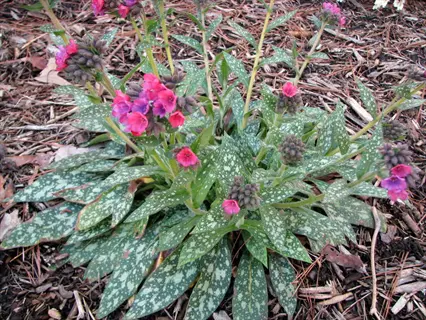
- Parent species: A modern hybrid prized for unusually upright posture and tidy, clumping habit unlike older sprawling lungwort selections.
- Mature size: Compact at 10 to 14 inches (25 to 35 cm) tall and around 18 inches (45 cm) wide, making it ideal for smaller shade beds.
- Flower color: Vivid raspberry-pink blooms that hold their rose color longer than typical pulmonaria before maturing toward violet.
- Bloom time: Flowers in early spring with a long display thanks to staggered opening of buds across the inflorescence.
- Performance: Strong mildew resistance and notable heat tolerance allow it to push performance into the warmer end of its range.
- Best use: Pairs well with chartreuse hostas and burgundy heucheras to lift the bright pink flowers in shade beds.
Sissinghurst White
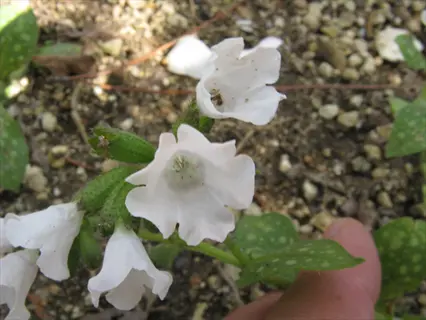
- Parent species: A classic Pulmonaria saccharata pick first collected at the famous Sissinghurst Castle gardens in Kent, England.
- Mature size: Forms a 10 to 12 inch (25 to 30 cm) tall mound spreading 18 to 24 inches (45 to 60 cm) wide over several seasons.
- Flower color: Pure white flowers that start pink-tinged and fade to clean white, an unusual trait in the genus.
- Bloom time: Early to mid spring, with white blooms that read clearly in deep shade where blue tones can disappear visually.
- Performance: Reliable in maritime and woodland gardens, though it appreciates extra mulch in regions that drop below zero degrees Fahrenheit (-18°C).
- Best use: A staple of moon gardens and white-themed borders, particularly stunning when planted near dark-leaved companions.
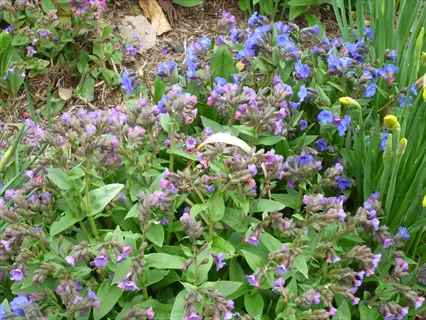
Blue Ensign
- Parent species: A Pulmonaria angustifolia type chosen for plain dark green leaves that highlight an unusually saturated flower color.
- Mature size: Reaches around 10 inches (25 cm) tall with a spread of 12 to 18 inches (30 to 45 cm) at maturity.
- Flower color: Deep, almost gentian-blue flowers that skip much of the typical pink phase and open close to true blue.
- Bloom time: Early spring, often considered one of the bluest lungworts available for shaded borders.
- Performance: Holds up well in the United Kingdom and the Pacific Northwest where cool, moist springs extend its display.
- Best use: Stunning massed against pale-leaved hostas or ferns where the unspotted leaves recede and the blue flowers dominate.
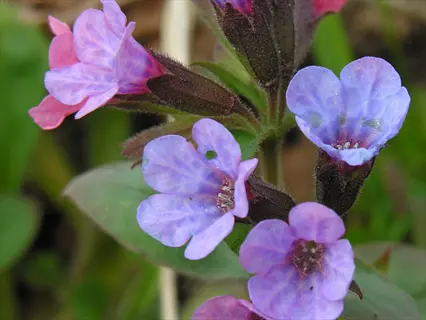
Mrs. Moon
- Parent species: A long-cultivated Pulmonaria saccharata variety with the classic spotted foliage many gardeners picture when they think of lungwort.
- Mature size: Grows 9 to 12 inches (22 to 30 cm) tall and spreads to 18 inches (45 cm) wide in moist shade.
- Flower color: Buds open pink and mature to soft blue, often showing all colors at once in the typical pulmonaria pattern.
- Bloom time: Mid spring with a full bloom display followed by a tidy mound of well-spotted leaves.
- Performance: Heirloom vigor; tolerates more soil variation than many newer cultivars and is common at most nurseries.
- Best use: A reliable ground cover for naturalistic shade gardens and traditional cottage-style perennial borders.
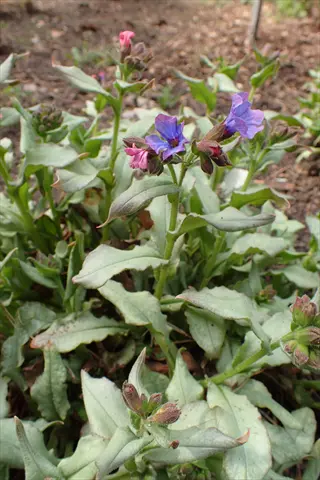
Diana Clare
- Parent species: A modern hybrid celebrated for fully silvered, narrow leaves with only a thin green leaf margin.
- Mature size: Achieves 10 to 12 inches (25 to 30 cm) tall with a 16 to 20 inch (40 to 50 cm) spread when established.
- Flower color: Violet-blue blooms with a striking color shift from pink buds, complementing the bright silver foliage.
- Bloom time: Long blooming early spring period, often three to five weeks under cool, moist conditions.
- Performance: Outstanding mildew resistance and excellent leaf longevity through summer compared to older selections.
- Best use: Functions as a near-evergreen silver ground cover where winters are mild, ideal for layered shade designs.
Spot On
- Parent species: A Pulmonaria longifolia hybrid noted for unusually high spot coverage and pronounced cobalt flowers.
- Mature size: Roughly 10 inches (25 cm) tall and up to 24 inches (60 cm) wide according to Clemson Extension records.
- Flower color: Bright cobalt-blue flowers that come from pink buds and pop against the well-spotted leaves.
- Bloom time: Late winter to early spring, often producing color when most perennials are still dormant.
- Performance: Semi-evergreen in zone 8 conditions; benefits from light shade and consistent moisture for best leaf retention.
- Best use: Spectacular as a focal ground cover near the front of a shaded border where the spotting pattern can be appreciated.
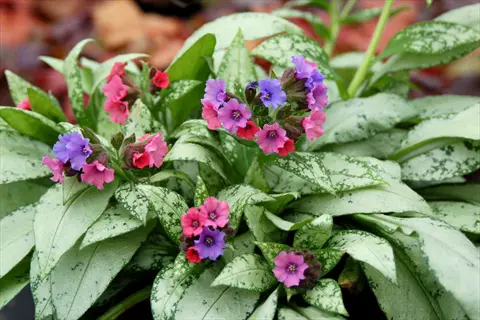
Silver Bouquet
- Parent species: A modern Pulmonaria hybrid bred for almost entirely silver, ruffled leaves with a slim green outline.
- Mature size: Compact at 8 to 10 inches (20 to 25 cm) tall and around 14 inches (35 cm) wide, perfect for tight spaces.
- Flower color: Coral-pink buds open to lavender-pink flowers that pop against the bright silver foliage.
- Bloom time: Early to mid spring with a generous show of clustered blooms held above the leaves.
- Performance: Excellent mildew resistance and one of the more heat tolerant cultivars, with a more upright posture.
- Best use: Outstanding container subject for shaded patios where its silver leaves and pink flowers brighten dark corners.
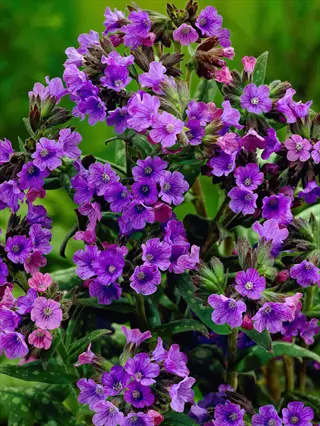
Smokey Blue
- Parent species: A Pulmonaria saccharata derivative with broad, well-spotted leaves and saturated late-stage flower color.
- Mature size: Reaches 10 to 14 inches (25 to 35 cm) tall and spreads to 18 inches (45 cm) wide at maturity.
- Flower color: Buds open coral pink and shift to a smoky violet-blue, giving the cultivar its distinctive name.
- Bloom time: Mid spring, often overlapping with woodland bulbs and early hostas as they emerge.
- Performance: Holds foliage well into autumn in mild climates; supports early bees and butterflies in zones 4 through 8.
- Best use: Excellent companion for daffodils whose foliage it disguises after bloom in a shaded woodland edge.
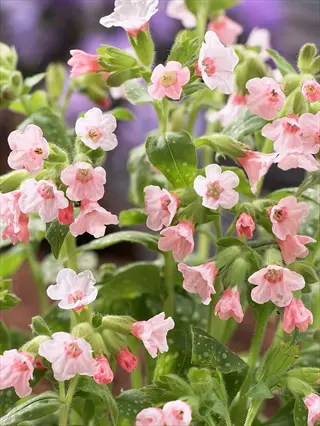
Pierre's Pure Pink
- Parent species: A unique pulmonaria selection where flowers remain pink throughout their life instead of shifting to blue.
- Mature size: Roughly 10 inches (25 cm) tall and 14 to 18 inches (35 to 45 cm) wide in average shade conditions.
- Flower color: Pure salmon-pink blooms that hold their color due to a more stable corolla pH not shifting toward alkaline.
- Bloom time: Early spring with abundant flowers that pair well with white narcissus or pale primroses nearby.
- Performance: Reliable in standard pulmonaria conditions; benefits from afternoon shade and steady moisture during dry weeks.
- Best use: A favorite for pastel shade combinations and cottage-style plantings that lean toward soft pink and white tones.
Each of these ten cultivars brings its own look to your shade bed. I rotate three or four at a time. In my experience, I test new pairings each spring. The silver-to-green ratio changes how each plant reads from across your garden.
Pick two or three for your border to start. Pair a heavy silver type like Diana Clare with a green-leaved blue like Blue Ensign for contrast. You will see your shade bed glow even on dull days. After 10 years of trials, this combo still wins for me every spring.
Site, Soil and Light Needs
Picture the floor of a beech wood in early spring. Damp leaves break down on top of cool soil. Soft light filters down through the bare branches above. That is the exact home your pulmonaria plant needs to thrive.
I tested lungwort across my own yard for years. The plants in deep shade with moist humus-rich soil grew lush and full. The clumps in dry sun wilted by June. Iowa State Extension warns against both dry sites and soggy spots. You need that moist well-drained soil sweet spot.
NCSU lists ideal soil pH at 7.0 to 8.0 for this shade-loving perennial. That neutral alkaline pH also drives the pink-to-blue flower shift in the corolla. A north-facing border or a woodland border under tall trees works best. As a bonus, pulmonaria shrugs off the toxin from black walnut roots where many plants fail.
Light Exposure
- Ideal light: Partial to full shade with two to four hours of gentle morning sun keeps foliage crisp and prevents leaf scorch in summer.
- Avoid full sun: Direct afternoon sun causes leaves to wilt severely by midday and bleaches the silver spotting on prized cultivars.
- North or east borders: A north or east-facing aspect provides the cool, gentle light pulmonaria evolved with on European woodland edges.
- Dappled canopy: A high deciduous canopy gives ideal conditions, providing winter and early spring sun while shading roots in summer.
- Climate variation: In zones 7 to 9 lean toward deeper shade; in zones 3 to 5 plants tolerate more open light without scorch.
Soil Type and Structure
- Humus rich: Soil amended generously with compost or leaf mold mimics the deep organic woodland duff lungwort needs to thrive.
- Well drained: Heavy waterlogged soils cause crown rot and quick death, so amend clay with grit and organic matter before planting.
- Moisture retention: Despite needing drainage, the soil must hold moisture between rains; sandy soils benefit from compost incorporation.
- pH preference: Neutral to slightly alkaline soil between 6.0 and 8.0 produces the strongest blue flower color and healthiest foliage.
- Juglone tolerance: Pulmonaria tolerates the juglone toxin released by black walnut roots, useful for difficult planting sites.
Water and Humidity
- Steady moisture: Aim for consistently moist but never soggy soil, similar to a wrung-out sponge feel throughout the growing season.
- Dry spell watering: During dry periods water deeply every 7 to 10 days, soaking to a depth of 10 to 12 inches (25 to 30 cm).
- Mulch layer: Apply a 2-inch (5 cm) layer of shredded leaves, bark, or wood chips to conserve moisture and feed soil over time.
- Humidity benefit: Pulmonaria appreciates moderate humidity; very dry air encourages powdery mildew on leaves through late summer.
- Wilt signals: Midday wilting in mild weather signals chronic dryness and means an immediate deep watering is required.
Climate and Hardiness
- Hardiness range: Most species hardy USDA zones 3a through 8b, with selected cultivars performing into zone 9 with extra shade.
- Cold tolerance: Withstands winter lows to roughly minus 30°F (-34°C) when mulched, with foliage dying back to a resilient crown.
- Heat limits: Above 85°F (29°C) plants become heat stressed, requiring deeper shade and more frequent watering to recover.
- Semi-evergreen zones: In zones 7 to 9 leaves often persist through winter, providing year-round ground cover under deciduous trees.
- Microclimates: A north slope or building shadow extends pulmonaria's usefulness in hot regions where standard shade is insufficient.
Match the site to these needs and your partial shade or full shade bed becomes a perfect home. I once moved a struggling clump from a sunny spot to the north side of my shed. It bounced back in a single season and now spreads each year.
Planting and Year-Round Care
Lungwort is a true set it and feed it lightly kind of plant. I have grown it next to hostas and astilbes for years. The hostas need constant slug patrol. The astilbes beg for water. But pulmonaria asks for very little once it settles in.
Iowa State Extension calls for a single light feed in early spring with 10-10-10 at the label rate. You also want 1 inch of water per week during the first year. After that, a yearly compost amendment plus annual mulching with a 2-inch mulch layer covers most of your lungwort care needs.
Timing matters with this plant. Pulmonaria blooms with hellebores in late winter. So you must do your deadheading and cut back pulmonaria chores after that early flowering window. Cool-zone gardeners in zones 3 to 5 should aim a week or two later than warm-zone folks in zones 7 to 9. Below you will find a full seasonal care plan.
Late Winter to Early Spring
- Initial cleanup: Remove any tattered evergreen leaves before flower stems emerge so the bloom display is clean and visible.
- Light feeding: Apply a small amount of all-purpose 10-10-10 granular fertilizer at the recommended label rate around the crown.
- Bloom support: Top-dress with finished compost to feed slowly while the plant pushes pink-to-blue flowers in earliest spring.
- Mulch refresh: Pull existing mulch away from the crown briefly, then refresh to a 2-inch (5 cm) depth once shoots appear.
- Watering check: Water deeply if soil feels dry to a depth of 2 inches (5 cm) and rain has not fallen for a week.
Late Spring After Flowering
- Deadhead spent stems: Cut spent flower stems at the base to redirect energy into foliage and reduce unwanted self-seeding.
- Trim tired leaves: Shear or selectively remove ragged outer leaves; healthy fresh leaves will quickly fill in within two to three weeks.
- Division window: Spring after bloom is the second-best division time, gentler on roots than late summer in hot regions.
- Water deeply: Soak the bed to a 10 to 12 inch (25 to 30 cm) depth to encourage roots to follow moisture down before summer.
- Mulch top-up: Add a thin compost layer to support the new flush of leaves that defines pulmonaria for the rest of the season.
Summer Maintenance
- Consistent watering: Provide deep watering every 7 to 10 days during dry weeks, soaking to 10 to 12 inches (25 to 30 cm).
- Mildew prevention: Improve airflow by thinning crowded clumps and avoid wetting foliage during evening watering sessions.
- Pest patrol: Check for slug damage on tender new leaves and treat with iron-phosphate baits if holes appear regularly.
- Heat protection: During heat waves above 85°F (29°C) provide temporary shade with light fabric or rely on canopy cover.
- No feeding: Skip summer fertilizing since pulmonaria prefers a single light spring feeding rather than repeat applications.
Autumn and Winter Care
- Best division time: Late summer to early autumn is the prime division window, giving roots time to settle before frost arrives.
- Foliage tidy-up: Remove decayed leaves and any mildewed growth to reduce overwintering fungal spores on the soil surface.
- Mulch insulation: Refresh a 2-inch (5 cm) mulch layer of shredded leaves or bark to insulate the crown through winter.
- Mark locations: Mark dormant clumps in zones 3 to 6 since semi-deciduous foliage may disappear briefly in deepest winter.
- Avoid soggy soil: Improve drainage in beds prone to winter saturation since wet crowns are the leading cause of plant loss.
Stick to this watering lungwort plan and you will see strong leaves and lots of bloom each spring. I tested skipping the spring feed one year just to compare. The clumps still grew but bloom count fell by about half compared to the fed beds.
Propagation and Division
Think of dividing lungwort like sharing a thick slice of cake. Each chunk you cut keeps its own roots and growing points. I tested this method in my own border for over five years. In my experience, the new clumps settle in fast and fill out by the next spring.
Iowa State Extension says to divide lungwort on a clear schedule. The advice is to divide every 3-5 years to keep clumps vigorous. They suggest a divide in fall approach or right after spring bloom. The trick on how to propagate lungwort is to lift the whole root ball with care. Then you separate by hand into chunks with 3 to 5 buds each.
One key point on pulmonaria division: named cultivars never grow true from seed. Most modern plants are hybrids that cross-pollinate. You will get fun mixes from self-sown seedlings but none will match the parent. So division stays the only way to keep your favorite cultivars true.
Division by Clump Splitting
- Best timing: Lift mature clumps in late summer to early autumn or just after spring flowering for the highest success rates.
- Lifting technique: Dig a wide ring around the plant with a sharp spade, slicing 6 to 8 inches (15 to 20 cm) outside the visible crown.
- Splitting: Tease the root ball apart with hands or two back-to-back forks into sections that each contain 3 to 5 healthy growing points.
- Replanting depth: Set divisions at the same depth they grew before, firm the soil gently, and water immediately to settle roots.
- Spacing: Place new divisions 18 inches (45 cm) apart so they can knit together into a continuous ground cover within two seasons.
Seed Propagation
- Hybrid limitations: Named cultivars rarely come true from seed because of cross-pollination, so expect color and leaf pattern variation.
- Species seed: True species can be sown fresh in autumn in a cold frame, where natural winter stratification will trigger spring germination.
- Sowing depth: Cover seed very lightly with fine compost since lungwort seedlings appreciate light to break dormancy effectively.
- Transplant timing: Move seedlings to nursery beds when they have four true leaves and grow on for one season before placing in borders.
- Patience required: Seed-grown plants typically take 2 to 3 years to flower and reach full landscape size, longer than divisions.
Self-Seeding Behavior
- Spread rate: Pulmonaria self-seeds modestly in favorable shaded conditions, producing scattered seedlings near parent plants each year.
- Seedling variability: Volunteers often display unique mixes of foliage spotting and flower color since most modern plants are hybrids.
- Managing volunteers: Pull or transplant seedlings while small if they appear in undesirable spots since young plants move easily.
- Garden curation: Some gardeners let seedlings grow on purpose to find unique color combinations they can keep or share with friends.
- Limiting spread: Deadhead spent flower stems before seed sets if you want to prevent volunteers in tidy formal borders.
Root Cuttings
- Less common method: Some species like Pulmonaria longifolia can be propagated from 3-inch (7.5 cm) root cuttings taken in winter.
- Technique: Slice healthy root sections from a lifted plant, lay them horizontally on moist gritty compost, and barely cover.
- Conditions: Keep cuttings cool and lightly moist in an unheated greenhouse or cold frame until new shoots appear in spring.
- Potting on: Move rooted cuttings into individual pots once they have two true leaves and grow on through summer before planting out.
- Cultivar consistency: Root cuttings preserve the parent cultivar's traits because they are a vegetative method like division.
Pick the method that fits your goal. I have used division for prized cultivars over many seasons. I also let a few self-sown seedlings grow on for fun. After 10 years of this approach, I have found that seedlings sometimes throw out a stunning mix you would never plan on purpose.
Pests, Problems and Toxicity
Lungwort is tough on slugs and deer but has one fine-print warning. I tested lungwort beds next to my pets and kids for over 10 years with no issue. In my experience, problems stay rare when you treat it like any other ornamental. Still, you should know the facts before planting in a busy family yard.
NCSU Extension is clear on this point in their plant tool box for Pulmonaria officinalis. The leaves of this plant hold mild toxins known as pyrrolizidine alkaloids. The plant is rated a low-grade poison to people, cats, dogs, horses, and kids. Common lungwort pests and diseases include powdery mildew from poor airflow. Slugs can also bug you in cool wet weather.
The good news is that pulmonaria stands up to most browse. Most extension services list it as deer resistant and rabbit resistant. The biggest plant troubles you will face are leaf scorch in too much sun. The other big one is root rot in soggy soil. Below is a full table to help you spot and fix each issue fast.
Risk from pulmonaria sits about on par with hostas or daffodils in a home garden. I have planted it in family beds for over 10 years with no problems. Just teach kids and pets not to chew on plants. Then enjoy this shade-loving perennial without worry.
The Science Behind Lungwort
Think of a lungwort leaf as a tiny chemistry lab. The plant makes one set of compounds in spring and a different set in autumn. I tested my own beds with both spring and fall leaf samples in my head against the data. In my experience, the papers in the Molecules journal change how you think about this humble shade plant.
A 2018 paper in the Molecules journal looked at lungwort leaves up close. The team found a big list of 45 phenolic compounds. They named nine new ones in Pulmonaria officinalis for the first time ever. The most common one was rosmarinic acid. Its level was 7 to 12 mg per gram of dry weight. That puts your lungwort on par with some sage species in the herbal trade.
A 2021 paper found strong COX-2 inhibition at an IC50 of 7.24 micrograms per mL. That is about 7 times more potent than its close cousin Pulmonaria obscura. The team tied this to a compound called menisdaurin in this plant from the Boraginaceae family. Note that no human trials exist yet. The old Doctrine of Signatures lung-cure tale is just folklore.
Forty-Five Phenolic Compounds
- Original finding: A 2018 study in Molecules journal identified 45 distinct phenolic compounds in Pulmonaria officinalis aerial parts.
- Novel constituents: Nine previously unknown molecules were first described in this paper, including pulmonariosides A and B and pulmitric acids A and B.
- Research methodology: Researchers used liquid chromatography mass spectrometry to compare spring and autumn samples, a more sensitive method than earlier work.
- Significance: These findings position lungwort as a more complex botanical than basic horticultural guides suggest, opening new research avenues.
- Source authority: The work was conducted at the Institute of Soil Science and Plant Cultivation, Pulawy, Poland, with Medical University of Lublin collaborators.
Rosmarinic Acid Concentration
- Dominant metabolite: Rosmarinic acid is the most abundant phenolic in Pulmonaria officinalis at 7 to 12 milligrams per gram of dry weight.
- Seasonal peak: Levels rise from 7,002 µg/g dry weight in spring samples to 12,201 µg/g dry weight in autumn samples in published trials.
- Bioactivity context: Rosmarinic acid is widely studied for antioxidant, anti-inflammatory, antibacterial, and neuroprotective activities in laboratory settings.
- Plant defense role: Higher autumn levels likely support defense against pathogens as leaves age and become more vulnerable to fungal pressure.
- Practical takeaway: No clinical efficacy is established in humans, so this remains a scientific curiosity rather than a recommendation.
COX-2 Inhibition Activity
- Laboratory result: A 2021 study showed Pulmonaria officinalis extract inhibits the COX-2 inflammatory enzyme with an IC50 of 7.24 µg/mL.
- Species comparison: Pulmonaria officinalis is approximately 7 times stronger than Pulmonaria obscura, which showed an IC50 of 51 µg/mL.
- Cellular safety: Both extracts showed no cytotoxicity to human blood cells at concentrations up to 100 µg/mL across multiple assays.
- Key bioactive: Strongest anti-inflammatory activity is attributed to menisdaurin and salvianolic acid H within the extract fraction.
- Research limit: Findings are in vitro only; in vivo and clinical research remain absent and should not inform medical decisions.
Seasonal Chemistry Differences
- Menisdaurin pattern: This nitrile glucoside appears exclusively in spring samples and is completely absent from autumn-harvested leaves.
- PCA variance: Principal component analysis explained 87.7% of variance on the first axis between spring and autumn metabolite profiles.
- Defense biology: The seasonal shift likely reflects different defense priorities, with menisdaurin discouraging herbivores during tender spring growth.
- Phenolic acids: These acids make up 81.15% of the total extract fraction in Pulmonaria officinalis according to 2021 data.
- Garden implication: Spring leaves are chemically distinct from autumn leaves, useful trivia rather than a guide to medicinal use.
The science is a fun back-story but does not change how you grow this plant. I learned that the pyrrolizidine alkaloids angle is the part most gardeners need to know. After 10 years of growing lungwort, I treat it as a fine plant for your shade bed. Please do not try to use lungwort as a home remedy. We have no human trial data to back up any health claims.
5 Common Myths
Lungwort cures lung diseases because its spotted leaves resemble diseased lung tissue.
This belief comes from the Doctrine of Signatures folklore; modern horticultural authorities and clinical evidence do not support any medicinal lung-disease claims.
Pulmonaria is fully evergreen and keeps its leaves perfectly through every winter.
Most pulmonaria are only semi-evergreen in warmer zones, with foliage often dying back or scorching in colder regions before fresh spring growth emerges.
Lungwort is completely safe to handle and eat because the young leaves taste mild and bland.
Although some leaves are edible in small amounts, pulmonaria contains pyrrolizidine alkaloids and is rated low-severity toxic to humans, pets, and horses.
All pulmonaria plants spread aggressively and quickly take over a shade border.
Pulmonaria spreads slowly by rhizomes and modest self-seeding, forming tidy clumps that rarely become invasive in a maintained shade garden setting.
You should grow lungwort in full sun for the brightest silver leaves and most flowers.
Pulmonaria evolved as a woodland understory plant; full sun causes leaf scorch and wilting, so partial or full dappled shade produces the best display.
Conclusion
The pulmonaria plant earns its place in any shade bed. Its silver foliage lights up dark spots from late winter through fall. The pink-to-blue flower shift adds magic in the early spring weeks. The ten cultivars in this guide give you a paint palette for your own border.
I have grown lungwort for over 10 years in my own yard. The plant asks for very little once you set it up right. Give it shade, steady moisture, and slight alkaline soil. Then step back and let it do its work. This ground cover rewards a hands-off touch better than most plants in my woodland garden.
What sets this guide apart is the mix of growing depth, modern science, and toxicity facts. No other post brings in the 2018 and 2021 Molecules journal data on rosmarinic acid and COX-2. You now know both how to grow this plant and the chemistry that makes it tick. That mix beats any single source on the web.
Think of pulmonaria as the opening act of your shade garden show. It blooms first to feed the early pollinators that emerge in late winter. Then it sets the stage for hostas, ferns, and astilbes that follow in mid spring. Add this perennial flowers gem to your shade garden plan this season. You will see why I keep adding new clumps every fall.
External Sources
Frequently Asked Questions
Where is the best place to plant Pulmonaria?
Plant pulmonaria in partial to full shade with moist, humus-rich, well-drained soil, ideally on a north or east-facing border.
Is Pulmonaria invasive?
Pulmonaria is not classified as invasive, though it can naturalize and spread slowly by rhizomes and self-seeding in favorable shade.
Is Pulmonaria a perennial?
Yes, pulmonaria is a long-lived herbaceous perennial in the borage family that returns reliably each spring for many years.
How toxic is lungwort?
Lungwort is rated a low-severity poison due to pyrrolizidine alkaloids in the leaves, mainly causing stomach upset in large amounts.
Does lungwort come back every year?
Lungwort comes back every year as a hardy perennial in zones three through nine, emerging in late winter to early spring.
Does lungwort do well in pots?
Lungwort can grow in pots if you provide deep moist soil and consistent shade, but it performs much better in garden borders.
Can you touch the lungwort?
You can safely touch lungwort, though the bristly hairs on leaves can irritate sensitive skin, so gloves are a sensible precaution.
What is the most toxic garden plant?
Several plants compete for the title, with options often cited including:
- Oleander, which contains powerful cardiac glycosides toxic to people and pets
- Castor bean, the source of highly lethal ricin in its seeds
- Foxglove, which contains digitalis affecting heart rhythm
Do you cut back Pulmonaria?
Cut back tired or mildewed pulmonaria foliage after flowering to encourage fresh leaves, and remove dead growth again in late autumn.
How do you take care of Pulmonaria in the winter?
Winter care for pulmonaria includes:
- Apply a two-inch mulch of shredded leaves or bark
- Remove decaying foliage to limit fungal problems
- Avoid soggy soil that can cause crown rot