Tree · Rosaceae
Bradford Pear
Pyrus calleryana
A fast, forgiving tree that once dressed every street, the Bradford pear splits in storms and spreads as an aggressive invasive, so it is best left out of the plan.
Full sun
Every 7–14 days
USDA 5–9
30–50 ft · 9.1–15.2 m
Overview
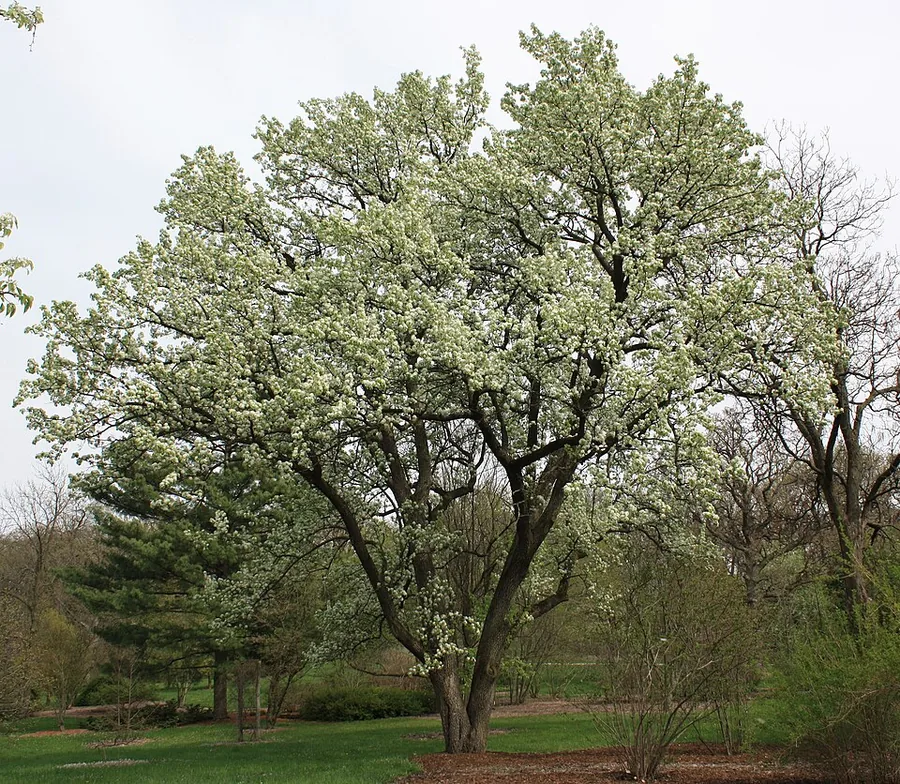
For a generation the Bradford pear was the easy answer to a bare front yard, a Callery pear whose neat shape and early-spring cloud of creamy white flowers framed driveways and parking lots across the country. It asked little of a site, taking poor soil, drought, and city air in stride, which is how it became the default street tree of so many neighborhoods. The catch arrives the moment the blossoms open, with a sour scent that few owners forget after the first warm spring afternoon.
The tidy look conceals two failings that shape how a tree ages in a landscape. Its branches meet at tight, weak angles that come apart in wind, snow, or ice, so a mature specimen often splits within 15 to 25 years and reshapes the yard around it. The deeper problem reaches past the property line, as the cultivars cross-pollinate and set fertile seed that birds scatter into the wider countryside, where it builds dense thorny thickets that push out native plants.
That wider cost has finally caught up with the tree's reputation. Several states have banned its sale, and the prevailing advice now sends gardeners toward a native flowering tree that earns its place. The care notes below help you steward a Bradford pear already rooted in your yard, but choosing a new one no longer fits a thoughtful planting.
Care
The short version: it wants full sun and almost any soil, very little water once it has settled into a yard, and next to no feeding, leaving structural pruning and the eventual splitting limbs as the real work of living with it.
Light
Set it in full sun for the cleanest shape and the fullest spring display, though it will hold its own in partial shade. More light reads directly in the canopy, which fills denser and more even where the sun reaches it.
Water
A young tree leans on steady water while it finds its footing in a new spot, but a settled Bradford pear is drought-tolerant and content on dry to medium moisture. Water it through a true dry spell and otherwise leave it be, letting the top half of the root zone dry between drinks.
Soil
Few trees ask so little of the ground they stand in. It takes clay, loam, or sand across a wide pH of 5.5 to 8.0, favors good drainage but shrugs off heavy clay, the occasional wet patch, drought, and city pollution.
Temperature
Hardy from about -20°F to 100°F (-29°C to 38°C), it carries a yard through zone 5 winters and southern summers without complaint. That range is part of why it once turned up in landscapes everywhere.
Humidity
Ordinary outdoor humidity is all it needs, so there is no level to manage around a planting. Airflow earns more attention than moisture in the air, since damp, crowded foliage is what invites leaf spot and fire blight.
Feeding
A settled tree in average soil rarely calls for feeding at all. Should growth lag, a balanced slow-release tree fertilizer in early spring is plenty, while extra nitrogen only pushes the soft growth that fire blight favors.
Pruning
Prune in winter while the tree rests, lifting out crossing, weak, and narrow-angled branches to build a sounder frame. Careful pruning improves the odds yet cannot undo the splitting weakness built into the cultivar, so place the tree well clear of strong winds.
Repotting
none
Size & spacing
Plan for a substantial tree, climbing 30 to 50 feet (9 to 15 m) tall and spreading 20 to 35 feet (6 to 11 m) wide. Give it open room set well back from buildings, wires, and walkways, since aging limbs come down without warning.
When to plant
Through zones 5 through 9 the Bradford pear keeps a steady seasonal calendar that is easy to plan a yard around. Set out balled-and-burlapped or container trees in early spring or fall, expect the scented white bloom to open in April, and watch the small brown pomes ripen in fall, the moment the birds begin carrying the seed.
Northern hemisphere
Southern hemisphere
Typical months for a temperate climate: start earlier in warm zones, later where spring frosts linger.
- Plant: Plant balled-and-burlapped or container trees in early spring or fall.
- Harvest: Creamy white flowers in early spring (April), before or with the leaves; small round brownish pomes mature in fall.
Hardiness
USDA hardiness zones: 5–9
Temperature: down to -29°C
Troubleshooting
Living with this tree means watching for two kinds of trouble: the structural failure that can rewrite a yard overnight, and the diseases it shares with other pears that dull its seasonal show. Knowing the early signs of each gives you the lead time to act before a problem turns a centerpiece into a liability.
A storm undoes the tree's tidy silhouette
The graceful canopy that made this tree a landscaping favorite hides its weakness: narrow, bark-pinched branch crotches that surrender to wind, snow, or ice and can split a mature specimen apart, often within 15 to 25 years. A quiet survey of the crown for tight V-shaped forks and several same-sized upright stems tells you where it stands. When a tree is already compromised, an arborist can reduce or remove it before a storm decides the look of your yard for you.
Fix:
- Remove damaged or hazardous limbs promptly with proper cuts
- Have a certified arborist assess and reduce or remove the tree if structurally compromised
- Replace failing trees with a structurally sound, non-invasive species
Spring blossoms blacken and droop into hooks
The season's white display can turn against you when shoots scorch black and bow over like a shepherd's crook, the calling card of fire blight, a bacterial infection that thrives in warm, wet spring weather. The clues are oozing cankers along the branches and dieback edging toward the trunk. Reach for the pruners on a dry day, taking the infected wood out 8 to 12 inches below any damage, and wipe the blades between cuts so the problem stays put.
Fix:
- Prune out infected wood at least 8-12 inches below visible symptoms during dry weather
- Disinfect pruning tools between cuts
- Remove and destroy pruned material; do not compost
Spotted leaves spoil the summer canopy
When the season's foliage starts to freckle with reddish to purple spots that blur together, the culprit is Entomosporium leaf spot, a fungus that arrives with wet weather. A heavy bout strips the canopy early and dulls the look of a yard, though it rarely puts the tree itself at risk. A tidy routine sets things right: clear and destroy the fallen leaves, open the canopy so air moves freely, and keep water off the foliage.
Fix:
- Rake up and destroy fallen infected leaves
- Improve air circulation and avoid overhead wetting of foliage
- Apply a labeled fungicide in spring if the problem is recurring and severe
Toxicity
On the safety front the tree is easy company: the Bradford pear is not a poisonous tree. It does not appear on the ASPCA toxic-plant lists, and the small hard pomes will not poison a pet or grazing animal wandering the yard. The one honest caveat is gentle, that like apple and pear seeds the pips carry trace cyanogenic compounds, so it is worth clearing a heavy fruit fall rather than letting an animal gorge on it.
Safe for
People · Cats · Dogs · Horses · Rabbits · Livestock · Birds
Cats None
A household cat that wanders the garden and tastes a leaf or a fallen pome is in no danger, since the tree sits off the toxic lists. The seeds inside the fruit carry trace cyanogenic compounds, as most rose-family kin do, which makes sweeping up the dropped fruit a sensible part of keeping the yard tidy.
Dogs None
A dog sharing the same lawn faces no real poisoning risk from the foliage or the small hard pomes. Bolting a whole drift of windfall can leave one with a passing upset stomach, and because the seeds hold the same trace cyanogenic compounds as other pears, it is wise not to let a dog gorge on them.
Horses None
Horses turned out near the tree can browse the leaves and fruit in normal amounts without harm. As with any pear, the seeds hold a little cyanogenic material, so the only scene worth a glance is a horse breaking into a heavy fall of dropped fruit.
Rabbits None
The leaves and twigs are not toxic to rabbits and make agreeable occasional browse around the garden. The seeds are the part to keep out of reach, since the trace cyanogenic compounds inside are best avoided in a small animal.
Livestock None
Cattle, goats, and sheep can graze the foliage and windfall fruit safely where the tree stands at a field edge. The single caveat is the familiar one for rose-family trees, that the seeds carry trace cyanogenic compounds, so a heavy fruit drop is worth clearing before stock crowd in.
Birds None
Birds take the small pomes with ease, which is precisely how the tree spread itself across so many landscapes. There is nothing in the fruit to give them pause.
People Safe
The tree poses no toxic threat to the people who share the space with it. The hard little pomes are no kind of harvest and hold no eating appeal, and like apple and pear seeds the pips carry trace cyanogenic compounds, so there is no reason to chew them.
No special handling needed for toxicity. Wear gloves and eye protection when pruning, as escaped seedlings and rootstock sprouts can bear sharp thorns.
Varieties
A few named Callery pear selections have moved through the trade over the years, each chosen for a cleaner shape or richer fall color to suit a designed landscape. Whatever their styling promise, every one still crosses with the others, so they all feed the same invasive seedling problem.
'Bradford'
The original and best-known selection cuts a dense pyramidal-to-oval silhouette that once defined suburban streets, yet its famously narrow crotches split in storms, and though it cannot pollinate itself it still feeds the invasive seedling problem by crossing with its neighbors.
'Cleveland Select' / 'Chanticleer'
A trimmer, more upright column of roughly 35 feet tall and 16 feet wide, it brings somewhat sturdier branching and better fire-blight resistance to a planting, but it stays a Callery pear that crosses with others to spread.
'Aristocrat'
Its more open, stronger branching gives a looser, airier shape than 'Bradford', though it succumbs to fire blight more readily and still adds to the invasive seedling spread.
'Autumn Blaze'
Prized for its dependable red-purple autumn show and good cold hardiness, it crosses with the other cultivars to scatter fertile, bird-carried seedlings exactly as the rest do.
How to propagate
This tree multiplies by two routes, and neither has any place in a home garden. Nurseries graft the named cultivars for the trade, while the species sows itself through bird-spread seed, the very path that carried it from tidy yards into wild ground.
GraftingDemanding
Late winter to spring (bench grafting) or summer (budding) · 1-2 growing seasons to establish the graft union
Named selections like 'Bradford' will not come true from seed, so nurseries graft or bud them onto Pyrus calleryana rootstock, usually a bench graft in late winter to spring or budding in summer. The graft union settles in over one to two growing seasons. It is exacting work, and with everything weighing against the tree, there is little reason to take it on at home.
SeedEasy
Fall, after fruit ripens · 1-2 growing seasons to a seedling
The species sows itself with no effort on anyone's part, as birds drop seed from the fall fruit and a seedling settles in over one to two growing seasons. The trouble is that cross-pollination among the cultivars makes those seedlings invasive, so raising them on purpose is discouraged and increasingly against the law.
Myths
Bradford pear is sterile and cannot spread, so it is safe to plant.
It is true that 'Bradford' cannot fertilize its own flowers, yet it crosses freely with other Callery pear cultivars and with rootstock sprouts, setting viable seed that birds carry far beyond the garden into dense thorny thickets. Several US states have now banned its sale outright.