Tree · Rosaceae
Kwanzan Cherry
Prunus serrulata
The tree that gives a garden one unforgettable week of double pink bloom each spring, and quiet, easy company the rest of the year.
Full sun
Every 5–10 days
USDA 5–9
25–36 ft · 7.6–11 m
Overview
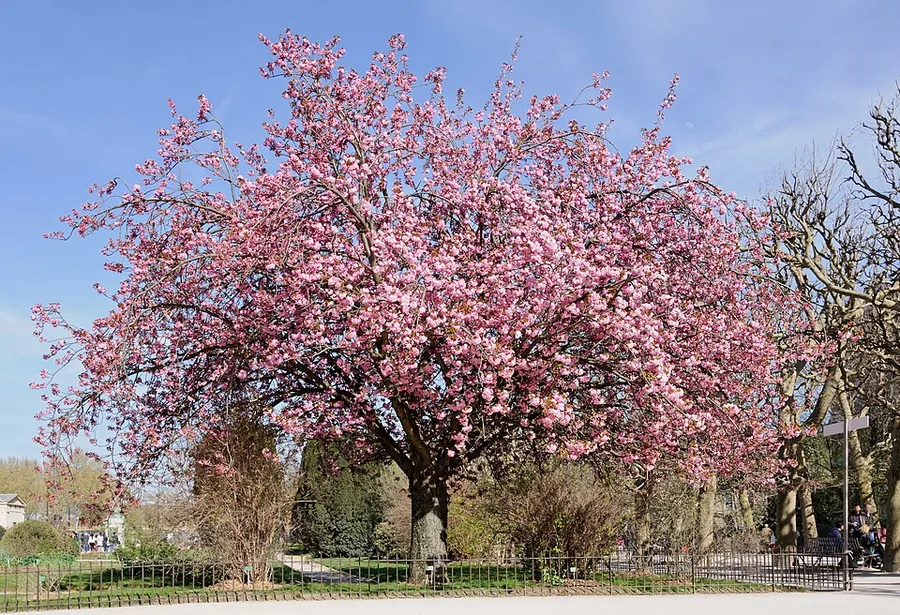
Kwanzan is the grand gesture of the spring garden, the flowering cherry that dresses a whole street or front lawn in pink for a single week in mid-spring. Each blossom is a double pompom of 20 to 30 deep-pink petals, and the branches carry them in dense clusters that arrive just before or as the leaves unfold. A member of the rose family, it was bred for that one glorious moment, and a home built around it feels like an occasion when the season turns.
Give it a place with room and it earns its keep all year. It settles at a moderate pace into a vase-shaped form 25 to 36 feet (8 to 11 m) tall that anchors a lawn or lines a drive, then closes the year in warm orange-bronze color. Because it is sterile and essentially fruitless, there is no litter to sweep from a patio and no harvest to plan around, only the bloom and the leafy canopy that follows.
One thing to weigh before it takes a place in the design: Kwanzan is a short-lived guest. Most trees begin to fade within 15 to 25 years, worn by borers, cankers, and softer wood that storms can break. Plant it as the centerpiece of a chapter in the garden rather than an heirloom, and let its brief, brilliant season be exactly the point.
Care
The short version: give it full sun, moist but well-drained loam, and steady water while it settles in. Prune lightly and only just after bloom, keep the trunk unmarked, and welcome it as a beautiful, short-term feature rather than a lasting shade tree.
Light
Set Kwanzan in full sun for the fullest bloom and the richest fall color, the qualities that make it a focal point in the first place. It will accept a little partial shade, but flowering thins and damp, shaded foliage invites the leaf diseases this tree is already prone to.
Water
Keep the soil moist but well-drained, watering every 5 to 10 days while the tree is young and finding its footing. An established Kwanzan handles moderate drought, though it always looks its best with steady moisture rather than a dry spell.
Soil
Give it fertile, well-drained loam, whether sandy, clay, or silt. A pH of 6.0 to 7.0 suits it, but drainage is the real deciding factor, since the tree fails on wet or coastal ground.
Temperature
Kwanzan is at home across a wide range, from about -20°F (-29°C) up to 95°F (35°C), which spans zones 5 through 9. It needs a real winter chill to bloom well and takes summer heat in stride as long as the roots stay moist.
Humidity
Ordinary outdoor humidity is all it asks, so there is no figure to manage. Air movement counts for far more here, because still, damp air around the canopy is what lets leaf spot and brown rot take hold.
Feeding
Feed lightly in early spring before bloom with a balanced slow-release tree fertilizer. Go easy on the nitrogen, since soft, lush growth draws borers and disease to a tree that is vulnerable enough already.
Pruning
Prune as little as you can, and only to remove dead, damaged, or crossing branches. Do it just after flowering, make clean cuts without stubs, and never prune in wet weather, since Prunus wounds are an open door to cankers and borers.
Repotting
As a landscape tree rather than a container plant, repotting does not apply once it is in the ground. If you are holding a nursery tree, watch for circling roots and water running straight through the pot, and plant it before it sits rootbound.
Size & spacing
Plan on a mature tree 25 to 36 feet (about 8 to 11 m) tall with a spread of 25 to 30 feet (about 8 to 9 m). Give it that full width of open ground so the vase-shaped crown can develop and air can move through the canopy.
When to plant
Kwanzan joins the garden while dormant rather than from seed. Set a balled-and-burlapped or container tree in the ground in early spring or fall, and it repays the gesture with its double pink bloom in mid-spring, before or just as the leaves break.
Northern hemisphere
Southern hemisphere
Typical months for a temperate climate: start earlier in warm zones, later where spring frosts linger.
- Plant: Plant balled-and-burlapped or container trees in early spring or fall while dormant.
- Harvest: Showy double deep-pink pompom-like flowers (about 20-30 petals each) in mid-spring, typically before or as leaves emerge; essentially fruitless.
Hardiness
USDA hardiness zones: 5–9
Temperature: down to -29°C
Troubleshooting
With Kwanzan, the first signs of trouble tend to show in the bark and branches long before the leaves, and that is part of the short life these trees lead. Learning to read the early hints of borers, disease, and black knot lets you keep the tree looking its best. Match what you see below, then act while the tree still has vigor to spare.
Sap weeping at the trunk while sawdust gathers and branches fade
Sawdust-like frass and gummy sap near the trunk usually mean borers are at work under the bark, often arriving in step with cankers that settle into stressed or wounded wood. The remedy is to cut away and burn the dead or heavily infested limbs. A tree kept in good health with steady water, generous mulch, and a trunk no mower ever nicks is your surest safeguard against them.
Fix:
- Remove and destroy heavily infested or dead wood
- Keep the tree vigorous with proper water and mulch to resist attack
- Avoid wounding the trunk with mowers or trimmers
Foliage reduced to lacework or silken canopies in the limbs
Metallic green Japanese beetles reduce the leaves to a lacy skeleton, while eastern tent caterpillars hang their silken nests in the branch forks come spring. A pail of soapy water takes care of the beetles, and the tents come out with a quick prune at dawn or dusk while the larvae are still inside. A well-settled tree brushes off a little feeding, so this rarely needs to interrupt the season.
Fix:
- Hand-pick beetles or knock them into soapy water
- Prune out and destroy tent caterpillar nests in early morning or evening
- Tolerate minor feeding on established trees
Foliage freckled with spots that open into small perforations
Round spots that drop their centers leave the tidy little shot-hole pattern of a fungal or bacterial leaf spot, which settles in wherever the air stays damp and crowded. Clearing and destroying the fallen leaves keeps the trouble from carrying into next year, and a light, thoughtful pruning opens the canopy back up. Keeping water off the foliage matters too, since wet leaves are what carry the spores along.
Fix:
- Rake and destroy fallen infected leaves
- Improve air circulation through proper spacing and pruning
- Avoid overhead watering that wets foliage
Dark knotted swellings tracing the line of the twigs
The rough, coal-black swellings wrapped around the twigs are black knot, a fungus that girdles the branches and, left alone, quietly spoils the tree's graceful line. The answer is to cut each knot several inches below the gall while the tree is dormant, then burn what comes off. A wipe of the pruners between cuts keeps the spores from traveling with you along the canopy.
Fix:
- Prune out knots several inches below the gall during dormancy
- Destroy pruned material
- Disinfect pruning tools between cuts
Toxicity
For all its beauty, this is a tree to place with care around animals. The leaves, twigs, bark, and any rare seeds hold cyanogenic glycosides that release cyanide when chewed or wilted, and a wind-thrown branch left in a paddock can kill grazing horses or livestock within minutes. Since the tree sets little or no fruit, there is nothing here for people to eat either. Keep pets and stock away from prunings and fallen limbs, and clear them promptly.
Toxic to
Cats · Dogs · Horses · Rabbits · Livestock · Birds · People
Cats Toxic
A cat that chews the leaves, twigs, or bark can absorb cyanide. Brick-red gums, wide pupils, panting, and labored breathing all call for an emergency vet visit, no waiting.
Dogs Toxic
A dog gnawing fallen twigs or wilted leaves meets the same cyanide danger. Drooling, dilated pupils, quick breathing, and weakness can arrive fast, so a trip to the vet should not wait.
Horses Toxic
Horses are especially vulnerable, and the wilted leaves are where the real danger lies. Cyanide can bring on anxiety, staggering, gasping, convulsions, and collapse within minutes, sometimes before anyone even notices a branch has come down in the paddock.
Rabbits Toxic
The same cyanogenic compounds put the foliage off-limits for rabbits. Keep them clear of any trimmings or fallen leaves rather than take the risk.
Livestock Toxic
Cattle, sheep, and goats face serious danger from wilted cherry leaves, which release cyanide and can kill within 15 to 20 minutes of grazing. Fence stock well away from the tree, and clear any storm-broken branches before the animals reach them.
Birds Toxic
Cyanide from the seeds, leaves, and bark endangers birds as well, so keep cage birds and poultry from pecking at any part of the tree.
People Caution
The tree sets little or no fruit, so there is nothing here to eat. The leaves, twigs, bark, and any rare seeds hold cyanide, so keep children from chewing them and never steep the foliage into a tea.
Keep pets and especially horses and livestock away from fallen, pruned, or wilted branches and leaves, which are the most dangerous. Dispose of prunings promptly.
Helpline numbers

United States
ASPCA Animal Poison Control: (888) 426-4435 (fee applies)
Poison Control: (800) 222-1222



Canada
Poison Centres: 1-844-764-7669
Varieties
Kwanzan is one of many flowering cherries, and the others offer their own shapes, scents, and longer lives to suit a different corner of the garden. These are the ones worth knowing by name.
'Yoshino' (Prunus × yedoensis)
The fragrant single pale-pink-to-white cherry behind much of the Washington DC display, it takes a more spreading shape and lives a touch longer than Kwanzan.
'Shirofugen'
Its double flowers open pink-tinged, settle to white, then blush pink once more, and it comes into bloom later than most flowering cherries.
'Amanogawa'
A slim, columnar tree carrying semi-double fragrant pale-pink flowers, it fits gracefully into narrow spots where a spreading cherry never could.
Weeping Higan cherry (Prunus subhirtella 'Pendula')
Its cascading branches carry early single pink flowers, and it outlasts Kwanzan by a comfortable margin.
'Mount Fuji' / 'Shirotae'
A broad, flat-topped tree whose fragrant white semi-double flowers ride along low, sweeping limbs.
How to propagate
Kwanzan is not a tree to raise from seed. Because the cultivar is sterile, every tree is a clone produced by skilled grafting, which places it well beyond casual backyard propagation.
GraftingDemanding
Late winter to early spring (bench grafting) or summer (budding) · 1-2 years to a saleable grafted tree
Because Kwanzan is sterile and double-flowered, it will not come true from seed, so growers graft or bud scion wood onto compatible cherry rootstock to hold the cultivar exactly. Bench grafting falls in late winter to early spring and budding in summer, and a saleable tree takes 1 to 2 years to grow on. This is skilled work that sits well outside casual propagation.
Stem cuttingsDemanding
Early summer from softwood · Several months to root, then 1-2 years to establish
Softwood cuttings taken in early summer under mist with a rooting hormone are worth a try, though they root unevenly and many simply fail. Even a cutting that takes needs several months to root and another 1 to 2 years to establish. Grafting remains the reliable route.
Myths
A flowering cherry doubles as a fruit tree for the garden.
Kwanzan is a double-flowered ornamental, chosen for its display and not for the table. It is essentially sterile and rarely sets any fruit, so the spring bloom is the whole point, never a harvest.
A cherry tree's danger to animals begins and ends with its pits.
The leaves, twigs, and bark hold the very same cyanogenic glycosides as the seeds. Wilted leaves are the classic cause of fast horse and livestock poisoning, which is why a branch brought down by a storm matters more than any pit.