Houseplant · Orchidaceae
Cattleya Orchid
Cattleya
Give it bright light, a good dry-out between waterings, and humid air, and the corsage orchid rewards you with show-stopping blooms.
Bright indirect
Every 5–10 days
55–86°F · 13–30°C
USDA 10–12
Overview
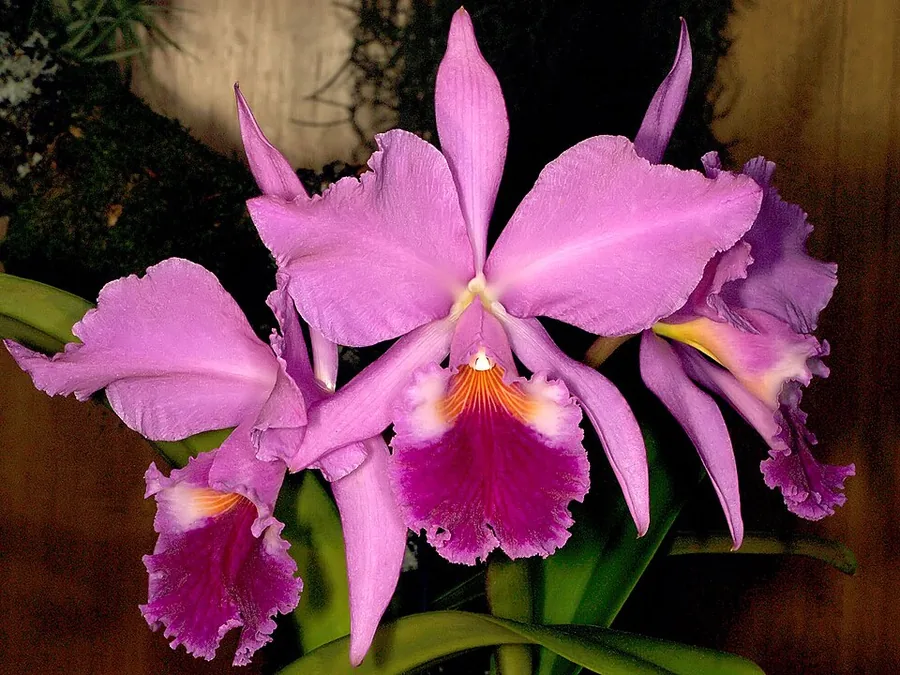
The Cattleya is the orchid that comes to mind whenever someone pictures a corsage, and it brings that same occasion-ready glamour into a room. Across the American tropics it lives as an epiphyte, gripping tree branches with thick roots instead of settling into soil. Each upright stem thickens into a pseudobulb that banks water and food, so the plant takes a forgotten watering in stride where a fussier houseplant would protest.
The flowers earned this orchid the title queen of orchids, large, frilled, and often perfumed in lavender, rose, and white, the sort of bloom that quietly anchors a console or a bedside table. Most arrive once a year, generally from fall through spring, after a fresh pseudobulb has matured. The display is brief beside the plant itself, which can live and flower for decades on the same simple routine.
Cattleyas ask for a handful of things, then prefer to be left in peace, which makes them well suited to a considered home. They want bright light, a coarse bark mix that drains in seconds, and air that never goes parched. Get the corner right and the plant is generous. Sit it in dense, soggy mix and it withdraws, then rots.
Care
The short version: bright indirect light, a coarse bark mix that drains fast, and a deep soak only once the mix has nearly dried. Keep the air humid, feed weakly through the growing season, and hold back from overwatering.
Light
Cattleyas want bright light to flower, more than most houseplants will take, which makes a sunny window their natural home. An east-facing pane or a lightly shaded south one is ideal. The leaves should read a stiff, light yellow-green, since dark, floppy foliage is the plant asking for a brighter spot.
Water
Soak the bark right through, then let it dry almost completely before the next watering, which tends to land every 5 to 10 days. The pseudobulbs carry a reserve, so when you're unsure, hold off. Far more Cattleyas are lost to staying wet than to running dry.
Soil
Leave potting soil out of it altogether and reach for a coarse, bark-based orchid mix that drains in seconds. A slightly acidic pH 5.5 to 6.5 suits these epiphytes, whose roots cling to bark in the wild and need air moving freely around them.
Temperature
These orchids settle comfortably across a wide band, from 55°F to 86°F (13°C to 30°C). What counts more for flowering is a drop of 5°C to 10°C (9°F to 18°F) between day and night, the seasonal cue that tells the plant to set buds.
Humidity
Aim for 50% to 70% humidity, well above the average dry room. A humidity tray or a small humidifier set nearby holds the air where it should be. Add a little gentle air movement so the leaves never linger damp and still.
Feeding
Through the growing season, spring into early fall, offer a balanced water-soluble fertilizer at quarter to half strength once a week. The grower's shorthand is feed weakly, weekly. Taper off as growth slows toward winter.
Pruning
There's very little to trim. Take off spent flower spikes and any dead or shriveled pseudobulbs and roots with a sterile blade. Never cut a healthy green pseudobulb, as each is a living store of water and energy the plant leans on to bloom.
Repotting
Repot every 2 to 3 years, or sooner once the bark crumbles into a dense mush that traps water. The best moment comes just as new roots begin to push. Step up only a single pot size, since these orchids flower better with their roots a touch snug.
Size & spacing
A mature Cattleya reaches 12 to 24 inches (30 to 60 cm) tall and spreads 12 to 18 inches (30 to 45 cm) wide. Grown as a single potted houseplant it needs no garden spacing, only enough breathing room around it for air to move and the blooms to open.
Troubleshooting
Most Cattleya trouble begins at the roots or surfaces when buds refuse to open. Learn to read the pseudobulbs and roots and a problem rarely catches you off guard. Find what matches below, then step in before a setback hardens into something serious.
Roots gone brown, soft, and mushy
What you are seeing is root rot, the cost of a heavy hand with the watering can or a bark mix that has collapsed and stays sodden. Sound roots feel firm and read white to green, while rotted ones cave in at the lightest pinch. Lift the plant out, cut every dead root away with a sterile blade, and settle it into fresh coarse bark that drains fast.
Fix:
- Unpot, trim all rotted roots with a sterile blade, and repot in fresh coarse bark
- Reduce watering frequency and ensure the pot drains freely
Buds yellow and fall before they open
Known as bud blast, this disappointment usually follows a change in the room rather than any illness. A draft slipping past a window, air that has gone dry, or a shift in the plant's place once buds appear can each set it off. Choose one steady, humid corner away from vents and let the orchid stay put while the buds mature.
Fix:
- Move the plant to a location with stable temperatures away from drafts and heat vents
- Raise humidity with a humidity tray or room humidifier
- Avoid relocating the plant once buds form
Pseudobulbs going wrinkled and soft
When pseudobulbs lose their plumpness, the plant is struggling to draw up water, either because its corner has run too dry or because the roots have given out. Start by pinching a few roots. Firm white ones say to water on a tighter schedule, while brown mushy ones point to root rot and a move into fresh bark.
Fix:
- If roots are healthy, increase watering frequency and soak the mix thoroughly
- If roots are rotted, repot into fresh bark and trim away dead roots
A healthy plant that just won't bloom
If the foliage thrives but no flowers ever arrive, too little light is almost always behind it. Dark green, floppy leaves carry the same message, since a Cattleya in a bright spot holds stiff, light yellow-green foliage. Shift it to a sunnier window and let it feel a 5°C to 10°C (9°F to 18°F) swing between day and night, the seasonal nudge that calls flowers up.
Fix:
- Move to a brighter spot with strong indirect or filtered direct light
- Provide a 5-10°C drop between day and night temperatures to trigger flowering
Toxicity
Reassuring news for a household with pets: the Cattleya is non-toxic to cats, dogs, and everyone else under the roof. A stray nibble poisons no one. The blooms are the only thing genuinely at risk, so place the plant where a swishing tail or a curious beak can't undo the display.
Safe for
People · Cats · Dogs · Horses · Rabbits · Livestock · Birds
Cats None
Safe around cats. A curious one that tastes a leaf or petal won't be poisoned, though a bloom can be left worse for the encounter.
Dogs None
Nothing here troubles a dog. The most a chewed leaf brings is a brief upset stomach from the strange fiber.
Horses Safe
No part of the plant poisons a horse, so a stray mouthful is nothing to worry over.
Rabbits Safe
Rabbits meet no toxin here. Even so, the tough bark mix and fibrous leaves make poor food, so set the pot up out of reach.
Livestock Safe
Cattle, goats, and sheep can stand near a Cattleya with no risk of poisoning.
Birds Safe
The plant carries nothing known to harm pet birds, so a parrot pecking from its perch comes to no harm.
People Safe
Handling it does no harm, and the flowers sometimes dress a plate as edible decoration, though this is a plant to admire rather than to eat.
No special handling precautions are required, though the bark mix and plant material are not intended for eating.
Varieties
Cattleya spans dozens of species and no end of hybrids, yet a few species surface time and again, both as themselves and as the parents behind today's crosses. These are the names worth carrying with you.
Cattleya labiata
The original corsage orchid, opening large ruffled rose-lavender flowers over a deeply colored frilled lip.
Cattleya walkeriana
A small, intensely fragrant species valued for its compact habit and leaned on often in breeding.
Cattleya mossiae
Venezuela's national flower, celebrated for its big spring lavender blooms set off by a richly patterned lip.
How to propagate
Cattleyas are increased by division at home rather than from seed, parting one mature clump into new plants that hold true to every trait of the original.
DivisionModerate
Just as new root growth begins, typically after flowering in spring · Several months to a year for divisions to establish and bloom
Split a crowded plant in spring, right as fresh roots begin to push after flowering. Make each cut so that every piece keeps at least three or four healthy pseudobulbs and a new lead, work with a sterile blade, and set the divisions into fresh bark. Be patient with them, because a division can take several months to a full year to settle in and flower again.
Myths
Orchids should be watered with ice cubes.
As tropical epiphytes, Cattleyas have roots that recoil from the cold. Water them thoroughly with room-temperature water and let the bark dry before the next round, the way a warm rain soaks through and then drains away in the wild.
Cutting back the roots and pseudobulbs forces better blooming.
Those green pseudobulbs and roots hold the plant's reserve of water and energy, and stripping them does nothing but set it back. Trim away dead or rotted tissue and nothing more, leaving every sound bulb to power the next flush of flowers.