Houseplant · Orchidaceae
Cymbidium Orchid
Cymbidium
Give it bright light and cool fall nights, and the cymbidium answers with long, arching sprays of bloom.
Bright indirect
Every 5–7 days
50–86°F · 10–30°C
USDA 10–12
Overview
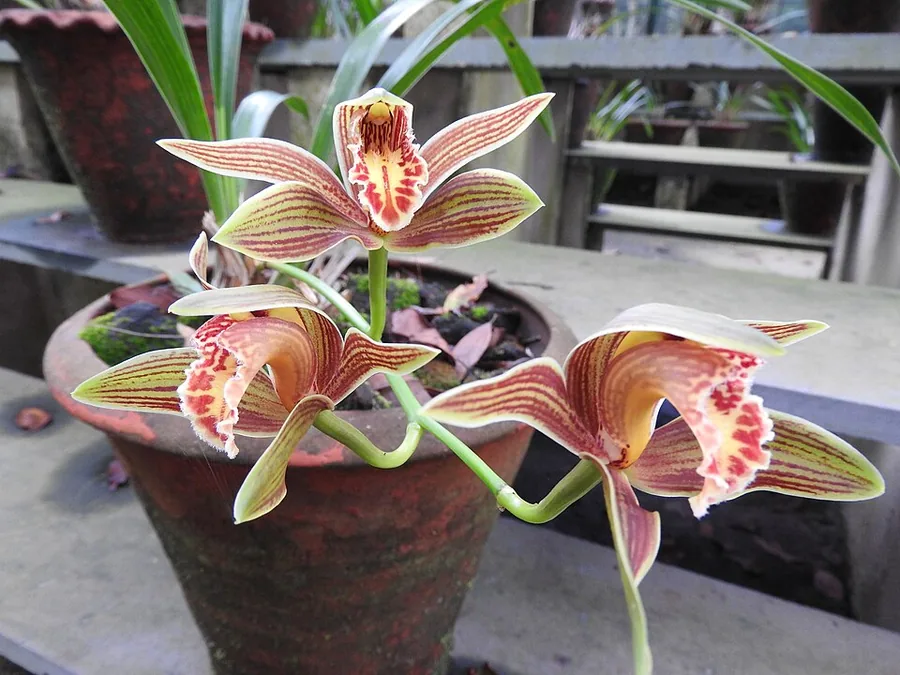
The cymbidium, known in older catalogs as the boat orchid, brings a quiet grandeur to a room without asking for the fuss most orchids demand. It rises from plump storage stems called pseudobulbs, sending out long arching spikes that hold their flowers for weeks through late winter and spring, just when a home most needs a lift of color. Grown in a loose bark mix rather than mounted on a slab, it settles comfortably into a styled corner the way a fine cut arrangement never can.
Its character is shaped by a love of the cool season. The plant needs a stretch of cool fall nights to set its spikes, which is why one kept warm and content all year tends to read as handsome but reticent, all leaf and no flower. Let it follow the calendar, bright light through the year and a true autumn chill, and it rewards the patience with a display that anchors a room.
Easy company once you know its temperament, the cymbidium likes its bark moist but never waterlogged and prefers to sit a touch snug in its pot. Give it a considered spot and it keeps that spot for years, broadening into a fuller presence and flowering more generously each season.
Care
The short version: bright indirect light all year, a bark mix kept moist but never soggy, and a stretch of cool fall nights to draw out the display. Feed weekly through the growing season at a gentle dilution, and repot no more than every couple of years.
Light
A cymbidium looks its best in bright indirect light, with strong full light through winter and bright filtered light in summer to keep the foliage from scorching. A spot too dim is the second most common reason the flowers fail to appear, so place it near a generous window.
Water
Water it well with tepid water every 5 to 7 days, keeping the bark moist but never soggy, and let the excess drain away cleanly. The aim is damp rather than wet, since water lingering at the roots is the surest path to trouble.
Soil
Set it in a bark-based orchid mix that drains freely instead of ordinary potting soil, which only smothers the roots. A slightly acidic pH of 5.5 to 6.5 suits it, and the open bark keeps air circulating where it counts.
Temperature
The cymbidium is comfortable across a generous range, roughly 50°F to 86°F (10°C to 30°C). What truly matters is the seasonal swing, because a run of cool fall nights is the cue that tells the plant to set its spikes.
Humidity
Aim for 50% to 70% humidity, a touch higher than most rooms hold through winter. A pebble tray or a nearby humidifier lifts it gracefully, and a little steady airflow keeps the damp foliage clear of pests and rot.
Feeding
Feed weekly from spring through fall with a balanced fertilizer cut to quarter or half strength, applied just after watering so it never reaches dry roots. As winter settles in and growth slows, ease back on the feeding.
Pruning
There is no shaping to do. Once the blooms have faded, cut the spent spikes back to the base and lift away any yellowed or dead leaves to keep the plant looking poised and well kept.
Repotting
Repot only every 2 to 3 years, in spring after flowering, since a cymbidium flowers more freely when slightly crowded. Move it up only when the leading pseudobulb meets the pot edge, the roots crowd or escape, or the old bark has broken down and stays wet.
Size & spacing
A mature clump reaches 1 to 4 feet (30 to 120 cm) tall and spreads 9 to 35 inches (23 to 90 cm) wide, the arching spikes carrying much of that height. Reserve it a place with room to arch outward, where its lines can be appreciated rather than crowded.
Troubleshooting
Nearly every cymbidium complaint traces to one of three roots: too little light or warmth at the wrong moment in the year, the usual houseplant pests, or a pot left too wet. Match what you see below and step in early, while a passing setback is still an easy correction.
A soggy crown and roots in decline
Behind a tired, sagging plant often sits root rot, the consequence of a medium kept too wet once old bark has collapsed and lost its drainage. Lift the plant from its pot and read the roots, since the firm pale ones are sound and the brown mushy ones are spent. Trim the dead away, settle it into fresh bark, and water on a lighter hand going forward.
Fix:
- Remove rotted roots and repot into fresh well-draining bark medium
- Reduce watering frequency and ensure free drainage
A handsome plant that never quite performs
A cymbidium that fills out with foliage but never flowers is nearly always going without its cool fall nights, the day-to-night temperature drop that sets the whole display in motion. Thin winter light keeps the show on hold as well. Move it into strong seasonal light and let it feel a run of cool autumn evenings, and the spikes arrive on cue.
Fix:
- Expose to cool fall nights with a marked day-night temperature drop
- Increase light to full winter light and bright filtered summer light
Speckled, yellowing leaves losing their luster
When the foliage dulls with fine speckling and a trace of webbing, spider mites are usually behind it, while soft clustered insects and a sticky film are the work of aphids. Both prefer the hidden undersides of leaves and the freshest growth. A rinse, a careful wipe, and a follow-up with insecticidal soap or horticultural oil restore the leaves to their polished best.
Fix:
- Rinse foliage and wipe off pests
- Treat with insecticidal soap or horticultural oil, repeating as needed
Toxicity
Reassuring news for a home with pets or children: the cymbidium is non-toxic. The ASPCA lists orchids as safe for cats, dogs, and horses, and the same comfort extends to the other animals under the roof. A curious pet that nibbles a leaf might feel a brief stomach upset from the roughage, but nothing poisonous is at play.
Safe for
People · Cats · Dogs · Horses · Rabbits · Livestock · Birds
Cats None
A welcome plant in a cat household. Should one sample a leaf, the most it brings on is a brief upset stomach from the roughage, nothing beyond that.
Dogs None
Equally at ease in a home with dogs. The most a curious chewer risks is a passing bout of mild tummy trouble.
Horses Safe
No concern for horses. Cymbidium foliage holds no toxin that could trouble them.
Rabbits Safe
Rabbits share the space without harm, though it is no part of their diet and should never stand in for their proper greens.
Livestock Safe
Cattle, goats, and sheep run no risk of poisoning from this orchid.
Birds Safe
Pet birds may settle near it in comfort, since the plant carries no toxic compounds.
People Safe
Gentle around people and children alike. It was simply never meant for the table.
Although non-toxic, eating large amounts of any plant material may cause mild, temporary stomach upset.
Varieties
Cymbidiums run to hundreds of species and hybrids, from cool-growing wild forms to award-winning crosses bred for color and form. A few stand out as especially worth knowing.
Cymbidium erythraeum
A cool-growing species whose steady garden showing has won it the RHS Award of Garden Merit.
Cymbidium lowianum
A large species that sends up long arching sprays of green flowers, each lip touched with red, and it carries an Award of Garden Merit of its own.
Cymbidium Sarah Jean gx 'Ice Cascade'
A white-flowered hybrid with a cascading habit that earns its keep spilling over the edge of a raised pot or a styled shelf.
Cymbidium Tiger Tail gx
An Award of Garden Merit hybrid prized for patterned blooms that return dependably.
How to propagate
At home, cymbidiums are increased by division rather than seed, parting one established clump into several new plants.
DivisionModerate
Spring, after flowering and at repotting · 1-2 years to re-establish and flower again
A crowded clump can be divided in spring, just after flowering as you repot. Leave each new piece with at least three healthy pseudobulbs and a leading growth, the reserve it needs to recover with confidence. Patience pays here, since a fresh division usually takes one to two years to settle in and bloom again.
Myths
All orchids are poisonous to cats and dogs.
The ASPCA lists orchids as non-toxic to cats, dogs, and horses, and cymbidiums belong on that safe list. A pet that chews a leaf faces nothing worse than a mild, short-lived stomach upset.
Orchids are parasites that live off other plants.
Far from it. Cymbidiums are terrestrial and semi-terrestrial orchids that root in their own bark medium and make their own food through their leaves. They take nothing from a host and never have.