Shrub · Ranunculaceae
Clematis
Clematis
Set it with sun on its head and shade on its feet, and clematis dresses a wall in bloom.
Full sun
Every 5–7 days
USDA 4–9
8–12 ft · 2.4–3.7 m
Overview
Few plants carry a title as gracefully as the queen of the climbers. A member of the buttercup family, Ranunculaceae, clematis spans everything from untamed wild species to the large-flowered hybrids that turn a trellis or arbor into a curtain of saucer-sized blooms. Across USDA zones 4 to 9 it comes back as a hardy perennial vine, a fixture you can plan a garden corner around.
Its flowering follows a generous arc that shifts with the type. A great many open in late spring to early summer, then return for an encore from late summer into early fall, keeping a sunny wall in color for much of the year. The vine climbs by curling its leaf stalks around anything slim, so it asks for wires, netting, or a delicate frame to take hold of rather than a heavy post.
Clematis answers to patience far more than fussing. Set it deep, hold its roots cool and moist while the top takes the sun, and prune to suit its bloom group. Manage those few things and a young vine quietly settles into a partnership that gives you decades of bloom.
Care
The short version: full sun on the top with cool, shaded, evenly moist roots below, rich well-drained soil, and pruning matched to the plant's bloom group.
Light
Clematis blooms at its fullest in full sun, ideally 6 or more hours a day, though it accepts partial sun or light shade. The old saying earns its keep: head in the sun, feet in the shade, since hot, exposed roots thin out the flowering.
Water
Offer clematis at least 1 inch (2.5 cm) of water a week, more when the weather dries, and never let the root zone go parched. Lay mulch on thick to lock in that moisture and keep the roots cool while the top stays in sun. A steady drink every 5 to 7 days keeps it pressing ahead.
Soil
Set it in rich, fertile, well-drained loam, though clematis makes do with clay or sandy ground once it has been amended. It works across a wide pH span from 6.0 to 8.0, so most garden soils oblige once compost is dug in.
Temperature
Clematis is hardy stock, weathering winters as low as -29°F (-34°C) and summers as high as 95°F (35°C). That tolerance for cold is what lets it live on as a perennial across zones 4 to 9.
Humidity
Everyday outdoor humidity suits it, so there is no figure to fret over. Moving air counts for far more, since still, congested growth opens the door to powdery mildew and stem rot.
Feeding
Work in a balanced fertilizer in spring as growth gets going, then through the season. Pause while the plant is flowering, and keep nitrogen modest, since it pushes the soft growth that wilt finds so easy to take.
Pruning
Prune to the bloom group, since the wrong cut at the wrong moment costs you flowers. Group 1 old-wood bloomers want only a light trim once flowering ends, Group 2 large-flowered hybrids take a light prune down to the topmost plump buds in late winter, and Group 3 new-wood types are taken back hard to 2 to 3 feet in late winter.
Repotting
Clematis seldom calls for repotting and dislikes any disturbance to its roots. Move it only when roots circle or break from the pot, growth slows, or the soil drains away far too quickly.
Size & spacing
A grown vine reaches 8 to 12 feet (2.4 to 3.7 m) tall and fans out 2 to 6 feet (61 to 183 cm) wide. Grant it that space and a support to wind through so air can pass around the leaves.
When to plant
Spring or early fall is the moment to set clematis out, while the soil works easily and the weather stays gentle. Tuck it in deep, with the crown an inch or two beneath the surface, and the roots establish themselves before heat or cold arrives. Look for the first flowers in late spring to early summer, often followed by a second flush later on.
Northern hemisphere
Southern hemisphere
Typical months for a temperate climate: start earlier in warm zones, later where spring frosts linger.
- Plant: spring or early fall
- Harvest: late spring to early summer, often reblooming in late summer to early fall
Hardiness
USDA hardiness zones: 4–9
Temperature: down to -34°C
Troubleshooting
Nearly every clematis worry shows up along the stems and leaves, whether it is a shoot that buckles overnight or a powdery film across the foliage. Spot it early and the problem can be cut away before it travels. Match what you are seeing below, then step in while there is still time to help.
An entire shoot falls dark and slack as the buds open
When a single stem goes limp and blackens at the very moment its buds should be unfurling, while the rest of the vine looks untroubled, the cause is clematis wilt, a fungal stem rot. Search the lower stem near the soil line for dark lesions. Take every spoiled stem back to clean tissue or below ground, wipe your pruners between cuts, and carry on watering. A vine whose crown sits a couple inches deep usually sends fresh growth up from below the next season.
Fix:
- Cut out and destroy all affected stems back to healthy tissue or below soil level
- Disinfect pruners between cuts
- Keep the plant watered; plants set with the crown a couple inches deep usually resprout from below ground the following season
Torn young shoots marked by silvery trails
Chewed-up young shoots and torn holes on a newly set vine point most often to slugs and snails, given away by the silvery trails left in their wake. With no trails to follow, look after dark for earwigs tucked into the blooms and crevices. Ring young plants with iron phosphate bait, sweep away debris and hiding spots, and set rolled cardboard to catch earwigs until the shoots toughen up.
Fix:
- Apply iron phosphate slug bait around young plants
- Remove hiding places and garden debris
- Trap earwigs with rolled cardboard or shallow traps
A pale film settles over crowded, stunted growth
A chalky white film over the foliage, set against dwarfed and warped growth, signals powdery mildew moving in where the air sits still and the planting is too tight. Brush a leaf to separate it from simple dust, since this film holds fast and the leaf itself is malformed. Pull the spoiled foliage, open up the vine so air can travel through, and keep the watering can off the leaves. A labeled fungicide applied early helps should it travel.
Fix:
- Remove affected leaves
- Improve airflow by thinning and proper spacing
- Avoid overhead watering
- Apply a labeled fungicide early in infection if needed
Tacky shoot tips swarmed with tiny soft insects
Soft green or dark insects gathered at the shoot tips, a sticky honeydew sheen, and the odd patch of sooty mold or a line of ants all point to aphids working over the freshest growth. Turn over the young leaves to be sure. A light run rinses away under plain water; for more, treat with insecticidal soap every 5 to 7 days across about 3 rounds. Hold a systemic insecticide back for the heavy, stubborn cases.
Fix:
- Spray with insecticidal soap, repeating every 5 to 7 days for about 3 applications
- Hose off light infestations with water
- Use a systemic insecticide only for heavy, persistent infestations
Toxicity
Clematis is neither a plant to eat nor one to leave within an animal's easy reach. Every part of it carries protoanemonin, an irritant released when the leaves or stems are chewed or crushed, and the ASPCA lists the vine as toxic to cats, dogs, and horses. A bitter taste keeps most animals from eating much, yet the sap can still sting skin and mouths, so it earns careful handling.
Toxic to
Cats · Dogs · Horses · Rabbits · Livestock · Birds · People
Cats Mild
A cat that bites the leaves or stems is left drooling, sick, and loose, with a raw, smarting mouth. That bitter, acrid taste tends to call a halt before enough goes down to cause real damage.
Dogs Mild
Gnawing on the foliage leaves a dog drooling, gagging, and queasy, with a tender, irritated mouth. The sharp flavor stops most before much is swallowed, so genuine poisoning rarely happens.
Horses Mild
A horse that grazes the vine can end up salivating freely, refusing its feed, and dealing with mouth blisters and colicky pain. Given better forage nearby, horses usually pass the bitter leaves by.
Rabbits Caution
The very protoanemonin that bothers cats and dogs will sting a rabbit's mouth and gut, so treat the vine as off-limits and keep it fenced clear of runs and hutches.
Livestock Caution
Cattle, goats, and sheep risk mouth and gut irritation should they browse clematis, though the acrid taste turns most away unless the pasture thins out. Keep the vine beyond the reach of grazing stock.
Birds Caution
Its irritant sap makes clematis a poor companion for pet birds and poultry, so keep inquisitive beaks from pecking at the foliage and stems.
People Caution
Nothing on this plant belongs in the mouth, and the sap can redden and blister skin or sting on contact. Pull on gloves before you prune and wash up afterward, and keep small children from chewing the leaves.
Sap can irritate skin; wear gloves when pruning and wash hands afterward.
Helpline numbers

United States
ASPCA Animal Poison Control: (888) 426-4435 (fee applies)
Poison Control: (800) 222-1222



Canada
Poison Centres: 1-844-764-7669
Varieties
Clematis runs into the hundreds of species and cultivars, yet a handful keep showing up in gardens. These are the names worth carrying, along with the bloom group each one belongs to.
Jackmanii
The classic among hybrids, set with large deep velvety-purple flowers, it falls into Group 3 and flowers on new wood, so it earns a hard cutback every late winter.
Nelly Moser
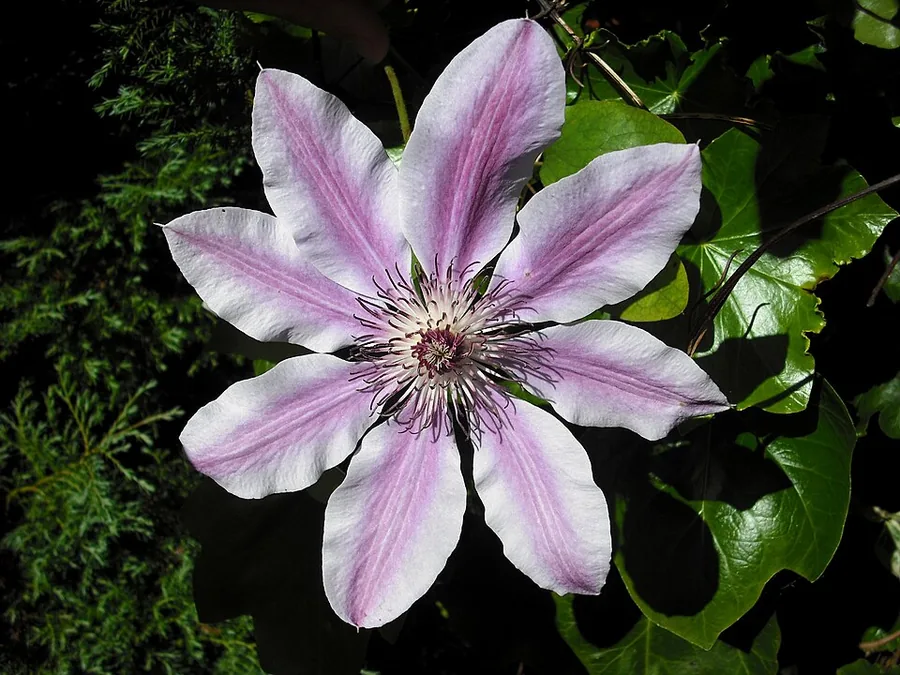
This Group 2 large-flowered hybrid wears pale pink petals striped with a deeper carmine bar, and because bright sun washes those tones out, a spot with some shade suits it best.
Henryi
A strong-growing Group 2 large-flowered hybrid, it unfurls big creamy-white flowers framed by dark anthers.
Sweet autumn clematis (Clematis terniflora)
Late in the season it buries itself under small fragrant white flowers, yet it self-seeds with such force and has turned so invasive across parts of the eastern US that gardens are better off without it.
Clematis montana
An early, strong-growing species that covers itself in masses of small spring flowers, this Group 1 type asks only for a light trim, and only once it has finished blooming.
How to propagate
Clematis takes its time multiplying, but the work is not hard, and the simplest methods copy a plant you already love rather than beginning from seed.
LayeringEasy
Spring to summer · A few months to a year
Layering is the surest path to a few more clematis. Anywhere from spring through summer, pin a low, supple stem to the soil and let it root where it rests, then part the new plant from its parent once it has anchored over the next few months to a year.
Stem cuttingsModerate
Late spring to early summer · Several weeks to months
Between late spring and early summer, gather semi-ripe internodal cuttings from this season's growth. Roots form across several weeks to a few months, though the method demands more attention than layering.
DivisionModerate
Early spring · A season
In early spring, lift and divide an established crown, handling it with a gentle touch since clematis dislikes having its roots pulled about. Allow the divisions a full season to find their footing before they truly take off.
Myths
Clematis is harmless to pets because it is just a flowering garden vine.
Sitting within the buttercup family, it holds protoanemonin, an irritant the ASPCA lists as toxic to cats, dogs, and horses. A mouthful can bring drooling, vomiting, diarrhea, and a raw, sore mouth. The bitter taste usually limits how much an animal eats, but the vine is far from harmless.
All clematis should be pruned hard every late winter.
The right cut comes down entirely to the bloom group. Group 1 flowers on old wood and asks only for a light trim once it blooms, the Group 2 large-flowered hybrids take a light prune, and only the new-wood Group 3 is cut back hard. Cut an old-wood type to the ground and you remove that year's flowers.