Shrub · Rosaceae
Scarlet Firethorn
Pyracantha coccinea
A working shrub with a sense of drama, firethorn dresses a sunny wall in white spring bloom and a long run of orange-red winter berries.
Full sun
Every 7–14 days
USDA 6–9
6–18 ft · 1.8–5.5 m
Overview
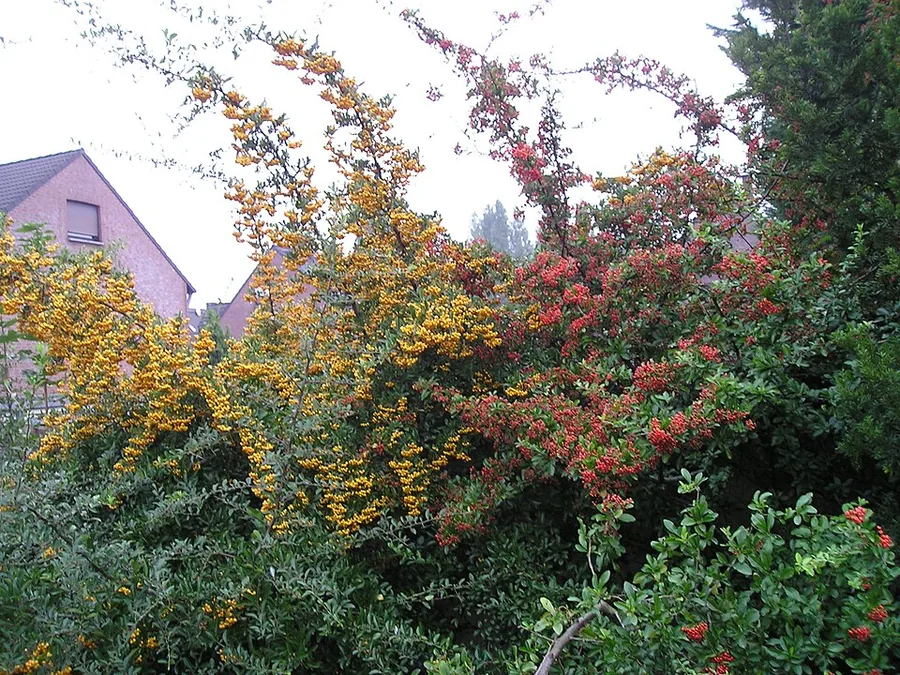
Firethorn brings two kinds of presence to a garden, the warm glow of orange-red berries through winter and the architectural edge of stiff, needle-sharp thorns along every branch. It is a fast-growing evergreen shrub in the rose family, unbothered by heat, drought, or cold once it has settled into a spot. That ease is why it reads so well as a hedge, a privacy screen, or an espalier trained flat against a sunlit wall.
Its appeal arrives in two acts across the year. A wash of small white flowers softens the plant in late spring, and by fall those blooms have become heavy clusters of berries that carry the look through the coldest months. Birds working the fruit turn the shrub into a quiet centerpiece for winter wildlife, and the color holds a garden together when the borders have gone bare.
There is a styling note to respect, though. The long spur thorns make a firethorn placed beside a walkway or an entry a hazard rather than a feature, so it belongs where it can be admired from a step back. Give it space, set it where the thorns define a boundary instead of catching a sleeve, and keep thick gloves on hand for the seasonal tidy.
Care
The short version: plant it in full sun, where the flowers and berries earn their keep, set it in free-draining soil, and water deeply only while it finds its place, after which it carries dry spells without you. Prune in late winter, and reach for gloves before you do.
Light
Give firethorn full sun and it delivers its best, the fullest bloom and the heaviest set of berries that make it worth a prime spot. It will hold in partial shade or partial sun, but the display thins as the light does, so save it for the bright corner of the garden.
Water
Water it deeply while it establishes and through any long dry heat, then step back and let the soil dry between drinks. Once it has rooted in, firethorn handles drought on its own and asks for little, needing water only every 7 to 14 days at most, which suits a low-maintenance planting.
Soil
It works in clay, loam, or sand as long as the drainage is sharp, since wet roots are the one thing that will undo it. A relaxed pH range from 6.0 to 8.0 keeps it content, and that span covers the soil in most gardens without any fuss.
Temperature
Firethorn carries a garden through the seasons, taking anything from about -9°F to 100°F (-23°C to 38°C) in stride. That reach is what makes it a dependable structural shrub across zones 6 through 9.
Humidity
Outdoor humidity asks nothing special of this shrub. What it does want is room to breathe, since crowded, still air invites fire blight and scab, so leave generous space when you place it in a bed.
Feeding
A balanced slow-release shrub fertilizer in early spring is plenty, and in good soil even that can be skipped. Keep the nitrogen restrained, because soft, lush growth is just what fire blight settles into.
Pruning
Shape it in late winter to early spring, and avoid heavy cuts in late summer or fall, since the flowers and berries form on last year's wood and you would be trimming away the show. It takes beautifully to a clipped hedge or a wall-trained espalier, though gloves belong in every session because of the thorns.
Repotting
Firethorn rarely needs repotting and looks its best left in place. In a container, watch for roots circling the pot or slipping out the drainage holes, water running straight through, or stalled new growth, and size it up when those signs appear.
Size & spacing
This is a substantial shrub, standing 6 to 18 feet (1.8 to 5.5 m) tall and spreading 8 to 18 feet (2.4 to 5.5 m) wide. Plan the bed around that footprint and give it real room, or keep it to scale with a regular trim.
When to plant
Firethorn settles into a garden in zones 6 through 9, and a planting in the mild stretch of spring or fall gives it the easiest start. The white flowers bring a soft note to late spring, and then the orange-red berries take the stage in fall and hold the look right through winter, just when a garden most needs the lift.
Northern hemisphere
Southern hemisphere
Typical months for a temperate climate: start earlier in warm zones, later where spring frosts linger.
- Plant: Spring or fall
- Harvest: White flowers late spring to early summer; showy orange-red berries fall through winter
Hardiness
USDA hardiness zones: 6–9
Temperature: down to -23°C
Troubleshooting
Firethorn keeps a clean profile in the garden, though the occasional fungal, bacterial, or insect issue does turn up on the new growth, the fruit, or the backs of the leaves. The point is to notice it early and respond, since something like fire blight moves quickly once it starts. Match the look below, then act while it still changes the outcome.
Shoots blacken, wilt, and hook at the tip
The culprit is fire blight, a bacterial infection firethorn takes on easily, and it can sweep down a branch before the season is out. Cut the infected wood away at least 12 inches below the damage on a dry day, and wipe the blades with alcohol between every cut so nothing travels to the next branch. Ease off nitrogen and overhead water, and lean toward a resistant cultivar such as Mohave or Teton when it is time to replant.
Fix:
- Prune out infected wood at least 12 inches below visible damage during dry weather
- Disinfect pruning tools between every cut with 70 percent alcohol or diluted bleach
- Remove and destroy prunings; do not compost
- Choose resistant cultivars such as Mohave, Apache, Teton, or Navaho when replanting
Sooty dark scabs marring the leaves and berries
This is Pyracantha scab, a fungus that prints velvety dark blotches across the foliage and turns the fruit a cracked olive-brown instead of the bright orange-red the planting is meant to deliver. Clear the fallen leaves and berries so the spores have no winter refuge, and thin any crowded growth to keep air moving through the canopy. Scab-resistant cultivars such as Mohave or Fiery Cascade keep the display clean from the outset.
Fix:
- Rake up and remove fallen leaves and fruit to reduce fungal inoculum
- Improve air circulation by thinning crowded growth
- Plant scab-resistant cultivars such as Mohave, Apache, or Fiery Cascade
Bleached, stippled leaves with dark flecks beneath
That washed-out, speckled foliage is the signature of the hawthorn lace bug, which feeds on the underside of the leaves and leaves dark varnish-like droppings behind. Turn a leaf and the bugs and their cast skins give it away. Treat the undersides with insecticidal soap or horticultural oil and repeat as needed, while a firm jet of water sees off a light infestation.
Fix:
- Spray leaf undersides with insecticidal soap or horticultural oil, repeating as needed
- Encourage natural predators
- Hose off light infestations with a strong water spray
Toxicity
Firethorn sits easy in a planted boundary, a low-toxicity shrub that stays off the ASPCA poison lists. Birds work the fruit through the season, and a stray berry or two does nothing worse than a mild stomach upset to a curious pet or child. The detail to design around is the needle-sharp thorns, which can give a painful prick, so place it with intention and keep it back from paths and the spots where children play.
Toxic to
People
Safe for
Cats · Dogs · Horses · Rabbits · Livestock · Birds
People Caution
The flesh of the berries is essentially harmless, with only trace cyanide-like compounds locked in the seeds, so a few cause no real trouble. The actual hazard is the thorns. Their long, needle-sharp spurs deliver painful puncture wounds, so wear thick gloves to prune and keep children clear of the branches.
Cats Mild
The berries are low risk, so a nibble usually passes without incident in a household with cats. A cat that takes a big mouthful might drool or have a brief bout of vomiting before settling. The thorns are the sharper concern, since a curious paw or face can get pricked.
Dogs Mild
Most dogs can swallow a few berries with no ill effect, which keeps a garden dog-friendly. A real pile may bring some loose stool or a single round of vomiting that clears on its own. Watch instead for puncture scratches from the thorns when a dog pushes through the shrub.
Horses Mild
Firethorn is not a known poisoning risk for horses, and the berries carry only trace cyanide-like compounds. A horse that strips a hedge of fruit might get a mild, passing stomach upset. The stiff thorns are more likely to scratch the muzzle than the berries are to do harm.
Rabbits Mild
A rabbit is not poisoned by the odd berry, though the fruit is no part of a healthy diet and large amounts can loosen the gut. Offer browse better suited to a rabbit and leave the firethorn to its corner. The thorns can injure a small animal pushing into the base of the shrub.
Livestock Mild
Cattle, goats, and sheep graze around firethorn without serious poisoning, and the berries rank low in toxicity. Heavy browsing of the fruit might bring a touch of digestive upset, nothing more. Keep in mind that the spur thorns can scratch grazing stock that lean into the hedge.
Birds None
Birds eat the orange-red berries freely all through fall and winter, and the fruit is one of the plant's main draws for wildlife. There is no concern here at all. The shrub even gives nesting birds a thorny, well-guarded shelter.
Wear thick gloves and eye protection when pruning or handling; the stiff, needle-like thorns inflict painful puncture wounds and localized swelling. Site away from walkways and play areas. Berries are low risk but discourage children and pets from eating large amounts.
Helpline numbers

United States
ASPCA Animal Poison Control: (888) 426-4435 (fee applies)
Poison Control: (800) 222-1222



Canada
Poison Centres: 1-844-764-7669
Varieties
The named firethorns offer a designer's palette, sorted by berry color, by scale, and by how cleanly they shrug off disease. These are the ones that turn up most often in a planting plan.
Mohave
A designer's standby for its strong resistance to both scab and fire blight, and it puts on a generous show of orange-red berries.
Apache
A compact, disease-resistant choice that brightens a planting with bold red berries.
Lowboy
A low, wide-spreading form that works as a groundcover or a polished cover for a bank.
Lalandei
A vigorous old cold-hardy cultivar with orange-red berries that suits a wall, where it espaliers gracefully.
Teton
An upright, narrow form with yellow-orange berries and good fire blight resistance, tailor-made for a tight corner.
How to propagate
Firethorn comes from a cutting or from seed, but only one route hands you a faithful match for the plant already shaping your garden.
Stem cuttingsModerate
Summer, taking semi-hardwood cuttings of current-season growth · Several weeks to root, then grow on for transplanting the following season
For a true match to a named cultivar, a cutting is the way to keep the look consistent across a planting. Take semi-hardwood cuttings of this year's growth in summer and dip them in rooting hormone to improve the odds. They root over several weeks, and from there you grow them on and set them out the following season.
SeedModerate
Fall to spring; seed is naturally bird-dispersed · Slow and variable; seedlings of named cultivars will not come true to type
Seed is an option for the patient gardener. The seed needs a cold spell to break dormancy, and germination comes slow and uneven from fall into spring. Birds carry it across the garden after a berry feast, but seedlings of a named cultivar will not match the parent, so cuttings keep a designed planting on theme.
Myths
Firethorn berries are highly poisonous and will seriously harm any child or pet that eats them.
Firethorn never appears on the ASPCA toxic-plant lists, and its berries rate low in toxicity. Birds feed on them all winter, the flesh is essentially harmless, and only trace cyanide-like compounds rest in the seeds. A few berries are safe, and a large helping at most brings a mild stomach upset. The real concern is the thorns, not the fruit.