Shrub · Rosaceae
Flowering Quince
Chaenomeles speciosa
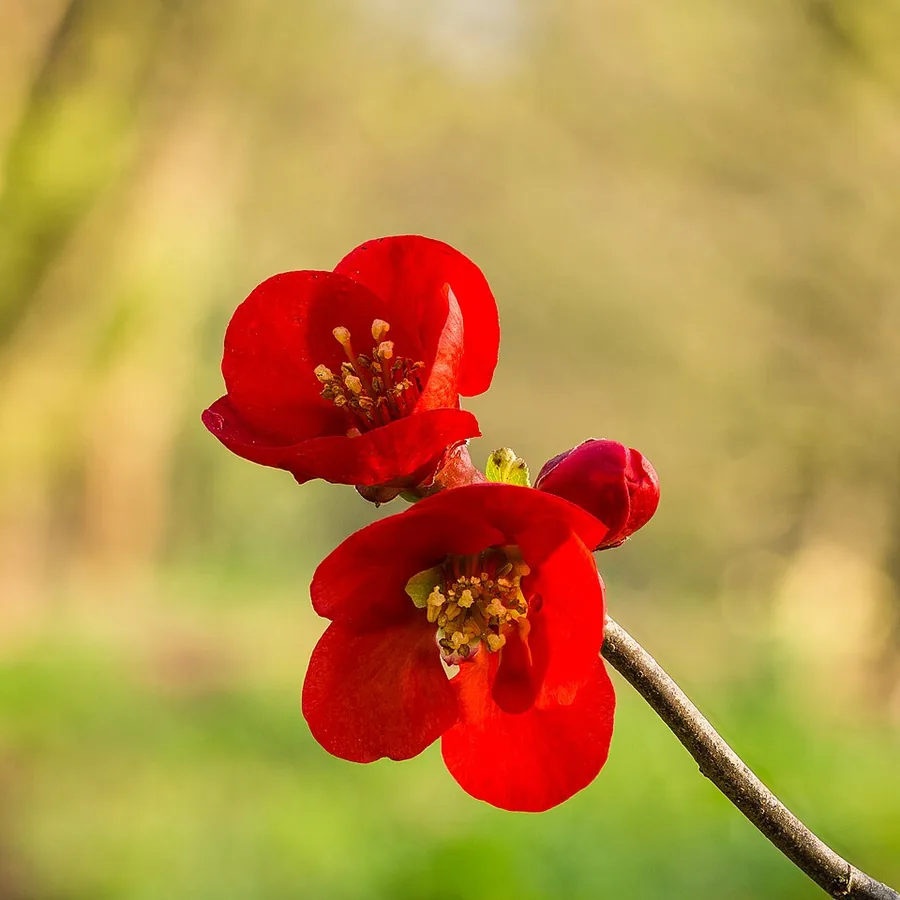
It is the shrub that announces the season, the first color of spring unfurling on bare branches before the leaves arrive.
Full sun
Every 7–14 days
USDA 4–8
6–12 ft · 1.8–3.7 m
Overview
Flowering quince has a gift for timing. It opens in early spring, before the leaves, so it reads as the season's opening note across a still-bare garden, its red, pink, orange, and white flowers strung along stems that have quietly held through cold to -29°F (-34°C). Later, after the flowers, a hard apple-like fruit forms and ripens into fall, carrying the plant's interest from one season into the next.
It belongs in the parts of a garden that ask for structure and reward a relaxed hand. Growing at a moderate pace into a dense, 6 to 12 foot (1.8 to 3.7 m) mound, it anchors a border, frames a far view, or settles a corner that needs presence more than fuss. It takes clay, sand, or rocky ground and dry weeks in stride, asking only that you keep it out of alkaline soil, which dulls the new leaves to yellow.
Read the thorns as part of its character rather than a flaw. They give flowering quince real purpose as a barrier hedge, defining an edge, screening a boundary, and offering nesting birds a sheltered place along the way. Sited with room to spread and set back from the paths you walk daily, it slips into the rhythm of the year and asks for little beyond a single trim once the flowers fade.
Care
The short version: place it in full sun to part shade with well-drained soil that leans acidic to neutral, and once it has settled, watering becomes a thing reserved for long dry spells. Prune it just after bloom, since the flowers you will enjoy next spring form on this year's old wood.
Light
Set it in full sun for the most generous bloom, though it carries partial sun or partial shade gracefully. The brighter the spot, the fuller the spring display it brings to a garden.
Water
Through its first seasons, water every 7 to 14 days to hold the soil at medium moisture while it establishes. After that it grows mildly drought tolerant, asking for water only across a long dry spell, which keeps it an easy companion to a busy routine.
Soil
Give it well-drained loam where you can, though it adapts willingly to clay, sand, and rocky ground. Keep the pH between 5.5 and 7.0, acidic to neutral, since alkaline soil leaves the foliage yellow and short on iron.
Temperature
This is a cold-hardy shrub at home across -29°F to 95°F (-34°C to 35°C). Winter rarely marks it, which is part of why it returns to color so early and sets the tone for the garden each spring.
Humidity
Ordinary outdoor air suits it completely, so there is no figure to manage. Good airflow matters far more, as crowded, damp branches are where leaf spot and scab settle in.
Feeding
Offer it a balanced slow-release shrub fertilizer or a layer of compost in early spring, just once a season. A light hand serves best, since excess nitrogen pushes the soft growth that fire blight and aphids favor.
Pruning
Prune right after flowering, because the blooms form on old wood and a later cut takes next year's flowers with it. Clear dead, diseased, or crossing branches, shape it lightly, and lift root suckers as they appear to keep its outline composed.
Repotting
In the ground it never needs repotting, and even in a container it moves up only rarely. Step it into a larger pot when roots circle the drainage holes, water runs straight through, or a potted plant simply stalls.
Size & spacing
Plan for a mature mound near 6 to 12 feet (1.8 to 3.7 m) tall and 6 to 10 feet (1.8 to 3 m) wide. Allow it that full breadth so air moves through the dense, thorny growth and the planting stays healthy and well held.
When to plant
The year with flowering quince keeps an easy rhythm, set by the fact that its buds form on old wood. Plant it in spring or fall, let the blooms open in early spring before the leaves, and time your pruning to the brief window just after flowering. The hard fruit arrives later, ripening quietly through the fall to close out the season.
Northern hemisphere
Southern hemisphere
Typical months for a temperate climate: start earlier in warm zones, later where spring frosts linger.
- Plant: Spring or fall
- Harvest: Blooms early spring (roughly March to April), often before leaves emerge; hard apple-like fruit ripens in fall
Hardiness
USDA hardiness zones: 4–8
Temperature: down to -34°C
Troubleshooting
Most of what troubles flowering quince arrives with spring, when damp weather encourages disease and tender new growth invites pests. Learn the early signs below and a quiet glance through the season is usually enough to head off any spread. Match what you notice, then act while it still makes a difference.
Charred-looking branch tips curled into hooks
This is fire blight, a bacterial disease that moves through the rose family and enters in spring by way of the open flowers. The shoot tips wilt, blacken, and curl over while the dieback works its way down the stem. Choose a dry day to cut the affected wood well below the damage, wipe your tools with bleach or alcohol between cuts, and send the prunings to the burn pile or the bin rather than the compost.
Fix:
- Prune out blighted wood 8 to 12 inches below visible damage during dry weather
- Disinfect pruning tools between cuts with 10 percent bleach or 70 percent alcohol
- Remove and destroy infected prunings; do not compost
Pale yellow foliage threaded with green veins
When the newest leaves pale to yellow yet keep green veins, the plant cannot draw up iron, and the cause is almost always alkaline soil, which flowering quince will not tolerate. Test the soil, and if it reads alkaline, ease the pH toward neutral with organic matter and elemental sulfur over time. A dose of chelated iron restores the color quickly while that slower correction takes hold.
Fix:
- Test and lower soil pH toward acidic to neutral
- Apply chelated iron as a short-term correction
- Amend with organic matter and elemental sulfur over time
Speckled foliage and blemished fruit after a wet spring
A wet spring can usher in fungal leaf spot and apple scab, freckling the leaves with dark rings and roughening the fruit with corky lesions, with early leaf drop in the worst years. Gather and discard the fallen leaves and fruit, thin crowded branches after flowering so air can move through, and turn to a labeled fungicide only when an infection runs heavy.
Fix:
- Rake up and dispose of fallen infected leaves and fruit
- Improve air circulation by thinning crowded branches after flowering
- Apply a labeled fungicide in spring if infection is severe
Puckered new leaves with a sticky sheen and clustered insects
Soft new shoots draw aphids, and bumpy scale sometimes settles along the stems and twigs as well. Both leave a sticky honeydew that darkens into black sooty mold. A firm jet of water clears the aphids, insecticidal soap or horticultural oil on the leaf undersides handles the rest, and a second pass of oil sees off stubborn scale. A healthy, unstressed plant fares best, while a stressed, over-fed one takes the brunt.
Fix:
- Spray off aphids with a strong jet of water
- Apply insecticidal soap or horticultural oil, covering leaf undersides
- Treat persistent scale with horticultural oil
Toxicity
This is a shrub you can live alongside with ease. Flowering quince appears on no pet poison list, and even the fruit becomes safe to eat once it is cooked. The single real consideration is the sharp thorns, which can scratch people and pets, so handle it in gloves and place it back from the paths and play areas of daily life.
Safe for
People · Cats · Dogs · Horses · Rabbits · Livestock · Birds
Cats None
There is nothing here to unsettle a cat household. Flowering quince is absent from the ASPCA toxic list, so a curious cat at the leaves will not be poisoned. The only thing to keep in mind is a scratch from the thorns.
Dogs None
A dog that takes a leaf or a fallen fruit faces no poison from this shrub. Keep the sharp thorns in view instead, since they can catch a nose or a paw.
Horses None
Horses can stand and browse near a flowering quince without harm, as the plant holds no toxin that affects them. Only the spines deserve attention, capable of scratching a soft muzzle.
Rabbits None
A rabbit nibbling the foliage runs no risk of poisoning. The thorns are the single thing to mind around small, soft-skinned pets.
Livestock None
Cattle, goats, and sheep can graze beside this shrub in safety, since it holds nothing toxic to them. The dense, thorny stems are the only reason to fence it away.
Birds None
Birds come to no harm from the plant or its fruit, and the thorny tangle even makes welcoming nesting cover. No part of it is toxic to keep them from.
People None
Raw the fruit is hard and sour, yet it cooks down into jams, jellies, and preserves, so nothing on the plant will poison anyone. The thorns are the genuine hazard, so wear gloves and long sleeves when you prune.
Stems bear sharp thorns and spines that can scratch or puncture skin, so wear gloves and long sleeves when pruning or handling, and site away from walkways and pet or play areas.
Varieties
A handful of cultivars are worth seeking out, whether you are drawn to the classic multicolor bloom or to a refined modern thornless type that forgoes the fruit. These are the ones to know by name.
'Toyo-Nishiki'
It opens red, pink, and white flowers together, now and then all on a single branch.
Double Take 'Pink Storm'
A refined thornless, fruitless choice whose full double pink flowers, set with 29 to 40 petals, recall camellias.
Double Take 'Scarlet Storm'
Another thornless, fruitless cultivar, this one offering deep double scarlet-red blooms.
Double Take 'Orange Storm'
It carries the same thornless, fruitless habit and trades the color for double flowers in a warm orange.
How to propagate
Flowering quince is generous when you want more of it, offering three approaches that suit different measures of patience and whatever the plant gives you to work with.
Stem cuttingsModerate
Mid-July to early fall for semi-hardwood cuttings · Several weeks to root, then transplant the following season
Take firm semi-hardwood cuttings from the current season's growth, anytime from mid-July into early fall, and dip the cut ends in rooting hormone to improve your odds. They root across several weeks, then settle in to be moved out the following season.
LayeringEasy
Spring through summer · Roots form over a season; ready to separate the following autumn or spring
Mound layering suits this low, densely branched shrub, and you can begin it anytime from spring through summer. The buried stems root over a full season, ready to cut free and replant the following autumn or spring.
DivisionModerate
Dormant season (late fall to early spring) · One season to reestablish
This shrub sends up rooted suckers from its base, and through the dormant season, late fall to early spring, you can dig and divide them into new plants. Each division takes about a season to settle in.
Myths
Growing flowering quince puts cats and dogs at risk of poisoning.
This is a worry you can set down. Chaenomeles speciosa never appears on the ASPCA toxic-plant lists and is regarded as non-toxic to both cats and dogs. The real concern in a home is the thorns, not poison. A pet that brushes the stems may pick up a scratch, while one that tastes a leaf comes to no harm.
The stone-hard, unpalatable fruit is unsafe for the table.
Texture has been mistaken for danger. Raw, the fruit is rock-hard and bracingly sour, which is just why it is assumed off-limits. Cooked, it is perfectly safe to eat, turning into excellent jams, jellies, and preserves for the kitchen.