Tree · Magnoliaceae
Jane Magnolia
Magnolia 'Jane'
A small tree that opens tulip-shaped purple-pink flowers late enough to grace the garden after the frost has passed.
Full sun
Every 5–10 days
USDA 4–8
10–15 ft · 3–4.6 m
Overview
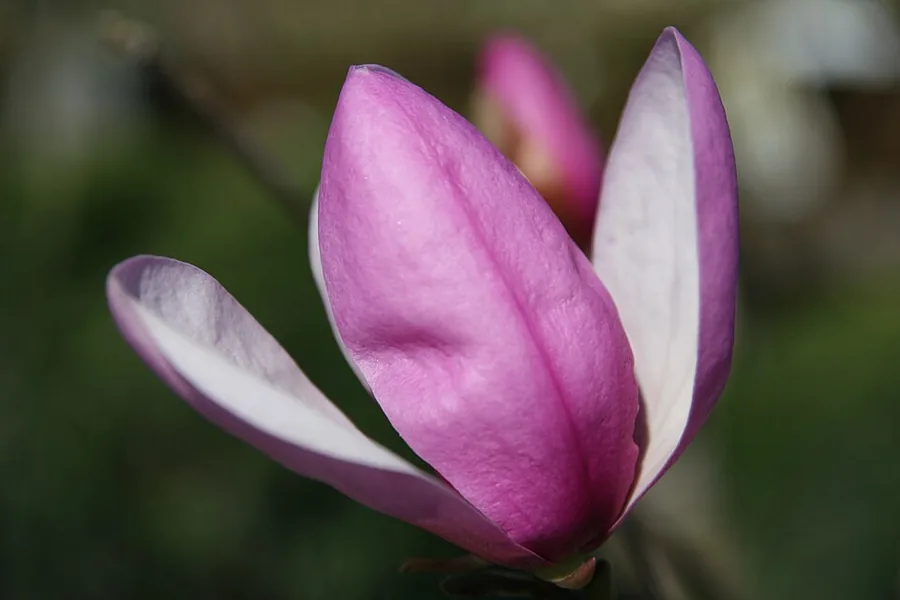
Jane magnolia earns a starring place in the spring garden. One of the eight Little Girl hybrids bred at the National Arboretum, it stays a compact tree or large shrub of 10 to 15 feet (3 to 4.5 m), a rounded silhouette that anchors a courtyard, frames an entry, or holds a corner of a modest yard without ever overwhelming it. Its tulip-shaped flowers open purple-pink outside and pale within, well before the leaves, giving the season its first real note of color.
The quiet luxury of Jane is its timing. Flowering in mid-to-late spring, a full 2 to 4 weeks behind the star and saucer magnolias, it arrives once the risk of a display-wrecking frost has largely passed, so the show reads reliably each year. Many trees offer an encore of scattered blooms into summer, keeping the garden in conversation past its opening act.
As a fixture it asks little of a busy household. Sun, room to spread, and steady water through its early years are all it wants, and this slow grower settles into a long-lived, unfussy presence that shapes the look of the garden and the rhythm of the spring season for decades.
Care
The short version: site it in full sun to part shade in rich, moist, slightly acidic soil, keep it watered while it establishes, mulch to hold moisture, and prune only right after it flowers.
Light
Jane magnolia gives its fullest display in full sun, though it accepts partial shade or partial sun with grace. The more sun the spot offers, the more generous the bloom, so reserve an open position for it where you can.
Water
Keep the soil evenly moist with regular watering, every 5 to 10 days, favoring the wetter side while the tree establishes or during a dry spell. A ring of mulch holds that moisture and tidies the base at once. Once settled, it takes moderate drought in stride.
Soil
Set it in rich, well-drained loam that runs acidic to neutral, ideally a pH of 5.5 to 6.5. It accepts clay better than most, so a heavier garden bed is no obstacle provided it drains.
Temperature
The tree is remarkably hardy, weathering deep cold near -29°F (-34°C) and summer heat up to 95°F (35°C). That resilience is what carries it comfortably through USDA zones 4 to 8.
Humidity
Ordinary garden humidity suits it well, so there is no figure to manage. Air movement is the greater consideration, since still, damp air is what invites powdery mildew onto the foliage.
Feeding
Offer a single feed in early spring with a balanced or acid-forming fertilizer, which is all the tree asks for the year. A heavier hand with nitrogen only encourages scale and soft growth that spoil its clean form.
Pruning
Prune right after it flowers, since next year's buds form on this year's growth and a late cut removes the coming display along with the wood. Beyond taking out dead or crossing branches, it needs almost no shaping.
Repotting
This is a landscape tree rarely kept in a container, so repotting seldom enters the picture. Where one is potted, slowed growth, water running straight through, or roots circling the sides signal it is time to move it up.
Size & spacing
Plan for a mature height of 10 to 15 feet (3 to 4.5 m) and a spread of 8 to 12 feet (2.4 to 3.7 m). Grant it that open room from the start so the crown can fill out and read as an intentional part of the garden's design.
When to plant
Jane magnolia keeps an elegant, unhurried calendar. Plant it in spring or early fall while the weather stays mild, then look forward to the display in mid-to-late spring, when it flowers later than most magnolias and typically opens after the frost has moved on.
Northern hemisphere
Southern hemisphere
Typical months for a temperate climate: start earlier in warm zones, later where spring frosts linger.
- Plant: Spring or early fall
- Harvest: Mid-to-late spring (mid-April to early May), about 2-4 weeks later than star and saucer magnolias; often reblooms sporadically in summer
Hardiness
USDA hardiness zones: 4–8
Temperature: down to -34°C
Troubleshooting
Jane magnolia holds its composure most years, so trouble is the exception in the garden rather than the rule. When something does surface, it tends to appear first on the leaves or twigs. Match what you notice to the entries below and act before it detracts from the display.
Waxy bumps on the twigs, sticky leaves, and a dark film beneath
When the twigs pick up raised waxy bumps, the culprit is magnolia scale, a sap-feeder that hides under a waxy shell. Its sticky honeydew drips onto the foliage below, where a black cast of sooty mold soon dulls what should be a bright spring feature. Prune away the worst-affected twigs, treat the summer crawlers or dormant scale with horticultural oil, and let natural predators restore the tree to its display-worthy self.
Fix:
- Prune out and destroy heavily infested twigs
- Apply horticultural oil during dormancy or treat crawlers in summer
- Encourage natural predators
Dark blotches on the leaves as twigs begin to die back
Dark leaf blotches alongside sunken lesions on the wood point to leaf spot or canker fungi. Once a branch begins to die back, prune it out and dispose of the wood rather than let it mar the tree's clean lines. Gather the fallen diseased leaves, keep the tree watered and mulched, and it will hold its composure through the rest.
Fix:
- Prune out and destroy cankered or dead wood
- Rake and remove fallen diseased leaves
- Maintain plant vigor with proper watering and mulching
A powdery white bloom dulling the foliage
A pale, powdery film on the leaves is powdery mildew, a fungus that settles in when the air hangs humid and unmoving. On a healthy tree it stays a cosmetic matter, more about looks than health. Open up crowded growth to let air circulate, clear the fallen leaves in autumn, and keep a labeled fungicide in reserve for the rare season it turns severe.
Fix:
- Rake and dispose of fallen infected leaves
- Improve air circulation by thinning
- Apply a labeled fungicide if severe
Toxicity
For a garden shared with pets or children, the verdict is reassuring: every part of this tree is safe. The ASPCA lists magnolia as non-toxic to cats, dogs, and horses, with no toxic compounds in the leaves, bark, or flowers. A stray nibble might bring a passing stomach upset, as any plant can, but nothing here poses a poisoning risk.
Safe for
People · Cats · Dogs · Horses · Rabbits · Livestock · Birds
Cats None
A cat can wander beneath a Jane magnolia with no cause for concern, as the ASPCA lists it non-toxic.
Dogs None
A dog that mouths a fallen leaf or bloom is in no danger, though a large helping of any plant can leave a passing stomach upset.
Horses None
Horses are equally untroubled by it, since magnolia holds no toxic principles for them.
Rabbits Safe
Rabbits face no toxic risk from either the leaves or the blooms.
Livestock Safe
Grazing animals such as goats and cattle may browse near the tree in safety.
Birds Safe
Birds that settle in the branches or sample the fruit are unharmed.
People Safe
The tree suits a family garden, with nothing poisonous in the leaves, bark, or flowers.
No special handling precautions are required for toxicity.
Varieties
Jane is one of eight Little Girl hybrids, and her sisters share the same late-blooming, frost-dodging habit across a palette of flower colors that lets you tune the display to a garden's mood. These are the ones you are likely to meet.
Ann
Ann joins the Little Girl series with slender, upright reddish-purple flowers that open among the earliest of the set.
Betty
Betty is the Little Girl hybrid whose generous blooms open wide to reveal purple-red outsides over clean white insides.
Susan
Susan lends the Little Girl group its fragrant fuchsia-red flowers, carried on gently twisted petals.
Randy
Randy takes a more upright form in the series, its narrow purple-pink flowers held close to the stem.
Judy
Judy, one of the eight National Arboretum Little Girl hybrids, arrives in a deep red-purple.
Pinkie
Pinkie is the Little Girl hybrid prized for softer pink flowers that open later than her sisters.
Ricki
Ricki spreads a little wider among the Little Girl hybrids and flowers in a deep purple-red.
How to propagate
Because Jane is a named hybrid, she comes true only when cloned. Three methods make that possible, each matched to a different level of patience and skill.
Stem cuttingsModerate
Early to mid summer using softwood to semi-hardwood growth · Several weeks to root; one or more seasons to establish
Take softwood to semi-hardwood cuttings in early to mid summer, since a named hybrid like Jane holds its character only when cloned. The cuttings need several weeks to root and a season or more to establish. Seed will not repeat the parent, which leaves cuttings as the home gardener's dependable route.
GraftingDemanding
Late winter to early spring onto compatible magnolia rootstock · One to several seasons
Nurseries graft Jane onto a compatible magnolia rootstock in late winter or early spring to keep her true to type. The method is demanding, asking one to several seasons to establish, which is why it stays largely in professional hands.
LayeringModerate
Spring · One or more seasons to root before separation
In spring, pin a low branch to the soil and let it root while still joined to the parent. Allow a season or more to root before separating it, and the new tree emerges as an exact clone of the original.
Myths
Magnolias bloom too early and always lose their flowers to spring frost.
Jane and her Little Girl sisters open 2 to 4 weeks later than the star and saucer magnolias, a difference that changes everything in the spring garden. That later start usually carries the display past the worst frosts, and many trees return with a scattering of blooms in summer to extend the season.
Magnolia flowers and foliage are poisonous to dogs and cats.
The ASPCA lists magnolia as non-toxic to dogs, cats, and horses, with no toxic principles anywhere in the plant. That makes it an easy choice for a garden shared with pets, where a curious sniff at a fallen bloom carries no risk.