Tree · Fagaceae
American Beech
Fagus grandifolia
Give it rich, acidic, moist soil and room to spread, and the American beech anchors a landscape with quiet, generational presence.
Full sun
Every 7–14 days
USDA 3–9
60–80 ft · 18.3–24.4 m
Overview
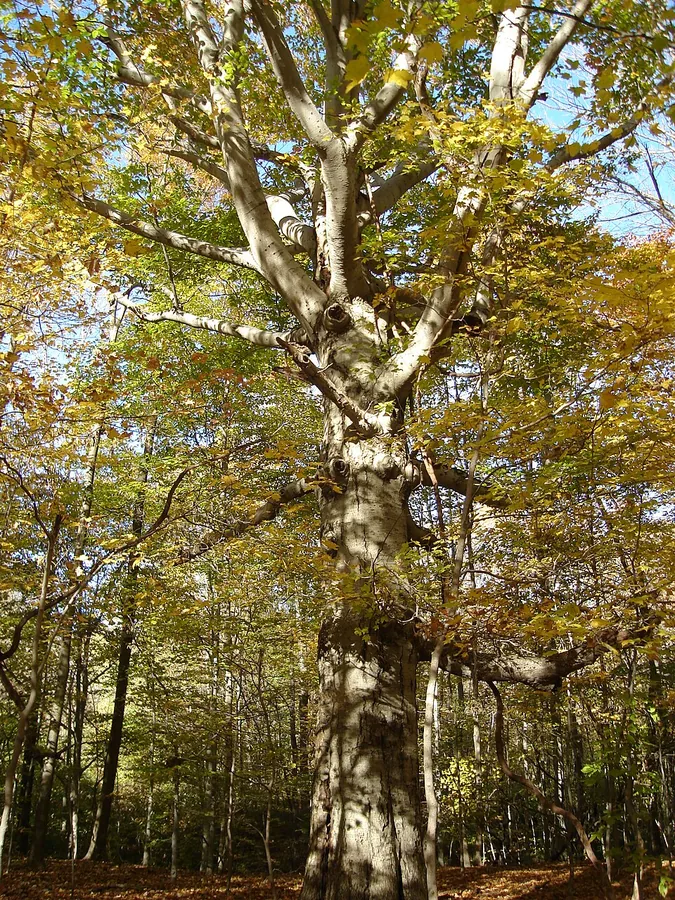
The American beech is the kind of tree that sets the mood of a whole property rather than a single border. Its smooth, silver-gray bark stays sleek while the trees around it turn rough, lending a refined, sculptural calm to an open lawn or the edge of a woodland walk. A member of the Fagaceae family alongside the oaks and chestnuts, it climbs at its own slow pace to 60 to 80 feet (18 to 24 m) and lays down deep, cooling shade for generations to gather under.
Its appeal is seasonal as much as architectural. Young trees keep their coppery leaves through the cold months, a habit called marcescence that warms a bare winter view, and mature trees scatter small triangular beechnuts that draw wildlife into the scene every few years. This is a tree for a spacious setting, not a tight courtyard, since the shallow roots range wide and the canopy spreads about as far as the tree stands tall.
Placement is everything with a beech, and the reward follows the right setting. It calls for deep, rich, moist, acidic soil and clean air, and it falters in compacted ground, drought, heat, or road salt. Two serious imports, beech leaf disease and beech bark disease, now press on established trees across the region, which makes a well-chosen site and a healthy, well-tended specimen more valuable than ever.
Care
The short version: site it in deep, rich, moist, acidic, well-drained loam with generous room to spread, water young trees through dry spells until they settle, and shield the thin bark from wounds and sunscald.
Light
American beech settles happily into full sun yet tolerates shade better than nearly any other tree, which is how it comes to hold the forest floor before rising into the canopy. Out in the open it branches low and broad for a fuller silhouette, while a shaded tree reaches upward toward the light.
Water
Keep the soil evenly moist, since beech has little tolerance for drought, heat, or waterlogged ground. Established trees in good native soil largely look after themselves, but a young tree wants a deep soak during dry spells, roughly every 7 to 14 days, until it settles in.
Soil
This tree wants deep, rich, moist, well-drained loam on the acidic side, ideally a pH of 5.0 to 6.5. It will not abide compaction or road salt, so the root zone is best kept loose and undisturbed.
Temperature
Beech is fully hardy, weathering winter lows near -40°F (-40°C) and summer heat up to about 100°F (38°C), which places it in USDA zones 3 to 9. Cold troubles it far less than drought or a hot, exposed position.
Humidity
Ordinary outdoor humidity is all it asks, so there is no figure to monitor. The greater concern is steady soil moisture and clean air moving around the canopy.
Feeding
A beech in suitable native soil rarely needs feeding at all. Where growth slows, a balanced slow-release fertilizer in spring or a simple layer of leaf-litter mulch over the shallow roots does the work without forcing it.
Pruning
Beech asks for very little pruning. Remove dead, damaged, or crossing branches in late winter to early spring, and stop there. The thin, smooth bark scars and sunscalds with ease, so every cut left untaken is a wound the tree never has to seal.
Repotting
This is a landscape tree rather than a container plant, and the shallow, spreading roots make transplanting hard once it has grown. Move a beech only while it is young, and watch a nursery transplant for circling roots, stunted new growth, or dieback that signals a rough start.
Size & spacing
Plan for a tree that reaches 60 to 80 feet (18 to 24 m) tall and spreads 40 to 80 feet (12 to 24 m) wide. Allow it a large, open setting well clear of buildings, paving, and other trees, since both the canopy and the surface roots travel far.
When to plant
Beech goes into the ground while it is young, because the shallow, spreading roots make relocating an older tree a difficult prospect. Plant it in spring or fall, water it through its first few dry spells, and then let it grow at its own unhurried tempo. The yellowish-green flowers arrive March to May, and the nuts ripen September to October once a tree is mature enough to bear.
Northern hemisphere
Southern hemisphere
Typical months for a temperate climate: start earlier in warm zones, later where spring frosts linger.
- Plant: Spring or fall, while young; transplanting is difficult once established.
- Harvest: Yellowish-green flowers March to May; triangular beechnuts ripen September to October.
Hardiness
USDA hardiness zones: 3–9
Temperature: down to -40°C
Troubleshooting
Most beech trouble surfaces on the leaves and bark, and the two diseases that matter most are recent arrivals worth catching early. Read the signs below, and where a serious disease is in play, bring in a certified arborist rather than treating it on a guess.
Foliage cupped and shadow-banded through the season
When a canopy that once read as effortless starts to look striped and curled, the cause is usually beech leaf disease, the work of a microscopic nematode that lodges in the buds and distorts each new leaf. The telltale dark banding reads most clearly when a spring leaf is turned over and viewed from beneath. No home remedy will turn it around, so the wise move is a call to a certified arborist or the state forestry office, steady watering and mulch through any dry stretch, and a quick report of fresh outbreaks so they can be mapped.
Fix:
- Consult a certified arborist or state forestry office for current management options
- Phosphite fertilizers may boost tree vigor and suppress nematode activity
- The nematicide/fungicide fluopyram (Broadform) has reduced nematode populations in trials
- Maintain tree vigor with mulch and watering during drought
Pale woolly wax dotting the bark, then cankers
The sleek trunk that gives this tree so much of its presence is the first casualty of beech bark disease, a problem that arrives in two acts. The felted beech scale feeds early and dots the bark with white wax, and then Neonectria fungi settle into those openings to form sunken, weeping cankers. Spotted at the scale stage, an arborist can step in before the fungus takes the lead. Once cankers and crown dieback are established, removing a badly affected tree is the responsible way to slow the spread to its neighbors.
Fix:
- Consult an arborist; insecticide treatments targeting the scale before fungal infection can help in early stages
- Remove and properly dispose of severely diseased trees to reduce spread
- Avoid wounding bark
White fluff on the twigs that sways as one
A patch of branch that suddenly looks frosted is most likely a colony of beech blight aphids, nicknamed the boogie-woogie aphid for the way the whole group sways together when something brushes past. Their honeydew drips down and feeds a film of black sooty mold across the leaves and the ground below. The effect is almost entirely a matter of appearance, so the tree can be left in peace, a small colony cleared with a firm jet of water, or the resident predators allowed to do the tidying.
Fix:
- Usually cosmetic and tolerable; no treatment normally needed
- Hose off small colonies with a strong stream of water
- Encourage natural predators
A white powdery film coating the leaves
A pale, dusted look across the foliage points to powdery mildew, a fungus that arrives late in the season when the air turns humid and the tree sits in shade. On a settled shade tree it amounts to little more than a passing blemish on the look of the canopy. Raking and discarding the fallen leaves, easing air movement through the crown where the layout allows, and skipping the fungicide is all the situation asks for.
Fix:
- Rarely serious; improve air circulation
- Rake and remove fallen infected leaves
- Fungicide is seldom warranted on a mature shade tree
Toxicity
American beech is safe to live alongside pets, livestock, and children. It is absent from the ASPCA toxic list, and animals browse beech woods freely. The single small caveat lies in the raw nuts and foliage, which carry natural saponins and oxalates that can upset a stomach in quantity, so cook any beechnuts meant for the table.
Safe for
People · Cats · Dogs · Horses · Rabbits · Livestock · Birds
Cats None
Beech sits off the ASPCA toxic list for cats, so a household tabby that drifts over for a sniff or a small taste raises no concern.
Dogs None
The tree is regarded as safe for dogs. A dog that hoovers up a heap of raw fallen nuts may feel briefly off from the saponins, though that passes on its own.
Horses Safe
Neither the foliage nor the nuts are counted poisonous to horses, so a horse can graze the ground around the tree untroubled.
Rabbits Safe
Beech leaves are safe for rabbits to nibble. The raw nuts are richer going, so they are best left as the occasional find they would meet in the wild.
Livestock Safe
Cattle, sheep, and goats move through beech woods without bother, and the fallen mast has fed foraging stock for generations.
Birds Safe
Beechnuts are sought after by jays, turkeys, and a long list of songbirds, who crack them open with no ill effect.
People Safe
Roasted beechnuts make an elegant snack, and the tree itself is non-toxic. A large helping of the raw nuts, leaves, or buds can unsettle the stomach thanks to natural saponins and oxalates, so cooking the nuts is the simple fix.
Beechnuts are edible to wildlife and to people in small amounts, but raw beechnuts (and the leaves and buds) contain saponin glycosides (fagin) and oxalates, so eating large quantities of raw nuts can cause gastrointestinal upset in people and some animals; roasting reduces this. This nuance does not change the cats/dogs rating of none.
Varieties
The American beech largely keeps to itself, but its European cousin has been shaped into a wardrobe of ornamental forms that turn up far more often in gardens and parks.
Fagus sylvatica (European beech)
A near Old World relative of more modest stature, dressed in darker gray bark and shorter, oval leaves whose wavy edges carry fine hairs, and far more likely to turn up as a planted ornamental.
Fagus sylvatica 'Purpurea' (copper / purple beech, Atropurpurea Group)
A European beech selection prized for foliage that ranges from deep purple to a warm coppery tone.
Fagus sylvatica f. pendula 'Pendula' (weeping European beech)
A European beech form whose branches cascade downward into a graceful weeping silhouette.
Fagus sylvatica 'Dawyck' (columnar / fastigiate European beech)
A slim, upright European beech that rises in a column, with a purple-leaved counterpart sold as 'Dawyck Purple' as well.
How to propagate
Beech can be raised from its nuts, drawn from its own suckering habit, or grafted to hold a named form, though each route asks for patience from a tree that hurries nothing.
SeedModerate
Sow fresh beechnuts in fall, or cold-stratify over winter for spring sowing. · Several years to establish; slow-growing
The usual path to a new beech runs through its nuts, though the seed will not stir until it has felt a cold spell. Sow fresh beechnuts in fall, or cold-stratify them over winter for a spring sowing, and expect the seedlings the first year, since viability fades quickly afterward. From there it asks for patience, with several years to establish and slow growth all the way along. Good nut crops appear only in scattered mast years, so the harvest is worth gathering whenever it comes.
LayeringModerate
Growing season · One to two seasons to root
Beech already renews itself in the wild through root suckers and stump sprouts, and that natural habit can be borrowed to clone a tree during the growing season. Layered shoots take roughly one to two seasons to root, while the shallow root system keeps any later move a delicate undertaking.
GraftingDemanding
Late winter to spring · One to two seasons
Named cultivars, European beech ones above all, are grafted to preserve their form and leaf color, since they do not come true from seed. Carried out from late winter into spring, a graft needs about one to two seasons to knit and settle, and it rewards a practiced hand.
Myths
The beech being harmless, its raw nuts may be eaten in any amount without a second thought.
The tree poses no toxic threat to cats or dogs, and the nuts are truly edible, yet the raw nuts, leaves, and buds still hold saponin glycosides (fagin) and oxalates. Work through a large quantity of the raw nuts and an upset stomach can follow, and the same applies to some animals. Roasting or cooking the nuts breaks down the irritants and is the safe way to enjoy them.
A verdant lawn or elegant border settles in effortlessly at the foot of an American beech.
Heavy shade overhead, shallow surface roots claiming every drop of moisture, and a firm preference for undisturbed acidic ground leave almost nothing able to flourish at the base. Underplanting and turf rarely succeed beneath a mature beech.
Sources
- ASPCA Animal Poison Control
- NC State Extension Gardener Plant Toolbox
- USDA Forest Service, Fire Effects Information System (FEIS)
- Penn State Extension
- University of New Hampshire Extension
- UMass Amherst Center for Agriculture, Food, and the Environment
- ASPCA Animal Poison Control
- NC State Extension Gardener Plant Toolbox