Shrub · Rosaceae
Japanese Kerria
Kerria japonica
Set in dappled shade and free-draining soil, Japanese kerria brings a golden lift to spring on bright green stems.
Partial shade
Every 5–10 days
USDA 4–9
3–7 ft · 0.9–2.2 m
Overview
Japanese kerria is the shrub for the shaded, half-forgotten edge of a garden that longs for a little spring color. It is an easygoing deciduous plant grown above all for the golden-yellow flowers that light its arching branches, and though it belongs to the rose family, it keeps its own company as the only species in its genus. Even in winter its bright green stems hold a quiet color that carries a bare border through the cold months.
As a piece of a garden's larger picture, kerria earns its keep where formal choices sulk. It settles happily into partial shade beneath taller trees, takes cold to zone 4, and slips into a low-effort routine once established, asking for little more than the occasional glance. Its one demand on the design is room, since it spreads by suckers and drifts into a loose thicket if left unchecked.
Place it where an informal, arching shape suits the mood rather than a clipped, mannered one, along a woodland path or against a fence that wants softening. The branches weave and lean, the main flush of bloom arrives in April and May, and a scattering of later flowers keeps the interest going through summer. Keep it out of hard afternoon sun and off soggy ground, and it becomes one of the most self-reliant players in the border.
Care
The short version: partial shade, loamy soil that drains freely, and steady water while it establishes, after which it carries itself through dry spells alone. Prune just after the flowers fade and lift suckers as they appear.
Light
Kerria settles best into partial shade, and it will take full shade as well, which makes it a natural for the darker corners of a plot. Keep it clear of strong direct sun, which bleaches the yellow flowers and thins the display.
Water
Give a newly set plant steady, medium moisture as it roots in, watering every 5 to 10 days as the top inch dries. Once established it carries itself through dry weather, so water at the base and keep the leaves dry to stay ahead of blight.
Soil
Plant it in loamy, well-drained soil of medium fertility for an easy life. A pH from 5.5 to 7.5 suits it, and the one thing to avoid is heavy, soggy clay, where wet roots invite rot.
Temperature
This is a hardy shrub that shoulders winters down to about -29°F (-34°C) and summers up to 100°F (38°C). That range opens it to a wide sweep of temperate gardens with no special coddling.
Humidity
Everyday outdoor humidity suits it, so there is no figure to fuss over. What counts is air moving through the branches, since still, damp air around crowded stems is what blight favors most.
Feeding
Kerria wants little at the table. A light spring feeding with a balanced slow-release fertilizer once a season is plenty, and a heavier hand only pushes soft growth in place of flowers.
Pruning
Prune right after flowering, since the blooms come on last year's wood and a late cut costs next spring's display. Lift unwanted suckers as they appear, and cut tired, overgrown stems to the ground to renew the plant's shape.
Repotting
As a garden shrub, kerria rarely calls for a pot. If one is held in a container, move it to a larger vessel when roots begin circling or escaping the pot or growth slows.
Size & spacing
Allow for a mature shrub around 3 to 7 feet (90 to 215 cm) tall with a wider spread near 6 to 9 feet (180 to 275 cm). Give it that room to arch and reach, and leave a margin for the suckers it sends beyond the main clump.
When to plant
Kerria keeps a gentle seasonal calendar that is easy to build a garden year around. Set new plants in spring or fall while the weather stays mild, look to April and May for the main show of bloom, and enjoy a scattering of later flowers through summer. Reserve any pruning for the moment just after the spring display, since next year's flowers form on this year's wood.
Northern hemisphere
Southern hemisphere
Typical months for a temperate climate: start earlier in warm zones, later where spring frosts linger.
- Plant: Spring or fall
- Harvest: April to May with sporadic rebloom in summer
Hardiness
USDA hardiness zones: 4–9
Temperature: down to -34°C
Troubleshooting
Kerria carries itself well with little attention, though a few troubles surface in wet weather or wet ground. They tend to show first on the leaves, flowers, or roots, so read the early signs below and step in before a small blemish spreads across the planting.
Wilting and dieback with dark, rotted roots
A kerria set in soggy ground loses its poise, wilting and declining as root rot works quietly below the surface. Ease the plant up and the roots show dark and mushy where they should be firm and white. The remedy is a better home for it, so improve heavy soil with compost, water more sparingly, and keep it clear of the low, damp corners of a garden.
Fix:
- Improve drainage by amending soil with compost
- Reduce watering frequency
- Avoid planting in heavy clay or low wet spots
Purple-bordered leaf spots and dark cankers on the stems
Behind those marks sits kerria twig and leaf blight, a fungus that stirs in wet weather and moves from the leaves down into the stems. Left alone, a canker can ring a stem and take the growth above it, which quickly spoils the shrub's role as a graceful backdrop. Cut away the diseased wood, clear the fallen leaves so they can't return next year, and let a soaker hose keep the foliage dry, which protects the planting better than any spray.
Fix:
- Prune out and dispose of diseased stems
- Rake and dispose of fallen infected foliage
- Apply a labeled fungicide such as chlorothalonil on a bi-weekly schedule during wet summer weather
- Switch to soaker hose or drip irrigation to keep foliage dry
Faded flowers and a sparse spring show
A washed-out, thin bloom takes the shine off the season, and two things usually explain it. Strong direct sun bleaches the petals, so give the plant partial shade, where the yellow reads warm against a wall or border. The other cause is mistimed pruning, since kerria flowers on last year's wood, so save the shears for the moment just after the spring display closes.
Fix:
- Site the plant in partial shade
- Prune only immediately after flowering since it blooms on previous year's wood
Toxicity
For a household with pets or children, kerria is a reassuring choice, since it is not toxic. It does not appear on the ASPCA's poison lists and counts as safe around cats, dogs, and everyone else at home. A chewed leaf might bring a passing stomach grumble, as any plant can, but nothing here will poison.
Safe for
People · Cats · Dogs · Horses · Rabbits · Livestock · Birds
Cats None
A household cat can share the garden with kerria in complete ease, since nothing in it will poison one. A stray nibble might bring a brief stomach upset, the sort any plant can cause, and it passes without event.
Dogs None
This is a shrub a dog can live alongside without concern, free of any poisoning risk. Even an enthusiastic chewer would come away with nothing worse than a little passing digestive grumble.
Horses None
Set near a paddock, kerria makes an untroubled companion for horses, holding nothing that would harm them. A horse that samples a few leaves is none the worse for it.
Rabbits None
Rabbits carry no risk from kerria and face no poisoning. They may browse the foliage as they would any planting, which asks for no special watchfulness.
Livestock None
Cattle, goats, and sheep may graze near kerria in safety, as it holds no compounds known to harm them. The shrub needs no fencing to keep grazing animals away.
Birds None
Garden birds settle among these branches with no danger at all. They can perch and forage through the stems freely, with nothing toxic to trouble them.
People None
For a family garden, kerria is an easy, safe choice, being non-toxic to people. No part is grown to be eaten, yet a child who tastes a leaf comes to no real harm.
No special handling required; wear gloves for routine pruning to avoid scratches.
Varieties
A few named kerrias reach garden centers, set apart mainly by flower form, size, and leaf color, each suiting a slightly different corner of a garden. These are the ones worth knowing by name.
Pleniflora
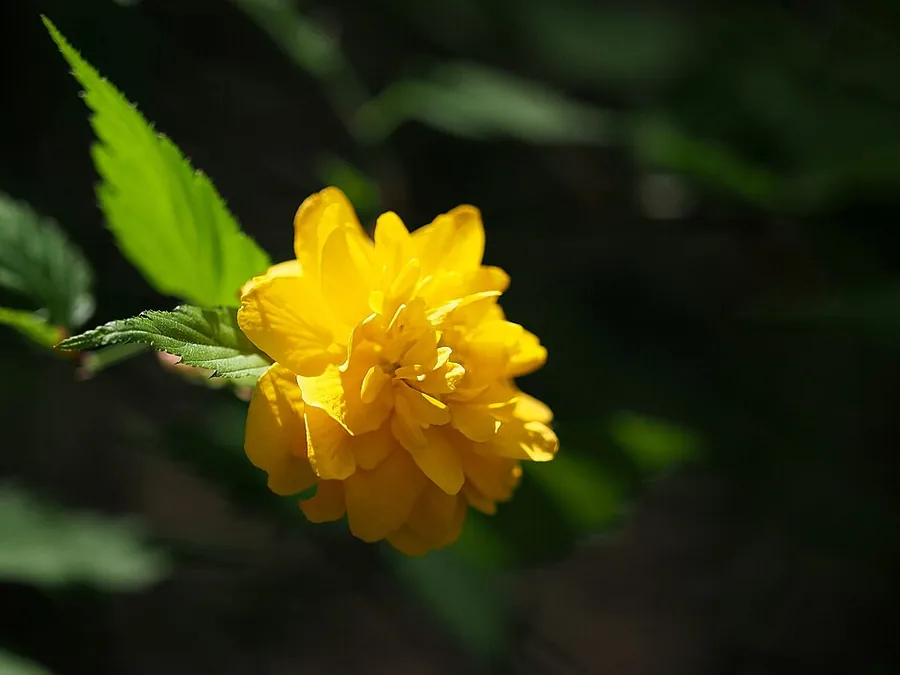
A generous, vigorous form rising to around 8 to 10 feet, dressing its branches in double, ball-shaped yellow pompons rather than plain single blooms.
Golden Guinea
Prized for large single flowers up to about 2.5 inches across and a season of bloom that lingers longer than most.
Picta
Brings a lighter, refined presence with leaves edged in creamy white and a slower pace, though it can slip back to plain green without attention.
Albescens
A compact 4 to 5 foot form suited to smaller settings, carrying soft creamy pale-yellow flowers about 2 inches across.
How to propagate
Kerria increases almost on its own, which makes it a generous shrub to spread through a garden or pass to a neighbor. You can divide its suckers, root a few soft cuttings, or let the low branches layer themselves into new plants.
DivisionEasy
Spring or fall · One growing season
The simplest way to carry kerria to another corner of the garden is to lift the suckers that gather around the shrub and replant them. Divide in spring or fall, and a moved sucker will find its feet and take hold within a single growing season.
Stem cuttingsModerate
May to July · Several weeks to root
Cuttings offer another route worth trying, taken as soft terminal tips from May through July and dipped in an IBA rooting hormone to draw out roots. Kept warm and evenly moist, they settle in and root over several weeks.
LayeringEasy
Spring to summer · One growing season
Kerria has a graceful habit of layering itself with almost no help. Through spring and summer its low arching stems root where they rest on moist soil, and after a growing season a rooted stem can be freed and set elsewhere as a new plant.
Myths
Japanese kerria is a true rose because of its common name.
The name simply borrows from the rose-like look of its yellow flowers, not from its botany. While it does belong to the rose family, Rosaceae, it holds a place all its own as the single species in the genus Kerria, and it is not a true Rosa at all.