Shrub · Rosaceae
Loganberry
Rubus × loganobaccus
Set against full sun, rich soil, and a handsome trellis, the loganberry brings a long summer of tart-sweet fruit to the garden.
Full sun
Every 5–7 days
USDA 5–9
5–7 ft · 1.5–2 m
Overview
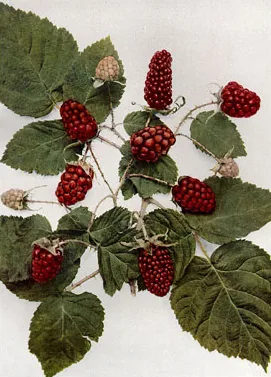
The loganberry began as a cross between a blackberry and a raspberry, raised long ago and grown ever since for its large, deep red fruit. It belongs to the rose family among its bramble relatives, and like a blackberry it keeps its core when picked. Its flavor settles between the two parents, sharper than a raspberry and richer than a blackberry, which makes it a fine choice for the kitchen as much as the plot.
In the garden it reads as a trailing perennial, sending out long, fast canes that want a fence or trellis to lean on rather than standing alone. Each plant lasts for years, though its canes follow a two-year pattern: they grow one season and fruit the next before they are done. That pattern is the thing to grasp, since it shapes how the plant is trained and pruned into a tidy screen.
This is a plant for the open garden, hardy across USDA zones 5 to 9 and at its best with room to sprawl along a boundary or a sunny wall. It asks little, though it is tender to hard cold and quick to form a thicket if the cane tips root where they fall. Give it a sheltered, sunny position and keep the canes in hand, and it settles into the space and earns its keep.
Care
The short version: full sun, rich and well-drained soil, and a steady 1 to 2 inches of water a week. Train the canes along a trellis, feed in early spring, and cut out each cane the year after it fruits.
Light
A loganberry belongs in full sun, the spot where the fruit ripens sweetest and the plant looks its most productive along a wall or fence. It will accept a little partial shade, but the shadier the position, the fewer and smaller the berries it sets.
Water
Keep it to 1 to 2 inches of water a week, and lift that while it flowers and the fruit fills out. Hold the soil moist but never sodden, since the canes resent standing in waterlogged ground and show it in a poorer crop.
Soil
Plant it in rich, well-drained loam worked through with organic matter, the base a productive bramble wants. A slightly acidic pH between 5.5 and 6.5 suits it, and good drainage keeps the roots sound through the season.
Temperature
It takes a wide range, from about 5°F to 86°F (-15°C to 30°C), which places it in USDA zones 5 to 9 and most temperate gardens. Hard cold is its limit, so the canes want shelter or a cover in a spot where winters turn severe.
Humidity
Ordinary outdoor humidity in the 40% to 70% band asks nothing of you. Airflow is the real consideration, since still, damp air around a crowded planting is exactly what gray mold and purple blotch look for.
Feeding
Feed in early spring as new growth begins, with a nitrogen-rich balanced fertilizer such as 10-10-10 and a topping of compost. A single seasonal feed carries a strong flush of canes through the season.
Pruning
Pruning follows the cane cycle and keeps the planting looking its best. Cut the old floricanes that have just fruited down to the ground after harvest, train the fresh primocanes along the trellis, and tidy and tie everything in over late winter.
Repotting
This is a ground plant that rarely wants a pot. Where a container is used, refresh it or move it up every 1 to 2 years in late winter, watching for roots circling the pot or water running straight through.
Size & spacing
Plants reach 5 to 6.5 feet (150 to 200 cm) tall and spread a sprawling 6 to 10 feet (1.8 to 3 m) wide along the trellis. Plan that width into the layout, because the long trailing canes need the run to sit well.
When to plant
The loganberry keeps to the calendar of the seasons, not the indoors. Set young plants out in early spring once hard frost has passed, or in late fall where winters stay mild. It blooms in late spring, and the fruit ripens from late June through August.
Northern hemisphere
Southern hemisphere
Typical months for a temperate climate: start earlier in warm zones, later where spring frosts linger.
- Plant: Early spring after the danger of hard frost has passed, or late fall in mild-winter regions
- Harvest: Blooms late spring; harvest late June through August
Hardiness
USDA hardiness zones: 5–9
Temperature: down to -29°C
Troubleshooting
Most of what goes wrong with a loganberry shows on the canes or the ripening fruit, and a damp spell usually sets it off. Notice the early signs and you can act before the trouble travels down the row. Match the look below, then step in while it still counts.
Purple and brown patches marring the canes
Those marks are purple blotch, a fungus that settles on the canes and spreads fastest in wet weather and a crowded planting. They begin small around the nodes, then swell and run together. Cut out the infected canes, thin the rest so air moves through, and turn to a labeled fungicide only if it takes a firm hold.
Fix:
- Prune out and destroy infected canes
- Thin canes to open the canopy
- Apply a labeled fungicide if infection is severe
Soft berries furred with gray mold
This is gray mold, caused by botrytis, and it moves in during damp, humid spells just as the fruit ripens. The berries soften, then slump beneath a gray fuzzy coat. Remove and bin anything infected, pick ripe fruit often so none sits, and open the canopy so the berries dry quickly.
Fix:
- Remove and discard infected fruit
- Harvest ripe berries promptly and frequently
- Improve airflow around the canopy
Brown, lifeless canes with no spring leaves
Trailing brambles like the loganberry are tender in the cold, so a hard winter can leave you with dead canes even when the crown below pulls through. Look for brown, brittle wood that snaps rather than bends. Cut the dead canes back to live tissue or the ground, and in cold areas mulch the crown and lower or cover the canes before winter sets in.
Fix:
- Prune dead canes back to live tissue or the ground
- Protect canes over winter in cold sites
Toxicity
For a home shared with pets and children, the loganberry sits easy: it holds nothing poisonous. The berries are safe to eat and every part of the plant is harmless to swallow. The only real hazard is physical, since standard forms carry sharp prickles, so wear gloves to prune and choose a thornless cultivar where scratches would be a worry.
Safe for
People · Cats · Dogs · Horses · Rabbits · Livestock · Birds
Cats None
Safe company for a cat. One that nibbles a leaf is in no danger, though the prickles on thorned canes can scratch a curious nose.
Dogs None
Nothing toxic here, so a dog can share a few ripe berries. A pile of leaves gulped down may bring a passing upset stomach, nothing more.
Horses Safe
A horse grazing beside the planting comes to no harm. Only the thorned canes deserve a second thought, as a stray prickle may catch the muzzle.
Rabbits Safe
Rabbits can browse the leaves and fruit freely. The plant holds nothing poisonous, so it counts as safe forage.
Livestock Safe
Cattle, goats, and sheep can graze the foliage with no risk of poisoning. The stems bear prickles, so the thorns are the only real concern.
Birds Safe
Birds love the ripe berries and come to no harm from them. They take the crop and scatter the seed as they go.
People Safe
Fresh off the cane or folded into a summer dessert, loganberries are a genuine pleasure, and the rest of the plant is just as safe. Standard forms do carry thorns, so gloves belong in the pruning routine.
Thorned forms bear sharp prickles that can scratch pets and handlers, while thornless cultivars exist; wear gloves when training or pruning canes.
Varieties
The loganberry comes in just a couple of forms worth knowing, sorted mainly by whether the canes carry thorns. These are the two you are most likely to bring into the garden.
Thornless Loganberry (L654)
The spineless canes turn harvesting and tying in into light work beside the thorned type, a graceful fit along a well-used garden path.
Loganberry LY59
The classic commercial selection, a thorned clone that has anchored growers' plantings with generous crops season after season.
Companions
The loganberry shares soil diseases with a few common crops, so the smarter move is knowing what to keep it away from rather than what to plant beside it.
Keep apart
Solanaceous crops (tomato, potato, pepper, eggplant): Share Verticillium wilt; avoid planting brambles where these crops recently grew
Wild brambles: Can harbor viruses and diseases that spread to cultivated canes
How to propagate
Adding another loganberry to the plot takes little doing, since the plant roots itself the moment a cane tip settles onto the soil.
LayeringEasy
Late summer to early fall · Roots in about 4 to 8 weeks; transplant the rooted tip the following spring
Tip-layering is the usual way to raise more trailing brambles, and it asks almost nothing of you. In late summer or early fall, bend a growing cane tip down and bury it in the soil, where it roots in about 4 to 8 weeks. Leave it in place, then lift the rooted tip to its new spot the following spring.
Stem cuttingsModerate
Summer (softwood) or late winter (hardwood) · Several weeks to a few months to root and establish
Cuttings are less common than tip layering but work well for building up the thornless clones. Take softwood cuttings in summer or hardwood ones in late winter, and give them several weeks to a few months to root and settle before you treat them as established plants.
Myths
The loganberry is simply a raspberry variety.
It is really a cross between a blackberry and a raspberry, and it belongs with the trailing blackberries rather than the raspberries. Like a blackberry, it holds onto its core when you pick the fruit, which is the easiest way to tell the two apart.
Every loganberry plant has thorns.
Both thorned and thornless cultivars are grown, so the prickles are not a given at all. Choose a spineless form and the picking and pruning get much easier, with no sharp canes to work around when you are shaping the planting.