Tree · Rosaceae
Nectarine
Prunus persica var. nucipersica
A nectarine is a peach without the fuzz, and it turns a sunny corner and one yearly prune into summers of sweet, smooth-skinned fruit.
Full sun
Every 7–14 days
USDA 5–9
10–20 ft · 3–6 m
Overview
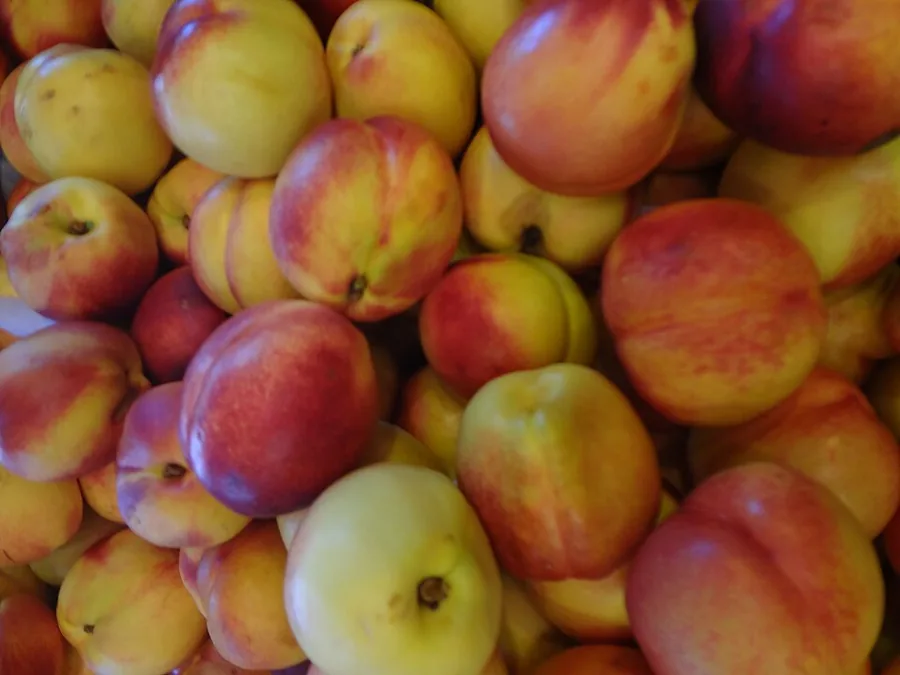
A nectarine is the same tree as a peach, parted from it by a single gene for the fuzz. It belongs to the rose family alongside cherries, plums, and apricots, and the smooth skin is the quiet detail that sets it apart from its fuzzy relation. Planted in a bright, open corner of the garden, it becomes the kind of small tree that shapes a whole summer, its harvest timed to the months a household spends outdoors.
This is a demanding tree, and it repays the gardener who gives it a proper place. It asks for full sun, deep well-drained soil, and a considered prune each winter, and its smooth skin marks more readily than a peach's. In return it gives fruit rarely found at its finest on a shop shelf, gathered ripe from a branch that has become a fixture of the yard.
Most trees arrive grafted onto a rootstock, so the season begins with a young whip and the pleasure of training it to shape. It settles happily into zones 5 through 9, flowers early enough that a late frost can catch the blossom, and brings its fruit to the table across the warm heart of summer.
Care
The short version: a bright open spot in full sun, deep well-drained soil kept on the dry side once the tree has settled, an open-center prune each late winter, and a dormant spray to stay ahead of leaf curl and brown rot.
Light
Give a nectarine full sun, the brightest corner the garden holds, since both fruit quality and sweetness depend on it. Set in shade, the tree grows leggy, sets little fruit, and holds damp leaves that invite disease, none of which flatters the plot.
Water
Water deeply through growth and while the fruit is sizing, then let the top half of the soil dry before the next soaking. An established tree takes a short dry spell in stride, and keeping the foliage dry quietly spares it much of the fungal trouble that spoils a season.
Soil
Plant into deep, well-drained sandy loam, since nothing undoes a nectarine faster than roots left sitting in water. Aim for a slightly acidic pH between 6.0 and 6.5, and improve the drainage before planting on any spot that stays wet.
Temperature
The tree is hardy across a wide reach, from about -9°F to 95°F (-23°C to 35°C), so it holds its place through most of what a temperate garden throws at it. The early bloom is its one weakness, since a late frost can take a whole year's flowers before the fruit forms.
Humidity
Average humidity in the 40% to 70% range suits it well. Damp, still air is the real trouble, since it invites brown rot and leaf curl, so keep the canopy open and let the garden breeze move through.
Feeding
Feed from early spring into midsummer with a balanced complete fertilizer such as 10-10-10, then follow with calcium nitrate. Ease off by late summer so the new growth firms up before the cold, and the tree carries a tidier frame into winter.
Pruning
Train the young tree to an open-center, vase shape and prune it firmly each late winter. Every year you remove water sprouts and thin the canopy so light and air reach the fruit, and this yearly shaping is both the tree's largest demand and much of its garden charm.
Repotting
This is a tree for the open ground, not a container plant, so there is no repotting in the usual sense. Choose the planting spot with care from the outset, since a nectarine resents being moved once its roots are set.
Size & spacing
Left to grow, a nectarine reaches 10 to 20 feet (3 to 6 m) tall and about as wide, a presence a sunny corner should be sized to hold. A yearly prune keeps it lower and easier to gather from, but grant it the full 10 to 20 feet (3 to 6 m) so air moves freely through the canopy.
When to plant
Set a bare-root nectarine into the garden while it is dormant, in late winter or early spring, so the roots settle before the first flush of growth. The tree flowers early, which leaves the blossom exposed to a late cold snap, and its fruit ripens from mid-June into September by cultivar, carrying the garden through the season.
Northern hemisphere
Southern hemisphere
Typical months for a temperate climate: start earlier in warm zones, later where spring frosts linger.
- Plant: late winter to early spring while dormant (bare-root)
- Harvest: blooms early spring; fruit ripens mid-June to mid-September by cultivar
Hardiness
USDA hardiness zones: 5–9
Temperature: down to -29°C
Troubleshooting
A nectarine's smooth skin shows the small troubles a fuzzy peach would hide, so difficulties tend to appear first on the fruit and the new leaves. Learn the early signs and a fungus or a borer can be met before it sets the tree back. Find what matches below, then step in while the season still allows it.
Fruit spoiling on the branch under fuzzy gray-brown patches
Those patches are brown rot, the work of Monilinia fungi that take hold quickly in warm, humid weather, and a nectarine in the garden proves more prone to it than most stone fruit. Clear away every mummified fruit and any infected twigs, then prune the canopy open so moving air can dry the wood. A fungicide at bloom and again before harvest keeps the harvest you have been picturing intact.
Fix:
- Remove mummified fruit and infected twigs, prune for airflow, and apply fungicide at bloom and before harvest
Weeping gum near the trunk base and sawdust-like frass
Gum and frass gathering low on the trunk are the mark of peachtree borers, the larvae of a clearwing moth that work through the lower wood and can girdle a young tree. A well-kept, vigorous tree walls off much of the damage on its own. Dig out any larvae you come across, and time the trunk sprays to the season when the moths are on the wing.
Fix:
- Keep trees vigorous, remove larvae, and time trunk sprays to moth flight
New spring growth curled, swollen, and blushed red
The distortion is peach leaf curl, brought on by the fungus Taphrina deformans, which slips into the buds while spring weather stays cool and wet. Once the leaves have curled there is no restoring them for the season, so the tree simply carries the marks a while. The measure that keeps the canopy looking its best is a dormant fungicide applied in late winter, before the buds swell.
Fix:
- Apply a dormant fungicide spray in late winter before bud swell
Silvery streaks and roughened patches marking the skin
That surface marking comes from western flower thrips feeding on the young fruit, and a nectarine's smooth skin shows their touch far sooner than a fuzzy peach would. Happily the blemish is only skin-deep, and the fruit is as good on the table as ever. Keep watch around bloom and petal fall, and reach for a treatment only if their numbers rise past the threshold.
Fix:
- Monitor at bloom and petal fall and treat if thresholds are exceeded
Toxicity
The ripe flesh is safe and a delight, but the rest of the tree is not. The pits, leaves, twigs, and bark hold cyanogenic glycosides that release cyanide, and wilted leaves are especially dangerous to grazing animals. Keep prunings and fallen pits well clear of pets and livestock, and let no one eat the pit.
Toxic to
Cats · Dogs · Horses · Rabbits · Livestock · Birds
Safe for
People
Cats Toxic
A cat that chews the leaves or stems may drool, be sick, or lose interest in its bowl. The graver concern is the cyanide held in the pit and foliage, which can bring on dilated pupils, labored breathing, and a racing heart.
Dogs Toxic
A dog that reaches the leaves or a fallen pit may vomit, develop diarrhea, and pant heavily. A swallowed pit can lodge in the gut as well, and a large helping of plant material risks cyanide poisoning.
Horses Toxic
Horses stand in serious danger, and wilted leaves drifting into the paddock are the gravest threat of all. Cyanide poisoning appears as brick-red gums, fast breathing, staggering weakness, and sudden collapse.
Rabbits Toxic
The leaves, twigs, and pits carry cyanogenic compounds beyond what a rabbit's small body can manage, so none of it should reach the hutch. A bite or two of ripe, pitted flesh is the single part it is reasonable to offer.
Livestock Toxic
Cattle, goats, and sheep are most exposed to wilted prunings tossed over a fence, where the cyanide concentrates. Poisoning arrives quickly, with breathing distress, trembling, and collapse.
Birds Caution
Birds are best kept from the pits, leaves, and bark, since the cyanogenic glycosides are no gentler on them. A little ripe flesh is fine, but the seed inside should never be set out.
People Ripe flesh safe
The ripe flesh is a summer pleasure and entirely safe to eat. The pit is the one thing to leave alone, since its kernel carries the same cyanide-releasing compounds as the leaves.
Keep pits and pruned leaves and stems away from pets and livestock; ripe flesh in moderation is not a concern.
Helpline numbers

United States
ASPCA Animal Poison Control: (888) 426-4435 (fee applies)
Poison Control: (800) 222-1222



Canada
Poison Centres: 1-844-764-7669
Varieties
Nectarines come in dozens of named types, but a few freestone cultivars earn their place in the garden again and again for flavor and dependability. These are the ones worth knowing.
Fantasia
A large freestone with firm yellow flesh and handsome color, it stands among the highest quality nectarines a garden can offer.
Redgold
A large yellow-fleshed freestone prized as much for its eating quality as for the ease with which it settles into one region after another.
Independence
A red-skinned, yellow-fleshed freestone that fruits on its own, so a single tree earns its place in the garden without a second pollinator nearby.
How to propagate
There are two ways to begin a nectarine, and only one delivers the fruit you have in mind. Grafting carries a known cultivar forward faithfully, while a pit is a gamble the garden takes on your behalf.
GraftingDemanding
Named nectarines are budded or grafted onto peach or plum rootstock, the way nurseries hold a cultivar true to type. It calls for a steady hand and some practice, which is why most gardeners bring home a grafted tree rather than raise one themselves.
SeedModerate
A pit will sprout once it has passed a stretch of cold, moist stratification to break its dormancy. The catch is that the seedling will not match its parent, so the reward is a tree all its own rather than a copy of the fruit you began with.
Myths
The nectarine is really a peach-plum cross.
There is no hybrid in the story at all. A nectarine is a smooth, fuzzless peach, the very same species Prunus persica, and the whole distinction rests on a single recessive gene that leaves off the fuzz.
Nectarines belong to a different species than peaches.
The two belong to one species, and a nectarine is simply a peach with a smooth skin. The fuzzless form reappears from the same single-gene mutation, which is why both trees ask for identical care and meet the same pests.