Tree · Rosaceae
Pear
Pyrus communis
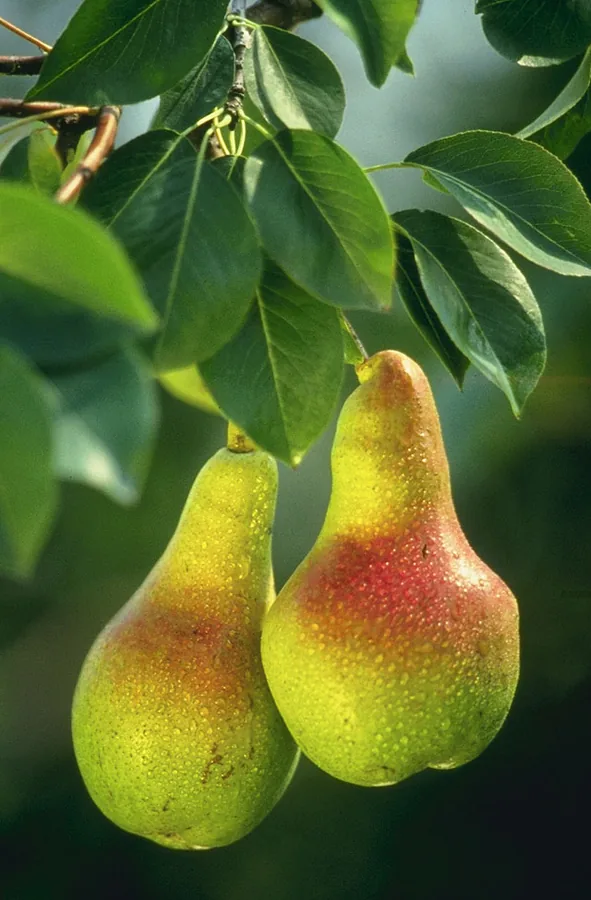
Two pear trees, planted for cross-pollination and bathed in sun, reward a patient household with decades of fruit.
Full sun
Every 7–14 days
USDA 4–8
40–50 ft · 12.2–15.2 m
Overview
A pear tree earns its place as an anchor of the garden, the kind of feature a home grows up around rather than a crop that comes and goes. Pyrus communis is a deciduous tree of the rose family, in the good company of apples, cherries, and plums, and a settled one rises 40 to 50 feet (12 to 15 m) and keeps its post for generations. Spring dresses it in white bloom that reads across the whole yard, and the season closes with the familiar bell-shaped fruit ready for the kitchen.
A pear rewards a little forethought about the space around it. Because most crop poorly alone, they rely on cross-pollination, which means room for a second compatible cultivar in bloom at the same time and the bees that move between them. Since named varieties do not come true from seed, the tree that goes into the ground is grafted onto a rootstock chosen to fit the plot, a full-size pear for an open orchard or a dwarfing quince for a courtyard corner.
Living with a pear has a rhythm the calendar sets. European pears ripen off the tree, not on it, so the harvest comes indoors mature but firm and finishes to a buttery softness on the counter, a small ritual that folds neatly into the week. Time that harvest, give the tree a pollination partner, and stay ahead of fire blight, and it settles into the landscape and asks little in return.
Care
The short version: full sun, a deep and freely draining soil, plus a second pear planted within pollinating distance. Water the young trees on a steady rhythm, prune through the dormant season to a clean central leader, and keep nitrogen modest so fire blight stays away.
Light
A pear does its best work in full sun, where at least six hours of direct light a day carries good flower and fruit set. A little afternoon shade is no trouble, but a tree set in the shadows repays it with weak growth and a thin harvest, so give it the open, sunlit corner of the garden.
Water
A tree wants about 1 inch of water a week, with young ones kept steadily moist while the roots find their footing in a new spot. Once established, a pear takes dry stretches in stride. Direct the water to the ground rather than over the canopy, since leaves left wet open the door to disease.
Soil
A pear settles most happily into deep, fertile, well-drained loam, and it will make peace with clay or sand wherever water keeps moving through. A pH of 6.0 to 7.5, slightly acidic to neutral, gives the tree the ground it prefers.
Temperature
A pear is a cold-hardy resident, at ease from about -20°F to 95°F (-29°C to 35°C) and suited to USDA zones 4 through 8. The winter chill is part of its character, since the buds want a cold rest before they break into spring.
Humidity
Ordinary outdoor air around 40% to 70% humidity keeps a pear content, so this is rarely a concern in the garden. What counts is airflow through the canopy, because still, damp air is the setting in which fire blight and scab take hold.
Feeding
A feeding of balanced N-P-K in early spring before bud break, about once a season, keeps a pear on an even keel. A light hand with the nitrogen serves the tree well, since a rush of soft, sappy growth is precisely what fire blight seeks out.
Pruning
Pruning comes in late winter while the tree is dormant, shaping a young pear to a single central leader and clearing crossing, dead, or diseased wood. Should fire blight appear, cut 8 to 12 inches below the visible canker and wipe the tools clean between every cut to keep it from traveling.
Repotting
A pear rarely lives in a container, though a dwarf tree in a large pot suits a terrace when it is top-dressed each year and repotted every 2 to 3 years. Refreshing the soil at the same time keeps the roots well provisioned in their close quarters.
Size & spacing
A standard pear stands 40 to 50 feet (12 to 15 m) tall and reaches 25 to 35 feet (7.5 to 10.5 m) across, so it wants open ground set well clear of buildings and power lines. A cross-pollinating pair still needs the room between them for air to pass and for each to hold its own in the landscape.
When to plant
A pear enters the garden while it is dormant and bare, an easy piece of timing to work into the year. Set it in early spring, or in fall where winters stay gentle, and it will open into white bloom in early to mid spring. The fruit arrives from late summer into fall, gathered firm and left to ripen off the tree indoors.
Northern hemisphere
Southern hemisphere
Typical months for a temperate climate: start earlier in warm zones, later where spring frosts linger.
- Plant: Early spring while dormant, or fall in mild-winter regions
- Harvest: Blooms early to mid spring; European pears are harvested mature but still firm in late summer to fall and ripened off the tree
Hardiness
USDA hardiness zones: 4–8
Temperature: down to -34°C
Troubleshooting
A pear meets only a short roster of recurring troubles, and fire blight stands well ahead of the rest. A passing look at the new growth in spring and the fruit through summer catches the first signs, since that is where they surface. Match what the tree shows below, then step in before it carries through the canopy.
Shoot tips blacken and arch over in a shepherd's crook
The culprit behind a scorched, crook-tipped tree is fire blight, a bacterial infection that arrives on the spring blossom during warm, wet weather and works its way down the shoots. The signs read plainly on the tree: that hooked tip, leaves burnt brown and still clinging, and cankers beaded with ooze. Restore the tree by cutting infected wood 8 to 12 inches below the damage on a dry day, wiping the tools clean between cuts so nothing travels to healthy branches.
Fix:
- Prune out infected wood 8 to 12 inches below visible symptoms during dry weather
- Disinfect pruning tools between every cut and remove and destroy prunings
Glossy sticky leaves, a sooty black cast, and curling edges
A tree that turns tacky and dull traces back to pear psylla, small insects that settle on the new growth and leave honeydew behind, and that residue is where black sooty mold takes up its dark coat. A glance at the fresh shoots reveals the little nymphs at rest in the droplets. A dormant horticultural oil ahead of bud break clears the overwintering generation, and an insecticide belongs in the picture only once monitoring shows the numbers have run high.
Fix:
- Apply dormant horticultural oil before bud break
- Use recommended insecticides only if monitoring thresholds are exceeded
Wormy, early-dropping fruit tunneled and packed with frass
The wormy pear that spoils the harvest is the doing of codling moth, whose larvae bore into the ripening fruit and leave the tunnels packed with frass toward the core. A single cut through a damaged pear lays the larva's path bare. Keep the ground gathered of infested and dropped fruit as it appears, and set out pheromone traps so any control lands in step with the moths' flight.
Fix:
- Remove and destroy infested and dropped fruit
- Use pheromone traps to time controls
Leaves stippled velvety and dark, fruit scabby and cracked
A wet spring can bring pear scab, a fungus that marks the foliage with velvety olive-to-black lesions and roughens the fruit with corky, cracked patches. The routine that keeps it in check is a familiar one: rake and destroy the fallen leaves where it overwinters, prune to open the canopy so air moves freely, and favor resistant cultivars. When the season turns against the tree, a fungicide through the infection period rounds out the effort.
Fix:
- Rake and destroy fallen leaves
- Apply fungicides during the infection period if needed
Toxicity
The ripe flesh of a pear is a wholesome fruit at the table and harmless to most pets in small amounts, which makes it an easy tree to live alongside. The care sits with the seeds, bark, and wilting leaves, which hold cyanogenic compounds common to the rose family. Keep the ground clear of fallen fruit and prunings, and set seed-laden cores and wilted foliage out of reach of horses, livestock, and grazing pets.
Toxic to
Cats · Dogs · Horses · Rabbits · Livestock · Birds
Safe for
People
Cats Caution
A cat may taste a little ripe flesh without concern; it is the seeds and wilting leaves that call for a watchful eye. A few chewed seeds or some wilted foliage can leave the stomach unsettled, and a true cyanide reaction, rare as it is, arrives as drooling and labored breathing.
Dogs Caution
A dog takes a little ripe pear in stride, so it is the core that deserves attention around the household. Seeds crunched through or wilted leaves grazed can sour the stomach, and a large helping can leave a dog weak and panting from the cyanogenic compounds within.
Horses Caution
Horses ask for the closest watch, since a paddock of windfall pears invites them to eat by the mouthful. Heaps of fallen fruit, seeds, and wilted leaves can bring on colic, and at the extreme, cyanide poisoning read in trembling and gasping.
Rabbits Caution
A small piece of ripe pear makes an agreeable treat for a rabbit, while the seeds and wilted greens are best kept from the hutch. Their compact size means even a modest amount of the cyanogenic parts can unsettle digestion.
Livestock Caution
Cattle, sheep, and goats will make a feast of dropped fruit and the wilting leaves of pruned or storm-broken branches. That wilted foliage carries the most cyanide, and a heavy feeding risks staggering, rapid breathing, and collapse.
Birds Caution
Chickens and other backyard birds take to ripe pear flesh with contentment and no harm. The seeds are the exception, carrying the cyanogenic compound, so lift out the cores before any is offered.
People Ripe fruit safe
Ripe pear is a wholesome fruit and altogether safe at the table. The one habit to avoid is swallowing the seeds, which hold the same cyanogenic compound found across the rose family.
Pets nibbling a little ripe pear flesh are unlikely to be harmed, but discard cores and seeds. The main real-world concern is horses and livestock eating large quantities of fallen fruit and seeds or wilted foliage.
Helpline numbers

United States
ASPCA Animal Poison Control: (888) 426-4435 (fee applies)
Poison Control: (800) 222-1222



Canada
Poison Centres: 1-844-764-7669
Varieties
A handful of European pears turn up again and again at the market and the nursery, each with its own place at the table. These are the names worth knowing, and most look for a partner in the garden to crop well.
Bartlett (Williams)
The most widely grown European pear wears a classic bell shape that shifts from green to yellow with ripeness and takes a place at the table equally well fresh or canned.
Bosc
Recognized at a glance by its long tapering neck and russeted cinnamon-brown skin, its firm, dense flesh keeps its shape through cooking and earns a place in the kitchen.
Anjou (D'Anjou)
An egg-shaped pear whose green skin, or red in Red Anjou, holds its color even at ripeness, so readiness is read in the gentle give at the neck.
Comice
The rounded greenish-yellow fruit often set on the holiday table as the Christmas pear, prized for its sweet, juicy, buttery flesh.
How to propagate
Pears are carried forward by grafting rather than by rooting cuttings or sowing seed, since a named variety holds its character only when grafted onto a rootstock.
GraftingModerate
Whip-and-tongue bench graft in late winter while dormant, or chip/T-bud in summer · Grafted trees typically begin bearing in about 3 to 6 years
A named cultivar will not come true from seed, so it is carried forward by grafting onto a chosen rootstock. The customary route is a whip-and-tongue bench graft in late winter while the wood rests dormant, with chip or T-budding taken up in summer. Pear seedling rootstock yields a full-size tree and quince a smaller one, though a few cultivars ask for a compatible interstem to unite. A grafted tree tends to come into bearing in about 3 to 6 years.
SeedModerate
Sow after 60 to 90 days of cold, moist stratification in spring · Several years
Raising pears from seed belongs to breeders and nurseries rather than to anyone hoping to copy a cherished tree. The seed goes down in spring after 60 to 90 days of cold, moist stratification to lift its dormancy. The seedlings need several years to make anything of themselves and will not come true to the parent, which is why they serve as rootstock or breeding stock.
Myths
Like apples, pears are meant to soften and ripen while still on the tree.
European pears such as Bartlett, Bosc, Anjou, and Comice keep their own counsel, quite unlike apples. Pick them mature but still firm and let them ripen off the tree, since fruit left to hang ripens from the inside out and settles into a mealy, gritty texture. Asian pears are the exception, content to ripen on the branch.
A lone pear tree, standing by itself, will bear a full crop.
A solitary tree tends to underwhelm come harvest. Most pears need a second compatible cultivar in bloom at the same time to cross-pollinate and set a generous crop, so a pair is the plan worth making from the start.