Shrub · Rosaceae
Rugosa Rose
Rosa rugosa
A shrub with seaside poise, the rugosa rose carries a garden through summer bloom and into a fall dressed in red hips.
Full sun
Every 7–14 days
USDA 2–7
4–6 ft · 1.2–1.8 m
Overview
There is a quiet confidence to the rugosa rose, the kind of shrub that anchors a garden without asking for attention. It hails from the coasts of eastern Asia and slipped so naturally into seaside life that the name beach rose followed it everywhere. In a border or along a path, its relaxed, informal presence reads as easy elegance rather than fuss, a rose that suits a lived-in landscape.
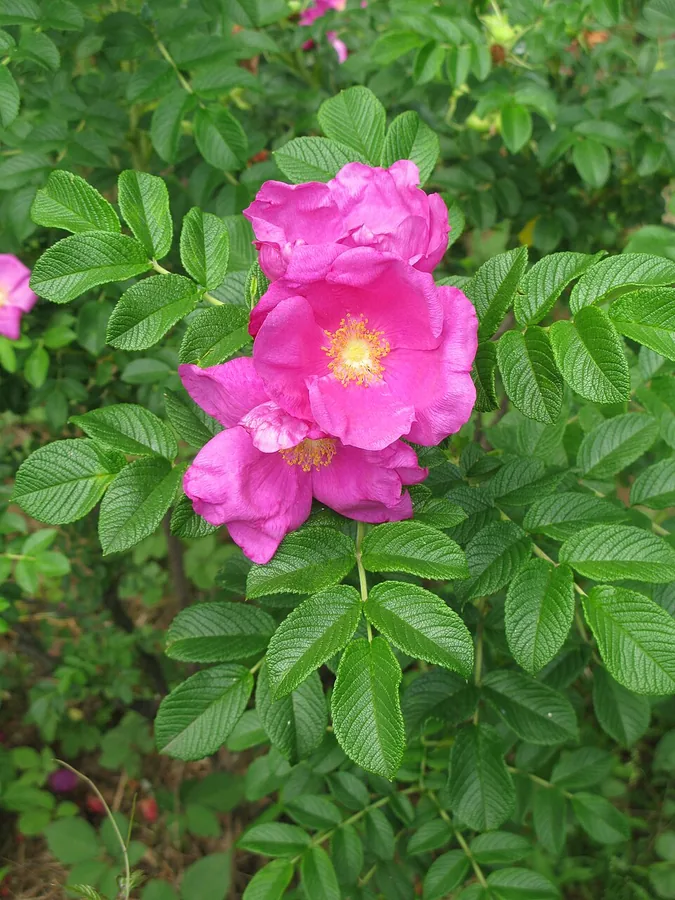
Its appeal is how gracefully it earns its keep. It settles into exposed, difficult sites where gentler roses falter, softening a windswept coastal plot or lining a country drive with color that lasts all summer. The blooms move through white, pink, and deep reddish purple, and their fragrance drifts on the air, turning an ordinary corner of the garden into somewhere you want to linger.
The one thing worth planning around is its ambition. This rose spreads by suckers into dense thickets, and along parts of the North American coast it has drifted beyond gardens into wild ground. Given a spot where its spread stays in hand, a contained bed or a defined hedge, it becomes one of the most carefree roses to live with, and its red hips carry the season into the kitchen for teas and preserves.
Care
The short version: set it in full sun and almost any soil, even sandy or salty coastal ground, and it slips easily into the landscape. Water it well while it settles, then let it carry on largely unattended, feed it lightly, and prune in late winter to keep its shape and hold the suckers in check.
Light
Give it full sun, the setting where it flowers most freely and stays healthiest, ideal for an open border or a bright coastal aspect. It manages partial shade, but a shaded, crowded corner keeps it damp and more prone to spotting, so the sunnier position always flatters it.
Water
While it is finding its feet, water deeply and often, then step back, because a settled rugosa is drought tolerant and asks little of a watering routine. A morning drink at the base, rather than over the top, keeps the foliage dry and the plant looking its best.
Soil
This rose is unfussy about ground, thriving in sandy, gravelly, clay, or poor coastal soils where little else will. It leans toward moist, well-drained, slightly acidic loam and a pH from 6.0 to 7.5, but it rarely holds out for the ideal.
Temperature
Few shrubs are so at ease across the seasons, holding steady from a fierce -51°F to 86°F (-46°C to 30°C). That range is what lets it belong in gardens far to the north, where a more delicate rose would never make it through winter.
Humidity
Everyday outdoor air is all it wants, so humidity is nothing to manage. What counts more is open air movement, since a still, crowded planting invites the leaf troubles that spoil its looks.
Feeding
Restraint suits it, as this is a rose that prefers lean ground. A single, light feed of balanced or rose fertilizer in spring is ample, and heavy feeding does it no favors, so a lighter hand keeps it at its best.
Pruning
In late winter to early spring, shape the shrub and clear any dead or weak canes to keep it looking composed. Take out the suckers in the same session, or the plant will slowly widen its footprint past where you meant it to sit.
Repotting
A rugosa belongs in open ground and seldom lives in a pot, so repotting rarely enters the picture. Should you grow one in a container, move it to a larger vessel when roots circle the base or reach the drainage holes, or when it wilts soon after watering.
Size & spacing
Allow for a rounded shrub of about 4 to 6 feet (120 to 180 cm) in height and width, and plan its place with that scale in mind. Leave a little extra room as well, since its suckering roots like to claim more ground than the canes suggest.
When to plant
Plant a rugosa rose in spring or fall and it eases into the garden with little ceremony. The flowers arrive in late spring and stay through the warm months, and as summer fades the red hips ripen and hold their color on the branches well into winter, a welcome note when the rest of the border has gone quiet.
Northern hemisphere
Southern hemisphere
Typical months for a temperate climate: start earlier in warm zones, later where spring frosts linger.
- Plant: Spring or fall
- Harvest: Blooms late May to July with intermittent rebloom until frost; showy red-orange hips ripen August into winter.
Hardiness
USDA hardiness zones: 2–7
Temperature: down to -46°C
Troubleshooting
This is an untroubled rose for the most part, and the few issues it meets are easy to head off. Most come down to suckers straying past their bounds or a little spotting on the leaves, and the notes below help you catch either one before it disrupts the picture.
A distorted red cluster stiff with thorns
A tight, warped broom of red shoots studded with extra prickles points to rose rosette disease, a virus carried by tiny eriophyid mites that cannot be cured once it arrives. For the sake of the roses nearby, dig out and remove the affected plant without delay. Milder clustered, stressed growth is often just aphids, scale, thrips, or spider mites, which a firm spray of water or the loss of a few canes will settle.
Fix:
- Promptly remove and destroy plants showing rose rosette symptoms to protect nearby roses
- Treat heavy insect infestations with a strong water spray or appropriate control
- Remove and dispose of badly infested canes
Stray shoots rising beyond the planting
Those new canes appearing away from the main clump are simply the rugosa rose's suckering habit, the same energy that lets it knit into a thicket so quickly. Its shallow roots keep pushing up fresh shoots past the crown, so cut and dig them as they appear, or contain the plant behind a root barrier from the start. Near dunes or wild ground, a well-mannered named cultivar keeps the scene tidy.
Fix:
- Cut and dig out suckers as they appear
- Install a root barrier or plant in a contained bed
- Choose a better-behaved named cultivar instead of the straight species
Spotted, blistered leaves falling ahead of season
Rugosa carries itself above most rose diseases, yet rust, black spot, and powdery mildew can settle in where a planting stays damp, shaded, and close. Clear away the marked leaves and rake up the fallen ones so nothing overwinters to return. Thin the canes for air and water at the base in the morning, and the shrub keeps its poise.
Fix:
- Remove and dispose of affected leaves and fallen debris
- Improve air circulation by thinning canes
- Water at the base in the morning rather than overhead
Toxicity
This is a rose you can live with easily around a busy household. Every part of it is non-toxic to cats, dogs, horses, and people, and the hips are edible and rich in vitamin C, at home in the kitchen as much as the garden. The only thing to mind is the sharp prickles along the canes, so a pair of gloves is all the caution the plant asks for.
Safe for
People · Cats · Dogs · Horses · Rabbits · Livestock · Birds
Cats None
With no toxic compound in the plant, a cat that nibbles a petal or leaf comes to no harm. The only thing to watch is the sharp prickles, which can scratch a paw or mouth.
Dogs None
A dog can chew the leaves, flowers, or ripe hips without any risk of poisoning. Keep it clear of the thorny canes, since a bristling stem is the single hazard worth minding.
Horses None
Horses graze the foliage and hips with no ill effect at all. The dense prickles are the one caution, as they can prick a soft muzzle reaching in among the canes.
Rabbits None
Rabbits browse the leaves and stems safely, and the hips make a fine treat. Nothing in the plant is poisonous to them.
Livestock None
Cattle, goats, and sheep can graze the shrub without harm. The thorny canes tend to discourage browsing more than they cause any injury.
Birds None
Birds are drawn to the red hips and scatter the seed far and wide, part of how the rose spreads on its own. Eating any part of it leaves them unharmed.
People None
The hips are edible and rich in vitamin C, lovely in teas, jams, and syrups, and the petals are edible as well. Wear gloves near the canes, since the sharp prickles are the only part that bites back.
Stems are densely covered in sharp, needle-like prickles that can cause scratches and puncture wounds; wear gloves and long sleeves when handling or pruning.
Varieties
Nearly all the rugosa roses offered for sale are named cultivars, each chosen for its flower color, its fragrance, or a habit that suits a particular corner of the garden. These are the ones you are most likely to find.
Hansa
A vigorous, generous shrub whose double, reddish-purple flowers bring a strong perfume and finish in large red hips.
Blanc Double de Coubert
A tough, disease-resistant choice with semi-double, pure white blooms and an intense fragrance that carries across a border.
Frau Dagmar Hastrup
A compact, well-mannered form with single silvery-pink flowers that give way to a heavy crop of large red hips.
F.J. Grootendorst
Its small red flowers, fringed like a carnation, gather in clusters for bloom that scarcely pauses through the season.
How to propagate
Increasing a rugosa rose fits neatly into the rhythm of the garden year, whether you lift one of its ready suckers, root a cutting through summer, or grow it slowly from the seed inside its hips.
DivisionEasy
Late winter to early spring or fall · 1 to 2 seasons
Because rugosa grows on its own roots and offers up suckers so freely, the easiest increase is to sever a rooted sucker from the parent and replant it in late winter to early spring or in fall. Give the new plant a season or two to settle, and it carries on as a faithful match to the original.
Stem cuttingsModerate
Summer (softwood or semi-hardwood) · Several weeks to root, then 1 to 2 seasons to establish
Nurseries favor cuttings, taken in summer from healthy current-season growth as softwood or semi-hardwood. They root over several weeks and then take a season or two to fill out into a shapely, established shrub.
SeedModerate
Sow cleaned seed from ripe hips in fall, or stratify and sow in spring · 1 or more years
Each ripe hip holds 20 to 120 seeds, so material is never scarce, though this route calls for patience. Sow cleaned seed in fall, or cold-stratify and sow in spring, then allow for slow, uneven germination and a year or more before the seedlings come into their own.
Myths
The rugosa rose is a well-behaved native you can plant anywhere along the coast.
Its roots lie in eastern Asia, not North America, and it has slipped out of gardens to grow invasive along the coasts of New England, Virginia, and parts of Canada. There it forms dense thickets that crowd out the native dune plants, which is why it appears on Maine's advisory list and belongs well away from wild ground.
Because roses are non-toxic, the whole plant is completely safe to handle.
The eating side is beyond question, since the leaves, flowers, and hips are safe for people and pets alike. The handling side is another matter, as the canes bristle with sharp, needle-like prickles that scratch and puncture, so gloves and long sleeves are the graceful way to prune.