Tree · Rosaceae
Serviceberry
Amelanchier × grandiflora
The small tree that dresses a garden in white spring flowers, sweet June berries, and fiery fall color.
Full sun
Every 7–14 days
USDA 4–9
15–25 ft · 4.6–7.6 m
Overview
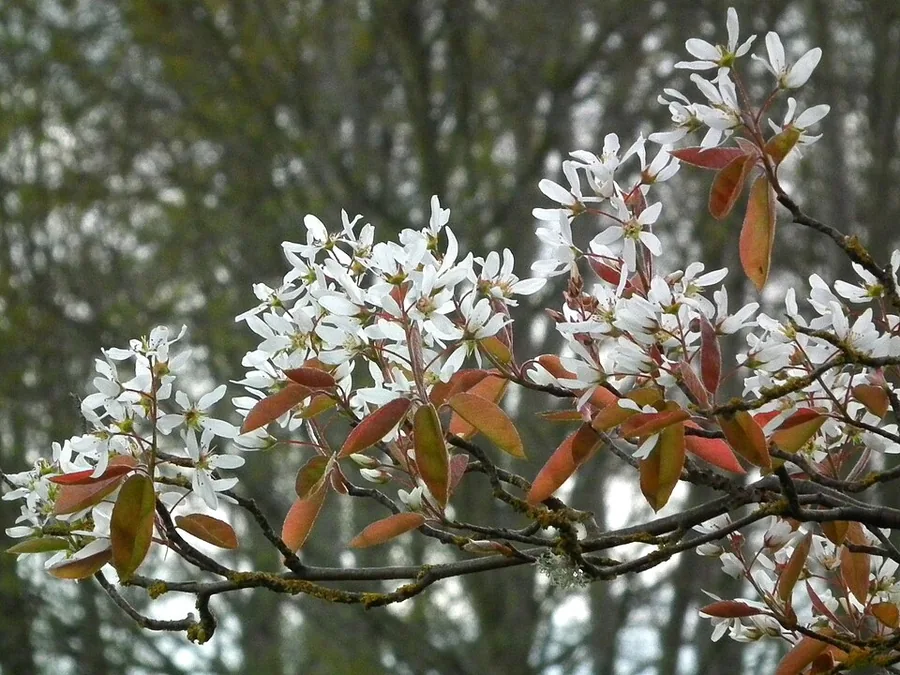
Serviceberry is the kind of small tree that gives a garden something to do in every season. Spring opens with a haze of white flowers set high before the neighboring trees have leafed out, June brings blue-purple berries for the breakfast table, and autumn closes the year in red and orange. It answers to a whole roster of names, from juneberry to shadbush to saskatoon, yet it is always the same unfussy native at the center of the planting.
A member of the rose family alongside apples and pears, it carries their gift for fruit into a domestic setting. The ripe berries read like blueberries on the plate, at home in a bowl fresh or folded into a pie, though the garden's birds will lay their own claim. As a design piece it plays two roles with ease, standing as a clean single-trunk specimen or relaxing into a multi-stem clump that softens a corner.
Few trees make so gracious a guest. Serviceberry settles into sun or shade, holds its poise through winters down to zone 4, and takes to loam, sand, or clay so long as the ground drains. Give it steady water while it finds its place, and it becomes a fixture of the garden for decades.
Care
The short version: place it in full sun to earn the fullest flowers and fruit, though a shadier spot still works, and set it in moist, well-drained, slightly acidic soil. Keep it watered while it establishes, and reserve any pruning for the dormant season.
Light
Serviceberry gives its most generous flowers and fruit in full sun, yet it is one of the rare small trees content in partial shade or even full shade, which opens up the dim corners most trees refuse. A deeply shaded position trades away some berries and a softer fall color, so choose the brightest spot the garden can spare.
Water
Keep the soil evenly moist while the tree settles in, watering about every 7 to 14 days. Once established it carries short dry spells with grace, though steady moisture rewards the garden with the fullest flowering and fruit.
Soil
It asks little of the soil, growing happily in loam, sand, or clay as long as the bed drains well. A slightly acidic pH of 5.5 to 7.0 suits it best, and a moist, compost-enriched planting brings out its most confident growth.
Temperature
Serviceberry is quietly hardy, at ease from -29°F to 100°F (-34°C to 38°C) across zones 4 to 9. That range is much of why it holds a place in gardens where less resilient fruiting trees never settle.
Humidity
Everyday outdoor air suits it, so there is no humidity figure to manage. What counts is good air circulation, since crowded, damp foliage is the opening rust looks for in a wet spring.
Feeding
A light spring feeding is plenty, whether a balanced slow-release fertilizer or a simple dressing of compost and mulch. Keep a light hand with nitrogen, since the soft, lush growth it encourages is exactly what fire blight seeks out.
Pruning
Prune in fall to early winter while the tree rests, which spares it a heavy loss of sap. Clear away dead, damaged, or crossing branches, and thin the root suckers to hold the form you favor, whether a poised single trunk or an easy multi-stem shrub.
Repotting
This is a tree for the open garden rather than a container, so repotting rarely enters the picture. A young one grown in a pot needs moving up only when the roots circle the base, the soil dries too fast, or the top growth loses momentum.
Size & spacing
Allow for a mature frame of 15 to 25 feet (4.6 to 7.6 m) tall and 15 to 20 feet (4.6 to 6.1 m) across. Giving it room to reach that full spread keeps air moving through the canopy and rust at bay, and lets the tree hold its shape in the design.
When to plant
Serviceberry lends a garden a clear seasonal rhythm. Set out container or balled-and-burlapped trees in spring or fall, look for the white flowers through March and April, and bring in the ripe berries in June before the birds arrive to share the moment.
Northern hemisphere
Southern hemisphere
Typical months for a temperate climate: start earlier in warm zones, later where spring frosts linger.
- Sow: Sow seed only after 2-6 months of cold stratification; germination is slow and often delayed to the second spring, and seedlings are not true to type.
- Plant: Plant container or balled-and-burlapped trees in spring or fall.
- Harvest: White flowers appear in early spring (March-April); sweet blue-purple pome fruit ripens in June.
Hardiness
USDA hardiness zones: 4–9
Temperature: down to -34°C
Troubleshooting
Serviceberry keeps its composure in the landscape, and most of its troubles are cosmetic rather than serious. A little attention lets you catch the one disease that does real harm before it spoils the picture. Match the sign you see below, then step in while it still matters.
Shoot tips scorched dark and bent into a hook
This is fire blight, a bacterial disease that scorches shoot tips from brown to black, bends them into a hook, and leaves the dead foliage clinging. An overfed tree pushing soft, quick growth is the easiest mark, and the cankers can weep in wet spring weather. Cut each infected branch at least 4 inches below the canker in dry, dormant weather, and wipe the tools between cuts so the trouble travels no further.
Fix:
- Prune out infected branches at least 4 inches below the canker during dry, dormant weather
- Disinfect pruning tools between cuts
- Remove highly susceptible root suckers and water sprouts
Rusty orange staining across the foliage and fruit
The blemish is cedar-serviceberry rust, a fungus that can complete its cycle only where a serviceberry and a nearby juniper or redcedar share the garden. A wet spring invites it in, marking the tops of leaves with orange and hanging odd tube-like growths beneath. Take off the worst leaves and fruit, keep junipers out of the setting, and a spray at bud break steadies things where the problem returns.
Fix:
- Remove and destroy heavily infected leaves, fruit, and twigs
- Avoid planting near junipers or eastern redcedar and remove unwanted ones nearby
- Apply a protective fungicide at bud break in problem areas if needed
Ripe berries gone from the branches in a single June morning
This is only the birds, who can empty a tree of ripe fruit within a day. Since the berries are a wildlife favorite, that vanishing act is part of the tree's charm unless the harvest was meant for your own kitchen. Lay netting over the canopy just as the fruit takes on color, then gather it promptly as it ripens.
Fix:
- Net branches before fruit ripens if you want to harvest for yourself
- Harvest promptly as fruit colors up
- Accept fruit loss as wildlife value if harvest is not a goal
Foliage worn to lace by the height of summer
The lacework is the mark of Japanese beetles, whose metallic green-and-bronze adults gather on the leaves and graze the tissue between the veins. Pear slug sawflies can leave the same effect. Tip the beetles into soapy water in the cool of the morning, and let an established tree carry a little light feeding without losing its looks.
Fix:
- Hand-pick beetles into soapy water in the morning
- Tolerate light feeding on established trees
- Use labeled insecticides only for severe infestations
Toxicity
This is a tree you can plant with an easy mind. Serviceberry is not on ASPCA toxic-plant lists, and its ripe fruit is a pleasure for people, pets, and wildlife alike. Like others in the rose family, the leaves and seeds hold only trace cyanogenic compounds, so it is wise to keep animals from grazing heavily on foliage, though the tree sits comfortably at the heart of a family garden.
Safe for
People · Cats · Dogs · Horses · Rabbits · Livestock · Birds
Cats None
Serviceberry is safe in a household with cats and appears on no ASPCA toxic-plant lists. A cat that nibbles a leaf might, at the very most, have a passing stomach upset.
Dogs None
A garden dog can share the space with this tree untroubled, and a fallen berry or two does no harm. Only a dog that made a meal of the leaves and seeds might feel briefly queasy.
Horses Safe
Horses graze around serviceberry with no concern. The foliage holds only trace cyanogenic compounds, far below any level that would register at ordinary browsing.
Rabbits Safe
Rabbits browse the leaves and twigs safely, as the wild ones do right through winter. A little of the ripe fruit suits them too.
Livestock Safe
Cattle, goats, and sheep graze serviceberry without harm. As with the rest of the rose family, its foliage carries only minor cyanogenic compounds that pose no real risk at pasture.
Birds Safe
Birds gather at the ripe berries, which count among their favorite foods. Nothing about the tree puts them at any risk.
People Safe
For people, the ripe blue-purple fruit is sweet and lovely fresh or turned into preserves. The seeds, like those of other rose-family fruit, carry trace cyanogenic compounds, so there is no sense in crushing and eating them in quantity.
Ripe fruit is safe and tasty; like other Rosaceae the leaves and seeds contain low levels of cyanogenic compounds, so discourage pets from eating large amounts of foliage or seeds.
Varieties
A few serviceberries have earned their place in gardens, from the well-mannered hybrids to the rugged natives. These are the ones worth choosing by name.
'Autumn Brilliance' (Amelanchier × grandiflora)
A much-admired, disease-resistant cross of A. arborea and A. laevis, it rises to about 25 feet tall and 15 feet wide in a rounded form that turns a striking red-orange each fall.
Amelanchier canadensis (shadblow/Canadian serviceberry)
A multi-stemmed, freely suckering shrub or small tree for zones 3 to 8, at its best naturalizing a garden's edges and filling the damp corners where other forms falter.
Amelanchier alnifolia (saskatoon/western serviceberry)
A western native grown commercially in Canada as a superfruit, valued for its large, sweet, juicy berries.
Amelanchier arborea (downy serviceberry)
A tall eastern native of 15 to 25 feet, offering downy young leaves, early white bloom, and a dependable orange-red finish to the season.
How to propagate
Serviceberry can be multiplied in several ways, and the right one turns on whether you are after a named cultivar or simply more trees for the garden.
SeedDemanding
Fall or spring after stratification · Often germinates the second spring
Seed is a slow indulgence. Allow 2 to 6 months of cold, moist stratification before sowing in fall or spring, and expect it to bide its time, often until the second spring, before it appears. The seedlings come on slowly and will not echo a named cultivar, so this way suits wild or naturalized plantings best.
DivisionModerate
Dormant season · One growing season
The suckering shrub forms, A. canadensis among them, divide with ease. While the plant sleeps, lift a rooted sucker from the base and replant it, and it will find its footing within a single growing season.
Stem cuttingsModerate
Summer · One growing season
Take softwood cuttings in summer, or turn to hardwood cuttings in spring should the window slip past. Rooted cuttings establish across one growing season and come true to the parent tree.
GraftingDemanding
Dormant season · One to two seasons
Grafting is how the trade preserves a named cultivar. In the dormant season a scion is united with seedling rootstock, and the join needs one to two seasons to mature into a dependable tree.
Myths
Serviceberry fruit is poisonous and best left to the birds.
The truth is far more inviting. The ripe blue-purple pomes are sweet and genuinely good to eat, close to blueberries, and welcome fresh or simmered into preserves. Serviceberry is not on ASPCA toxic-plant lists, so the only real rivals for a bowlful are the birds.
A named cultivar like 'Autumn Brilliance' will come true from its own seed.
Not so, since serviceberry behaves like an apple, so its seedlings wander from the parent and vary widely. Named cultivars are propagated by grafting or cuttings rather than seed, which is how their habit and fall color are kept intact.