Tree · Rosaceae
Weeping Cherry
Prunus subhirtella
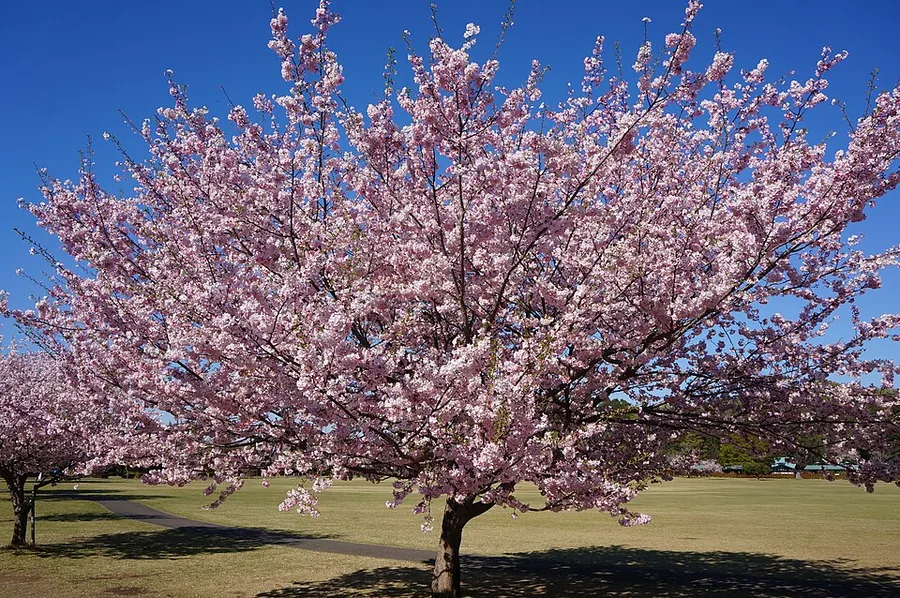
Every April, the weeping cherry turns a corner of the garden into a soft curtain of pink and white.
Full sun
Every 5–10 days
USDA 4–8
15–40 ft · 4.6–12.2 m
Overview
Few trees set a spring scene like the weeping cherry. Its long branches lift from a grafted standard and fall in a graceful arc, and for a few weeks in early spring, before any leaf appears, that arc becomes a veil of light pink to white flowers. A member of the rose family with roots in Japan, where the Higan cherry has been treasured for centuries, it brings an unmistakably poetic note to a yard.
The tree you plant is almost always a graft, and that shapes how it reads in a landscape. A weeping crown is set atop an upright standard rootstock, usually at 4 to 6 feet, so the cascade begins at eye level rather than the ground and draws the gaze upward before it spills. It is worth knowing that any growth below the graft breaks the effect, coming in straight and plain, so those shoots come off to keep the silhouette clean.
Given room, it grows quickly into a presence of 15 to 40 feet (4.6 to 12 m) tall with a spread to match, enough to anchor a lawn or frame a view. It settles across much of the country and asks little once established, making it an easy centerpiece. The one caveat for a household is its cherry foliage, which carries cyanide-bearing compounds, so its placement deserves thought where grazing animals share the space.
Care
The short version: a sunny position, moist well-drained soil, and steady water through its early years. A single feeding in early spring, a light prune once the flowers pass, and a habit of clearing suckers below the graft keep it looking its best.
Light
Set it where it will stand in full sun and the bloom comes in at its fullest, turning the whole crown into a spring feature. It accepts a little partial shade and still flowers, though with a lighter touch. The brighter the position, the more generous the display that greets the season.
Water
Keep the soil moist and well drained, watering every 5 to 10 days while the tree is young or during a dry spell. Once established it carries on through some dryness with ease. What it never wants is to stand in soggy ground, which undoes its poise.
Soil
It looks its best in moist, fertile, well-drained loam, yet it adapts gracefully to clay or sand. A pH anywhere from 5.5 to 7.5 suits it, a range that takes in most garden soils and leaves little to fuss over.
Temperature
This is a hardy tree, at home across a wide sweep from -20°F to 100°F (-29°C to 38°C). It draws on the winter chill of a temperate climate, which is what sets the stage for its spring performance.
Humidity
Ordinary outdoor air suits it perfectly, so there is nothing to manage on that front. Far more telling is good airflow through the canopy, since crowded, damp branches invite the leaf and bark troubles that dull a cherry's looks.
Feeding
A single feeding carries it through the year. Offer a balanced slow-release tree fertilizer in early spring as growth begins, and leave it at that, since heavier feeding only forces soft growth that pests and canker are quick to claim.
Pruning
Take up the pruners just after flowering to lift out dead, damaged, or crossing wood and to keep the weeping line graceful. The suckers below the graft union always come off, and big cuts are best avoided, as large wounds invite borers and canker.
Repotting
This is a tree to plant and leave. It is not suited to containers, so give it a permanent place with room for the full spread and let it grow into its role.
Size & spacing
At maturity it reaches 15 to 40 feet (4.6 to 12 m) tall with a spread of 15 to 25 feet (4.6 to 7.6 m), so plan that footprint from the outset. Site it well clear of buildings and other trees, since it grows fast and settles in for good rather than moving.
When to plant
The weeping cherry lives by the cool half of the year, and its rhythm is easy to fold into a garden calendar. Plant while it rests in early spring or fall, look forward to blossom before the leaves in early to mid spring, and set aside pruning for the quiet moment just after the flowers fade.
Northern hemisphere
Southern hemisphere
Typical months for a temperate climate: start earlier in warm zones, later where spring frosts linger.
- Plant: Early spring or fall while dormant
- Harvest: Early to mid spring (light pink to white flowers before leaves)
Hardiness
USDA hardiness zones: 4–8
Temperature: down to -34°C
Troubleshooting
For all its grace, the tree's troubles gather on the bark and twigs rather than the flowers. A canker or a black knot gall caught early can be removed before it spreads and spoils the line of the canopy. Match what appears below, then act while the surrounding wood is still sound.
Wilting branch tips over sunken, oozing cankers
The look points to canker and dieback, where fungi enter through wounds and shut down whole limbs, at times with borers working underneath. Remove the cankered wood well below the lesion during dry weather, cleaning your tools between cuts. A vigorous, well-watered tree with unbroken bark stays the surest safeguard.
Fix:
- Prune out cankered wood well below the lesion during dry weather
- Sterilize tools between cuts
- Improve vigor with proper watering and avoid bark wounds
Hard black galls swelling around twigs and branches
Those coal-black, corky swellings are black knot, a fungus that seizes the twigs and stands out most in winter. Cut each knot out 10 to 15 cm below the gall in late winter and dispose of the prunings. Clearing away any wild cherry nearby matters too, since it keeps returning the same disease to the tree.
Fix:
- Prune out knots 10-15 cm below the gall in late winter
- Destroy or remove pruned material
- Repeat inspections annually
Spotted, sticky, or nibbled foliage
A handful of culprits settle on the leaves. Aphids and scale leave sticky honeydew and curling foliage, Japanese beetles strip the green between the veins, and leaf spot or leaf curl fungi mark clear lesions. Rinse off or treat the sap-feeders with horticultural oil, lift the beetles off by hand, and gather fallen leaves so the fungus cannot return the next season.
Fix:
- Hose off or treat aphids/scale with horticultural oil or insecticidal soap
- Handpick Japanese beetles
- Rake and destroy fallen diseased leaves
Toxicity
This is a tree to admire rather than sample. Like every cherry, its leaves, twigs, bark, and seed pits hold cyanogenic glycosides that release cyanide, and wilted foliage is the most hazardous of all. Keep prunings and fallen leaves well away from horses and livestock, and see that pets and children do not chew the twigs or pits.
Toxic to
Cats · Dogs · Horses · Rabbits · Livestock · Birds · People
Cats Mild
A cat that chews wilted leaves, twigs, or a seed pit may show brick-red gums, widened pupils, and labored, panting breath. Such cases are uncommon, yet cyanide acts quickly, so any breathing trouble calls for emergency care.
Dogs Mild
A dog that gnaws bark, twigs, or fallen seeds might drool, breathe hard, and show flushed red gums with dilated pupils. It happens rarely, but a dog that has cracked into the pits needs a vet without delay.
Horses Severe
Horses face genuine danger here. A pile of wilted prunings left within reach can bring on staggering, gasping breath, bright red mucous membranes, and convulsions, with death possible within minutes.
Rabbits Toxic
The same cyanogenic compounds make the leaves, twigs, and bark unsafe for rabbits. Keep cuttings and prunings out of reach, since even a little wilted foliage can bring on weakness and breathing distress.
Livestock Severe
Cattle, sheep, and goats are the classic victims of wilted-leaf cyanide poisoning. Within 15 to 20 minutes of eating fallen or pruned leaves they may slobber, breathe rapidly, show bright red membranes, and convulse, often fatally.
Birds Toxic
The cyanide in the foliage, bark, and seed pits endangers birds as well, so keep poultry and pet birds from pecking at prunings or cracked pits.
People Caution
This is an ornamental tree, not a food. The pits, leaves, twigs, and bark carry cyanogenic glycosides, so none of it should be eaten, and children are best kept from chewing the seeds or foliage.
Keep pruned branches and fallen leaves away from horses and livestock, since wilting raises cyanide. Prevent pets from chewing twigs, bark, wilted leaves, or seeds.
Helpline numbers

United States
ASPCA Animal Poison Control: (888) 426-4435 (fee applies)
Poison Control: (800) 222-1222



Canada
Poison Centres: 1-844-764-7669
Varieties
Most weeping cherries descend from a small cast of named cultivars, distinguished by flower color, single or double blooms, and the scale of the tree. These are the ones that shape a planting.
'Pendula'
The classic weeping form drapes single light-pink flowers along long cascading branches grafted atop a 4 to 6 foot standard.
'Pendula Plena Rosea'
This weeping selection exchanges the single blooms for fuller, double pink flowers.
'Snofozam' (Snow Fountains)
A dwarf weeping cultivar, it sends white flowers down a low cascading frame that suits a smaller garden.
'Autumnalis'
Its semi-double pink flowers arrive twice, once in fall and again in early spring.
Yoshino cherry (Prunus × yedoensis)
A related flowering cherry, upright and spreading rather than weeping, dressed in white to pale-pink blooms.
How to propagate
Propagating a weeping cherry belongs to the nursery rather than the home garden. The cascading form depends on grafting onto a tall standard, which is why growers produce nearly all of it and a home cutting seldom captures the same effect.
GraftingDemanding
Late winter to early spring (bench graft) or summer (budding) · 1-2 years to a saleable grafted tree
Grafting shapes nearly every weeping cherry in the trade. Growers bench-graft in late winter or bud in summer, joining the weeping scion to an upright standard rootstock, often Prunus avium, at 4 to 6 feet so the branches begin their fall from the top. A saleable tree takes 1 to 2 years to form, and the craft is demanding enough that few home gardeners take it up.
Stem cuttingsDemanding
Early summer (softwood) · Several weeks to root, 1-2 years to establish
Softwood cuttings taken in early summer will root, though grudgingly, needing several weeks to strike and 1 to 2 years to establish. The lasting drawback is that a rooted cutting has no tall standard, so it never reaches the elevated cascading form grafting creates, which keeps this path uncommon.
Myths
Weeping cherries grow from seed or cuttings and rise straight like an ordinary tree.
The cascade is the work of a scion grafted onto an upright standard rootstock, not a seed. Any sucker that rises below the graft union reverts to the rootstock and grows straight, so those are removed to hold the shape.
Only the flowers and fruit put animals at risk.
The petals are not the concern. The cyanogenic compounds settle in the leaves, twigs, bark, and seeds, and wilted foliage is the most dangerous of all to grazing animals.