Tree · Arecaceae
Windmill Palm
Trachycarpus fortunei
Hardy down to single digits, the windmill palm lends a true tropical mood to gardens far colder than most palms could ever call home.
Partial shade
USDA 7–10
8–40 ft · 2.4–12.2 m
Overview
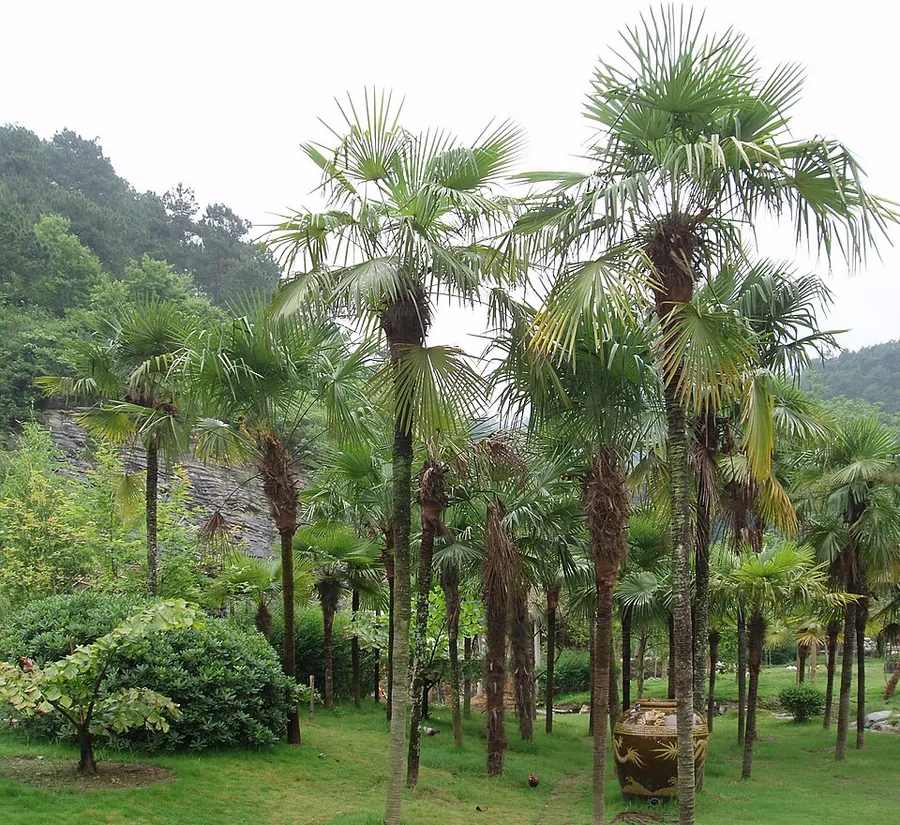
The windmill palm is the piece that brings a resort mood to a garden well outside the tropics. It comes from the mountains of central and eastern China, and that high-altitude home is why it stands up to cold that would see off other palms, holding to 5°F (-15°C). Its stiff, rounded fans open like the blades of a windmill, a shape that reads as sculpture against a wall or a wide sky.
The plant rises on a single, slender trunk sheathed in coarse brown fiber, climbing slowly, often only a few inches a year. Over decades it can reach 8 to 40 feet (2.4 to 12 m), though most garden specimens settle well below that, an easy scale to live with. It suits a hardy landscape planting across USDA zones 7 to 10, a generous container on a terrace, or a cool conservatory under glass.
This is the palm to reach for when the look is the point and the upkeep is not, since it asks little once it has settled into a spot. Give it good soil, steady moisture, and a sheltered corner away from harsh wind, and it holds its poise for years with barely a thought.
Care
The short version: part shade to full sun, rich and well-drained soil kept evenly moist but never waterlogged, a slow-release palm feed through the growing season, and a sheltered spot away from cold, drying winds.
Light
It looks its best in partial shade and takes full sun once established, so it slots neatly into a dappled courtyard or an open terrace alike. Light to medium shade suits it, and a young plant especially prefers to be spared the harshest midday glare.
Water
Give it regular, ample water in soil that stays evenly moist yet drains freely, and the crown stays lush. An established palm rides out a moderate dry spell, but it will not tolerate standing water or a high water table, which quietly rots the roots.
Soil
Set it into rich, fertile, well-drained loam and it settles in gracefully. A pH of 6.0 to 7.5 is welcome, it takes sand and a wide range of soils in stride, and its moderate salt tolerance makes it a natural for a coastal garden.
Temperature
This is the hardiest trunked palm of them all, weathering cold to 5°F (-15°C) and heat to 104°F (40°C). That range is what lets it hold a tropical look in a garden far from the tropics, though a young plant still appreciates a little winter shelter.
Humidity
No humidity target is needed, since ordinary outdoor air suits it perfectly. Shelter from cold, drying wind does far more to keep the fronds looking their best than any reading on a gauge.
Feeding
Feed it through the growing season, spring into early fall, with a slow-release palm fertilizer carrying micronutrients like manganese, magnesium, and iron. Palms tend to run short on nitrogen, potassium, magnesium, and manganese in sandy ground, and the right feed keeps the fronds a clean, even green rather than yellowing.
Pruning
It stays elegant with almost no pruning. Remove only the fully dead, browned lower fronds and spent flower or fruit stalks, and never cut a healthy green one. Loose trunk fiber can be tidied for a cleaner line, but the growing point at the crown must stay untouched.
Repotting
Move a container specimen into a larger pot every 2 to 3 years, or sooner once it turns rootbound. Mature landscape plants are left in place, so this only applies while the palm is still styled in a pot.
Size & spacing
Over many years a windmill palm reaches 8 to 40 feet (2.4 to 12 m) tall, with a crown spreading 4 to 6 feet (122 to 183 cm). Its slow pace makes it easy to place, so choose a spot that flatters it for the long haul.
When to plant
There is no planting season to plan around, since the windmill palm grows slowly through the whole year rather than by a sowing calendar. It does keep a quiet seasonal rhythm: yellow flowers open in early summer, and on female plants the dark drupes ripen from late summer into fall.
Northern hemisphere
Southern hemisphere
Typical months for a temperate climate: start earlier in warm zones, later where spring frosts linger.
- Harvest: Yellow flowers on drooping panicles in early summer (June to July); dark blue to nearly black drupe fruits ripen on female plants in late summer to fall.
Hardiness
USDA hardiness zones: 7–10
Temperature: down to -18°C
Troubleshooting
The windmill palm asks little and gives back a lot, so real trouble is rare and most of what appears is cosmetic or easy to prevent. Keep a casual eye on the fronds and the drainage, where any early sign tends to surface. Match what you see below and step in before a small thing settles.
A wilting, fading crown while the soil stays wet
A palm that slumps in wet ground is showing root rot. Roots left in standing water or a high water table turn soft and dark and stop supplying the canopy, so the elegant crown fades even with moisture underneath. Reset the planting for good drainage, ease off the watering, and keep it out of any low corner where runoff gathers.
Fix:
- Improve drainage and reduce supplemental watering
- Avoid planting in low spots that collect water
Sticky fronds dulled by a sooty film and small bumps
That grimy, glazed look on the fronds comes from scale insects or palm aphids. Their sugary honeydew draws a black sooty mold that flattens the plant's whole presence in a room, and the pests sit as small hard bumps or soft clusters along the tops and undersides. A wipe-down with horticultural oil or insecticidal soap restores it, and any badly covered frond is best removed.
Fix:
- Treat with horticultural oil or insecticidal soap
- Remove heavily infested fronds
Yellow, frizzled fronds appearing on the newest growth
New fronds coming in pale and distorted point to a nutrient deficiency, usually manganese, potassium, or magnesium. Light, sandy soils drain these minerals away first, which dulls the fresh growth that gives the palm its poise. A slow-release palm fertilizer with micronutrients puts it right, kept up as a steady seasonal habit rather than a single corrective feed.
Fix:
- Apply a slow-release palm fertilizer containing micronutrients
- Correct deficiency on a regular schedule rather than a single dose
Fronds tearing and shredding along the leaf segments
The tattered look is only wind damage, not disease. Cold, drying gusts catch the broad fans and split them along their natural folds, which spoils the clean silhouette but leaves the plant unharmed. Give a potted specimen a sheltered corner of the terrace or a screening windbreak, and tidy away only the fronds that read as truly ragged or dead.
Fix:
- Provide a windbreak or relocate to a more sheltered position
- Trim only the most badly damaged or fully dead fronds
Toxicity
For a home with animals, the verdict is reassuring: the windmill palm is non-toxic throughout. It is a true palm, not the poisonous sago palm it is so often mistaken for, so there is no cycasin or other toxin to keep in mind around pets, livestock, or children.
Safe for
People · Cats · Dogs · Horses · Rabbits · Livestock · Birds
Cats None
A household cat can share the room with it freely. The ASPCA lists the windmill palm as non-toxic, so a cat brushing past the fronds has nothing to fear.
Dogs None
It sits easily in a dog-friendly home, carrying the ASPCA non-toxic listing, so a dog that mouths a frond comes to no harm.
Horses None
For a country setting, NC State Extension records it as non-toxic to horses, making it a graceful, worry-free choice near the paddock.
Rabbits Safe
Rabbits are in no danger around it, since nothing in this true palm is known to harm them and a passing nibble matters not at all.
Livestock Safe
Cattle, goats, and sheep can graze alongside it in peace, as the plant holds no toxins that would trouble them.
Birds Safe
Birds keep good company with it, since the fronds and ripe fruit carry no poisoning risk for garden visitors or a pet indoors.
People Safe
It belongs in a family space, children included. This is the true palm, not the toxic sago it is mistaken for, so a handled frond is entirely harmless.
Often confused with the highly toxic sago palm (Cycas revoluta); the true windmill palm is a different, non-toxic plant.
Varieties
Only a couple of named windmill palms turn up in gardens, and each earns its place for a practical reason rather than pure display.
Trachycarpus fortunei var. wagnerianus ('Waggie')
Its stiffer, smaller, more compact leaves hold their shape in wind far better than the standard species, so it keeps a tidy silhouette in an open, exposed setting.
Trachycarpus fortunei 'Nanus'
A dwarf form that settles in noticeably shorter than the standard windmill palm, ideal for a courtyard or balcony where scale matters.
How to propagate
There is a single way to raise more windmill palms, and it rewards patience far more than any particular skill.
SeedModerate
Sow fresh, cleaned ripe seed in spring at its own depth in a moist, free-draining medium. · Seed germinates in roughly 1 to 3 months; several years are needed to develop a visible trunk.
New plants come from seed alone, and viable seed asks for both a male and a female palm in the picture. Sow it fresh and cleaned in spring at its own depth in a moist, free-draining mix, and it rises in 1 to 3 months. The reward comes slowly, since several years pass before a trunk stands tall enough to anchor a planting. Being a solitary, single-trunked palm, it never sends up pups or offsets and will not take from a cutting, so seed is the whole story.
Myths
The windmill palm is the same as the sago palm and just as poisonous.
The two are not related in the least. The sago palm (Cycas revoluta) is a cycad and genuinely toxic, while the windmill palm is a true palm in the family Arecaceae. The ASPCA lists the windmill palm as non-toxic, so there is no reason to treat the two as one and the same.