
Introduction
A row of green that blocks the neighbor's window, softens road noise, and gives birds a place to nest beats a wooden fence on every count. The right privacy hedge plants screen the view you want gone and feed the yard at the same time. A good living fence does the work of a tall fence and then keeps growing better with each season instead of rotting in the rain.
There is real science behind a screen that lasts, not just a list of pretty shrubs. Iowa State University Extension found that a smart planting cuts sound by up to 10 decibels. A drop of 5 to 8 is more common. That buffer only works when the planting is dense and deep, so the design matters as much as the plant you pick.
Most fast-growing roundups hand you 10 plants and stop there. They skip the one mistake that wipes out a whole screen. A single-species row, all the same plant in a straight line, can be lost in a season when one disease or pest moves down the row. That is the design wisdom the spec-lists leave out, and it is the difference between a hedge that lasts and one you dig up in three years.
The market pushes arborvitae and Leyland cypress hard, with growth claims of 1 to 5 feet a year. Speed alone is the wrong way to choose. This guide pairs the popular fast picks you want with what you actually need. That means correct spacing, a mixed screen that survives, and honest limits on noise. You will get the best privacy screen plants, the case for an evergreen hedge over a bare one, and a true fast-growing hedge plan. We cover the plants, spacing, mixed screens, disease, and the wider benefits, in that order.
Best Privacy Hedge Plants
Five years ago my back corner was bare and open to the woods. Now it is a solid green screen. I can no longer see the neighbor's shed through it. The plants doing that work are three Green Giant arborvitae and two Nellie Stevens hollies, set in a loose mix instead of a straight line.
My first try in that damp spot was a single row of one arborvitae type. A few of them browned out. Deer chewed the lower branches bare, and the gaps never closed. Then I swapped in a mix of conifers and broadleaf plants. The holly kept its leaves and color while the arborvitae shot up in height.
So the best privacy hedge plants for your yard are not always the ones at the top of every roundup. Those roundups skew toward arborvitae, laurels, and Leyland cypress. But a screen you build from one species can vanish fast. One disease or pest can take your whole row. A varied planting keeps your screen up even when one plant struggles. Extension agents at Clemson and Penn State back that diversity rule.
Each plant below pairs its real strengths with the trade-off most lists leave out. A fast-growing hedge sounds great until deer browse it, canker hits in a wet spring, or snow splays it open. So the data here comes from extension sources, not sales tags. In plain fact, you will see how big each one gets and where it fails. Pick for your long term, not just your fastest first season.
The picks cover both sides of your screen. The conifers give you a classic evergreen privacy hedge with quick height. The holly, southern wax myrtle, and Chindo viburnum add tough broadleaf density. Those broadleaf plants resist deer and feed birds, so mixing the two is how you get a screen that lasts for you.
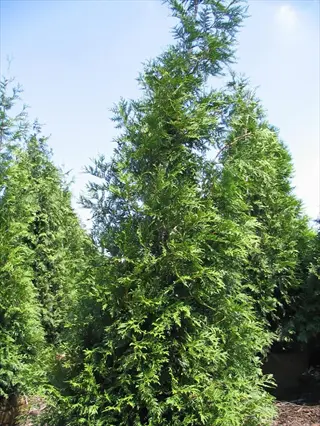
Green Giant Arborvitae
- Mature size: Reaches roughly 50 feet tall and 12 feet wide, so it screens tall views but needs real room to grow.
- Zones: Suited to USDA zones 6 to 9 and tolerant of a broad soil pH range from 6.0 to 8.0.
- Growth rate: One of the fastest conifers, often adding several feet a year once roots establish in the first seasons.
- Strength: The most windbreak-suitable arborvitae and the only cultivar rated somewhat resistant to deer browsing.
- Watch for: Susceptible to foliar fungal pathogens, and gardeners routinely underestimate its eventual towering size.
- Best for: Large yards needing a tall, fast evergreen screen with space for a full 12-foot mature spread.
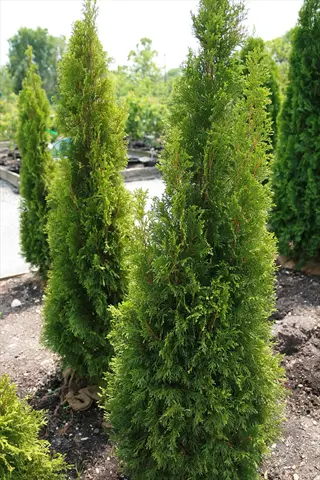
Emerald Green Arborvitae
- Mature size: Stays compact at 10 to 15 feet tall and 3 to 4 feet wide, ideal for narrow side yards.
- Zones: Hardy across USDA zones 3 to 7, handling colder northern winters better than larger conifers.
- Growth rate: Slower and more restrained than Green Giant, which keeps it tidy in tight spaces.
- Strength: Its narrow, upright habit fits along property lines where wide-spreading plants will not.
- Watch for: Branches can splay or break under heavy snow and ice, and deer browse it readily.
- Best for: Smaller lots and cold climates that need a slim, formal evergreen screen without much width.
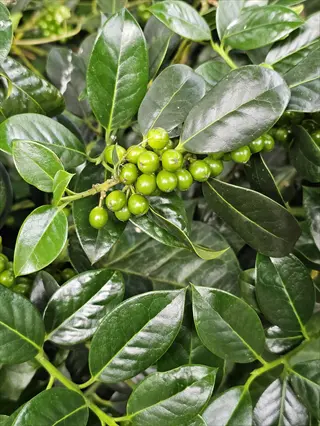
Nellie Stevens Holly
- Mature size: A dense broadleaf evergreen reaching about 15 to 25 feet with a pyramidal habit and glossy leaves.
- Zones: Reliable in USDA zones 6 to 9 and adaptable to a range of soils and light levels.
- Growth rate: Moderately fast and very dense, filling in solidly from the ground up for true screening.
- Strength: Hollies resist deer far better than arborvitae and add winter berries that feed birds.
- Watch for: Spiny leaves make hand-pruning uncomfortable, so wear gloves and plan access carefully.
- Best for: Mixed screens wanting a tough, deer-resistant broadleaf evergreen with year-round structure and color.
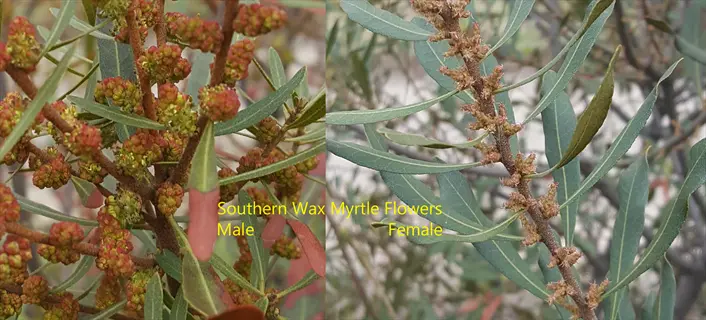
Southern Wax Myrtle
- Mature size: A fast broadleaf evergreen reaching 10 to 20 feet, easily kept lower with light pruning.
- Zones: Thrives in warmer USDA zones 7 to 11 and tolerates wet, poor, and salty soils well.
- Growth rate: Rapid and bushy, making it a quick informal screen for difficult, low-lying sites.
- Strength: Adaptable, low-care, and a strong native choice that supports local wildlife and pollinators.
- Watch for: Can sucker and spread, so site it where some natural widening is welcome rather than fought.
- Best for: Warm-climate yards with wet or tough soil that need a fast, forgiving evergreen buffer.
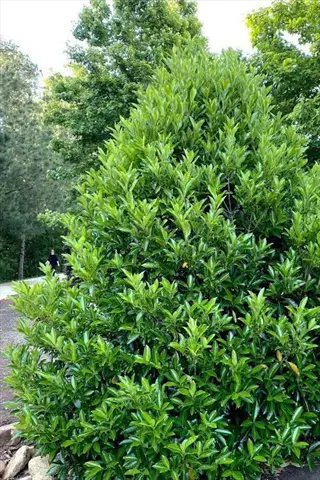
Chindo Viburnum
- Mature size: A handsome broadleaf evergreen growing 10 to 15 feet tall with large, leathery dark-green leaves.
- Zones: Performs well in USDA zones 7 to 9 and tolerates sun to part shade without losing density.
- Growth rate: Moderate to fast, forming a thick, lustrous screen that holds its leaves through winter.
- Strength: Adds fragrant spring flowers and red-to-black fruit, bringing year-round interest to a mixed screen.
- Watch for: Wants decent drainage and benefits from occasional shaping to keep its base full.
- Best for: Gardeners wanting a lush, flowering broadleaf evergreen to diversify a conifer-heavy hedge.
Evergreen vs Deciduous Hedges
The evergreen vs deciduous hedge question comes down to one thing. When do you need the screen to work? A bare patio in July is one problem. A bare patio in January is another. Each one calls for a different plant, so start there before you pick a species.
An evergreen privacy hedge keeps its dense leaves in every season. That matters more than people expect. Iowa State Extension says evergreens are the better pick for year-round privacy and noise. They hold their leaves when deciduous shrubs have dropped theirs. So if your neighbor's deck looks into your yard in December, only an evergreen solves it.
A deciduous hedge drops its leaves and opens the view once the weather turns cold. That sounds like a flaw, but it can be a feature. Those bare branches let in welcome low-season light. The warmth feels great when the sun sits low. A deciduous flowering hedge also gives you spring blooms and fall color that most evergreens cannot match.
Here is the simple way to choose. Pick evergreen when you want full-year screening and steady noise control. Pick deciduous when you mainly need cover in the spring and summer. You also get flowers, fruit, or winter light in the bargain. Use the side-by-side below to weigh both at a glance.
- Screen views all year, including through winter when privacy often matters most.
- Hold dense foliage that buffers noise and blocks wind in every season.
- Provide a steady green backbone for a mixed screen, such as arborvitae, holly, and wax myrtle.
- Tend to need less seasonal cleanup since they do not drop all their leaves at once.
- Lose leaves in winter, opening the view and letting in welcome low-season light.
- Offer flowers, fruit, and fall color that evergreens usually cannot match.
- Work well where privacy is mainly needed during the spring and summer growing season.
- Include flowering options like lilac, weigela, forsythia, and rose of Sharon for seasonal interest.
You do not have to pick just one. Plenty of gardeners blend both in one screen. Evergreens form the steady green backbone. Deciduous flowering shrubs go in for color. That mix gives you cover plus seasonal interest. It also makes the planting tougher against disease, which I cover in the mixed-screen section ahead.
Planting and Spacing Basics
Learning how to plant a privacy hedge comes down to three steps. You choose the right plant for your site, space each one by its mature size, and then keep it watered as it fills in. Most rows fail at step two, not because the wrong plant went in the ground.
Start with a soil test before you buy a single plant. The results tell you what your dirt can actually support, so you match plants to the site instead of forcing the wrong plant into the wrong soil. Standard hedge plants come in 5-, 7-, and 10-gallon containers, and that pot size hints at how big the plant already is, not how big it will get.
Now for hedge spacing, the part old advice gets wrong. A common rule says set arborvitae a fixed distance apart and call it done. Skip that. The real answer to how far apart to plant a hedge is to space by each plant's mature height and width, so the canopies grow to touch but never crowd. A small shrub might sit 2 to 3 feet apart, while a large Leyland cypress needs a minimum of 12 to 15 feet.
I packed a young row too tight in the damp back corner of my yard, right at the woods edge. By the second summer the middle plants thinned and browned while the ends stayed full. Air never moved through that gap, so I pulled every other plant and reset the row at full spacing. The thin ones greened back up once they could breathe.
Crowding for an instant wall always backfires. Give established plants about 1 inch of water per week and let them grow into the space you left. The steps below walk through the planting itself, from soil prep to mulch.
Run a soil test first, then in heavy clay amend the entire planting area with compost or pine bark fines rather than just the holes, and never add sand.
Set plants so their mature canopies will touch but not crowd; small shrubs sit 2 to 3 feet apart while large Leyland cypress need a minimum of 12 to 15 feet.
Break up the root ball, remove any nursery stakes, and set each plant so the root flare sits level with the soil, since nursery stock is often potted too deep.
Water deeply at planting and give established plants about 1 inch per week, then mulch to hold moisture and steady soil temperature.
Plant plants far enough apart that they will grow to touch, but not so close that their canopy would be right on top of each other.
Mixed Screens vs One Species
One choice shapes whether your hedge lives for decades or dies in a single season. You can plant one species in a long, neat row, or you can mix two or more. Most people go for the matching row because it looks tidy. That tidy look hides a real weakness.
Think of a single-species row like one long line of dominoes. A disease or pest lands on the first plant. Then it moves straight down the line to the next identical one, and the whole screen can fall. A mixed screen breaks that chain. When a problem hits one plant, the different species around it block the spread. The damage stays in one spot instead of taking the whole row.
There is a hard truth behind the tidy row too. If one plant dies in a matched hedge, you cannot replace it at the same mature size. So you live with a permanent gap in the view. Clemson Extension sets a simple minimum diversity rule for a screen that lasts. Use at least two evergreen conifers, two broadleaf evergreens, or two evergreen shrubs. That small bit of variety is what stops trouble from moving plant to plant.
Layered Design
- How it works: Place the tallest plants at the back and step shorter species toward the front for depth.
- Why it helps: Layers fill the screen from ground to top and avoid a thin, single-height wall.
- Good for: Wider borders where there is room for two or three depths of planting.
- Resilience: Mixing heights and species means no single problem opens a clean gap in the view.
Staggered Rows
- How it works: Set two or three offset rows so plants in one row cover the gaps in the next.
- Why it helps: Offsetting closes sightlines faster than a single straight row without overcrowding any one plant.
- Good for: Long property lines where a solid, gap-free screen is the main goal.
- Resilience: If one plant declines, neighbors in the offset rows still block the view behind it.
Clustered Groups
- How it works: Plant odd-numbered groups of three, five, or seven of differing species in natural clusters.
- Why it helps: Clusters read as an informal, garden-like screen rather than a rigid hedge.
- Good for: Relaxed landscapes that want privacy with a softer, more naturalistic look.
- Resilience: Spreading species across clusters keeps any disease or pest from spreading down a single line.
Minimum Diversity Rule
- How it works: Choose at least two evergreen conifers, two broadleaf evergreens, or two evergreen shrubs.
- Why it helps: Genetic variety stops a disease or pest from moving laterally through identical plants.
- Good for: Any screen meant to last decades rather than just fill in quickly.
- Replacement reality: A lost plant in a single-species row cannot be matched in size, but a mixed screen absorbs the loss.
When the choice of plantings are all the same, disease or insects that cause damage can be easily transferred laterally from plant to plant.
The payoff is more than a disease-resistant hedge. A mix of plants gives you more to look at all year. NC State Extension notes that different species flower, fruit, and change color at different times. So a tough screen and a pretty one come from the same choice. Build it with staggered rows, with depth from layered planting, or with loose clusters. Stepping away from a one-plant row cuts the monoculture risk and gives you a screen that lasts and looks alive in every season.
Disease, Pests, and Problems
I was snapping off browning branches on my neighbor's Leyland cypress row last spring. I see that row straight down the property line from my kitchen window. The third tree had rust-colored dieback creeping up the trunk. The two plants beside it showed the same sunken streaks. He had packed them about 4 feet apart for a fast wall, and one sick plant passed the canker straight to its neighbors. That row is why I put in a mixed screen of Green Giant arborvitae and Nellie Stevens holly instead.
Most plant roundups sell you a tidy green wall and skip the trouble that comes with it. The popular fast pickers carry real risks you should know first. Leyland cypress problems are the clearest example, and they hit hardest when your trees sit stressed and crowded.
Seiridium canker and Botryosphaeria dieback both strike drought-stressed Leyland cypress, and neither one has a cure. Fungicides will not save an infected tree. Bagworms are another headache, since each female lays 500 to 1,000 eggs in a single bag and can strip a plant bare. Scale insects work slower but no less harmful, and a heavy infestation can kill a tree within 2 to 3 growing seasons.
The cure for almost all of this is prevention, not a spray bottle. Chemical control rarely works on large trees, so give each plant correct spacing, good airflow, and roots that never go thirsty. Boxwood blight follows the same pattern, spreading fast through dense, humid plantings and slowing down where air moves freely.
Arborvitae brings its own troubles even when disease stays away. Bagworms can strip a plant bare. Deer browse most cultivars down to bare stems and ruin your screen. For a deer-resistant privacy hedge, lean on hollies or junipers instead. Among the arborvitae, only Green Giant holds up at all, and even it gets nibbled. That is why your plant choice and spacing matter far more than how fast something grows.
Most hedge disease starts with stress and poor airflow, so resist crowding plants for fast fill-in; wide spacing and drought-free roots prevent far more problems than any spray can cure.
Noise, Wind, and Wildlife
A privacy hedge does more than block the view. The same wall of green can soften road noise, slow the wind across your yard, and feed birds through the seasons. But the noise part is where most guides oversell what plants can do, so let me give you real numbers instead of vague promises.
A noise reduction hedge works the way a thick curtain does. A solid, wide curtain muffles sound, while a thin sheer one barely dampens anything. A single skinny row of trees is that sheer curtain. It looks like a sound barrier, but it does almost nothing to the noise itself.
Iowa State Extension lays out what it actually takes. A well-designed planting buffer cuts sound by up to 10 decibels, though 5 to 8 is more typical. Heavy highway traffic runs 70 to 85 dBA, so even a great hedge only takes the edge off. To do this with plants alone, the buffer must be at least 100 feet wide. It also has to be as tall as what you want to block, dense from the ground up, and set within 50 feet of the source.
So the work comes from density and design, not from one magic species. If you have the room, an earth berm with a dense planting on top beats vegetation alone every time. And evergreens win here, since they hold their leaves and keep working as a windbreak and sound buffer all winter long.
No tree or shrub species is a superior noise blocker. Sound reduction comes from density and design, not from specific species.
Wildlife is where a mixed planting pays off twice. A diverse wildlife habitat hedge stacks staggered flowers, fruit, and berries. That feeds pollinators in spring and birds well into fall. You get your screen, your wind protection, and a busy little ecosystem from the same row of plants.
5 Common Myths
A single straight row of one fast-growing species is the smartest, most reliable way to build a privacy hedge.
Single-species rows are the leading cause of hedge failure, since one disease or pest can wipe out the entire screen at once.
Planting hedge plants close together is best because it makes the screen fill in and look finished much faster.
Crowding causes canopy competition, thinning, and disease from poor airflow; space plants by mature width so they touch without overlapping.
Any privacy hedge will block road noise and give you a quiet yard once it grows tall enough to hide the source.
Meaningful noise reduction needs a dense buffer at least 100 feet wide; a thin single row barely lowers sound at all.
Leyland cypress and arborvitae are trouble-free privacy plants you can plant and then basically forget about.
Both face serious issues like canker disease, bagworms, and deer browsing, and fungicides do not cure the worst cankers.
You should only plant a privacy hedge in spring once the weather is warm and the soil has fully heated up.
Fall and winter are often ideal, letting roots establish during cool, moist months before the stress of summer heat arrives.
Conclusion
The best privacy hedge plants are the ones that match your site and still stand strong years down the road. Speed of growth grabs all the attention, but it is only one piece of the puzzle. The screens that fail are almost always the ones planted in a rush, with one species jammed too close together.
A mixed screen of at least two species beats a single row every time. When you plant the same thing over and over, one disease or pest can wipe out the whole line. Mix in conifers, broadleaf evergreens, or shrubs and a problem stays put in one spot. Your hedge spacing matters just as much. Space each plant by its mature width so the grown canopies touch but never crowd each other, because crowding traps moisture and feeds fungal trouble.
Keep your noise hopes realistic too. A thin row of trees will not block much sound on its own. A real buffer needs width and density, with planting that runs thick from the ground to the top. One tall line looks nice, but it does little against highway traffic.
Match the plant to the spot, space it right, and plant in fall or winter, and your hedge will thrive for decades. That is not luck, it is planning. Pick an evergreen privacy hedge for year-round cover, or blend in a few deciduous picks for seasonal color and texture.
A well-built privacy screen only gets better with age. It fills in thicker, feeds the birds, and softens the noise from the road a little more each season. Think about who ends up happiest with their hedges years later. It is the gardeners who planned for diversity, smart spacing, and the right plant in the right place. Build yours that way and you will be glad you did.
Glossary
- Bagworm
- A caterpillar pest whose females lay 500 to 1,000 eggs per bag and can fully strip the foliage from arborvitae and Leyland cypress.
- Botryosphaeria dieback
- A fungal disease that kills branches or whole stressed Leyland cypress trees and is not controlled by fungicides.
- Broadleaf evergreen
- An evergreen plant with wide flat leaves, such as holly, that stays green all year rather than having needles.
- Instant hedge
- A row of pre-grown, mature plants installed together so the screen looks established right away.
- Mixed screen
- A privacy planting that combines at least two different plant species so one disease or pest cannot wipe out the whole screen.
- Monoculture
- A hedge made of a single plant species, which is vulnerable to total loss because disease and pests spread easily between identical plants.
- Root flare
- The point where a plant's trunk widens into its roots, which should sit level with the soil surface when planting.
- Seiridium canker
- A fungal disease that causes branch dieback in stressed Leyland cypress and cannot be cured with fungicides.
External Sources
Frequently Asked Questions
What is the fastest growing hedge for privacy?
Green Giant arborvitae, Leyland cypress, and certain laurels are among the fastest, often adding several feet a year.
What is the best low maintenance privacy hedge?
Native arborvitae, holly, and wax myrtle stay dense with minimal pruning once established.
How far apart should I plant a privacy hedge?
Space plants by their mature width so canopies touch but do not crowd:
- Small shrubs: roughly 2 to 3 feet apart
- Mid-size evergreens: 4 to 6 feet apart
- Large trees like Leyland cypress: 12 to 15 feet apart
Can I plant a privacy hedge in fall or winter?
Yes, fall and winter are often ideal because roots establish before summer heat arrives.
What is the best height for a privacy hedge?
Most privacy needs are met at 6 to 8 feet, though screening upper windows may need 10 to 15 feet.
What is an instant hedge?
An instant hedge is a row of pre-grown, mature plants installed together to look established right away.
What are the downsides of a privacy hedge?
Hedges face disease, pests, crowding, and ongoing maintenance, especially single-species rows.
How close to a fence can I plant a hedge?
Plant about half the mature width away, so a 6-foot-wide plant sits roughly 3 feet from the fence.
How much noise does a privacy hedge actually block?
A well-designed buffer reduces sound by up to 10 decibels, with 5 to 8 more typical.
What is the best deer-resistant privacy hedge?
Hollies, boxwood, and some junipers resist deer better than arborvitae, which deer often browse.