Tree · Fagaceae
Southern Live Oak
Quercus virginiana
A sprawling, long-lived shade tree that wants room to grow and little else once it settles in.
Full sun
Every 7–14 days
USDA 8–10
40–80 ft · 12.2–24.4 m
Overview
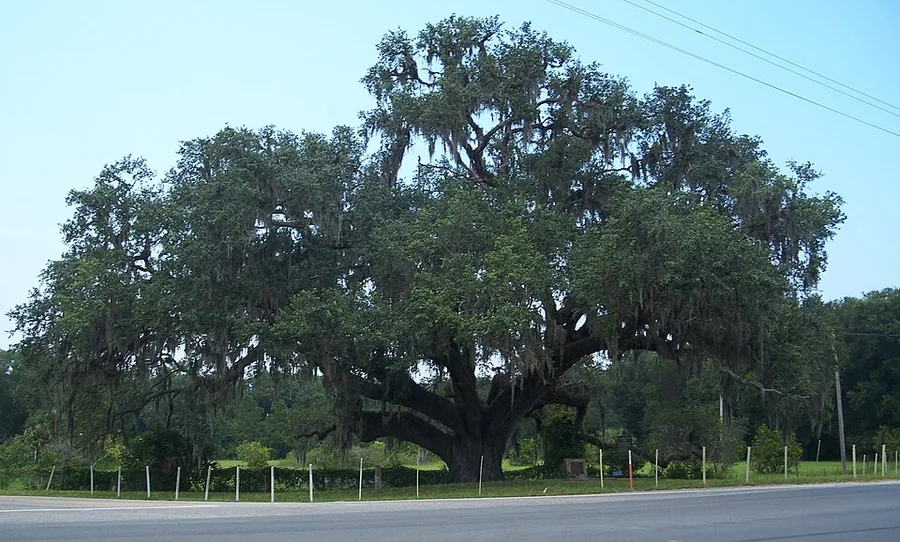
Few trees set the mood of a Southern property the way a live oak does. Its low, far-reaching limbs draw a wide canopy over a lawn or a drive and turn an open yard into a shaded, unhurried room outdoors, the sort of place where a bench or a table finds a natural home. Because it keeps most of its leaves through winter, the scene it frames stays green and grounded all year, with the old foliage slipping away in spring as the new arrives.
As a landscape anchor it earns its keep with almost no fuss. It settles into sand, loam, or clay, takes the salt air of a coastal lot in stride, and holds its composure through dry spells once it has rooted. Hardy across USDA zones 8 to 10 and content to grow at a moderate pace over generations, it becomes the fixed point a garden is arranged around, the tree that outlasts every other choice on the plot.
What it asks in return is space, and plenty of it. A mature specimen can spread a canopy 40 to 80 feet (12 to 24 m) across on heavy horizontal limbs, so it belongs at the center of a lawn or the far edge of a lot rather than crowded against the house. Give it that open room, well clear of walls, walks, and power lines, and it repays you with shade that shapes the whole feel of the place.
Care
The short version: set it in full sun on almost any soil, water it while young, and prune with care in summer to keep oak wilt away, and from there it settles into the landscape on its own.
Light
A live oak wants full sun to fill out the broad, even canopy that makes it such a presence in a yard. It will accept partial sun or light shade, but a tree set in the open grows denser and more balanced, which shows in the shade it casts.
Water
Give a young tree a steady drink, roughly every 7 to 14 days, while it is putting down roots and finding its footing in the landscape. Once it is established, a mature live oak is highly drought tolerant and rarely needs watering, an easy fit for a low-maintenance property.
Soil
Little about the ground troubles it, which frees you to plant it where the design wants it. It settles into sand, loam, or clay, takes acidic or alkaline soil from pH 5.0 to 7.5, weathers the odd wet spell, and shrugs off coastal salt. It looks its best in moist, well-drained, slightly acidic soil.
Temperature
Suited to the warm South, it holds up through anything from about 10°F to 100°F (-12°C to 38°C). That span carries it through hard summer heat and the occasional deep freeze at the cool edge of its range.
Humidity
The open air of a Southern yard is all it needs, so humidity is never something to manage. It feels most at home in the muggy coastal South, where it grows wild along the shore.
Feeding
A settled tree in reasonable soil needs no feeding at all, a welcome trait in a low-key landscape. Reach for a balanced slow-release tree fertilizer in spring only if growth has plainly slowed.
Pruning
Plan any pruning for mid to late summer, when the beetles that spread oak wilt are least active. Take out dead, crossing, or weak branches and shape good structure while the tree is young, since heavy cuts on a mature oak are best avoided for the sake of the tree and the view.
Repotting
A live oak is no container piece for a patio; it is a tree for open ground. Move it from the nursery pot into the earth before the roots begin to circle, and once it is planted, it holds that spot for life.
Size & spacing
This is a landscape at full scale, reaching 40 to 80 feet (12 to 24 m) tall with a canopy that can spread 60 to 120 feet (18 to 37 m) across. Give it that open room, set well back from buildings, walks, and utilities.
When to plant
A tree meant to define a property for decades is in no hurry, and there is no narrow window to catch. Set a young live oak in place in fall or early spring, when the soil works easily and the roots can settle before summer heat or hard cold. The flowers are easy-to-miss spring catkins, and the acorns ripen and fall in autumn.
Northern hemisphere
Southern hemisphere
Typical months for a temperate climate: start earlier in warm zones, later where spring frosts linger.
- Plant: Fall or early spring
- Harvest: Inconspicuous spring catkins; acorns mature in fall
Hardiness
USDA hardiness zones: 8–10
Temperature: down to -12°C
Troubleshooting
A well-sited live oak asks little and gives back a lot, and most of what turns up is cosmetic rather than serious. The one condition to respect is oak wilt, the reason pruning is timed as it is. Match what you are seeing below before you make a single cut.
A wilting, browning canopy losing its presence
When a once-stately canopy starts to thin, wilt, and brown, the cause is often oak wilt, a fungus that quietly blocks the tree's water channels and works through the crown limb by limb. Dark streaking in the wood and dieback that spreads from branch to branch give it away. Because nothing reverses it once it settles in, have it confirmed by an extension office or lab, then keep any pruning to mid to late summer and sever root grafts to neighboring oaks where advised.
Fix:
- Avoid pruning during active beetle season; prune only in mid-to-late summer
- Remove and properly dispose of infected trees per extension guidance
- Sever root grafts between adjacent oaks where recommended
Little galls and blister spots across the foliage
The odd bumps and spots that appear across the leaves are almost always insect galls, the work of gall wasps or mites, while the raised blisters trace back to a leaf fungus called Taphrina. Neither one troubles the tree, however unlovely they look up close. A quick rake of the fallen leaves slows the blister, and the galls are best left in place, since a well-kept oak carries them without complaint.
Fix:
- Tolerate galls, which rarely harm the tree
- Rake and remove fallen infected leaves to reduce leaf blister
- Maintain tree vigor with proper watering
Toxicity
For all its grace in the landscape, this tree carries tannins in its acorns, buds, and young leaves that are not safe to eat. Dogs and cats that nibble them get an upset stomach, while horses and grazing livestock that eat a lot risk serious, sometimes fatal kidney damage. Keep animals from feeding on fallen acorns and clippings, especially in fall.
Toxic to
Cats · Dogs · Horses · Rabbits · Livestock · Birds · People
Cats Mild
A curious cat that samples a leaf or acorn tends to come away with an upset stomach, some vomiting, loose stool, and a day or two of picking at meals. It usually clears on its own, though a tender belly comes with it.
Dogs Mild
A dog that chews acorns or foliage typically shows vomiting, diarrhea, and a listless appetite. The real concern is a swallowed acorn, which can lodge and block the gut, so any dog that strains or keeps retching should see a vet.
Horses Severe
Horses take the tannins hard once they eat much, so this is one to watch closely. Colic and stomach upset arrive first, and a genuine binge on acorns or young leaves can scar the kidneys badly enough to be fatal.
Rabbits Toxic
Oak has no place in a rabbit's diet. Their systems rely on steady, gentle greens, and the tannins in the leaves and acorns upset that balance, so keep clippings and fallen acorns well away from the hutch and run.
Livestock Severe
Cattle, goats, and sheep that graze acorns and buds in quantity fare worst of all. What begins as constipation can turn to dark, bloody diarrhea, and in the gravest cases the kidneys fail outright.
Birds Caution
Many wild birds handle whole acorns without a second thought, yet the raw tannins are hard on smaller pet birds. The safe course is to keep oak leaves and whole acorns away from cage birds entirely.
People Caution
Raw acorns find their way onto no one's plate, since the tannins leave them bitter and unsettle the stomach. They turn edible only after long leaching, so keep small children from mouthing acorns off the ground.
Keep pets and livestock from grazing on fallen acorns, buds, and leaves, particularly in fall.
Helpline numbers

United States
ASPCA Animal Poison Control: (888) 426-4435 (fee applies)
Poison Control: (800) 222-1222



Canada
Poison Centres: 1-844-764-7669
Varieties
Most live oaks planted are simply the species, though a couple of selected forms exist for a garden that calls for a particular silhouette.
Cathedral Oak
A selected cultivar admired for the even, symmetrical dome its canopy settles into with age.
Highrise
It grows taller and narrower than the usual broad, sprawling form, which makes it the natural pick for a tighter setting.
How to propagate
Live oaks come easily from their own acorns, and the only real catch is timing, since the seed will not wait around.
SeedEasy
Sow fresh acorns in fall as soon as they mature · Germinates within weeks to a few months; several years to a sapling
Live oaks rise easily from their own acorns, which makes starting one a quiet pleasure. Gather the ripe acorns in fall and sow them at once, because they lose the ability to sprout if they dry out or sit in storage. A fresh one roots within weeks to a few months, then asks for several years of patient growth to become a sapling.
Myths
The Spanish moss draped through a live oak is a parasite that slowly kills the tree.
That signature veil of moss is an epiphyte, resting on the branches purely for a foothold and taking its moisture and nutrients from the air. It draws nothing from the tree and does it no harm, so the romantic drapery can stay exactly where it is.