Tree · Fagaceae
White Oak
Quercus alba
A tree that turns a plot of ground into an estate, giving a century of shade and a canopy the whole neighborhood grows up beneath.
Full sun
Every 7–14 days
7300–9125 days
USDA 3–9
Overview
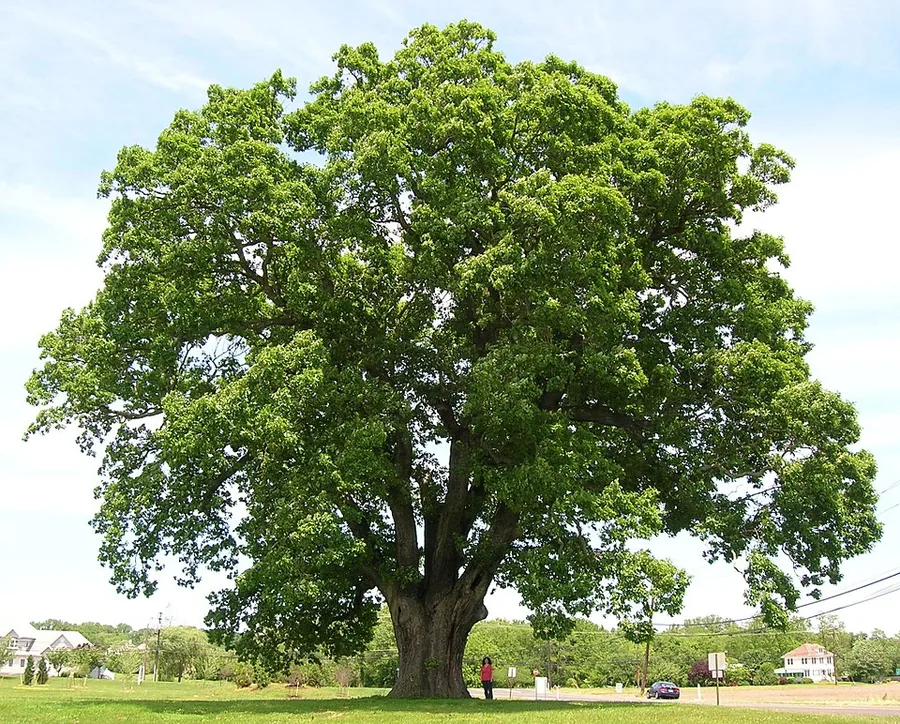
Few trees confer a sense of permanence on a property the way a white oak does. This is one of North America's grand native shade trees, slow to rise and content to live for centuries, and its broad, rounded crown eventually becomes the defining feature of the land it stands on. Even the bark plays its part, aging to a pale, scaly gray that reads almost white and lends a settled, timeless look to a yard.
Consider it the architecture of the landscape rather than a plant in a bed. At a mature 50 to 100 feet (15 to 30 m) tall and nearly as wide, it wants an open lawn or a generous corner well away from the house, the foundation, and the utility lines, where its silhouette can stand on its own. Because the deep taproot commits a grown tree to its spot for life, the choice of where it goes is really a choice about the shape of the whole property for generations.
There is a rhythm to living alongside one. Each autumn it scatters sweet acorns that draw jays, squirrels, turkeys, and deer into the yard, turning the space into a small theater of wildlife. Those acorns and the spring buds carry tannins that can unsettle pets and seriously harm grazing horses and cattle, so a household with animals plans the tree's place with that daily reality in mind.
Care
The short version: set it in full sun on deep, moist, slightly acidic soil with good drainage. See it through the first season or two with regular water while it settles, then let a mature tree carry itself, and reserve pruning for the quiet of dormancy.
Light
Give a white oak full sun and it rewards the setting with the fullest, most graceful crown, though a young one will accept some partial shade. An open, unshaded position is what draws out the broad, even canopy that makes the tree such a presence on a property.
Water
Water deeply and on a regular schedule through the first 1 to 2 years as it settles into its place, then ease back. A mature white oak takes drought in stride, yet it has no patience for wet ground, so keep it off soggy sites and offer the moist, well-drained soil it prefers.
Soil
It looks its best in deep, moist, well-drained loam with a gentle acidity, ideally a pH of 5.0 to 6.5. The tree adapts to clay, loam, or sand, but rich acidic loam brings out its finest form, while soil that runs too alkaline can leave the foliage yellowed with iron chlorosis.
Temperature
White oak stands comfortably across USDA zones 3 to 9, weathering winters near -40°F (-40°C) and summer heat around 95°F (35°C). That generous range makes it at home across most of the eastern half of the continent, a fixture in landscapes from the far north to the deep south.
Humidity
Ordinary outdoor humidity suits it, so there is no figure to tend. What serves the tree better is open air moving through the canopy, since crowded, damp foliage is what invites the leaf fungi to settle in.
Feeding
A white oak in decent ground rarely asks to be fed. Where the soil is poor or growth looks weak, a balanced slow-release tree fertilizer in early spring will do, and it is worth watching for the leaf yellowing that overly alkaline soil can bring.
Pruning
Keep pruning to late fall or winter, while the tree is dormant, since cuts made in the growing season draw the beetles that spread oak wilt. Take out the dead, damaged, or crossing branches, and guide a strong central leader while the tree is young enough to shape.
Repotting
A landscape oak is never repotted. A container sapling simply needs to reach open ground while young, before the deep taproot circles or girdles the pot, since a settled tree resists being moved.
Size & spacing
This is a tree that defines the scale of a place. It reaches 50 to 100 feet (15 to 30 m) tall and spreads 50 to 80 feet (15 to 24 m) wide, so give it distance from buildings and utilities and the open room its crown needs to fill the view.
When to plant
The white oak keeps a seasonal calendar worth planning around. Its acorns ripen and drop in autumn with little dormancy, asking to go straight into the ground, while the understated catkins that produced them appeared back in the soft weeks of April and May. Gather and sow in fall, then move any young seedling in early spring, before the taproot has committed to its place.
Northern hemisphere
Southern hemisphere
Typical months for a temperate climate: start earlier in warm zones, later where spring frosts linger.
- Sow: Not typically; acorns are best sown outdoors. If started in deep containers, sow fresh acorns in fall before the radicle emerges.
- Plant: Sow fresh acorns outdoors in fall as soon as they drop; transplant young seedlings in early spring while the taproot is still small.
- Harvest: Inconspicuous yellowish-green catkins in April-May; acorns mature in one season and ripen in fall (September-October).
Hardiness
USDA hardiness zones: 3–9
Temperature: down to -40°C
Troubleshooting
An established white oak carries most trouble lightly, and the spotted or nibbled leaves that catch the eye rarely amount to more than a passing blemish. The one exception worth knowing is oak wilt, so it pays to tell a swift dieback in the crown from the merely cosmetic. Match what the tree is showing below before reaching for any remedy.
The crown browning and thinning from the top down
This is the mark of oak wilt, a fungus carried by sap beetles and passed along the roots that graft between neighboring oaks. White oaks resist it more stoutly than red oaks, yet they still fall ill, and the decline can claim a tree within a single season. Bring in a certified arborist or the extension office, confirm it by lab culture, and sever the root grafts between adjacent oaks wherever the site allows.
Fix:
- Contact a certified arborist or extension office promptly
- Remove and properly dispose of severely infected trees
- Sever root grafts between adjacent oaks where feasible
- Avoid pruning during the growing season
Tan patches tracing the veins after a wet spring
A cool, damp spring ushers in anthracnose, a leaf fungus that leaves tan dead patches and sheds a little early foliage; raised yellow-green bumps point instead to oak leaf blister. Neither does an established tree any lasting harm, so the graceful response is simple housekeeping, raking up the fallen leaves and thinning crowded branches for air, with the fungicide left in the shed.
Fix:
- Rake and dispose of fallen infected leaves
- Improve air circulation by thinning overcrowded branches
- Fungicides are rarely warranted on established shade trees
Nibbled leaves and small swellings along the twigs
Most of the chewing is the work of caterpillars, whether spongy moth, orangestriped oakworm, or the oak skeletonizer, while the firm swellings on leaves and twigs are galls raised by tiny wasps and mites and look far worse than they are. A healthy oak absorbs light feeding without complaint, so tolerate the minor damage, pick off or prune out small infestations, and call for controls only in a heavy spongy moth year.
Fix:
- Tolerate minor feeding on otherwise healthy trees
- Hand-pick or prune out localized infestations and galls
- For heavy spongy moth outbreaks consult extension for recommended controls
Toxicity
Grace on the lawn comes with one honest caveat for households with animals. The leaves, buds, and above all the acorns hold tannins that turn toxic once eaten, ranging from mild stomach upset in pets to fatal kidney damage in horses and grazing livestock. Clear fallen acorns from the areas animals use, keep stock off oak pasture through the heavy drop, and remember that even acorns destined for the table need their tannins leached out first.
Toxic to
Cats · Dogs · Horses · Rabbits · Livestock · Birds · People
Cats Caution
A cat that samples acorns or leaves may be left with vomiting, loose stool, a fading appetite, and a tender belly, all traced to the tannins. Keeping fallen acorns swept from the spots a cat favors settles the matter.
Dogs Caution
A dog that gnaws acorns or leaves can show vomiting, diarrhea, and a lost appetite, and swallowing a whole acorn brings the added risk of a gut blockage, the greater concern with a determined chewer.
Horses Severe
Here lies the real danger. Browsing young spring leaves, buds, or green acorns can bring colic and belly pain, constipation that turns to bloody diarrhea, a dull and heavy mood, frequent urination with dark urine, jaundice, and kidney damage that is sometimes fatal.
Rabbits Caution
Oak is no forage for a rabbit. The tannins in the leaves and acorns unsettle a delicate gut, so both are best kept well out of reach.
Livestock Severe
Cattle, sheep, and other grazers that take in large amounts of oak leaves, buds, or acorns lose their appetite, grow listless, and pass dark or bloody manure. In the gut the tannins become gallic acid and inflict severe, often fatal kidney damage, the risk highest in drought when other forage grows scarce.
Birds Caution
Wild jays and turkeys treat acorns as a staple, yet the same tannins can trouble pet and backyard birds in quantity, so oak parts are never a safe feed for them.
People Caution
Raw acorns are bitter and hard on the stomach for their tannins, and become fit to eat only once those tannins are leached or boiled out. Treat any raw acorn as a caution, and keep children from tasting them off the ground.
Rake up and dispose of fallen acorns and leaf litter where pets, horses, or cattle have access, especially in fall and after storms; keep livestock off oak-heavy pasture during heavy acorn drop or in drought years when other forage is scarce.
Helpline numbers

United States
ASPCA Animal Poison Control: (888) 426-4435 (fee applies)
Poison Control: (800) 222-1222



Canada
Poison Centres: 1-844-764-7669
Varieties
White oak comes to the landscape almost entirely as the wild species, with a single natural leaf-form variant worth recognizing among them.
Quercus alba (species)
The wild species is known by leaves 4 to 9 inches long with 5 to 9 deep, rounded, bristle-free lobes, a light ashy-gray scaly bark, and sweet edible acorns up to about 1 inch long that wildlife prize.
Forked-leaf white oak (forma)
This natural leaf-form sets itself apart with narrower lobes, more deeply and irregularly forked than the foliage of an ordinary white oak.
How to propagate
A white oak arrives by way of the acorn, and the art of it is speed. The seed scarcely pauses before it sprouts, so fresh and prompt sowing outdoes any careful attempt at storage.
SeedModerate
Collect and sow fresh acorns in fall as soon as they drop · Acorns germinate within a few weeks of falling; a sturdy taproot forms the first autumn, with above-ground seedling growth the following spring
White oak takes to seed with ease, though it grants no time to linger. The acorns hold little or no dormancy and sprout almost the moment they touch the ground, so gather them fresh in autumn and sow them before the radicle emerges. A strong taproot descends that first fall while the top growth waits for spring, which is why a seedling should be moved only while it is young. Keep the acorns from rodents, or they may vanish before they ever sprout.
Myths
White oak acorns are safe to eat raw, since squirrels and deer eat them freely.
Wildlife carries the tannins far more easily than people do. Raw acorns are bitter and irritate the digestive system, so the tannins must be leached or boiled out before anyone eats them. In quantity, raw oak is toxic to pets and truly dangerous to horses and livestock.
An oak can be pruned at any point in the year.
Timing counts for more here than with most trees. Prune oaks only while they are dormant, since cuts made in spring and summer draw the sap beetles that spread oak wilt. Should a wound be unavoidable while the tree is in leaf, seal it at once.