Tree · Fagaceae
Chestnut
Castanea sativa
Give it acidic, well-drained ground and a pollen partner, and the sweet chestnut becomes the centerpiece that returns a heavy crop of roasting nuts.
Full sun
Every 7–21 days
USDA 4–8
49–98 ft · 15–30 m
Overview
Few trees anchor a landscape the way a sweet chestnut does. A long-lived nut and shade tree from the beech family, grown for its harvest for thousands of years, it settles into the deep background of a property and quietly defines it. At 15 to 30 m it is a tree for an estate or an open meadow rather than a courtyard, and it asks for that breadth of view. Each autumn it drops the nuts that turn an ordinary evening into something worth gathering around, roasted over coals while the season closes in.
There is one distinction every owner learns early, and it changes how the tree fits a home. The horse chestnut, the conker tree, belongs to an unrelated family and only echoes this one from a distance. A true chestnut from the genus Castanea is the one that earns its keep at the table; the horse chestnut offers shade and little else. Its nuts are toxic and stay well outside the kitchen.
What a chestnut wants is mostly a matter of where it stands. It favors acidic, well-drained soil and full sun, and it loses its composure on heavy, wet, or limey ground. Set a second chestnut within view for cross-pollination, and the tree shifts from a handsome silhouette to a working part of the household calendar, trading bare burs for a harvest worth planning around.
Care
The short version: a sunny, open setting with deep, acidic, well-drained soil, steady summer water as the nuts fill, and a companion chestnut nearby so the season ends in a real crop.
Light
Place it in full sun, where it flowers most freely and sets the fullest crop. Partial sun or light shade is workable, but a shaded chestnut grows leggy and loses its presence along with its harvest, so an open, sunlit position serves both the tree and the view.
Water
In its first few seasons a young tree wants a deep soak to settle in and find its footing. A mature chestnut carries a dry spell with ease, yet steady summer moisture keeps the nuts filling and the canopy looking its part. Standing water is the one thing to avoid, since waterlogged ground invites root rot.
Soil
Soil is where a chestnut's whole bearing is decided. Give it deep, well-drained sandy loam on the acidic side, a pH of 5.0 to 6.5, and it carries itself well for decades. Heavy, wet, or alkaline ground undoes that poise, bringing chlorosis and a slow decline that no setting can disguise.
Temperature
This is a tree for a wide swath of country. It weathers winter cold down to about -22°F (-30°C) and summer heat up to 95°F (35°C), which makes it a confident choice across USDA zones 4 through 8.
Humidity
There is nothing here for an owner to tend. Ordinary outdoor air around 40% to 70% humidity suits it completely, leaving the site and the soil drainage as the things that truly shape how it lives.
Feeding
A balanced complete fertilizer in early spring, as growth resumes, keeps the tree in good form. On naturally acidic ground, leave the lime aside, since lifting the pH past the tree's range works quietly against everything else it needs.
Pruning
Tend the shape in late winter while the tree is dormant. Train a young chestnut to a single central leader, take out dead, crossing, or damaged wood, and remove any branch with a sunken bark canker without delay, keeping both the line of the tree and the blight in check.
Repotting
There is no repotting to keep on the calendar, since this lives in the ground as a landscape tree. The single move that matters is settling a nursery sapling into its final site while young and dormant, before the roots begin circling and the tree loses its start.
Size & spacing
Plan for real scale, a tree of roughly 49 to 98 feet (15 to 30 m) tall with a spread of 33 to 49 feet (10 to 15 m). Give it that sweep of open ground, well clear of buildings and power lines, and let the room around it be part of the effect.
When to plant
A chestnut gives a property its seasonal rhythm. Dormant saplings or stratified nuts go out in spring once the hard frosts pass, or nuts go down in fall to let winter chill them on the spot. The catkins arrive in early summer to soften the canopy, and by September and October the burs open to mark the harvest that closes the year.
Northern hemisphere
Southern hemisphere
Typical months for a temperate climate: start earlier in warm zones, later where spring frosts linger.
- Plant: Plant dormant saplings or stratified nuts in spring after the last hard frost, or set out nuts in fall for natural cold stratification.
- Harvest: Catkins bloom in early summer (June to July); nuts ripen and drop inside spiny burs in September to October.
Hardiness
USDA hardiness zones: 4–8
Temperature: down to -34°C
Troubleshooting
When a chestnut falters, the cause usually traces to its setting, a missing partner tree, or the blight woven through the species' story. The bark, the burs, and the foliage each carry the tell, so the tree more or less explains itself. Read the signs below and respond early, while a setback is still a passing chapter rather than the end of the tree.
Scarred bark, dead limbs overhead, and fresh shoots near the base
Sunken orange-brown lesions on the bark mark chestnut blight, the fungal disease that emptied the American chestnut from eastern forests. It enters through wounds in the bark and forms a girdling canker that kills the wood above it, even as the roots keep sending up fresh shoots from below. Cut the cankered limbs out well below the lesion, and where the trouble returns, replant with blight-resistant Chinese chestnut or resistant hybrids.
Fix:
- Prune out and destroy cankered limbs well below the lesion
- Replace highly susceptible American or European trees with blight-resistant Chinese chestnut or resistant hybrids
A flush of bloom, yet burs that come to nothing
A chestnut that flowers freely yet sets almost nothing is usually standing alone. Chestnuts are largely self-incompatible, so a solitary tree pollinates itself poorly and the burs finish flat or empty. Bring a second, genetically different chestnut within about 30 m, and the harvest comes back into the picture.
Fix:
- Plant a second, genetically different chestnut within about 30 m to supply cross-pollen
Washed-out leaves, listless shoots, a tree losing its vigor
When the foliage pales and the shoots stay thin, the setting is usually at fault. Chestnuts will not abide alkaline or soggy ground, and either one starves the roots and brings on chlorosis. Acidify the soil toward pH 5.0 to 6.5 with elemental sulfur, improve the drainage, or move the tree to a deeper, better-drained acidic site.
Fix:
- Acidify soil toward pH 5.0 to 6.5 with elemental sulfur
- Improve drainage or relocate to a better-drained, acidic site
Toxicity
For a home shared with pets and children, the sweet chestnut sits easily in the picture: it is non-toxic, and its roasted nuts have been part of the human table for ages. The only real cautions are physical, the spiny bur and the whole hard nut, which can choke a pet or catch a hand. The toxic look-alike horse chestnut is the one to keep out of the scene entirely.
Safe for
People · Cats · Dogs · Horses · Rabbits · Livestock · Birds
Cats None
The true sweet chestnut is non-toxic to cats, so a nibble brings no poisoning. The real risk is a whole nut swallowed in a hurry, which can choke a cat or leave its stomach unsettled.
Dogs None
Dogs can share the space around a sweet chestnut with no poisoning worry. The thing to watch is a gulped whole nut, since the size and hard shell can lodge in the throat or trigger a mild upset stomach.
Horses None
Sweet chestnut is safe for horses and brings on no toxic reaction. Just keep one from bolting the spiny burs, which can prick the mouth.
Rabbits None
A rabbit faces no poisoning from the true chestnut. The dense, starchy nut is simply heavy food for a small gut, so it stays a stray bite rather than a meal.
Livestock None
Cattle, sheep, and goats can graze near a sweet chestnut safely, and fallen nuts have long been used as feed. Trouble comes only from a sharp bur underfoot or in the mouth, never from a toxin.
Birds None
Chickens, jays, and other birds eat chestnuts without harm, and wild birds help scatter the crop across the grounds. Offer the nuts broken into manageable pieces so nothing is taken whole.
People Safe
Roasted, boiled, or milled into flour, sweet chestnuts are a wholesome food for the table. The one caution is the look-alike horse chestnut, or conker, whose nuts are toxic and must never be eaten in their place.
Wear gloves when collecting the spiny burs, and keep whole shelled nuts away from pets since they can be a choking or mild GI-upset risk if gulped.
Varieties
A few chestnut species and hybrids find their way into orchards and grounds, each with its own nut size, character, and resistance to blight. These are the ones worth recognizing as you choose what suits the setting.
Castanea sativa (Sweet / European chestnut)
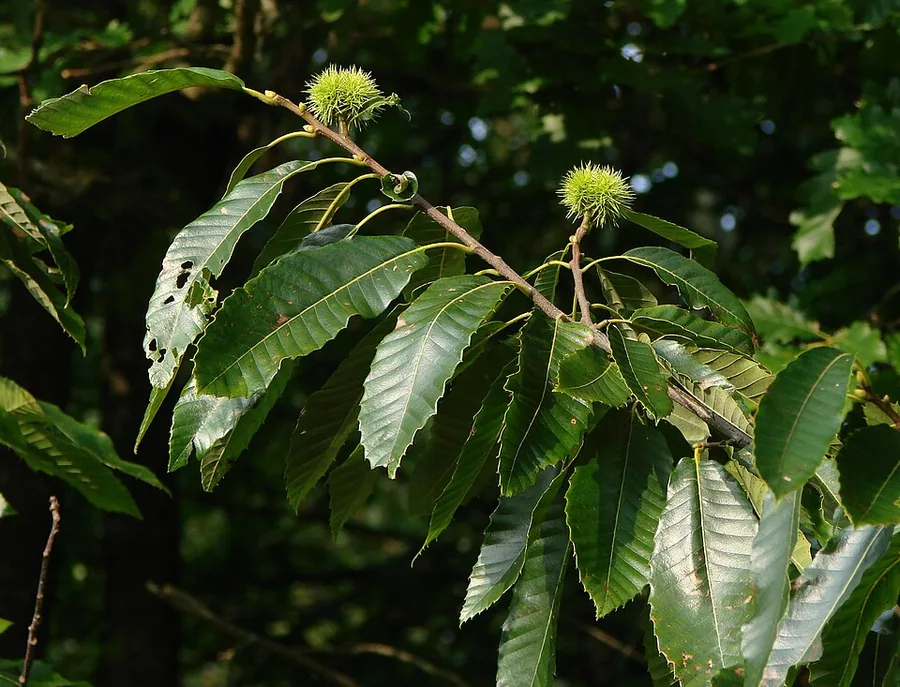
The classic Mediterranean nut tree, prized for its large, sweet nuts and recognized by long, lance-shaped leaves with toothed edges.
Castanea dentata (American chestnut)
Once a defining presence in eastern US forests, lost as a canopy tree to chestnut blight, and known by its coarsely toothed, hairless leaves.
Castanea mollissima (Chinese chestnut)
Planted widely for its harvest thanks to its blight resistance, and set apart by the soft hairs on its twigs and leaf undersides.
'Dunstan' hybrid chestnut
A cross of American and Chinese parents, bred to bring strong blight resistance together with good nut quality.
Companions
A chestnut's best neighbor is another chestnut, since one tree needs a partner to set nuts, and its worst is the grass crowding its trunk.
Plant near
A second, different chestnut cultivar: Supplies cross-pollen for nut set because chestnuts are largely self-incompatible.
Keep apart
Turfgrass or sod against the trunk: Competes with young chestnuts for water and nutrients; keep a mulched, grass-free zone around the base.
How to propagate
A chestnut can begin from its own nut or from a graft of a named cultivar, and the path you choose sets both how soon the tree earns its place and whether it carries the parent's qualities forward.
SeedModerate
Sow fresh nuts in fall, or cold-stratify moist nuts for about 2 to 3 months and sow in spring. · 5 to 7+ years to first nut crop from seed
Most chestnuts begin as the nut itself, though the nut is recalcitrant and dies if it dries out, so it goes in fresh in fall or stays moist and cold-stratified for 2 to 3 months ahead of a spring sowing. A seedling will not echo its parent, and patience is the price, since 5 to 7 or more years pass before the first crop.
GraftingDemanding
Graft in late winter to spring onto compatible seedling rootstock. · Grafted trees typically bear in 3 to 5 years
Grafting carries a named cultivar forward true to type and folds blight resistance together with good nut quality. The work goes onto compatible seedling rootstock in late winter or spring, with nuts expected in 3 to 5 years, though a graft union now and then refuses to take.
Myths
The sweet chestnut and its horse chestnut look-alike are one tree, and either nut belongs on the table.
The two are not even close relatives. The edible sweet chestnut belongs to Castanea in the family Fagaceae, while the horse chestnut, or buckeye, is Aesculus, whose nuts hold aesculin and saponins that are toxic to pets and people. Never eat a horse chestnut or conker in place of the real thing.
Not a single American chestnut remains.
Castanea dentata is functionally extinct only as a mature canopy tree, struck down by blight before it can rise to full height. Surviving root systems still sprout year after year, and breeding programs continue to produce blight-resistant hybrids meant to return the tree to the landscape.
One chestnut standing alone will set a full harvest.
A lone tree sets poorly because chestnuts are largely self-incompatible. You need two genetically different trees standing close enough to share pollen before the burs will fill out properly.