Shrub · Apocynaceae
Asiatic Jasmine
Trachelospermum asiaticum
Hard-wearing, glossy, and happy in sun or deep shade, Asiatic jasmine lays down a calm green carpet and asks for almost nothing.
Full sun
Every 7–14 days
USDA 7–11
6–24 in · 15–61 cm
Overview
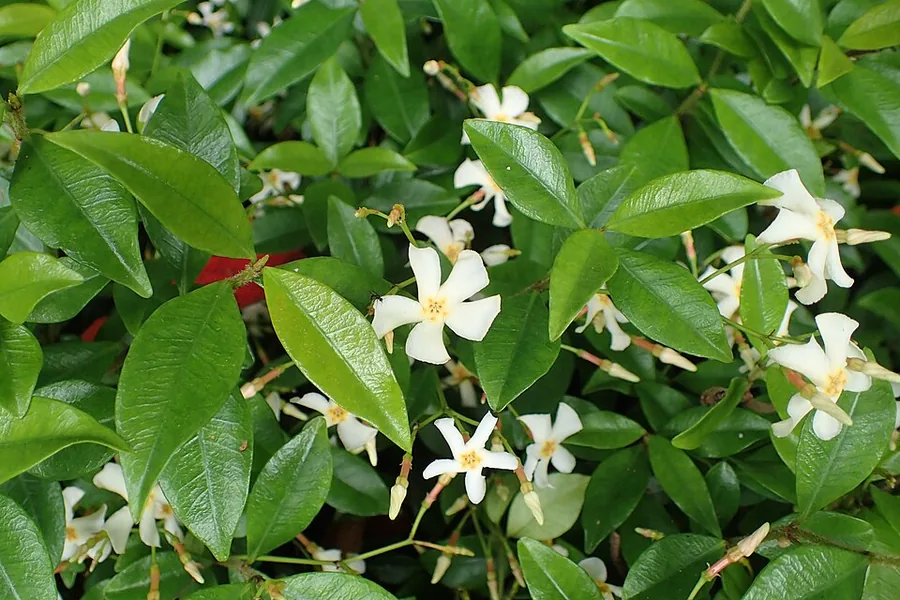
Asiatic jasmine reads as a low, evergreen groundcover, valued for the even green expanse it lays across a space rather than for any flower show. It sits in the dogbane family and, the name notwithstanding, is no true jasmine. Fresh growth often arrives coppery bronze or red before easing to deep green, lending the planting a quiet seasonal mood that suits relaxed, naturalistic settings.
Its real appeal is how lightly it leans on you. The planting takes full sun to deep shade, brushes off drought once settled, and works in clay, loam, or sand. Hardy from zones 7 to 11, it holds down to about 10°F (-12°C) and rides out heat to 100°F (38°C), which is why it slips so easily under trees and along curbs where most plantings struggle to look composed.
The catch is its drive to spread. Those trailing stems root as they travel, so the carpet that finishes a bare slope will just as readily scale a trunk or drift over a walkway left unchecked. Frame it with a defined edge and a yearly shearing, and it keeps a clean, even sweep across a garden for decades.
Care
The short version: site it almost anywhere from full sun to full shade, keep it watered through the opening season, then largely step back and shear it once a year in early spring so the carpet stays dense and stays where you want it.
Light
Few groundcovers sit this comfortably across so much light. Asiatic jasmine settles in from full sun all the way to full shade, though it stays at its densest and most colorful with at least a little sun. Deep shade slows it and lets the mat thin a touch, yet the cover holds.
Water
Hold the soil evenly moist through the first season while it roots in. From there it is honestly drought tolerant and seldom looks for extra water. Keep a light hand, since overwatering is one of the things that tips it into pushy, unruly growth.
Soil
It settles into almost any well-drained soil, clay, loam, or sand alike, across a generous pH range of 6.0 to 8.0. The single snag is strongly alkaline ground, which holds back iron and yellows the leaves, so steer toward neutral to slightly acidic where the site allows.
Temperature
Hardy in zones 7 to 11, it carries a wide swing from roughly 10°F to 100°F (-12°C to 38°C). That pairing of cold hardiness and heat tolerance is what lets it carpet a garden in climates that wear down softer plantings.
Humidity
Everyday outdoor humidity suits it, with no figure to watch. It carries humid Southern summers and drier stretches with equal ease.
Feeding
Feed it lightly, if you feed it at all. A modest dose of balanced slow-release fertilizer in spring is ample, and most settled plantings want none. Overdo the feeding and you simply earn faster, more unruly growth to cut back.
Pruning
The headline task is a once-a-year mow or shear in early spring to refresh the planting and keep it dense. Trim the edges here and there through the season to keep it from drifting into lawns, beds, and walkways.
Repotting
Set in the ground, it almost never asks for repotting. In a container, size it up only when roots circle the pot, work their way out the drainage holes, or water begins running straight through.
Size & spacing
It keeps low, just 6 to 24 inches (15 to 61 cm) tall, while each plant reaches wide, from 3 to 12 feet (91 cm to 3.7 m) across. Set plants 1.5 to 3 feet apart for groundcover and leave clearance away from trunks and structures it might climb.
When to plant
Asiatic jasmine settles into the garden in spring, once the last frost is behind you and the soil is starting to warm. Plant it then and keep it watered through that first season so it roots in, and it will give the next two years to drawing itself into a solid evergreen carpet.
Northern hemisphere
Southern hemisphere
Typical months for a temperate climate: start earlier in warm zones, later where spring frosts linger.
- Plant: spring after last frost
- Harvest: late spring to early summer (blooms sparsely)
Hardiness
USDA hardiness zones: 7–11
Temperature: down to -18°C
Troubleshooting
Few plantings ask for less attention, and most of what arises is either a spreading habit that wants reining in or a soil matter you can put right. Find the look that matches your garden below, then step in before a small issue drifts across the whole sweep.
Stems wandering into the lawn and reaching up the nearby trees
This is a fast, traveling groundcover that takes root anywhere a stem rests on damp soil. Give it too much water, sun, or fertilizer and the easy carpet turns restless, sending runners up trunks and across the path. Define the bed with a crisp edge, lift the stems back off your shrubs and trees, and shear the planting once each spring to return it to a smooth, settled mat.
Fix:
- Trim and edge the perimeter regularly to keep it in bounds
- Pull or cut stems climbing trees and shrubs
- Mow or shear the whole planting once a year in early spring to renew it
- Reduce supplemental water and fertilizer to slow aggressive growth
Pale yellow foliage while the veins hold their green
Foliage that fades to yellow while the veining stays green points to iron chlorosis, and the usual culprit is alkaline soil holding the iron out of reach. The look appears first across the freshest growth. A chelated iron supplement turns it around quickly, and working the soil toward a lower pH keeps the planting looking even again.
Fix:
- Apply a chelated iron supplement
- Acidify or amend the soil to lower pH
Open spaces between plants through that first year
Expect a fresh planting to read patchy and a little sparse all season, and treat that as part of the plan. The first year goes into root building, and the planting wants about two growing seasons to knit together into a finished sweep. Hold the soil evenly moist, set plants 1.5 to 3 feet apart to close the gaps sooner, and let the second season carry it home.
Fix:
- Keep soil evenly moist while establishing
- Space plants closer (about 1.5 to 3 feet apart) for faster coverage
- Be patient; growth accelerates in the second season
Tiny bumps along the stems with a sticky film
Now and then scale insects take up residence on the stems and the underside of the leaves, leaving small bumps and a tacky honeydew that invites sooty mold. Real pest trouble is uncommon on this planting. Clear it with horticultural oil and cut away any stem that has been heavily covered.
Fix:
- Treat with horticultural oil
- Prune out heavily infested stems
Toxicity
A reassuring fit for homes with pets and children: Asiatic jasmine counts as non-toxic, and its relative star jasmine holds a place on the ASPCA non-toxic list. The single thing worth knowing is that cut stems weep a milky latex that can bother sensitive skin, so reach for gloves before you prune.
Safe for
People · Cats · Dogs · Horses · Rabbits · Livestock · Birds
Cats None
A fine choice for a home that shares its garden with cats. The related star jasmine appears on the ASPCA non-toxic list, and an idle nibble is unlikely to bring on more than a brief, passing stomach upset.
Dogs None
Dogs are welcome to roam the planting with no cause for concern. No known toxin applies to them, so a chewed stem might bring at most a short tummy grumble.
Horses Safe
Counted as safe in a horse pasture. There's no toxin in play, though as with any lush new foliage it's wise not to let a horse make a meal of it.
Rabbits Safe
Carries no toxicity for rabbits. The tough, milky leaves rate poorly as browse, so most rabbits walk on by.
Livestock Safe
Safe near cattle, goats, and sheep, with no poisoning on record. The bitter latex in the stems tends to discourage grazing all on its own.
Birds Safe
Carries no toxic risk for birds. They can shelter within the dense mat with no harm from the foliage.
People Safe
An easy planting to keep around children and adults. Cut stems do weep a milky latex that can bother sensitive skin, so slip on gloves before a large pruning session.
It is a member of the dogbane family (Apocynaceae) and exudes a milky latex sap when cut that may cause mild skin irritation in sensitive people; wear gloves when pruning. Despite the name it is not a true jasmine.
Varieties
Past the plain green form, a few selections bring color through variegated leaves or brightly tinted new growth. These are the ones most likely to turn up at the garden center.
'Snow-N-Summer' ('HOSNS')
A variegated selection prized for fresh growth that arrives pink and white, then mellows to green and white with age.
'Variegatum'
Creamy white edging and marbling over green foliage give this one a crisp, two-tone presence.
'Bronze Beauty'
Grown for fresh growth that flushes a warm bronze to reddish before turning green.
'Goshiki' / 'Ogon Nishiki'
New growth arrives in a blend of yellow, orange, and red for a multicolored carpet.
'Elegant' / dwarf forms
Lower, tighter selections that work as a fine-textured dwarf groundcover where less height suits the spot.
How to propagate
Asiatic jasmine takes almost no effort to multiply, and it tends to handle the work itself wherever a stem settles onto the ground.
LayeringEasy
Growing season · Several weeks to months
Layering is the simplest route to more plants, since the trailing stems already root themselves anywhere they meet moist soil. Pin a stem to the ground during the growing season and it will settle in over the next several weeks to months, ready to lift away as a fresh plant.
Stem cuttingsModerate
Summer · Several weeks to a couple of months
Semi-hardwood stem cuttings taken in summer offer a second path, though they call for a touch more attention than layering. Allow several weeks to a couple of months for rooting before you pot them on.
Myths
Asiatic jasmine is a true jasmine.
The name aside, this is Trachelospermum asiaticum in the dogbane family rather than a genuine jasmine, which sits in the genus Jasminum within the olive family. The common name is misleading, and the two are not even close kin.
Asiatic jasmine is the same as star jasmine and is grown for its flowers.
Set it beside star or Confederate jasmine and the differences show: it keeps lower, fills denser, holds smaller leaves, and blooms far less. It rarely flowers and is grown as a foliage groundcover, not for a floral display.