Shrub · Apocynaceae
Oleander
Nerium oleander
A tough, drought-proof shrub that carries a garden through summer in bloom, with one caution attached: every part is dangerously poisonous.
Full sun
Every 7–14 days
USDA 8–10
5–20 ft · 1.5–5.9 m
Overview
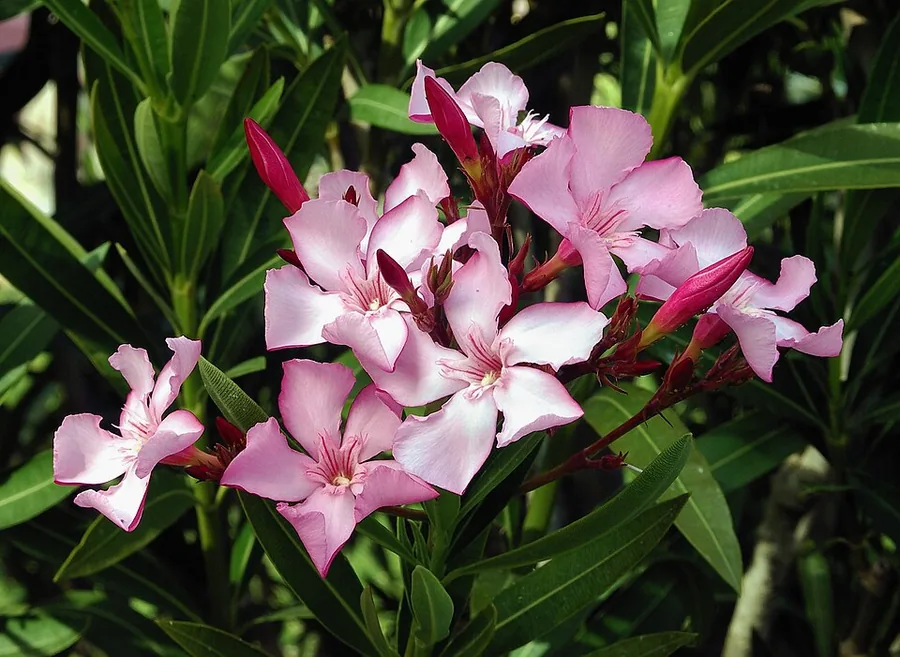
Oleander brings an easy, sun-drenched confidence to a warm garden, holding its own where drought, salt air, and thin soil would defeat something more precious. It gives a terrace or courtyard months of pink, white, or salmon flowers from late spring into summer, the kind of long, unhurried color a relaxed outdoor room is built around. Given its head it reaches 20 feet (6 m), yet it accepts hard pruning with ease, which is why it settles so naturally into the role of a hedge or a screen that frames a view.
The poise that makes it such a good fit for a space comes with a serious caveat. All of it, root to flower, holds cardiac glycosides that affect the heart, and it stands among the most poisonous shrubs planted close to a home. That danger holds in dried leaves, in the smoke of burning clippings, and in the water a cut stem has stood in, so it has no place indoors as a cut stem or an arrangement.
The way to enjoy it is to place it with intention. Keep it clear of pastures, play areas, and vegetable beds, work with gloves, and never burn the trimmings, and it slips easily into a garden's daily rhythm. Given that considered placement, it returns one of the longest, most reliable bloom seasons a shrub can offer a warm-weather setting.
Care
The short version: give it full sun and well-drained soil, water deeply but let it dry between drinks, and prune to shape after it flowers. It asks almost nothing of a settled garden, though every part is poisonous, so keep it well placed and handle it with gloves.
Light
Oleander is at its most generous in full sun, where it flowers freely, and it will carry on in partial shade with a lighter show. The brighter the position, the fuller and more floriferous the plant, which is worth keeping in mind when siting it in a garden.
Water
Water regularly while a new plant establishes, then let the top half of the soil dry out before the next drink, an easy rhythm to fold into a weekly round. A settled oleander is genuinely drought-tough and untroubled by poor, salty ground, so it needs water only every 7 to 14 days at most. Ease off through winter for anything kept in a container.
Soil
It asks little of the ground, thriving in clay, loam, sand, or shallow rocky soil and shrugging off poor or salty conditions. Drainage counts for far more than richness here, and it stays content across a wide pH band of 6.0 to 7.8.
Temperature
Oleander takes real heat, up to about 100°F (38°C), in its stride, which suits a sun-baked terrace. It weathers a light freeze down to roughly 19°F (-7°C), but a harder cold snap will damage or kill it, so container plants come indoors or overwinter cool.
Humidity
Average outdoor humidity suits it, with no figure to chase, which makes it an undemanding presence in most gardens. Dry air and coastal salt spray leave it unbothered.
Feeding
Feed seasonally from spring through summer with a balanced general-purpose fertilizer to keep the display full. A settled in-ground plant needs very little, while a potted one appreciates a regular light feed through the growing season.
Pruning
Prune lightly to shape after flowering, from late summer into early fall, to keep a form that reads as intentional. Buds set on new growth, so cutting back later than early fall costs the coming season's bloom. Deadhead spent flowers, keep gloves on for the whole job, and never burn the clippings.
Repotting
A container oleander wants stepping up every 2 to 3 years, or sooner if roots circle the pot, water runs straight through, or growth stalls. Move it into a slightly larger vessel with fresh, well-drained mix, gloves on, to keep a terrace planting thriving.
Size & spacing
Plants run about 5 to 19.5 feet (1.5 to 6 m) tall and spread 6 to 10 feet (1.8 to 3 m) wide, so a full-size hedge needs a generous footprint in the design. Dwarf cultivars stay far more contained and suit a large pot on a patio.
When to plant
Oleander belongs to the mild end of the temperate range, roughly zones 8 to 10, the warm gardens where it looks most at home. Start cuttings or seed in late winter to early spring, set young plants out after the last frost, and the flowers carry a space from late spring through late summer.
Northern hemisphere
Southern hemisphere
Typical months for a temperate climate: start earlier in warm zones, later where spring frosts linger.
- Sow: late winter to early spring
- Plant: spring after last frost
- Harvest: late spring through late summer
Hardiness
USDA hardiness zones: 8–10
Temperature: down to -12°C
Troubleshooting
Oleander is a low-drama plant that rarely disrupts a garden, and what does appear tends to sit on the leaves rather than trouble the whole shrub. Match what you see below and address it early, before it dulls the display. Keep gloves on for any task that means touching the plant.
A once-full screen thinning to bare veins
A hedge that anchors a border can lose its presence fast to the oleander caterpillar, which feeds in groups and skeletonizes foliage in a hurry. The remedy keeps the planting looking intentional again. With gloves on, pick the orange, black-tufted caterpillars off by hand and prune away any branch that is heavily overrun. Where an outbreak has taken hold, a treatment of Bacillus thuringiensis settles it and lets the screen fill back in.
Fix:
- Hand-pick and destroy caterpillars (wear gloves)
- Remove and dispose of heavily infested branches
- Apply Bacillus thuringiensis (Bt) for severe infestations
A sticky sheen and darkening leaves that dull the display
When a planting loses its polish under a tacky, blackened film, the usual source is a colony of bright yellow oleander aphids on the fresh growth, with scale or mealybugs occasionally in the mix. Their honeydew feeds the sooty mold that mutes the foliage. Clear the lighter colonies with a firm jet of water, then follow with insecticidal soap or horticultural oil across the affected growth. A repeat pass breaks the cycle, and the mold washes away to restore the plant's clean, glossy look.
Fix:
- Spray off light infestations with a strong jet of water
- Apply insecticidal soap or horticultural oil to affected growth
- Repeat treatment to break the pest cycle and wash off sooty mold
Blemished leaves that break up a clean silhouette
Brown or yellow spots with crisp margins usually signal a fungal leaf spot, and since insect honeydew and its sooty mold can leave lookalike marks, a closer look is worth the moment. Strip the marked leaves and clear the fallen litter at the base to keep the setting tidy. Open the plant for better airflow and keep water off the foliage, so the display stays clean and spores find little foothold.
Fix:
- Remove and destroy affected leaves
- Improve air circulation and avoid overhead watering
- Clean up fallen debris around the plant
Toxicity
This is one of the most dangerous plants to grow close to a home, and it deserves a clear-eyed welcome. Every part holds cardiac glycosides that can stop a heart, and the poison lingers in dried leaves, in burning smoke, and in vase water, so it never comes indoors. A single leaf has killed children, and it is rapidly and often fatally toxic to cats, dogs, horses, livestock, and birds. Keep it well away from anyone who might taste it, and never burn the clippings.
Toxic to
Cats · Dogs · Horses · Rabbits · Livestock · Birds · People
Cats Severe
A cat that samples any part of this plant is in genuine danger, and it warrants an immediate response. The first signs, meaning drooling, vomiting, diarrhea, and belly pain, are followed by an irregular or racing heartbeat, weakness, and collapse. Even a small taste can prove fatal, so treat any contact as an emergency.
Dogs Severe
One chewed leaf or stem puts a dog in the same grave situation. Drooling, vomiting, and diarrhea soon give way to dangerous heart rhythm changes, tremors, and sudden collapse. Reach a vet at once rather than waiting to see how it unfolds.
Horses Severe
Horses are remarkably sensitive, and only a few leaves can be lethal. Colic, drooling, and diarrhea arrive together with a wildly abnormal heartbeat, muscle tremors, and collapse. Dried clippings carried into a paddock are every bit as deadly as the living plant.
Rabbits Severe
The cardiac glycosides act hard on rabbits, and a tiny amount can stop the heart. Look for gut pain, refusal to eat, weakness, and a faltering pulse. No nibble is safe, so keep oleander well beyond their reach.
Livestock Severe
Cattle, goats, and sheep are poisoned by green leaves and by dried clippings raked into hay alike. Vomiting, colic, diarrhea, and a staggering heartbeat advance to collapse and sudden death. Many losses come from animals eating trimmings tossed over a fence.
Birds Severe
Birds are not spared, and the same heart toxin can kill them quickly. Watch for weakness, a ruffled stillness, an erratic heartbeat, and sudden death. Keep poultry and pet birds clear of every part of the plant.
People Caution
No part of oleander is edible, and a single leaf has been enough to kill a child. Swallowing any of it can bring vomiting, a dangerously irregular heartbeat, and death, while the sap irritates skin. Wear gloves, never burn the clippings, and keep children well away.
Wear gloves when handling or pruning; never burn clippings; wash hands after contact; keep all plant parts, prunings, and vase water away from pets, children, and livestock.
Helpline numbers

United States
ASPCA Animal Poison Control: (888) 426-4435 (fee applies)
Poison Control: (800) 222-1222



Canada
Poison Centres: 1-844-764-7669
Varieties
Oleander offers a considered palette of flower colors and a range of sizes, from compact dwarfs for a pot to tall forms for a screen. These are among the cultivars a gardener is most likely to find.
Hardy Pink
A pink-flowered selection that carries more cold than most, making it the reassuring choice for gardens sitting at the edge of the range.
Petite Salmon
A compact dwarf in soft salmon that stays well below the wild species, tailor-made for a courtyard corner or a statement pot on a terrace.
Sister Agnes
A vigorous white-flowered cultivar that climbs tall and fast, long favored where a clean, luminous screen is the goal.
How to propagate
Oleander multiplies with ease, and cuttings are the surest way to repeat a plant whose color already suits a scheme. Whichever route you take, wear gloves, because every part you handle is poisonous.
Stem cuttingsEasy
Late spring through summer · 2-4 weeks to root
Cuttings are the graceful way to build a matching run of oleander, since each one comes back true to the parent and keeps a planting cohesive. Softwood or semi-hardwood stems taken from late spring through summer settle in within 2 to 4 weeks, even standing in plain water on a sunlit sill. Keep gloves on throughout, because the cut stems and their sap are poisonous.
SeedModerate
Late winter to spring · Several weeks to germinate; seedlings vary
Seed is the slower and less predictable path, better suited to the gardener who welcomes a surprise than to one after a uniform look. Sown from late winter into spring, the seeds need several weeks to sprout, and the seedlings often turn out quite unlike the parent. Handle them with gloves, since they hold the same toxin as the rest of the plant.
Myths
Only the leaves are dangerous, so the flowers, smoke, and vase water are harmless.
Every part of oleander is poisonous, from the bark, flowers, and fruit to the leaves, roots, sap, seeds, and stems, so nothing about it belongs indoors on a table. The danger does not fade as the plant dries, the smoke from burning clippings is toxic to breathe, and even the water a cut stem stood in can poison someone, which rules it out as a cut flower entirely. A single leaf can be enough to kill a child or a pet.