Shrub · Apocynaceae
Star Jasmine
Trachelospermum jasminoides
Draped along a wall or terrace rail, star jasmine turns an ordinary corner into a scented retreat.
Full sun
Every 5–10 days
USDA 8–10
3–20 ft · 0.9–6.1 m
Overview
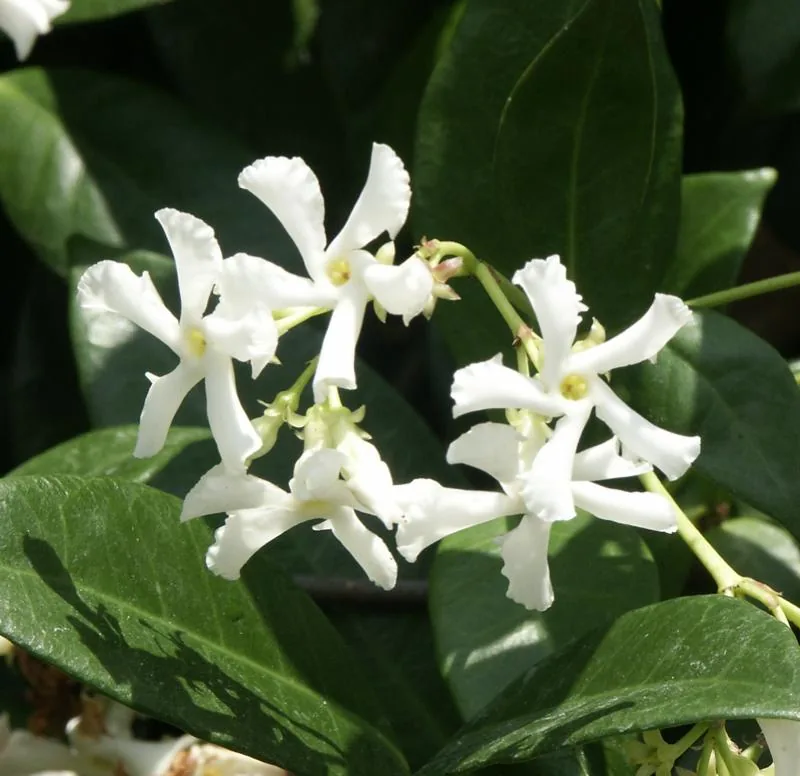
Star jasmine has a way of softening a space. An evergreen from the dogbane family, it can be styled as a climbing vine along a wall, a loose sprawling shrub beside a bench, or a groundcover flowing between pavers, so it slips easily into most garden schemes. When the white pinwheel flowers open in late spring, their fragrance settles over a patio at dusk and makes an evening outdoors feel like an occasion.
It climbs by twining, so it asks for a trellis, wire, or fence to lean into, which makes it a natural for framing a doorway or dressing a bare boundary. Given open ground instead, it spreads into a calm green carpet that quiets a slope or a side return. Growth is quick, and once settled it reaches 3 to 20 feet (91 cm to 6 m), enough to green a whole wall in a season or two.
Part of its appeal is how little it asks in return. It resists most pests, accepts a range of soils, and takes a brief cold snap in stride in milder gardens, which keeps a planting looking composed with almost no effort. Offer it sun, good drainage, and something to climb, and it holds its polished, evergreen presence year round.
Care
The short version: site it in full sun for the fullest bloom, keep the soil evenly moist but well-drained, and give it a support to climb; once established it takes dry spells in stride and folds into a low-maintenance routine.
Light
For the richest flowering, give star jasmine full sun, though it holds up in partial shade and grows well in the bright indirect light of an interior spot. A shaded corner tends to trade flowers for leggy green stems, so the sunnier the setting, the more lavish the bloom that dresses it.
Water
While a young plant establishes, keep the soil evenly moist and water about every 5 to 10 days to help it settle into its place. After that it becomes drought tolerant, slipping into a hands-off routine that only needs the hose during a genuine dry spell.
Soil
It looks its best in fertile, well-drained loam worked with a little leaf mold, though it tolerates a fair range of soils. Aim for a pH of 6.0 to 7.5. The one condition it will not abide is wet feet, so drainage is the detail worth getting right before anything else.
Temperature
Star jasmine is comfortable across a wide range, from 10°F to 100°F (-12°C to 38°C), and that hardiness is what lets it furnish an outdoor wall in zones 8 to 10. In colder regions it settles just as gracefully into a pot that can move indoors for winter.
Humidity
Everyday average humidity suits it, so there is no target to manage. It adapts to the ordinary air of a terrace or an interior room without asking for anything special.
Feeding
A single spring feeding with a balanced general-purpose fertilizer sets up the season's growth. Should the leaves pale on alkaline ground, an iron supplement or acidifier restores the deep green that keeps the planting looking crisp.
Pruning
Prune after flowering to keep the shape tidy and in scale with its setting, guiding the twining stems onto their support as they lengthen. The sap runs as a milky latex, so wipe the tools once the trimming is finished.
Repotting
A container plant appreciates a fresh pot every 2 to 3 years, or sooner once roots circle the base, water drains away too fast, or growth and flowering begin to ease off.
Size & spacing
Depending on how it is trained, star jasmine ranges from 3 to 20 feet (91 cm to 6 m) and spreads 3 to 6 feet (91 to 183 cm) across, so allow it room and a solid support and let it become the green backdrop of a wall or corner.
When to plant
Star jasmine settles happily into gardens in zones 8 to 10. Plant in spring, once the frost has passed, and the display builds toward its high point from late spring into early summer, when the scent is at its most generous, with a lighter show carrying on through the warmer months.
Northern hemisphere
Southern hemisphere
Typical months for a temperate climate: start earlier in warm zones, later where spring frosts linger.
- Plant: spring, after danger of frost has passed
- Harvest: late spring to early summer, with sporadic bloom into summer
Hardiness
USDA hardiness zones: 8–10
Temperature: down to -12°C
Troubleshooting
A well-placed star jasmine mostly takes care of itself, so the occasional off note is easy to read and easy to settle. Most trace back to soil chemistry, a sap-sucking insect, or a spot that never quite gets enough light. Match the symptom below and adjust early to keep the planting looking its best.
Sticky leaves with a black film and bumps along the stems
The bumps are scale insects or mealybugs, and the black film is sooty mold settling on the honeydew they leave behind. Wipe the stems clean with water and a little mild soap, then treat with horticultural oil or insecticidal soap. Cut away any stem too far gone to save, and the planting soon looks fresh again.
Fix:
- Wash off honeydew and sooty mold with water and mild soap
- Treat infestations with horticultural oil or insecticidal soap
- Prune out heavily infested stems
Pale leaves with veins that stay green
Leaves that fade while their veins keep their green are showing chlorosis, usually an iron shortage that surfaces when the soil turns alkaline. A chelated iron supplement or an acidifier restores the color, and a mulch of leaf mold keeps the ground in good heart. Check the drainage as well, since soggy roots can leave the same tired look.
Fix:
- Apply a chelated iron supplement or soil acidifier
- Improve drainage and avoid overwatering
- Mulch with organic matter such as leaf mold
Thin, leggy stems and few flowers
A star jasmine set in too much shade grows plenty of stem but offers little bloom, reading as green rather than floral. Move a container into brighter light or thin the canopy above it. Full sun is what brings the generous, fragrant flush that makes the plant worth its place.
Fix:
- Move container plants or relocate to a sunnier spot
- Thin overhead shade where possible
Toxicity
For a home shared with pets or children, star jasmine is an easy choice, because it is not toxic. The ASPCA lists it as safe for cats, dogs, and horses, and no toxic compounds are reported for other animals. The only note to keep in mind is the milky sap that weeps from cut stems, which can leave sensitive skin a little itchy, so rinse your hands after pruning.
Safe for
People · Cats · Dogs · Horses · Rabbits · Livestock · Birds
Cats None
A curious cat can taste a leaf with no ill effect, and the ASPCA lists star jasmine as non-toxic to cats.
Dogs None
It sits comfortably in a dog-friendly home, with no toxic compounds reported, so a pup that chews a trailing stem comes to no harm.
Horses None
Listed as non-toxic to horses, it presents no grazing risk along a fence line or pasture edge.
Rabbits Safe
No toxins are reported for rabbits, and the bitter milky sap tends to discourage a second nibble.
Livestock Safe
Cattle, goats, and sheep can graze nearby without concern, as the plant holds no known toxic principle.
Birds Safe
Backyard and aviary birds are in no danger from the foliage or the flowers.
People Safe
It is safe to grow and to handle, though the milky sap can leave sensitive skin a little itchy, so rinse your hands after pruning.
Stems exude a milky latex sap when cut, which may cause mild skin irritation in sensitive people; wash hands and clean tools after pruning.
Varieties
A few named selections and one close cousin turn up at nurseries, each suited to a slightly different corner of the garden.
'Madison'
A hardier selection that carries more cold than the species, opening star jasmine up to cooler gardens.
'Variegatum'
Chosen for its foliage, with creamy-white leaf margins that lighten a shaded wall or fence.
Asiatic jasmine (Trachelospermum asiaticum)
A close cousin with smaller, darker leaves and tiny yellowish-white flowers that settles in as a tough, fast-spreading groundcover.
How to propagate
Star jasmine is easy to multiply, and because its stems already twine and trail, two simple methods let you carry it from one part of the garden to another with no special equipment.
Stem cuttingsEasy
Late spring to summer · Several weeks to a few months to root
Cuttings are the usual route to another plant. Take semi-ripe stem cuttings in late spring or summer, and over several weeks to a few months they root into new plants that match the parent, ready to dress a second wall or border.
LayeringEasy
Spring to summer · One season to root before separating
Layering makes use of the way the stems already twine and trail. Pin a low stem to the soil in spring or summer, let it root through a full season, then separate it from the parent to start again elsewhere in the garden.
Myths
Star jasmine is a true jasmine.
The name and the heady scent lead most people to assume it belongs with the true jasmines, yet it does not. It sits in the dogbane family (Apocynaceae) as Trachelospermum jasminoides, a separate lineage from the genus Jasminum behind true jasmine.