Ornamental · Poaceae
Bahiagrass
Paspalum notatum
Tough, drought-proof, and happy in poor sandy soil, bahiagrass holds ground where finer lawns give up.
Full sun
Every 3–7 days
60–90 days
USDA 7–11
Overview
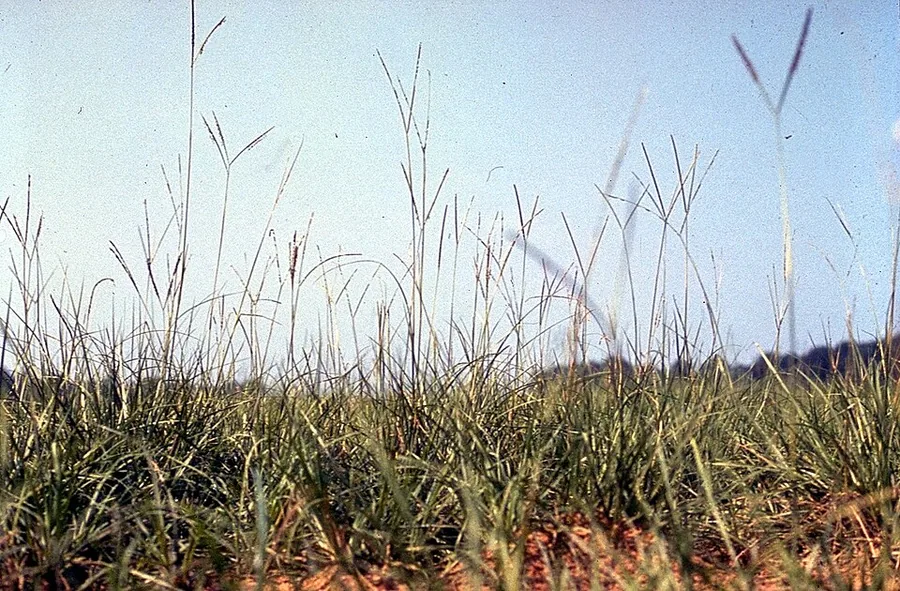
Bahiagrass is a warm-season perennial drawing on deep, far-ranging roots, and that root system is the reason it carries drought so gracefully. Its origins lie in South America, and it spread across the warm, sandy lower South, where it now reads as lawn, pasture, and roadside cover at once. The tall, two-pronged seedheads that fork into a Y above the turf give it away.
Its defining quality is how little it demands. It settles happily into infertile, acidic, sandy soil that would leave other grasses hungry, lives on light feeding, and seldom calls for water once it is rooted. The return is an open, coarse, light-green sheet rather than a tight carpet, along with an almost steady procession of seedheads through summer.
Think of it as a grass chosen for purpose over polish. Give it full sun and room to spread and it will crowd out weeds and bind a slope together on next to nothing. Ask it to pass for a fine lawn and you are signing on for weekly mowing while still chasing those seedheads.
Care
The short version: full sun, infertile acidic sandy soil, and very little water after it roots. Keep the cut high at 3 to 4 inches, feed with a light hand, and count on frequent summer mowing to hold the seedheads in line.
Light
Bahiagrass calls for full sun to do well and will not keep a stand in shade. The more direct light it takes, the denser and more weed-resistant the turf holds.
Water
After it roots, this counts among the most drought-tolerant lawn grasses you can put down, owing to its deep roots. Water only when needed, roughly half to three-quarters of an inch each time, and let it fade brown and dormant through a dry spell rather than working against it. The exception is new plantings, which want steady water across the first 2 to 3 weeks.
Soil
It genuinely favors infertile, sandy, acidic ground where finer grasses falter, with a comfort zone near pH 5.5 to 6.5. Carry the pH much beyond that and the grass yellows and stalls, so keep the soil leaning acidic.
Temperature
Being a warm-season grass, it greens with heat and fades with cold, working across a span of roughly 19°F to 100°F (-7°C to 38°C). Through winter it slips into dormancy rather than dying off within its hardiness range.
Humidity
Outdoor humidity asks nothing of an established lawn. What counts more is letting the blades dry between waterings, since leaf wetness left to linger is the opening for dollar spot.
Feeding
Bahiagrass is a light feeder, asking for only about 1 to 2 pounds of nitrogen per 1000 square feet across the spring and summer growing season. On high-pH soils a measure of iron as ferrous sulfate settles the yellowing that lime-heavy ground brings on.
Pruning
Cut high, at 3 to 4 inches, and never strip more than a third of the blade in a single pass. Through summer the tall Y-shaped seedheads climb within days, so plan to mow often to hold them down, and keep the blade sharp since the wiry stalks dull it quickly.
Repotting
none
Size & spacing
The mown turf keeps low at 3 to 4 inches (8 to 10 cm), while the individual plants reach 1 to 3 feet (30 to 100 cm) as they knit a stand together. Plant or sprig with that spread in view so the cover draws in without leaving long bare runs.
When to plant
Bahiagrass needs warm ground before it stirs. Sow seed or lay sod from spring into early summer so the stand has the full warm season to root and close in before cooler weather eases its pace.
Northern hemisphere
Southern hemisphere
Typical months for a temperate climate: start earlier in warm zones, later where spring frosts linger.
- Plant: Seed or sod in spring to early summer once soil is warm, allowing establishment before cool weather
- Harvest: Summer; tall two-spike Y- or V-shaped seedhead racemes
Hardiness
USDA hardiness zones: 7–11
Temperature: down to -18°C
Troubleshooting
Most bahiagrass trouble is surface-level and simple to read once the signs are familiar. Seedheads, yellowing, thinning patches, and small bleached rings each trace back to a particular cause. Match what shows up below, then act before it travels.
Failing patches above soft, tunneled ground
Mole crickets are the most damaging insect the grass contends with, working through the root zone and grazing the roots along the way. You can confirm them with a soap flush, stirring 1 to 2 ounces of lemon dish soap into 2 gallons of water poured over a 2-square-foot patch, and the crickets rise to the surface within minutes. Address the young nymphs in early summer before the count climbs, and keep the turf in good heart so it can carry light feeding without showing it.
Fix:
- Treat for mole crickets when young nymphs are active in summer
- Keep turf healthy so it can outgrow light feeding
Pale coin-sized rings dotted through the turf
Those small silver rounds are dollar spot, a fungus that moves in once the grass is low on nitrogen and the blades sit wet with morning dew. Hourglass-banded lesions along the blades will confirm it. A modest feeding of about half a pound of nitrogen per 1000 square feet pushes the grass past the trouble, and watering early so the blades dry by dusk keeps it from traveling.
Fix:
- Apply a light nitrogen feeding (about 0.5 lb N per 1000 sq ft)
- Water early in the day so blades dry quickly and avoid evening irrigation
Forked seedheads rising over the lawn just after a cut
Those slim forked stalks are simply how bahiagrass lives, never a fault in the lawn, and they rise quickest under the long light of high summer. A cut every 7 to 14 days keeps the look settled, and a sharp blade matters because the wiry stems blunt it in no time. For a more composed finish around the home, the Argentine type sends up fewer and shorter seedheads than the common selections.
Fix:
- Mow frequently in summer (every 7 to 14 days) to keep seedheads down
- Keep a sharp, heavy-duty rotary blade because the tough seedstalks dull blades
- Choose Argentine for fewer, shorter seedheads if a tidier look is wanted
Pale blades over chalky ground while the veins stay green
What you are seeing is iron chlorosis, and it surfaces once the soil pH rises past 7.0 and ties up the iron the grass needs. A measure of ferrous sulfate, around 2 ounces per 1000 square feet, restores the color within days, and you can repeat it every 6 weeks or so should the pallor creep back. The durable answer is to keep the ground acidic and set the lime aside.
Fix:
- Apply ferrous sulfate at about 2 oz per 1000 sq ft, repeating roughly every 6 weeks as needed
- Avoid raising soil pH; do not over-lime
Toxicity
A bahiagrass lawn is safe for pets and people and does not appear on the ASPCA toxic-plant lists. The genuine cautions sit with grazing animals, since the summer seedheads may carry an ergot fungus, and with hay-fever sufferers troubled by the pollen. A pass with the mower over the seedheads clears the grazing risk in full.
Safe for
People · Cats · Dogs · Horses · Rabbits · Livestock · Birds
Cats None
A bahiagrass lawn poses no hazard to cats. As with any turf, a few chewed blades might raise a small hairball, yet the plant holds nothing toxic.
Dogs None
Dogs are free to sprint and tumble across a bahiagrass lawn. Nothing in the blades is poisonous, and the turf stands up nicely to paws and rough play.
Horses Moderate
The grass is sound forage and fine to graze. The single exception is the summer seedheads, which may harbor an ergot fungus that brings tremors and an unsteady, staggering walk. Mow the seedheads away and the danger leaves with them, and a horse already affected settles once taken off the pasture.
Rabbits Safe
Rabbits can graze bahiagrass quite safely, since neither the leaves nor the roots hold any toxin.
Livestock Moderate
Cattle, goats, and sheep take bahiagrass widely as pasture. The only difficulty comes from ergot-infected seedheads, which can set off paspalum staggers, a tremoring, off-balance state. Keep the seedheads mown and the threat clears.
Birds Safe
Birds take the seed and forage across bahiagrass with no ill effect.
People Safe
A bahiagrass lawn is fine to walk, sit, and play on. The one thing to keep in mind is that the pollen can trouble those with hay fever, so a sensitive household may prefer to mow before the seedheads open.
Safe as a lawn for pets and people. Two grazing-only nuances: grass pollen is allergenic to sensitive people, and for livestock the Paspalum seedheads can be infected with ergot (Claviceps paspali) whose sclerotia cause paspalum staggers (tremors and incoordination) in grazing cattle and horses. Mowing off seedheads removes this risk; it does not affect pet or human safety of the lawn.
Varieties
A handful of named types account for most plantings, and the right one turns on whether you favor a more composed lawn or a tougher pasture. These are the selections worth knowing.
Pensacola
The selection grown more than any other, with narrow leaves and a real tolerance for cold, though that hardiness comes at the price of tall, plentiful seedheads.
Argentine
A broader-bladed selection that settles into denser, more even sod with fewer and shorter seedheads, the more refined choice for a lawn even if it takes cold less gracefully.
Tifton 9
An improved Pensacola selection bred by USDA-ARS and the University of Georgia for stronger seedlings and longer leaves, grown mainly for pasture and forage.
TifQuik
A quick-germinating selection within the Pensacola line that settles in rapidly for pasture and forage use.
How to propagate
Bahiagrass is among the more forgiving warm-season grasses to start, whether you sow it from seed or set it as sod. Either route rewards patience, since it is slow to draw into full cover.
SeedEasy
Spring to early summer when soil is warm · Several weeks to a few months; scarified seed speeds germination
Bahiagrass ranks among the few warm-season lawn grasses you can raise directly from seed, which is why most new stands open this way. Sow from spring into early summer once the ground has warmed, and allow several weeks to a few months for it to close in, as germination runs slow. Scarified seed rises faster when you can source it.
DivisionModerate
Warm season; spring to summer · A few weeks for sod to root; plugs and sprigs are slow to fill in
Laying sod or setting sprigs and plugs through the warm months brings cover on sooner than seed, with sod taking root inside a few weeks. The catch is that bahiagrass never forms tight, uniform sod slabs, and plugs are slow to draw together into a solid stand.
Myths
Bahiagrass makes a fine, manicured lawn like Bermuda or St. Augustine.
It builds open, coarse, light-green sod and goes on lifting tall Y-shaped seedheads all season long, so it will never present as a carpet lawn however diligently you mow. Its true place is broad, low-maintenance ground such as pastures, roadsides, and erosion control, where its grit and drought resistance matter far more than a polished finish.