Herb · Musaceae
Banana
Musa acuminata
Give it warmth, rich soil, and steady water, and this giant herb brings a sweep of the tropics to a sunlit room or terrace.
Full sun
Every 2–4 days
59–86°F · 15–30°C
270–600 days
Overview
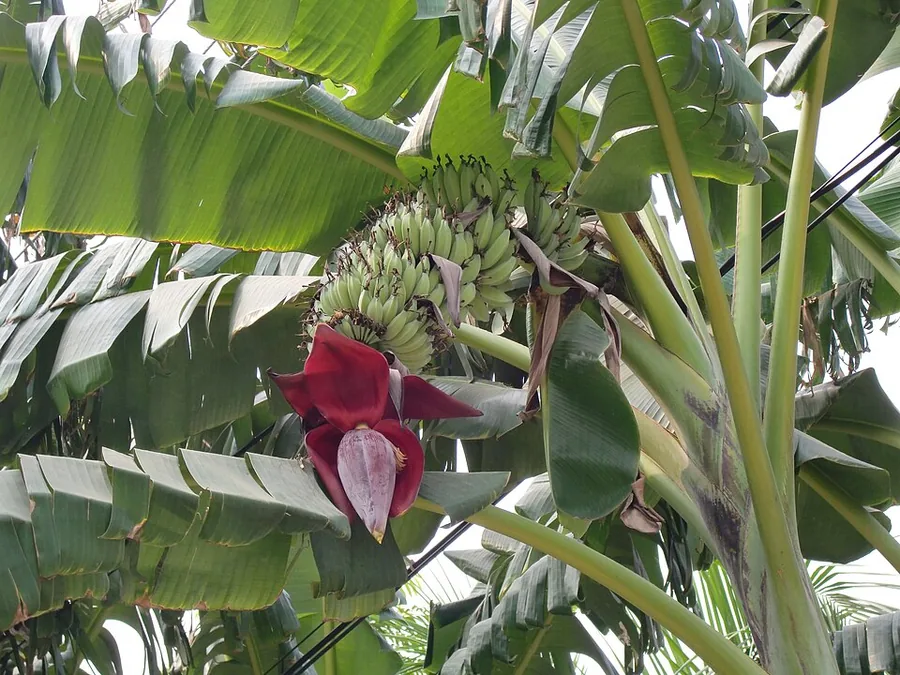
Few plants set a mood the way a banana does, and the surprise is that it is no tree but a giant herb, the largest there is. The upright form taken for a trunk is a pseudostem, a clean column of leaf sheaths that carries the plant until it flowers. Each stem rises quickly, fruits once, then steps aside for the suckers gathered at its base, so the display renews itself season after season.
A banana asks for the same things that make a room feel alive: warmth and humidity, generous light, and a little patience. It lives outdoors in USDA zones 9 to 11, while in cooler climates a large container lets it summer on a terrace and overwinter indoors. Sited in sun with deep rich soil and steady water, a single plant grows into a sculptural clump that anchors a courtyard or a glassed sunroom with ease.
There is a slow pleasure to growing one. A new stem needs 9 to 20 months to reach harvest, so it asks for the kind of patience that suits a considered home. Once the clump is settled, the followers ripen in turn, and even between harvests the broad leaves give a space the unhurried, resort-like calm that no cut arrangement can match.
Care
The short version: a bright warm position, deep rich soil kept evenly moist, and steady high-potassium feeding through the growing season, with cold protection ready the moment frost is in the forecast.
Light
Banana wants full sun, the kind of bright, open exposure that suits a south-facing terrace or a glassed sunroom, though it will accept partial shade and carry on. The more light the spot offers, the sturdier the stem and the better the fruit.
Water
This is a thirsty plant, so it rewards a watering routine you keep. Hold the soil evenly moist at all times but never waterlogged, watering every 2 to 4 days and more often in heat or wind. Deep, well-drained ground lets you water freely without the roots ever sitting wet.
Soil
Plant in deep, fertile, well-drained loam rich with organic matter, which both feeds the plant and holds the moisture banana likes. A pH between 5.5 and 7.0 keeps it at its best.
Temperature
Banana settles happily between 59°F and 86°F (15°C to 30°C), much the comfort range of the rooms it shares. Growth eases as the air cools toward 60°F (16°C), and a freeze at or below 32°F (0°C) cuts the leaves down, so warmth is what keeps it cropping.
Humidity
A tropical at heart, banana prefers the air humid, around 50% to 80%, which makes a steamy bathroom or a plant-filled sunroom a natural home. Dry air browns the leaf edges, so a sheltered, muggy corner or the occasional mist keeps the foliage looking its best.
Feeding
Banana is a heavy feeder with a real appetite for potassium. A high-potassium fertilizer at roughly a 3-1-6 N-P-K ratio, given about once a month through the warm growing season, keeps the leaves a deep green and the fruit filling.
Pruning
Clear away dead or torn leaves to keep the plant looking composed, and once a stem has fruited, cut that pseudostem to the ground, since it fruits only once. Thinning the suckers to one or two followers per clump keeps the form tidy and the plant's energy focused.
Repotting
A container banana wants moving up every 1 to 2 years, or sooner if roots circle the pot, growth stalls, or suckers crowd the surface. Repot into a larger vessel at the start of the warm season so the roots settle before the plant puts on its show.
Size & spacing
This is a grand plant, reaching 6.5 to 16 feet (2 to 5 m) tall and spreading 5 to 10 feet (1.5 to 3 m) wide, so it commands a courtyard corner or a double-height room. Leave it open space to fill, since the clump only widens as new suckers come on.
When to plant
Banana keeps time by warmth rather than the calendar, which suits the rhythm of a garden lived in rather than merely tended. Plant in spring once soil and air have warmed, let the stem build through the long season, and look for fruit anywhere from 9 to 20 months on. Where winters turn cold, a container that moves indoors keeps the tropical note going all year.
Northern hemisphere
Southern hemisphere
Typical months for a temperate climate: start earlier in warm zones, later where spring frosts linger.
- Plant: Spring, after the last frost when soil and air are warm (zones 9 to 11)
- Harvest: Each pseudostem flowers and fruits once, about 9 to 20 months after planting, then is cut down and replaced by suckers
Hardiness
USDA hardiness zones: 9–11
Temperature: down to -7°C
Troubleshooting
When a banana loses its poise, the cause usually traces to cold, hungry soil, or a fungus in the ground. The plant wears its trouble plainly, in the leaves and the pseudostem, so a careful look tells you most of what you need. Match the signs below and act early, and a brief setback rarely spoils the whole effect.
Lower leaves yellowing and wilting from the bottom up
When the lower leaves of a statement banana yellow and slump, the culprit is often Panama disease, a soilborne Fusarium fungus that quietly shuts the plant down from within. Slice through a pseudostem and brown or red streaking through the tissue confirms it. There is no rescuing an infected plant, so lift and dispose of it, and resist returning a vulnerable cultivar to that same corner of the garden, since the fungus settles into the ground for years.
Fix:
- Remove and destroy infected plants
- Do not replant susceptible cultivars in the same soil
- Use resistant cultivars where available
Leaves turning black and collapsing after a cold snap
A cold night can leave a once-lush banana looking forlorn, the leaves blackened and draped, but this cold damage is rarely the end of the story. As a tropical at heart, banana feels the chill below 60°F (16°C), and a freeze at or below 32°F (0°C) finishes the foliage. Once the frost has gone, clear away the spent leaves, draw a generous layer of mulch over the rhizome, and the plant usually returns with fresh growth come spring.
Fix:
- Cut away dead foliage once frost danger passes
- Mulch heavily over the rhizome
- Allow the plant to resprout from the rhizome in spring
Older leaves yellowing or scorching at the edges
A banana that loses its lush composure, with the oldest leaves yellowing or scorching at the edges and new growth coming in thin, is usually telling you it wants feeding, the mark of a potassium or nutrient shortage in a hungry plant. A soil or leaf test settles the question. Reach for a high-potassium fertilizer at roughly a 3-1-6 N-P-K ratio and keep it up through the warm season, and the plant soon recovers its full, handsome presence.
Fix:
- Apply a high-potassium fertilizer (about 3-1-6 N-P-K)
- Feed regularly through the warm growing season
Toxicity
For a home shared with animals, the banana is a reassuring choice, non-toxic from root to fruit. The ASPCA lists it as safe for cats and dogs, and the same holds for other animals and for people. At worst, a big mouthful of leaves might unsettle a stomach, the way any rich plant material can.
Safe for
People · Cats · Dogs · Horses · Rabbits · Livestock · Birds
Cats None
A banana earns its place in a cat-friendly home, since the ASPCA lists it as non-toxic to cats. The most a determined nibbler risks is a passing upset stomach, no different from any houseplant they decide to test.
Dogs None
Dogs share a room with banana happily, and the ripe fruit even finds its way into plenty of dog treats. A dog that overindulges on foliage may end up with a softer stool, but nothing in the plant counts as a real toxin.
Horses Safe
Horses graze the leaves without any harm, and many take to the peeled fruit with enthusiasm. There is simply no toxin in the plant to trouble them.
Rabbits Safe
Banana sits well with rabbits, though the sweet, rich fruit reads more as an occasional treat than a daily ration, best offered in small amounts.
Livestock Safe
Cattle, goats, and sheep take the leaves and stems without ill effect, and across many tropical regions the plant is grown as feed for them.
Birds Safe
Birds gravitate to ripe banana, and both fruit and foliage are non-toxic. Backyard hens and a pet parrot can share a slice without concern.
People Safe
Ripe bananas are an everyday pleasure on the table, eaten raw or cooked, with no toxin anywhere in the plant. Even the green fruit and tender inner stem appear in kitchens the world over.
Safe around pets; fruit and foliage are non-toxic, though eating large amounts of any plant material can cause mild digestive upset.
Varieties
The bananas grown at home come down to a few familiar cultivars, each suited to a slightly different setting. These are the ones worth knowing as you plan a space.
Dwarf Cavendish
A short-stemmed seedless dessert banana that settles gracefully into a container and takes wind in its stride, which makes it the natural choice for a balcony, a sunroom, or any compact indoor setting.
Cavendish
The familiar dessert banana of every supermarket aisle, sterile and seedless and therefore raised only from suckers.
Lady Finger
A tall, elegant grower that rewards the patient gardener with small, intensely sweet sugar bananas.
Lacatan
One of the tallest bananas a gardener can grow, ideal where a bold vertical accent is wanted.
How to propagate
Banana increases itself with quiet generosity, every clump sending up new shoots of its own accord. Fresh plants come from those shoots or from a piece of the underground rhizome, never from seed.
Offsets & pupsEasy
Warm season (spring to summer) · Roots in a few weeks; first fruit in about 9 to 20 months
The most elegant way to gain another banana is to lift a sword sucker, a young shoot about 4 to 5 feet tall with slender leaves, easing a piece of the rhizome up with it. Set out in the warm season it roots within a few weeks, then takes about 9 to 20 months to carry its first bunch, a slow flourish well worth the wait.
DivisionModerate
Warm season (spring to summer) · Several weeks to root
The rhizome can also be divided in the warm season, each piece keeping firm white tissue and a bud or two, with roots forming over several weeks. Seed offers nothing here, the edible bananas being sterile and seedless.
Myths
Bananas grow on trees.
For all its tropical, treelike stature, the banana is really a giant herbaceous perennial. What reads as a trunk is a pseudostem, a sleek column of tightly furled leaf sheaths with no wood to it. It is often celebrated as the world's largest herb, a charming, if debated, distinction.
You can grow an edible banana from the seeds in store-bought fruit.
Tempting as it sounds, dessert bananas such as Cavendish are sterile and seedless, so the fruit holds nothing to plant. New plants instead arrive through suckers, pups, or divisions of the rhizome.