Herb · Lamiaceae
Basil
Ocimum basilicum
Offer it warmth, sun, and a regular pinch, and basil keeps your kitchen in fresh, fragrant leaves straight through summer.
Full sun
Every 7–10 days
50–86°F · 10–30°C
60–90 days
Overview
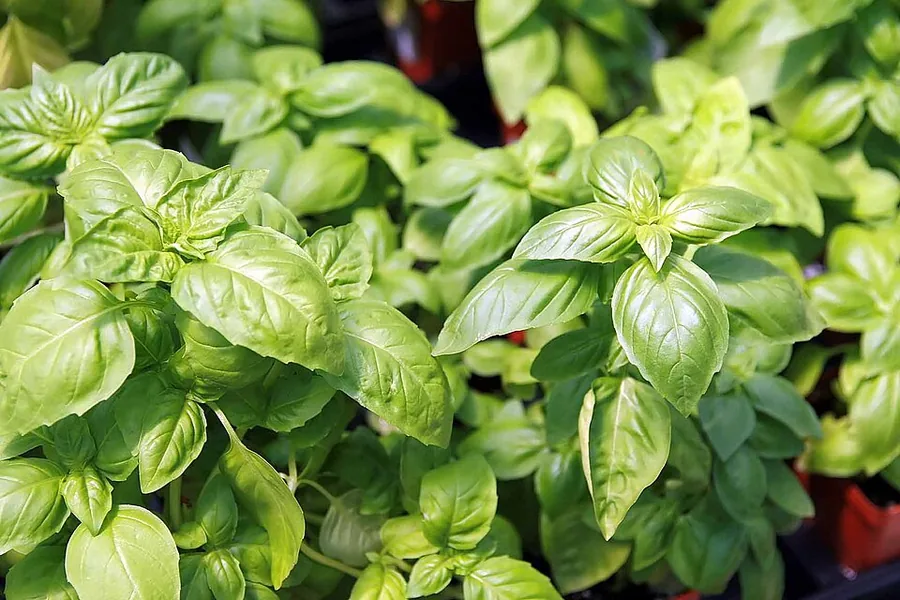
Few herbs feel as at home in a kitchen as basil, a tender annual of the mint family with roots in the warm reaches of Asia and Africa. Quick to grow and devoted to heat, it settles as comfortably into a garden border as into a glazed pot on a sun-washed windowsill. Offer it light and warmth and it answers with handfuls of perfumed leaves.
This is a plant of a single season, rising 12 to 24 inches (30 to 60 cm) tall according to its type. Given its own way it stretches upward, flowers, and turns to seed, yet a steady habit of pinching the tips redirects all that vigor back into the foliage. No single gesture does more to shape how generous the harvest turns out.
Basil is gentle with newcomers, asking only that two conditions be honored. It cannot abide frost or cold soil, and it falters quickly in close, humid air where downy mildew finds its opening. Keep it warm, leave space for the air to move, and aim your watering low, and everything else falls into place.
Care
The short version: give it full sun and warmth, keep the soil evenly moist, and water low to leave the leaves dry. Feed with a light hand, pinch the tips often, and never hurry it into cold earth.
Light
Basil reaches for full sun, six hours or more being ideal, since that light is what concentrates the oils behind its flavor. A little afternoon shade is welcome where summers turn fierce, yet too little sun leaves the plant thin, drawn, and weak.
Water
Hold the soil evenly moist, soaking it through every 7 to 10 days as the rainfall allows. Potted plants run dry sooner and want a closer eye. Always send the water to the base, because damp leaves are an open invitation to downy mildew.
Soil
Set basil into rich, well drained loam enriched with compost. A pH from 6.0 and 7.5 keeps it content, so most reasonable garden soil obliges with little effort.
Temperature
Warmth is basil's element, somewhere around 50°F to 86°F (10°C to 30°C), with its briskest growth near the upper edge. Frost is out of the question, and cold soil checks young plants, so warmth must come before all else.
Humidity
An everyday humidity of 40% to 60% more than suffices, leaving no figure to fuss over. What truly counts is airflow, for it is the still, moist air pooling among crowded plants that lets downy mildew begin.
Feeding
Restraint is the rule. A balanced fertilizer along the lines of 5-10-5, once or twice through the season, is all basil requires, and a sparing hand keeps the flavor deep, since lavish growth thins the oils away.
Pruning
Pinch the growing tips regularly to send the plant branching into a fuller shape, and remove every flower bud the moment it shows. That patient pinching is what keeps fresh leaves arriving and the flavor at its peak.
Repotting
Raised as an annual, basil seldom calls for genuine repotting. Simply move seedlings up into larger quarters as they fill the old one, before the roots begin to coil and the soil empties of moisture too soon.
Size & spacing
Each plant climbs 12 to 24 inches (30 to 60 cm) in height and broadens 12 to 18 inches (30 to 45 cm) across. Allow that much room around every one so air can travel freely and disease has no foothold.
When to plant
Everything basil wants comes down to warmth, and frost is simply beyond it. Sow your seeds indoors toward the close of winter, move plants outside only after the chill has truly lifted and the ground has warmed, then gather leaves all season long until frost draws the year to a close.
Northern hemisphere
Southern hemisphere
Typical months for a temperate climate: start earlier in warm zones, later where spring frosts linger.
- Sow: 6-8 weeks before the last spring frost; germinates best at media temperatures of at least 70°F
- Plant: After all danger of frost when soil is warm and nighttime temperatures stay above 50°F
- Harvest: Harvest leaves continually once plants have several sets of leaves; pinch off flower buds to delay bolting and prolong leaf production
Hardiness
USDA hardiness zones: 2–11
Temperature: down to -46°C
Troubleshooting
The leaves are where basil tells you something is wrong, be it disease, an appetite at work, or the urge to flower. Read those early signals and you can intervene before a minor issue takes hold. Find your symptom among the entries below, then act while action still counts.
Pale blotches on top, a smoky gray-purple bloom beneath
What you are seeing is basil downy mildew, which spreads quickly through damp foliage and stagnant corners of the garden. There is no rescue once that bloom appears, so lift and discard the affected plants at first sight. Open up the remaining stand, direct your watering to the soil, and turn to a resistant variety such as 'Prospera' for the next round.
Fix:
- Remove and destroy affected plants immediately
- Increase plant spacing and prune for airflow
- Water at the base to keep foliage dry
An abrupt collapse with dark streaking inside the stem
Fusarium wilt is a fungus that lives in the soil and clogs the stem from within, and once it settles in the plant cannot be brought back. Lift it, send it to the bin rather than the compost heap, and begin again on clean ground with fresh media. Your best defense going forward is resistant stock paired with seed known to be disease-free.
Fix:
- Remove and destroy infected plants
- Do not compost affected material
- Replant in a different location or use fresh sterile media
Soft, blackened roots and a plant languishing in chilly, sodden ground
Root rot takes hold where the soil sits soaked or stays too cold for the roots to manage. A sound root feels firm and pale, while a failing one goes soft, browns, and gives off an unpleasant smell. Sharpen the drainage, draw back on your watering, and hold off setting plants out until the ground has warmed past 50°F (10°C).
Fix:
- Improve drainage and reduce watering frequency
- Remove severely affected plants
- Allow soil to dry between waterings
Flowering tips and foliage that has lost its edge
This is bolting, the plant's instinct to make seed once it matures or the weather lengthens into long, hot days. As the flower spikes rise, the leaves that follow arrive smaller and noticeably duller on the palate. Catch the buds the instant they show and keep cutting, and your basil holds onto its lush, well-flavored growth.
Fix:
- Pinch off flower buds as soon as they appear
- Harvest and prune leaves regularly to delay flowering
Tattered leaves left full of gnawed openings
Blame one of two appetites here. Japanese beetles work in daylight, reducing the foliage to a fretwork of bare veins, while slugs and snails feed under cover of dark and betray themselves by their glistening trails. Drop the beetles into soapy water, ring the slugs with traps or barriers, and stay watchful so the population never gathers momentum.
Fix:
- Hand-pick beetles into soapy water
- Apply insecticidal soap for soft-bodied pests
- Set out slug traps or barriers
Toxicity
Here the news is reassuring. Basil is non-toxic and raised for the table, which makes it safe in the company of cats, dogs, horses, rabbits, livestock, birds, and children alike. The most a curious pet stands to gain from a generous mouthful is a fleeting, mild stomach upset that clears on its own.
Safe for
People · Cats · Dogs · Horses · Rabbits · Livestock · Birds
Cats None
A cat may sample basil with no consequence at all. Should one overindulge on any greenery and bring a little back, the moment resolves itself without help.
Dogs None
Basil sits well with dogs. At most, an oversized helping leaves behind a passing flutter of stomach upset that settles quickly.
Horses Safe
A horse comes to no harm near basil. The plant holds nothing that would trouble it.
Rabbits Safe
Rabbits may browse basil at will, and a good many regard the tender leaves as a prized little treat.
Livestock Safe
Goats, sheep, and cattle may graze on basil with nothing to fear from it.
Birds Safe
Birds face no danger from basil, and backyard hens are glad to peck through the leaves.
People Safe
Grown expressly for the table, basil suits adults and children equally, fresh from the stem or stirred into a dish.
No special handling precautions are needed; basil is non-toxic and edible.
Varieties
Basils run into the dozens, from sweet Italian classics to fiery and purely ornamental kinds, yet only a few make regular appearances in the garden. These are the names worth carrying with you.
Genovese
The traditional broad-leaved Italian sweet basil that pesto was practically built upon, though that prized depth of flavor arrives with the greatest vulnerability to downy mildew.
Thai basil
A purple-stemmed type carrying notes of anise and licorice, standing 24 to 36 inches and lending its signature to so much of Southeast Asian cuisine.
Purple Ruffles
A handsome ornamental prized as much for its rich purple, frilled foliage as for anything it brings to the plate.
Spicy Globe
A neat, dome-shaped basil that tops out at just 8 to 10 inches, settling gracefully into containers and border edges.
Prospera
A Genovese-style selection bred to resist downy mildew, its compact habit making it a natural fit for pots.
Companions
Basil earns its old reputation as a tomato's best neighbor, sharing the same warm, sunny, well-drained ground the two crops both want.
Plant near
Tomato: Basil is a traditional interplanting companion for tomatoes in the vegetable garden, sharing similar warm-season, full-sun, well-drained growing conditions.
How to propagate
Among plants worth multiplying, basil ranks with the most willing, whether you open a fresh seed packet or take cuttings from one already thriving in your care.
SeedEasy
Sow indoors 6-8 weeks before last frost or direct sow after frost when soil is warm · Germinates in 5-10 days at about 70°F; transplant-ready in roughly 3-4 weeks
Seed is where most basil begins its life. Set each one roughly a quarter inch deep some 6 to 8 weeks ahead of your last frost, holding the media at a steady 70°F (21°C) or warmer to coax dependable sprouting. The first shoots show in 5 to 10 days and stand ready for transplanting in about 3 to 4 weeks, or you might simply sow straight into warm ground once the season turns.
Stem cuttingsEasy
Any time during the growing season from healthy non-flowering shoots · Roots form in water in about 1-2 weeks
Few plants copy themselves as obligingly as basil. Snip a 4-inch piece from a vigorous, non-flowering shoot at any point in the season, clear the lower leaves away, and set it in a glass of water, where fresh roots appear within a week or two and ready it for potting as a faithful echo of its parent.
Myths
Once basil flowers, the leaves turn toxic and have to be thrown out.
Basil in bloom remains entirely good to eat. What fades is a measure of its flavor, as the plant turns its attention toward seed, and that is the reason growers nip the buds away, not any spoilage in the leaf.
Basil needs constant heavy feeding to grow well.
A restrained approach serves it far better. Heavy feeding dilutes the very oils that carry the flavor, so a single feed, or perhaps two across the season, covers everything it asks for.