Shrub · Lamiaceae
Bluebeard
Caryopteris × clandonensis
One hard spring cut, and bluebeard returns a haze of cool blue to the border just as late summer asks for it.
Full sun
Every 7–14 days
USDA 5–9
24–35 in · 60–90 cm
Overview
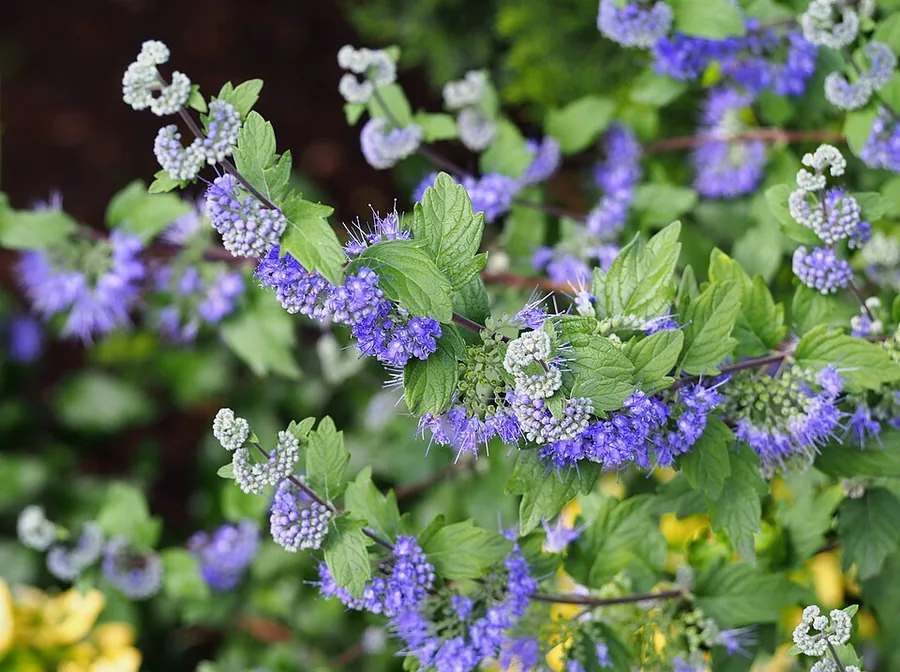
Bluebeard is the small deciduous shrub to reach for when a planting needs a cool note late in the season. A member of the mint family, it keeps to a well mannered 2 to 3 feet (60 to 90 cm) in height and much the same across, a scale that settles into a mixed border or a sunny corner near a patio without crowding its neighbors. The gray-green foliage carries a clean scent that meets you on the way past.
Its appeal is all about timing in the garden's year. The flowers arrive from July into September, when many borders are tiring, and the bees and butterflies they draw keep the space feeling alive through the slow weeks of late summer. Because it renews on new wood, a single spring cut resets the whole display, which makes it an easy fixture in a low fuss scheme.
Around the house and grounds it asks for little once placed. Set it in full sun on lean, fast-draining soil, somewhere it can take heat and dry spells in stride, and it rewards the spot with steady late color. Its one condition is drainage, so a raised, free draining position suits it far better than a low, damp pocket of the garden.
Care
The short version: full sun, lean and well-drained soil, a deep drink only when the top of the soil dries, and a hard cut back to 6 to 12 inches every late winter or early spring.
Light
Give bluebeard full sun, ideally 6 or more hours a day, and let it anchor the brightest part of the border. A little partial shade is tolerated, but shade soon brings weak, leaning stems and a thin scatter of flowers that undercut the effect.
Water
Settled in, it reads as a drought-tolerant shrub that asks little of a watering routine. Water deeply but only once the top half of the soil has dried, about every 7 to 14 days, and keep it clear of standing water, which rots the crown and roots.
Soil
Plant it in average, loose, well-drained soil, loamy or sandy, the kind a sunny border usually offers. Rich ground works against it, and wet feet are the one thing it cannot abide, so drainage outweighs fertility every time.
Temperature
Bluebeard takes a wide range in stride, from about -20°F to 100°F (-29°C to 38°C), which lets it hold a place across many gardens. In colder spots it may die back to the ground over winter and return in spring, a habit that fits its bloom-on-new-wood nature.
Humidity
Ordinary outdoor air is all it asks, so it adds nothing to the day's tasks. Open air and dry roots do far more for it than any moisture around the leaves.
Feeding
A light hand suits it best. One balanced feed or some compost in spring is plenty, since overfeeding only brings soft, leaning stems that flop and bloom poorly, spoiling the tidy shape.
Pruning
This is the single task that shapes the season. Cut the whole plant back hard to 6 to 12 inches (15 to 30 cm) in late winter or early spring before growth begins, because every flower forms on the new wood that follows.
Repotting
As a garden shrub it rarely needs repotting. Kept in a container near a doorway or terrace, it wants moving up only when roots circle the pot or water runs straight through.
Size & spacing
Each plant settles into a neat mound of 2 to 3 feet (60 to 90 cm) tall and roughly as wide. Allow about that much room between plants so air moves freely and the rounded form reads cleanly in the bed.
When to plant
Bluebeard keeps an easy place in the garden's calendar. Set new plants out in spring once frost has passed, give established shrubs their hard cut before they stir from dormancy, and the blue flowers come along to carry the border from midsummer into early fall.
Northern hemisphere
Southern hemisphere
Typical months for a temperate climate: start earlier in warm zones, later where spring frosts linger.
- Plant: spring after last frost
- Harvest: late summer to early fall (July-September)
Hardiness
USDA hardiness zones: 5–9
Temperature: down to -29°C
Troubleshooting
Bluebeard rarely causes concern, and the few issues it does raise come back to wet ground or thin light. The early signs below tend to settle with a touch more drainage, a sunnier placement, or a prune at the right moment.
A collapsing plant with darkened lower stems in damp ground
When a plant droops and its lower stems darken even though the bed stays moist, the trouble is crown and root rot, set off by ground that holds water around the roots. Lift the crown and the tell is dark, soft roots in soil that never seems to dry. Take out the plants past saving, open the bed with grit or relocate the shrub to a higher, free draining position that suits it better, and let the watering taper off.
Fix:
- Remove and discard severely affected plants
- Improve drainage by amending soil with grit or replanting in a raised, well-drained site
- Reduce watering frequency
A sparse, leaning shrub short on bloom
A shrub that leans and gives little color usually wants for one of three things: enough sun, a spring prune, or leaner ground. Since bluebeard carries its flowers on new wood, a sunny placement, a hard cut in late winter or early spring, and a lighter hand with feeding restore the display. Move it into the open, lean out the soil, and the late season show returns.
Fix:
- Site in full sun (6+ hours)
- Cut back hard in late winter or early spring to force vigorous flowering new growth
- Avoid overfeeding and overly rich soil
Toxicity
For a home shared with animals, bluebeard sits easily in the garden. The ASPCA lists it as non-toxic to pets, with no record of harm to livestock, birds, or people. It can take a place wherever curious animals wander.
Safe for
People · Cats · Dogs · Horses · Rabbits · Livestock · Birds
Cats None
A household cat can share the garden without concern, since a passing nibble poses no poisoning risk. The most a large mouthful of any plant might bring is a day of mild stomach upset.
Dogs None
Dogs that roam the borders are in safe company, as bluebeard holds no toxin for them. A chewed stem might leave a little loose stool at worst, and it passes on its own.
Horses Safe
The shrub belongs comfortably along a paddock edge, since it carries nothing known to harm grazing horses.
Rabbits Safe
Rabbits in the garden come to no harm from it, and the aromatic foliage tends to keep them browsing elsewhere.
Livestock Safe
Cattle, goats, and sheep are safe in its company, and the strong scented leaves rarely draw a grazer to it at all.
Birds Safe
Birds are perfectly safe around bluebeard. With bees and butterflies drawn to the late summer flowers, the shrub becomes a quietly animated corner of the planting.
People Safe
Nothing on the plant is poisonous to people. It earns its place for looks rather than the table, so there is no call to taste it, though a stray leaf does no harm.
No special handling required; as with any plant, ingestion of large amounts may cause mild gastrointestinal upset.
Varieties
A short list of named cultivars makes up most of what the nursery offers, set apart mainly by flower shade, foliage color, and size, each lending a slightly different note to a planting. These are the ones worth knowing.
Dark Knight
A compact 2 to 3 foot mound carrying deep blue to bluish-purple flowers, well suited to the front of a border.
Longwood Blue
At about 4 feet it lends more height, its violet-blue flowers reading against silvery gray-green foliage.
Worcester Gold
Golden-yellow foliage set beside light lavender-blue flowers gives a polished two-tone presence in the bed.
Blue Mist
It takes its name from the soft powder-blue of its flowers.
How to propagate
Bluebeard is easy to increase for a wider planting, and the method comes down to whether you want a true match to an existing shrub or can welcome a little variation.
Stem cuttingsEasy
Late spring to summer · Several weeks to root
Filling out a planting with more bluebeard is simple work, and softwood or semi-hardwood cuttings taken in late spring or summer are the graceful way to do it. Set a healthy shoot in moist mix and it roots over the next several weeks into a true match for the parent.
SeedModerate
Spring · Weeks to germinate
Seed sown in spring germinates over a few weeks, but named cultivars will not come true from it. The results vary, so when a particular look matters to the scheme, cuttings are the dependable choice.
Myths
A hard spring pruning sacrifices the year's flowers on bluebeard.
The fear is misplaced, since bluebeard flowers on new wood grown each season, so a hard spring cut costs the display nothing. It draws out stronger flowering stems instead, which is why the annual cut belongs in the routine of anyone who wants the late season color.