Tree · Sapindaceae
Golden Rain Tree
Koelreuteria paniculata
A handsome, easygoing shade tree, crowning midsummer in papery lantern pods and soft yellow sprays.
Full sun
Every 7–14 days
USDA 5–9
30–40 ft · 9.1–12.2 m
Overview
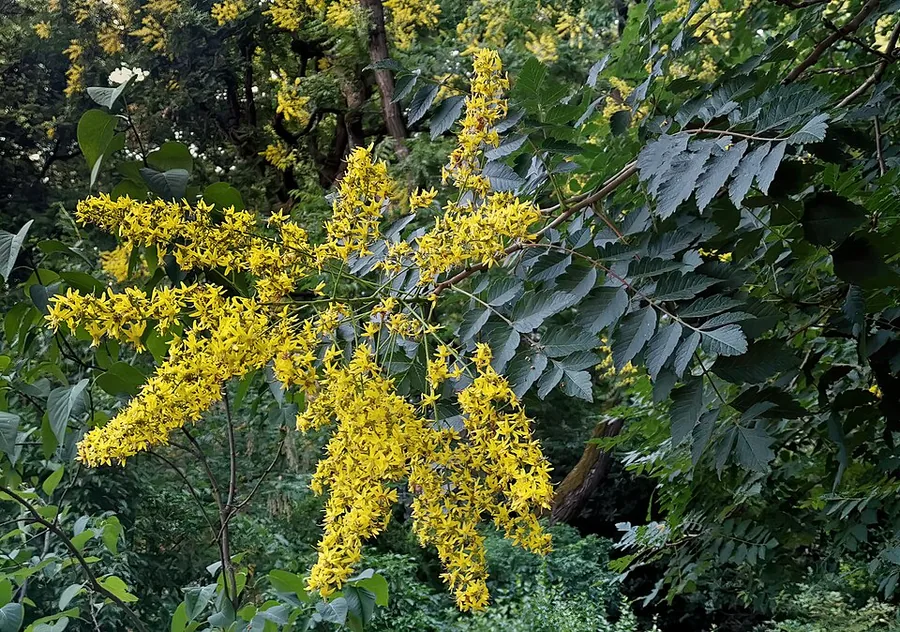
Few trees give a summer garden a focal point the way the golden rain tree does. At the height of the season its crown fills with loose sprays of small yellow flowers, and the papery lantern pods that follow carry that presence into fall, so the tree earns its keep in the yard for months. As a deciduous shade tree in the soapberry family, it lends a rounded, spreading silhouette that anchors a lawn, frames a patio, or gives a seating area its ceiling.
It suits the way most households actually live, because it asks for so little upkeep. Once its roots are down it rides out drought, settles happily into clay, sand, or thin rocky ground, and holds its own in cold to -20°F (-29°C). Set in full sun with drainage underneath, it slips into a low-maintenance garden and a busy weekly routine without a fuss.
One habit shapes where it belongs. The tree scatters seed in great quantity and volunteers freely, so much that it has turned weedy and invasive across parts of the eastern and southeastern US. In those regions it reads best in a considered spot, near a bed you tidy anyway or a lawn you mow, where the stray seedlings never become a chore.
Care
The short version: a place in full sun, well-drained soil of almost any kind, and a deep drink through long dry spells while the tree is young. Past the first year or two it looks after itself, and a light prune in late winter keeps the frame handsome.
Light
Give it a place in full sun for the fullest flowering, though it will accept part sun without complaint. The more direct light the site offers, the richer the summer display it puts on.
Water
See a young tree through its first year or two with regular water while the roots reach down. After that it is drought tolerant and wants a drink only in long dry spells, so let the top half of the soil dry between waterings.
Soil
Few trees make so few demands of the ground. It takes to clay, loam, sand, and even shallow rocky ground, asking only for decent drainage, and it sits comfortably across a wide pH from 6.0 to 8.0.
Temperature
This is a cold-hardy tree at ease from -20°F to 100°F (-29°C to 38°C). That generous range opens it to a great many gardens, part of why it has settled so widely.
Humidity
Ordinary outdoor air suits it, so there is no humidity figure to mind. Good drainage counts for far more than anything in the air around it.
Feeding
It seldom needs feeding at all. Where growth looks thin, a single dose of balanced slow-release tree fertilizer in spring is enough, since this tough tree is no heavy eater.
Pruning
Prune in late winter while the tree is dormant to shape one strong central leader and to clear crossing, weak, or dead branches. The wood runs a touch brittle, so a well-built frame set early keeps the tree looking its best for years.
Repotting
A tree set in the ground stays put, so repotting hardly enters into it. In a container, move it up only when roots circle the pot, water runs straight through, or top growth stalls.
Size & spacing
Plan for real scale. A mature golden rain tree stands around 30 to 40 feet (9 to 12 m) tall and spreads about as wide, so give it a spot well clear of buildings and overhead lines where its full shape can show.
When to plant
Think of this as a long-term fixture rather than a seasonal planting to time to the day. Set it out in spring after the last frost or in fall, look for the yellow flowers in early to midsummer, and let the lantern pods carry the display gracefully toward autumn.
Northern hemisphere
Southern hemisphere
Typical months for a temperate climate: start earlier in warm zones, later where spring frosts linger.
- Sow: Late winter, after seed scarification and cold-moist stratification
- Plant: Spring after last frost, or fall
- Harvest: Summer (June to July; cultivar 'September' blooms August to September)
Hardiness
USDA hardiness zones: 5–9
Temperature: down to -29°C
Troubleshooting
A settled golden rain tree asks for little correction. What does surface tends to be either a wilt disease within the wood or a harmless gathering of insects on the seed pods. Match what you see below and step in while the tree is still in good heart.
A wilting flank and dark-streaked wood within
When one side of the canopy falters and the wood beneath shows dark streaks, the likely culprit is verticillium wilt, a soilborne fungus with no cure. Wood already stressed or wounded can also pick up canker or coral spot fungi, and ground that stays wet invites root rot. The remedy is to prune well below the damage, clean your tools between cuts, and put the drainage right so the tree keeps its footing.
Fix:
- Prune out and destroy affected branches well below symptoms, disinfecting tools between cuts
- Improve drainage and avoid drought and mechanical wounding to reduce stress
- Remove severely declining trees, as there is no cure for verticillium wilt
Bold red-and-black bugs massed along the lantern pods
The red-and-black crowds that settle on the papery pods each late season are the goldenrain tree bug, a boxelder relative that lives off the seeds. It reads as a nuisance rather than a genuine threat, so it is fine to let them gather, or to move them along with a firm jet of water or insecticidal soap. Clearing the fallen pods removes the seed larder that pulls them in, and a horticultural oil settles any scale that takes hold on the twigs.
Fix:
- Tolerate the bugs where possible, as they are a nuisance rather than a serious threat to tree health
- Knock bugs off or spray congregations with a strong stream of water or insecticidal soap
- Treat heavy scale infestations with horticultural oil
Toxicity
For a home shared with pets and children, the news is easy: this tree is not poisonous. The name unsettles people, yet golden rain tree carries no toxin and does not appear on ASPCA toxic-plant lists. Take care only not to confuse it with the genuinely poisonous golden chain tree, Laburnum, an altogether different plant.
Safe for
People · Cats · Dogs · Horses · Rabbits · Livestock · Birds
Cats Safe
A cat that wanders the garden and brushes past or samples this tree comes to no harm, since it holds no toxin that affects them. A cat that overindulges on any greenery may bring up a hairball or a little foliage, which is routine rather than a warning sign.
Dogs Safe
Nothing in this tree makes it a hazard to a dog sharing the yard. A dog that mouths a fallen pod may have a brief run of loose stools from the roughage, easily settled by keeping fresh water within reach.
Horses Safe
Horses can graze in the shade of a golden rain tree with nothing to fear, as it carries no toxin that troubles them. This is the harmless relative of the dangerous golden chain tree, so the caution owed to Laburnum has no place here.
Rabbits Safe
The foliage poses no poisoning risk to a rabbit. As with any fresh green, offer only a small amount at first so a delicate digestion can adjust.
Livestock Safe
Cattle, goats, and sheep can pasture in the company of this tree in safety, since it is not toxic to grazing animals. A stomach may protest heavy browsing of any one plant, but that is simple overindulgence, not poisoning.
Birds Safe
Birds meet no toxic threat in the leaves or seeds, and most pass the dry pods by. Backyard poultry can forage beneath the canopy with nothing to trouble them.
People Safe
This tree is not poisonous to people, and its common name stirs far more concern than the plant ever earns. Even so, the seeds belong to the display and not the table, so there is no call to eat them.
No special handling required; as with any plant, discourage pets and children from chewing on foliage or seed pods to avoid mild stomach upset.
Varieties
The trade offers just a few selections, and one near relative often stands beside the species on the bench. These are the ones worth telling apart.
'September'
This selection saves its yellow flowers for August and September, carrying the display weeks past the usual summer bloom, though it surrenders a little winter hardiness in the trade.
Koelreuteria bipinnata (Chinese flame tree)
A close relative dressed in twice-divided leaves and showy rosy-pink lantern pods, it leans more tender and belongs to warmer zones than the golden rain tree.
How to propagate
Your first golden rain tree may well arrive uninvited, as a self-sown seedling, since this tree increases with no help at all. To raise more by choice, seed or root cuttings are the two routes open to you.
SeedModerate
Sow in fall outdoors, or stratify and sow in late winter to early spring · Seedlings appear in weeks; several years to a sizable tree
The tree sets seed in abundance and self-sows so willingly that raising it on purpose is rarely necessary. To do so by design, nick the hard seed coat and give the seed a spell of cold, moist stratification, sowing outdoors in fall or in late winter to early spring. Seedlings rise within weeks, though it takes several years to reach a tree of any presence.
Stem cuttingsModerate
Dormant season for root cuttings · One to two growing seasons
Root cuttings lifted in the dormant season are the customary way to clone this tree, and named cultivars are raised this way rather than from seed so they hold true. Allow a rooted cutting one to two growing seasons to settle before much top growth follows.
Myths
Golden rain tree stands as the toxic golden chain tree, a peril to pets.
The likeness begins and ends with the name. Golden rain tree belongs to the soapberry family and does not appear on ASPCA toxic-plant lists, while the genuinely poisonous golden chain tree is Laburnum, an unrelated legume. Note the botanical name, Koelreuteria paniculata, and this is a tree you can plant with ease.