Tree · Sapindaceae
Sugar Maple
Acer saccharum
Give it rich ground and open space, and the sugar maple becomes the anchor of a property, cool through summer and radiant by fall.
Full sun
Every 7–14 days
USDA 3–8
39–79 ft · 12–24 m
Overview
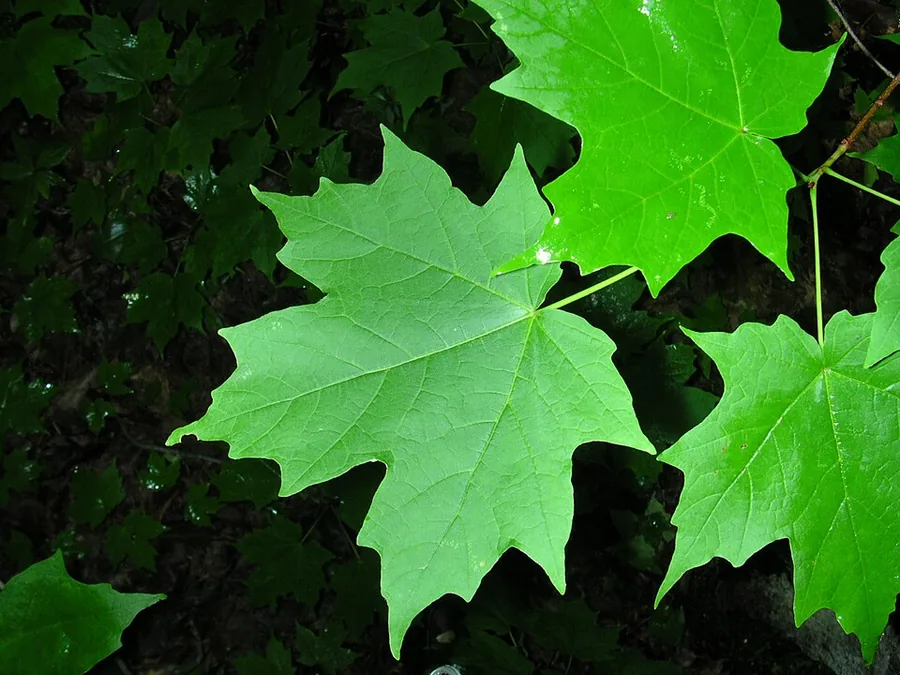
Few trees define a property the way a sugar maple does. It settles in slowly, rising into a broad, rounded shade tree that can reach 80 feet (24 m), its heavy trunk and dense canopy laying a pool of cool shade across the lawn all summer. By fall the whole crown turns to orange, red, and gold, the kind of view that frames a house and marks the season for everyone who passes.
This is a tree for open, northern ground rather than a tight urban lot. Content in zones 3 through 8 and untroubled by winters at -40°F (-40°C), it asks only to be kept away from the heat, road salt, and packed soil that come with pavement and close quarters. Give it deep, fertile, evenly moist ground and room to spread, and it will stand at the center of a landscape for generations.
A sugar maple rewards the long view. It grows slowly and lives for decades, so it belongs to a household's future as much as its present, a fixture that outlasts the seasons around it. Its late-winter sap runs sweet, tapped each spring in northern sugarhouses, so the tree even earns a place in the year's rituals.
Care
The short version: give it full sun to part shade, deep, fertile, evenly moist but well-drained soil, about an inch of water a week through heat and drought, and a spot well clear of pavement and road salt.
Light
Sugar maple looks its best in full sun, where it fills out into a fuller crown and stronger fall color, though it accepts partial shade while young. A site with at least a half day of sun will still give a landscape a shapely, healthy tree.
Water
Keep the ground deep and evenly moist, watering roughly every 7 to 14 days when rain is scarce. Through a genuine heat wave or drought, an established tree appreciates about an inch of water a week, which spares it the leaf scorch that can dull a summer canopy.
Soil
Give it deep, fertile loam that holds moisture, drains cleanly, and carries plenty of organic matter. A pH from 5.5 to 7.0, slightly acidic to neutral, suits it, and it will never look right in compacted, soggy ground.
Temperature
Cold suits it beautifully, from -40°F to 95°F (-40°C to 35°C). It comes into its own across northern landscapes and looks strained where summers run long and hot.
Humidity
There is no humidity to manage with a tree in open air. Steady soil moisture and good airflow do far more for its presence in a landscape than anything atmospheric.
Feeding
Feed in early spring with a balanced slow-release tree fertilizer, guided by a soil test rather than habit. A ring of mulch around the drip line finishes the look and feeds the roots slowly as it breaks down.
Pruning
Prune in summer or full dormancy to lift out dead, damaged, or crossing limbs and keep the crown handsome, since a maple cut in late winter or early spring bleeds sap heavily. Wipe tools between cuts with 10 percent bleach or 70 percent alcohol to keep disease from moving through the canopy.
Repotting
As a landscape tree it lives in the ground, so repotting rarely enters the picture. When choosing nursery or potted stock, look past the label for roots circling the trunk flare or a top that lags a crowded root ball, and free those roots before planting for a tree that will stand well for years.
Size & spacing
Plan for scale from the start. This is a tree of 40 to 80 feet (12 to 24 m) tall and 30 to 60 feet (9 to 18 m) wide, so give it an open setting well away from the house, the drive, and any power lines, where its full form can read.
When to plant
Plant a sugar maple in spring or fall, when cool weather lets it settle into its place before the season turns. Its greenish-yellow flowers open quietly in April, before or with the leaves, but the moment a household waits for is autumn, when the canopy turns the yard red, orange, and gold.
Northern hemisphere
Southern hemisphere
Typical months for a temperate climate: start earlier in warm zones, later where spring frosts linger.
- Plant: Spring or fall
- Harvest: Inconspicuous greenish-yellow flowers in April before or with the leaves; brilliant red, orange, and yellow fall color
Hardiness
USDA hardiness zones: 3–8
Temperature: down to -40°C
Troubleshooting
A sugar maple wears its troubles on its leaves, whether the cause is a hot spell, a soil fungus, or a wet spring. Knowing how to read those signs keeps a passing blemish from being mistaken for real decline, so compare what the tree shows against the notes below.
One side of the crown fading out of step
When a single side of the crown wilts and dies while the rest holds its form, the likely cause is Verticillium wilt, a soil fungus that closes off the tree's water channels from within. Slip back the bark on a wilting branch to look for green or brown streaks, then have a lab confirm it, since these diseases are near impossible to tell apart by eye. There is no cure, so remove the dead wood as it appears and keep the tree watered and fed to hold its place in the landscape as long as it can.
Fix:
- There is no cure; prune out dead branches as they appear
- Water about one inch per week and fertilize based on a soil test to prolong tree life
- Mulch around the drip line and sanitize pruning tools with 10 percent bleach or 70 percent alcohol between cuts
Browned leaf edges dulling the canopy in high summer
Tan, dead margins and browning between the veins in a hot, dry stretch are leaf scorch, a sign the roots cannot draw water quickly enough to keep the canopy fresh. Salt, compaction, and a cramped root zone near pavement all deepen it. See the tree through with about an inch of water a week in heat and drought, and lay mulch over the roots to hold moisture and steady the soil.
Fix:
- Water established trees with about one inch of irrigation per week during heat and drought
- Mulch over the root zone to conserve moisture and moderate soil temperature
- Avoid salt accumulation and soil contaminants around the roots
Glossy black flecks marking the leaves in late summer
The thick, shining black spots ringed in yellow are tar spot, a leaf fungus that looks worse against a fine canopy than it ever proves. Clear and destroy the fallen leaves each autumn, where the fungus waits out the winter. A copper fungicide at leaf-out is an option on a small specimen, though most maples carry it without any real cost.
Fix:
- Rake up and destroy fallen leaves where the fungus overwinters
- If desired on small trees, apply a copper-based fungicide, mancozeb, or triadimefon three times at two-week intervals starting at spring leaf unfurl
Browning and dead buds after a long, wet spring
A drawn-out cool, wet spring invites anthracnose, a fungus that browns the leaves along their veins, kills buds, and leaves crooked twig dieback in a young crown. Gather and destroy the infected leaves so the spores do not carry into the next year. Open airflow and quick-drying foliage keep it from settling into the canopy at all.
Fix:
- Rake and destroy fallen infected leaves
- On valuable small trees, spray a copper-based fungicide, mancozeb, or chlorothalonil three times at two-week intervals from spring leaf emergence
Toxicity
This is a tree a household can live around with ease. Sugar maple is safe for people, pets, and livestock, and its boiled sap is the very syrup that flavors a winter morning. The wilted-leaf poisoning that troubles horse owners belongs to red and silver maple, not to this one.
Safe for
People · Cats · Dogs · Horses · Rabbits · Livestock · Birds
Cats None
A household cat is safe beside it. A fallen leaf batted across the porch does no harm.
Dogs None
Dogs are at ease around it, with nothing in the leaves, bark, or twigs to trouble them.
Horses None
Horses are safe near sugar maple. The red-blood-cell poisoning that worries owners comes from wilted red and silver maple leaves, not this tree.
Rabbits None
Rabbits browsing the foliage come to no harm.
Livestock None
Cattle, goats, and sheep graze near a sugar maple without any ill effect.
Birds None
Birds nest and feed in the canopy in safety, and the seeds keep a yard's wildlife fed.
People None
People are perfectly safe with it, and its boiled-down sap is the very maple syrup that ends up on the breakfast table.
Non-toxic to cats and dogs. Note that it is the related red maple (Acer rubrum) whose wilted leaves are notoriously toxic to horses; sugar maple is not the species classically implicated, but as a general precaution wilted maple leaves of any species are best kept away from horses.
Varieties
The sugar maples chosen for a designed landscape are usually named cultivars, selected for sturdier leaves and richer fall color. These are the ones worth requesting for a prominent spot.
Green Mountain
A heat- and drought-tolerant selection that keeps a tidy, dense oval crown and settles into orange-red each fall.
Legacy
A strong, scorch-resistant cultivar whose thick, glossy leaves hold their looks through tearing winds and dry spells.
Fall Fiesta
A tough, quick-to-establish tree admired for dependable yellow-orange to red autumn color that lingers later than most.
How to propagate
A sugar maple can be raised from seed with a spell of cold, though the refined named selections keep their character only when grafted.
SeedModerate
Sow outdoors in fall or after 60-90 days of cold, moist stratification before spring sowing · 1 to 2 growing seasons
Grown from seed, sugar maple needs a cold spell before it will stir, so sow outdoors in fall or give it 60 to 90 days of cold, moist stratification ahead of a spring sowing. A young tree finds its footing over 1 to 2 growing seasons. Layering and stem cuttings offer other ways to start the species.
GraftingDemanding
Late winter (bench graft) or summer (budding) · 1 to 2 seasons
The named selections like Green Mountain and Legacy will not come true from seed, so growers graft or bud them onto seedling rootstock to preserve their character. Bench grafting falls in late winter and budding in summer, with the union settling over 1 to 2 seasons. The work calls for a practiced hand, which places it among the demanding methods.
Myths
All maples, sugar maple among them, are deadly to horses.
The real hazard lies with red maple and silver maple, whose wilted leaves can destroy a horse's red blood cells. Sugar maple carries no such reputation, and far from being poisonous it is the tree tapped for the maple syrup on the table.