Shrub · Vitaceae
Grape
Vitis vinifera
Give a grapevine full sun, a handsome support, and one hard prune a year, and it turns a wall or arbor into a fruiting fixture for decades.
Full sun
Every 7–14 days
730–1095 days
USDA 6–10
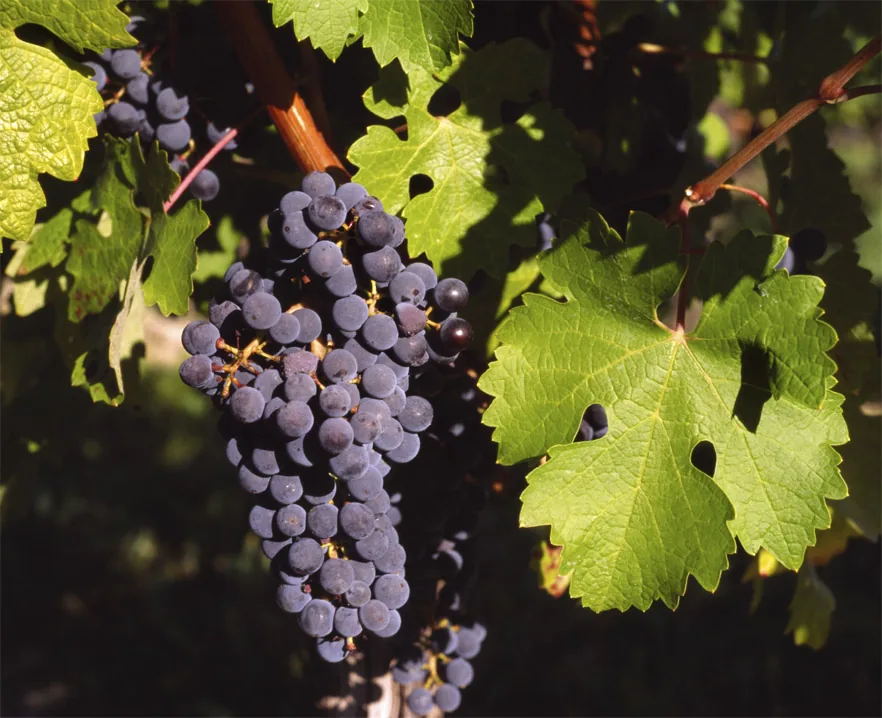
Overview
Few plants root a garden in time the way a grapevine does, a long-lived woody climber grown for its fruit across thousands of years of tables and terraces. The European wine grape sets the tone in most vineyards, while American species and hybrids carry the look into colder gardens where it cannot follow. Plant one thoughtfully and it becomes a fixture that fruits for decades.
A grape wants full sun, deep well-drained soil, and a structure worth climbing, which is where it earns its keep as a design element. Trained along a wall, a pergola, or an arbor over a seating area, the vine draws the eye upward and lays down summer shade; left to itself, it sprawls to 40 to 60 feet (12 to 18 m), which is why that firm yearly prune keeps it looking intentional. It grows fast, so a little guidance turns raw energy into a shapely, productive canopy.
This is a plant that rewards the long view rather than the quick fix. A young vine gives its first couple of years to roots and framework before it settles into the rhythm of the seasons, and the fruit follows in 2 to 3 years. What you gain is a living part of the home, marking each late summer with grapes for the table, the juice press, the raisin tray, or the wine bottle.
Care
The short version: full sun, deep well-drained soil, and a handsome, sturdy trellis or arbor to climb. Water young vines well as they settle, keep the nitrogen light, and prune hard each winter so the vine stays shapely and productive.
Light
Grapes ask for full sun, ideally the length of the day, which is worth remembering when choosing a wall or corner for them. A touch of partial sun is tolerated, but shade leaves you with a leafy vine, disappointing fruit, and more disease in the dim, close canopy.
Water
Water a young vine deeply every 7 to 14 days as it establishes in its spot. Once its roots run deep, a mature vine carries itself through dry weather, so the watering can ease off; keep the soil from turning soggy and skip overhead wetting, both of which invite fungus.
Soil
Give the vine deep, loamy, humus-rich soil that drains freely beneath its support. It accepts a fair range of ground and a pH from 5.5 to 7.0, though it will never make peace with a spot that stays wet.
Temperature
Grapes weather a broad range, roughly 5°F to 95°F (-15°C to 35°C) depending on the type. American grapes and hybrids stand up to cold far better than the European wine grapes, so choose the variety that suits your winters and setting.
Humidity
Grapes favor low humidity, around 30% to 60%. Damp, still air is what feeds powdery mildew and black rot, so an open canopy and a breezy, sunlit position do more good than any reading on a gauge.
Feeding
Feed once in early spring as growth begins, using a balanced fertilizer such as 10-10-10. Keep the nitrogen restrained, since a heavy hand pushes leafy growth and quietly costs you fruit.
Pruning
Prune hard every winter while the vine rests, taking away roughly 80% to 90% of last year's wood to keep it shapely on its support. Train it along a strong trellis or arbor with cane or spur pruning to suit the variety, the single gesture that most shapes the season ahead.
Repotting
Grapes are meant for open ground or a large permanent container, not routine repotting. Where one grows in a pot, move it up a size before the roots circle, or the vine will stunt and dry out in a hurry.
Size & spacing
Pruned and trained on its support, a vine settles at around 5 to 20 feet (1.5 to 6 m) with a spread of 4 to 10 feet (1.2 to 3 m), an easy scale for a pergola or wall. Left unpruned it can climb to 40 to 60 feet, so a sturdy structure and room to work keep it looking composed.
When to plant
A grapevine keeps the calendar for you, moving to a slow and pleasing rhythm. Set dormant bare-root or potted vines in place in early spring once hard frost has passed, then prune them back firmly each winter while they rest. Bloom comes in late spring and the fruit ripens from late summer into fall, marking the season on the arbor even though the first real harvest waits a couple of years.
Northern hemisphere
Southern hemisphere
Typical months for a temperate climate: start earlier in warm zones, later where spring frosts linger.
- Plant: Early spring after danger of hard frost has passed, as dormant bare-root or potted vines
- Harvest: Blooms late spring; fruit harvested late summer to fall (roughly Aug-Oct depending on variety and climate)
Hardiness
USDA hardiness zones: 6–10
Temperature: down to -23°C
Troubleshooting
Most of what troubles a grapevine traces to fungal disease in a damp, crowded canopy, to pests hidden in the soil, or to the wildlife that arrives for the ripe fruit. Notice it early and the planting comes through unscathed. Match what you see below, then act before it spreads across the vine.
Marked leaves and clusters shrinking to hard black beads
When warm, wet weather sets in, black rot can undo a season, beginning as tan leaf spots edged in dark rings before the berries harden into black mummies along the cluster. It moves through a planting quickly, so the moment matters. Clear away the mummified fruit and infected canes, prune to let air pass through, and keep a spray program going from bud break through fruit set.
Fix:
- Remove and destroy mummified berries and infected canes
- Apply fungicide from bud break through fruit set
- Prune and thin for better airflow
A once-lush vine quietly thinning, its roots swollen
A European vine on its own roots that keeps thinning, its underground parts knotted with galls, is answering to grape phylloxera, a tiny insect at work out of sight below the soil. No spray reaches that far down, so the remedy lies in starting again. Replant on resistant American rootstock, which the pest cannot touch, and the planting can recover its former fullness.
Fix:
- Replant on phylloxera-resistant American rootstock
- Remove severely affected own-rooted vinifera vines
A chalky bloom settling over leaves, shoots, and fruit
A pale, chalky film across the canopy is powdery mildew, a fungus that arrives with warm, muggy weather and lingers where a vine has grown too dense and shaded to breathe. It brushes away, yet it curls the foliage and leaves the fruit rough and split, dimming the whole planting. Thin the canopy with a careful prune, keep the vine in an open, sunny spot, and stay ahead of it with a preventive sulfur or fungicide spray.
Fix:
- Open the canopy with proper pruning and shoot thinning to improve airflow
- Apply sulfur or a recommended fungicide on a regular preventive schedule
- Site in full sun with good air circulation
Ripe clusters emptied before they reach the table
Birds and other wildlife have a sense for ripe grapes, often ahead of the household, and a cluster can vanish between one afternoon and the next. Drape netting over the vines as the fruit begins to color, well before it is ready to pick. Then gather the grapes soon after they ripen, rather than leaving a set table for the garden's visitors.
Fix:
- Drape bird netting over vines as fruit begins to color
- Harvest promptly once fruit is ripe
Toxicity
Ripe grapes are a welcome fruit on any table, yet the same clusters are seriously dangerous to dogs and cats. Grapes and raisins can cause acute kidney failure, and even a small amount may be enough. Keep fruit, fallen grapes, and prunings well away from pets around the home, and treat any ingestion as an emergency.
Toxic to
Cats · Dogs · Horses · Rabbits · Livestock · Birds
Safe for
People
Cats Toxic
For cats, grapes and raisins belong on the same do-not-share list as they do for dogs. The kidney harm is the concern, so keep fruit and fallen grapes out of reach around the home and call a vet at once if a cat gets into any.
Dogs Severe
Even a small amount can bring on acute kidney failure in a dog. The warning signs are vomiting, diarrhea, low energy, a lost appetite, belly pain, heavy thirst, and less urine. This calls for a vet without delay, not a wait-and-see.
Horses Caution
The risk to horses has never been studied closely. The graceful choice is to keep grapes, raisins, and vine prunings away from them and to leave the fruit off the list of treats.
Rabbits Caution
For rabbits the evidence simply is not there in either direction. Set grapes and raisins aside entirely and keep to the greens and hay already known to suit them.
Livestock Caution
How grapes sit with cattle, goats, and sheep remains unsettled. With the kidney risk seen in pets in mind, fence off dropped fruit and keep prunings clear of grazing areas.
Birds Caution
For birds the picture has never been drawn clearly. As a precaution, keep grapes and raisins away from pet birds and watch over any poultry that range near the vines.
People Safe
At the table, ripe grapes are one of life's easy pleasures, whether served fresh, dried into raisins, or pressed for juice and wine. The concern rests with pets, never with the household.
Keep fruit, prunings, and fallen grapes out of reach of dogs, and never feed grapes or raisins to pets. Grapes and raisins are also advised against for cats as a precaution.
Helpline numbers

United States
ASPCA Animal Poison Control: (888) 426-4435 (fee applies)

United Kingdom
Animal PoisonLine: 01202 509000 (fee applies)

Australia
Animal Poisons Helpline: 1300 869 738
Varieties
Grapes fall into three broad companies: the European wine grapes, the cold-hardy American types, and the hybrids that bring the two together. These are the ones a home grower is most likely to welcome into a garden.
'Cabernet Sauvignon' (V. vinifera)
The classic European wine grape, small and dark-berried, it asks for a long, warm season and settles happily into zones 6 to 9.
'Thompson Seedless' (V. vinifera)
A seedless green table grape for the fruit bowl, it is also the one most often dried into raisins.
'Concord' (American Vitis labrusca)
A cold-hardy blue-black slip-skin grape destined for juice and jelly, it holds its own in colder zones than vinifera will bear.
'Niagara' (American Vitis labrusca)
A cold-hardy white labrusca with an unmistakable foxy flavor, at home in both juice and white wine.
'Reliance' (interspecific hybrid)
A seedless red table grape bred for cold hardiness and easier disease resistance.
Companions
Grapes do best with low plantings that improve the soil or warn of disease early, and worst near big trees that steal their light and water.
Plant near
Roses: Traditionally planted at vineyard row ends as an early-warning indicator, since powdery mildew often appears on roses before the vines.
Clover or legume cover crops: Living mulch between rows improves soil and reduces erosion without heavily competing once vines are established.
Keep apart
Large shade trees: Compete for light, water, and nutrients and cast shade that reduces fruiting and worsens disease.
How to propagate
A grapevine multiplies gracefully from itself, so most new plants are clones of the parent rather than seedlings. Cuttings and layering are the easy, satisfying routes, while grafting asks more skill but answers the phylloxera problem for good.
Stem cuttingsEasy
Late winter while the vine is dormant · Roots in one growing season; fruiting in about 2-3 years
In the quiet of late winter, while the vine still sleeps, take pencil-thick dormant hardwood cuttings that each hold 3 to 4 buds. This is the classic route for starting own-rooted American types and rootstocks, and the cuttings root across a single growing season, coming into fruit in about 2 to 3 years.
LayeringEasy
Spring to early summer · Roots within one growing season
In spring or early summer, draw a low cane down to the ground and bury a length of it so it takes root at the buried nodes. One growing season on, it has found its own roots and can be cut free from the parent vine to stand alone.
GraftingDemanding
Late winter as a bench graft, or in spring · 1-2 years to a productive vine
Join European vinifera scions to phylloxera-resistant American rootstock, worked as a bench graft in late winter or in the field come spring. It is the established answer wherever phylloxera lives in the soil, and the union grows into a productive vine within 1 to 2 years.
Myths
Only dried raisins are dangerous to dogs, not fresh grapes.
Fresh grapes carry precisely the same danger as raisins, and sultanas and currants join them. Each one can bring on acute kidney failure in dogs, whether it comes to the bowl fresh or dried.
Seedless or peeled grapes are safe for dogs.
Neither the seed nor the skin is where the harm lives, so removing them changes nothing. Seedless and peeled grapes are just as toxic, and because the dangerous amount is anyone's guess, no portion is worth offering.