Shrub · Adoxaceae
Arrowwood Viburnum
Viburnum dentatum
A native shrub that gives a garden spring flowers, blue-black berries, and fiery fall color through every season.
Full sun
Every 5–10 days
USDA 2–8
5–10 ft · 1.5–3 m
Overview
Arrowwood viburnum is the kind of shrub that quietly organizes a planting around it. A native of eastern North America, it carries the easy authority of something that belongs, holding its own through winters down to -40°F (-40°C) and asking little of the soil it stands in. The name carries its own history, since Native peoples once cut the straight young stems for arrow shafts.
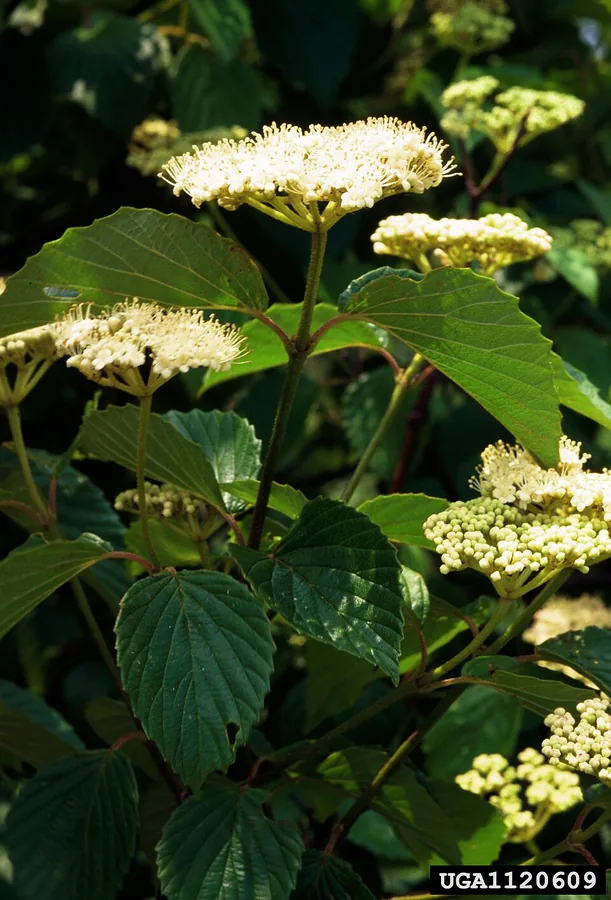
What it offers a garden is a sense of changing season more than a single set piece. Creamy-white flower clusters open the year in late spring, blue-black berries carry it into fall, and the leaves close it out in yellow, orange, and red. Birds arrive for the fruit as it ripens, so the shrub gives a space a feeling of life as well as a frame.
Settled in, it reads as a rounded, multi-stemmed presence of 5 to 10 feet (1.5 to 3 m), suckering at the base into an informal thicket where there is room for one. The single thing to manage is a beetle, covered below. Keep ahead of that and arrowwood becomes the dependable green backdrop a planting can lean on.
Care
The short version: site it in full sun to part shade in almost any well-drained soil, water it through the settling-in season, and look over the twigs for viburnum leaf beetle eggs across winter.
Light
Arrowwood is at its best in full sun to part shade, which leaves plenty of room when placing it. Full sun brings the fullest flowering, fruit, and fall color, while a spot with afternoon shade still performs well and settles naturally into a woodland edge.
Water
Keep the soil consistently moist, watering deeply while the shrub establishes and through any dry spell. Once it is at home it shrugs off the occasional drought, which in practice means watering every 5 to 10 days as heat and soil dictate.
Soil
Few shrubs are this gracious about where they are planted. Arrowwood accepts clay, loam, sand, or shallow rocky ground wherever it drains, and it works across a wide pH from 5.5 to 8.0, acidic to alkaline.
Temperature
A cold-hardy native, it carries through from -40°F to 100°F (-40°C to 38°C), spanning USDA zones 2 through 8. Winter cold is no concern, so it can hold a place almost anywhere in the temperate range.
Humidity
For an outdoor shrub, humidity is simply not part of the conversation. Air movement matters more, since open, breezy growth keeps the foliage dry and discourages pests.
Feeding
It asks for almost nothing in reasonable ground. A balanced slow-release fertilizer or compost in early spring is ample, and an established shrub in good soil often carries on with no feeding at all.
Pruning
Prune right after flowering in late spring to shape or thin the form, and pull suckers where you want to keep the outline tidy. The job that truly counts is winter scouting: cut out and burn any twigs carrying viburnum leaf beetle eggs between October and spring.
Repotting
This is a shrub for the open garden rather than a container, so repotting rarely enters the picture. If one waits in a nursery pot, move it on once the roots begin to circle or water runs straight through without soaking in.
Size & spacing
Allow for a rounded shrub 5 to 10 feet (1.5 to 3 m) tall and about as wide, spreading 6 to 10 feet (1.8 to 3 m). Give it that footprint, or more, where a second plant sits close by for pollination.
When to plant
As a woody, fully hardy shrub, arrowwood spares you any indoor seed-starting. Set new plants out in spring or fall, look forward to flowers in late spring, and watch the berries deepen from late summer into fall as they draw the birds in.
Northern hemisphere
Southern hemisphere
Typical months for a temperate climate: start earlier in warm zones, later where spring frosts linger.
- Plant: Spring or fall
- Harvest: Creamy-white flat-topped flower clusters in late spring (roughly March-May depending on region), followed by blue-black berries in late summer to fall
Hardiness
USDA hardiness zones: 2–8
Temperature: down to -46°C
Troubleshooting
Arrowwood is a forgiving anchor in a planting, and the little that troubles it shows up on the leaves. One pest does the genuine damage and another is mostly a passing blemish. Match what you see below, then step in before the leaf beetle in particular gets ahead of the season.
Foliage reduced to lace, leaving only the veins
When the leaves thin to a tracery of veins, the culprit is the viburnum leaf beetle, and arrowwood is the species it favors above all. Larvae feed in spring and adults follow, so a hard year can leave a once-handsome screen looking bare. Keep the planting looking its best by cutting out the egg-laden twigs over winter, clearing larvae from smaller plants, and letting lady beetles and lacewings round out the work.
Fix:
- Prune out and destroy egg-infested twigs between October and spring before eggs hatch
- Hand-remove or knock larvae off small plants
- Encourage natural predators such as lady beetles, lacewings, assassin bugs, and spined soldier bugs
- Treat heavy larval infestations with an appropriate labeled insecticide if needed
Speckled, sticky leaves and a drift of small white flies
A whitefly colony settling on the undersides leaves the foliage speckled and tacky with honeydew, which dulls the planting under a film of black sooty mold. A firm spray of water clears most of them, and a follow-up of insecticidal soap beneath the leaves keeps the screen looking clean. The blemish reads worse than it is and seldom leaves any lasting mark.
Fix:
- Spray foliage with a strong stream of water to dislodge insects
- Apply insecticidal soap or horticultural oil to leaf undersides
- Encourage natural predators
Toxicity
For a garden shared with pets or children, arrowwood viburnum is reassuringly non-toxic from top to bottom. The ASPCA lists it as safe for cats, dogs, and horses, and the berries become food for the birds rather than a worry underfoot. They are too tart for people to enjoy raw, yet they pose no danger to anyone.
Safe for
People · Cats · Dogs · Horses · Rabbits · Livestock · Birds
Cats None
A cat that wanders the garden is in no danger here, since the ASPCA lists viburnum as non-toxic to cats and a stolen nibble means nothing. The most an enthusiastic browser might feel is a brief, passing upset stomach, as with any plant.
Dogs None
The ASPCA listing covers dogs as well, so a household pet can share the same border without concern. A large mouthful of leaves or berries may bring on mild, short-lived stomach upset and nothing more.
Horses None
Horses can graze beside this shrub in a paddock planting without trouble, since viburnum holds no toxin known to affect them.
Rabbits None
Rabbits browse arrowwood in the wild, and it poses no poisoning risk in a garden setting. With a pet rabbit, introduce any new green slowly so its digestion stays settled.
Livestock None
Cattle, goats, and sheep can browse the leaves and twigs safely, which suits its long-standing place as a native shrub along pasture edges, with no record of poisoning stock.
Birds None
For birds the shrub is more than safe, since the blue-black berries become a prized fall food that draws songbirds into the garden to feed on the ripe fruit.
People None
The plant will poison no one, but the raw berries are tart and astringent and offer little at the table in quantity. The fruit is best left on the branch for the birds.
No special handling required; as with any plant, ingesting large amounts of foliage or berries may cause mild stomach upset in pets.
Varieties
Most garden arrowwoods are named selections chosen for a more refined size, a heavier crop of fruit, or richer fall color. These are the forms a designer or gardener tends to reach for most.
Blue Muffin
A compact choice at 5 to 7 feet that suits smaller borders while still setting a heavy crop of blue berries, especially with a second arrowwood nearby to cross-pollinate it.
Chicago Lustre
A vigorous, upright form whose glossy dark green leaves and dependable late-season bloom make it a polished anchor for a planting.
Autumn Jazz
A vase-shaped shrub kept for the autumn moment it creates, when the foliage turns vivid yellow, orange, and red.
Companions
Arrowwood fruits far better with a second, different arrowwood nearby to pollinate it, and pairs well with shade plants at its feet. Keep it away from other beetle-prone viburnums.
Plant near
A different arrowwood viburnum cultivar: Provides cross-pollination that dramatically improves berry set.
Native ferns and shade perennials: Fill the shaded base of the shrub and thrive in the same moist, well-drained soil.
Keep apart
Other highly VLB-susceptible viburnums (e.g. V. opulus): Clustering preferred hosts together can concentrate viburnum leaf beetle pressure.
How to propagate
You can multiply arrowwood three ways, from quick and easy to slow and stubborn. Cuttings and layering give you an exact copy of the parent; seed is a long project for the patient.
Stem cuttingsModerate
Early to mid summer · 6 to 10 weeks to root
To repeat a favorite cultivar through a border, cuttings are the dependable route. In early to mid summer, take softwood cuttings from the fresh new growth, dip the cut ends in rooting hormone, and hold them under high humidity, where roots form over the next 6 to 10 weeks.
SeedDemanding
Collect ripe fruit in fall · Several months to over a year (needs warm then cold stratification)
Seed is the unhurried path, suited to a gardener who enjoys the long view. Collect ripe fruit in fall, then allow for complex double dormancy that asks for a warm spell followed by a cold one, so germination unfolds anywhere from several months to more than a year and arrives unevenly.
LayeringEasy
Spring to summer · One growing season or more
The most effortless method belongs half to the shrub itself. From spring through summer, pin a low branch against the soil and let it root over a full growing season or longer. Natural suckers also rise around the base, ready to be lifted and divided into new plants for the garden.
Myths
The berries are poisonous to pets and people.
There is no cause for worry in a household garden, since the ASPCA lists viburnum as non-toxic to cats, dogs, and horses, leaving the blue-black fruit no threat to the animals around the space. The berries are valuable bird food, not a hazard, even if they are far too tart for anyone to enjoy raw by the handful.
One arrowwood viburnum will always fruit heavily on its own.
A solitary shrub usually sets only a modest crop. Cross-pollination from a second, genetically different arrowwood raises fruit set sharply, so a grouping of two or more distinct cultivars or seedlings is the route to a generous autumn display of berries.