Shrub · Aquifoliaceae
Japanese Holly
Ilex crenata
Settle it into acid ground that drains cleanly, and this evergreen repays the garden with crisp lines that endure.
Full sun
Every 5–10 days
USDA 5–8
3–10 ft · 0.9–3 m
Overview
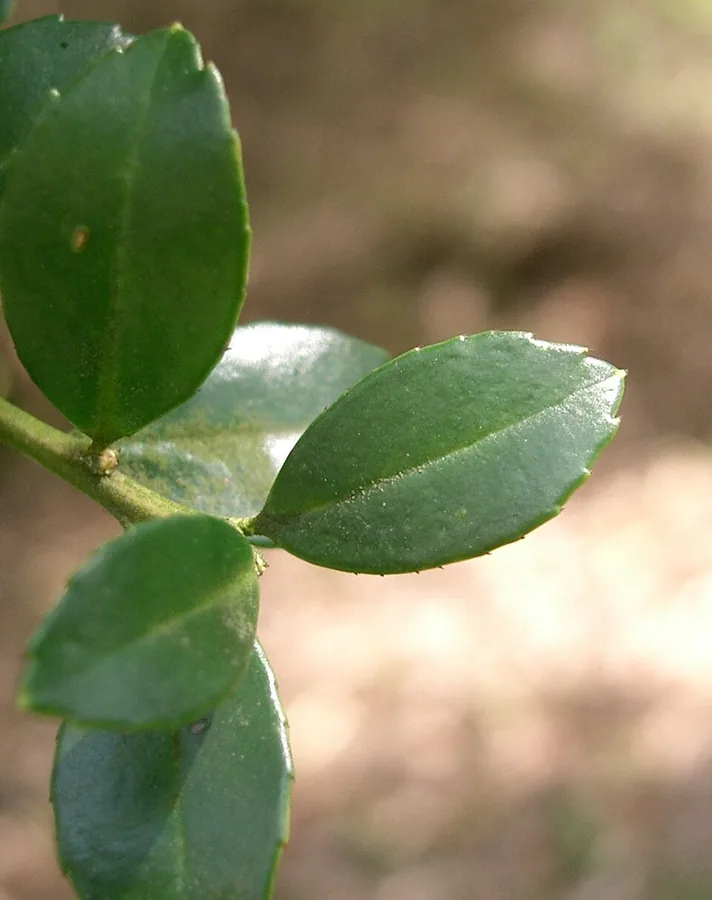
Japanese holly is the quiet workhorse behind a great many polished garden pictures, the evergreen chosen when a scheme wants the composure of boxwood with a little more resilience. Its small, glossy dark leaves and dense habit read as a smooth green mass from across a lawn, which is why designers clip it into low hedges, neat globes, and the crisp lines that frame a front door. Given its own way it settles slowly into a rounded shrub of 3 to 10 feet (91 cm to 3 m), an easy anchor for a border or a path.
It is a plant that rewards the long view, slow to grow and generous in its years, hardy through USDA zones 5 to 8 and unbothered by temperatures from -20°F to 95°F (-29°C to 35°C). Being dioecious, it carries male and female on separate plants, and only the female sets the small black fruit that ripens in fall. Those drupes recede into the dark foliage as a garden's understated winter detail, a note the birds are quick to find.
Style it as you like, but honor its one preference: acidic, well-drained soil. Let the pH rise and the leaves yellow between the veins; let the roots stand in cold, wet ground and root rot follows. Site it thoughtfully, give it space to hold its form, and it settles into the background of daily life, always composed and asking little in return.
Care
The short version: full sun to part shade in acidic, well-drained soil, kept evenly moist while young, sheared in late winter, and fed once each spring with a fertilizer made for acid-loving evergreens.
Light
Japanese holly looks its best in full sun, though it accepts partial shade and partial sun with grace. Fuller light builds a denser, tighter shrub that keeps a clipped outline crisp, while deep shade leaves the growth thin and open, softening the very form a design counts on.
Water
Keep the soil evenly moist, watering about every 5 to 10 days as heat and rainfall shift through the season. Young plants rely on that steadiness while they settle into a spot, and an established shrub, its roots run deep, carries a dry spell without losing composure.
Soil
The shrub asks for light, acidic, well-drained loam and adapts from sand to clay so long as water moves freely through it. Hold the pH at 5.0 to 6.5, since alkaline ground locks up iron and yellows the leaves that give the planting its polish.
Temperature
Hardy and heat-tolerant alike, it holds from -20°F to 95°F (-29°C to 35°C) across USDA zones 5 to 8. That reach lets it anchor most temperate gardens with no seasonal fuss.
Humidity
Ordinary outdoor air is all it wants, so there is no target to meet. Airflow around the foliage counts for more, keeping mites and disease from settling into a close-clipped mass.
Feeding
A single feeding in early spring with a balanced or acidifying fertilizer made for acid-loving evergreens is all it needs. One seasonal helping suits its slow pace, and an acidifying grade also steadies the soil within the range the roots prefer.
Pruning
This is a shrub that takes to the shears, which is the heart of its appeal for formal work. Prune in late winter to early spring to shape hedges and hold density, and since it answers repeated clipping much as boxwood does, it lends itself to the tight, tailored lines a room-like garden loves.
Repotting
Grown mostly in the ground, it seldom needs a pot. Where one frames a terrace or entry in a container, repot every 2 to 3 years in spring, taking roots that circle the pot or slip out the drainage holes as the cue.
Size & spacing
Plants reach 3 to 10 feet (91 cm to 3 m) tall and spread 5 to 8 feet (152 to 244 cm) wide over time. Give each shrub room for its full mature spread so air moves freely and the planting keeps its clean, healthy look.
When to plant
This slow, woody evergreen keeps an unhurried calendar that suits a garden meant to mature over years. Set new plants out in spring or fall while the soil is cool and workable, welcome the small white flowers in late spring, and look for the black fruit to color on female plants as the season turns.
Northern hemisphere
Southern hemisphere
Typical months for a temperate climate: start earlier in warm zones, later where spring frosts linger.
- Plant: Spring or fall
- Harvest: May to June (small white flowers); black drupes ripen in fall on female plants
Hardiness
USDA hardiness zones: 5–8
Temperature: down to -29°C
Troubleshooting
Most of what unsettles a Japanese holly planting comes down to the soil or to one persistent pest, and the foliage is where the story first shows. Learn to read a bronzed leaf, a yellow one, and a stalled tip. Find the match below and act while a fix still holds.
A planting losing vigor, its tips stalled and color fading
A hedge that stops filling out, its tips stalled and its leaves crowding tight as the whole planting fades, is usually the mark of black root rot, a soil fungus at home in wet, cool ground. Lift a root and look for tips gone dark brown to black. There is no bringing it back once it settles, so the honest move is to remove and discard the plant, open the drainage with a raised bed, and start again with a sturdier choice such as Chinese holly. Among landscape shrubs, Japanese holly is one of the most susceptible.
Fix:
- Remove and discard infected plants (cannot be cured)
- Replace with resistant species such as Chinese holly
- Improve drainage with raised beds
Foliage dulled to bronze beneath a fine gauze of webbing
When a clipped hedge loses its polish and the foliage turns dull, speckled, and faintly webbed, the southern red mite is usually at work, feeding unseen on the leaf undersides. Confirm it by tapping a branch over white paper and watching for specks that move. A firm rinse beneath the leaves, followed by horticultural oil and a repeat a week to 10 days on, restores the sheen. Give the cupped-leaf cultivars such as Convexa the first look, since they gather mites most readily.
Fix:
- Spray undersides thoroughly with horticultural oil
- Use strong water sprays to dislodge mites
- Repeat treatment in 7-10 days
- Encourage natural predators
Yellowing foliage traced with still-green veining
When the leaves pale to yellow while the veins hold their green, the look is chlorosis, and on this shrub it nearly always traces to soil that has turned too alkaline for the roots to draw up iron. A pH test settles it, showing a reading above the acidic range these plants favor. Work in elemental sulfur to ease the pH down, lean on an iron chelate for a quick recovery of color, and finish with a mulch of acidic organic matter to keep the gain.
Fix:
- Acidify soil with elemental sulfur per soil test
- Apply iron chelate as a temporary corrective
- Mulch with acidic organic matter
Toxicity
This is a mildly toxic shrub, a matter for quiet care rather than worry. The leaves and berries hold saponins that upset the stomach, and the small black fruit is the part to mind most. A single nibble seldom causes lasting harm, yet it pays to keep pets and small children from the berries and to clear any that fall.
Toxic to
Cats · Dogs · Horses · Rabbits · Livestock · People
Safe for
Birds
Cats Mild
A cat that samples a leaf or takes a berry tends to drool, be sick, and pass loose stools, then withdraw into a quiet, off-its-food mood for a while.
Dogs Mild
Dogs are the likeliest to chew the spiny leaves or swallow a dropped berry, and the upshot is vomiting, diarrhea, and a low, listless mood that eases as the gut clears.
Horses Mild
Horses seldom trouble holly, yet a mouthful of foliage or fruit can still unsettle the stomach and leave the animal flat and slow.
Rabbits Mild
A rabbit's delicate gut takes poorly to the saponins in the leaves and berries, so keep clippings and fallen fruit out of its reach to spare it the diarrhea and the dullness.
Livestock Mild
Grazing animals usually pass the prickly evergreen by, though a hungry one that browses the foliage can meet the same digestive upset and low spirits.
People Caution
Nothing on this shrub belongs at the table. The berries hold the true concern, since a child who eats a handful can fall ill with vomiting and diarrhea, so set it where small hands cannot reach the fruit.
Birds Safe
Birds take the ripe black drupes through the winter and pass the seeds unharmed, the very partnership that carries the shrub into new ground.
Keep fallen berries away from pets and children; wear gloves when pruning if skin is sensitive.
Helpline numbers

United States
ASPCA Animal Poison Control: (888) 426-4435 (fee applies)
Poison Control: (800) 222-1222



Canada
Poison Centres: 1-844-764-7669
Varieties
Nearly all the plants offered for sale are named cultivars chosen for form and scale rather than the wild species, each suiting a different corner of a design. These are the ones worth knowing before you plant.
Compacta
A dense, rounded form that takes shearing gracefully, which makes it a natural for low hedges and foundation plantings.
Helleri
A dwarf cushion that settles into a low mound, though it yields to black root rot a little more readily than most.
Convexa
Named for its cupped, convex leaves, it invites southern red mite more than its kin, so it repays a watchful eye.
Sky Pencil
A slim, columnar form that rises straight as a green exclamation point wherever a vertical accent is called for.
Hetzii
A vigorous, spreading cultivar that covers ground quickly, sharing Helleri's soft spot for black root rot along the way.
How to propagate
Japanese holly copies easily from cuttings, the method nurseries trust to keep each cultivar faithful to its parent.
Stem cuttingsEasy
Summer to early fall · 6 to 10 weeks to root
Semi-hardwood stem cuttings taken from summer into early fall root with little fuss, generally striking within 6 to 10 weeks. Because a cutting comes true to type, it is the sure way to reproduce a named cultivar exactly, holding its habit and leaf shape from one plant to the next.
Myths
Berries as small and discreet as these surely mean the shrub poses no risk worth a second thought.
For all their innocent look, those small fruits and the leaves alike carry saponins that upset the stomach. A pet or child that eats them can end up with vomiting and diarrhea, and the berries are the part to guard most. Treat the plant as mildly toxic and keep the fallen fruit tidied away.