Shrub · Aquifoliaceae
Sky Pencil Holly
Ilex crenata
The vertical line a considered garden reaches for, content with acidic soil and a little winter attention.
Full sun
Every 5–10 days
USDA 5–8
4–10 ft · 1.2–3 m
Overview
Few plants punctuate a space the way Sky Pencil Holly does. This columnar Japanese holly rises 4 to 10 feet (1.2 to 3 m) on a footprint of only 1 to 3 feet (30 to 90 cm), a proportion that turns awkward, narrow ground into an asset. Set one at each side of an entrance, run a rhythm of them along a path, or let a single spire draw the eye upward in a courtyard.
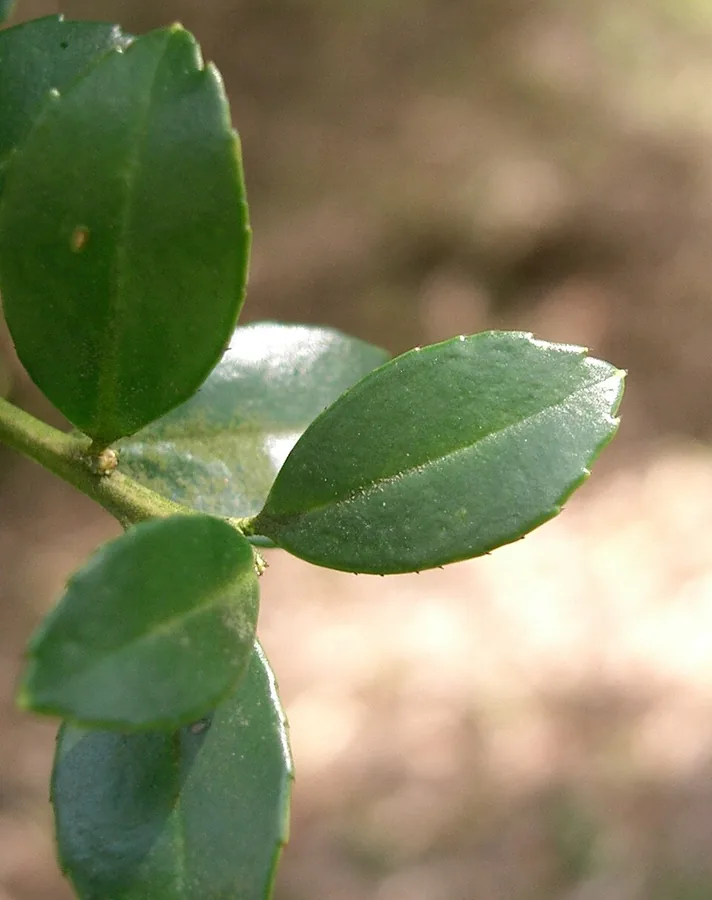
Its small, glossy leaves stay green through every season, so the look holds whether the borders around it are full or bare, and its slow pace keeps that composed silhouette steady for years. Worth knowing before you plant: this is an all-female cultivar, and it carries its small black berries only when a male holly shares the garden. On its own it stays a clean, unbroken green, which many gardeners prefer for its calm.
It belongs in cooler gardens, holding its poise through winters near -9°F (-23°C) across zones 5 to 8. That elegant narrowness is also its vulnerability, since a snow load or a scouring wind can open the line it was chosen for. Give it acidic, free-draining soil and a sheltered aspect, and it settles into the scene with little asked in return.
Care
The short version: a place in full sun or part shade, acidic and free-draining soil kept lightly moist, a single feed in early spring, and a discreet tie holding the stems through winter so the column keeps its line.
Light
Give Sky Pencil Holly full sun and it rewards you with a dense, upright column that reads as a crisp architectural line. It accepts partial shade as well, though thin light softens the form into something looser and less defined.
Water
Keep the soil evenly moist, which in practice means watering every 5 to 10 days as the weather shifts. A brief dry spell passes without incident, but lasting drought and, worse, waterlogged ground both undo it, the latter by inviting root rot.
Soil
Set it in light, acidic, well-drained soil near a pH of 5.0 to 6.5 and it looks after itself. It manages in clay or sand, yet alkaline ground drains the color from the leaves and dulls its vigor.
Temperature
This is a cold-hardy holly, comfortable across roughly -9°F to 95°F (-23°C to 35°C). That reach lets it hold its place through zone 5 to 8 winters, though a dry, biting wind can scorch the foliage, one more reason to give it shelter.
Humidity
Everyday outdoor air suits it, so no humidity target applies. Good airflow matters far more than any reading, especially where summers turn heavy and humid.
Feeding
A single feeding in early spring, using a balanced, acid-forming shrub fertilizer, is all its slow constitution requires. There is no need to return to it later in the season.
Pruning
Left alone, it keeps its column beautifully, so pruning is seldom part of the routine. Trim lightly in spring to tidy the outline, and gather the stems into a loose tie before winter so snow and ice cannot break the line open.
Repotting
In a container, repot it every 2 to 3 years, or when roots wind around the pot or slip through the drainage holes. Move it up one size into fresh acidic potting mix as growth eases or water begins to run through too fast.
Size & spacing
Expect a finished height of 4 to 10 feet (1.2 to 3 m) on a slim 1 to 3 feet (30 to 90 cm) of width. That narrow base is what lets a line of them stand close as a living screen or a low, tailored hedge along a boundary.
When to plant
No harvest calendar governs this evergreen, only the moment you choose to plant it. Set it out in spring or fall, when mild weather lets the roots take hold before the extremes of summer or deep winter. Quiet flowers appear in May and June, and berries follow only where a male holly keeps company, a small detail that rarely troubles anyone growing it for form.
Northern hemisphere
Southern hemisphere
Typical months for a temperate climate: start earlier in warm zones, later where spring frosts linger.
- Plant: spring or fall
- Harvest: May to June
Hardiness
USDA hardiness zones: 5–8
Temperature: down to -29°C
Troubleshooting
In a well-chosen spot this holly stays handsome and untroubled, though a damp site or a hard winter can test it. Its few complaints surface on the foliage and the upright stems, where they are easy to notice on a passing look. Match the symptom below and address it before the shape suffers.
Yellowing, sparse foliage with dieback at the crown
When yellowing and dieback rise from soil that stays wet, the cause is usually Phytophthora or black root rot. Ease the plant from the ground and the roots read dark brown to black and decayed, the damage deepening the wetter the site. Begin with drainage, hold back on watering, and on ground that refuses to dry, settle it onto a raised bed. A plant far gone with rot is best removed before it carries the problem to its neighbors.
Fix:
- Improve drainage and stop overwatering
- Avoid planting too deeply or over-mulching
- Use raised beds in heavy or wet soils
- Remove severely affected plants
Speckled, bronzed leaves veiled in fine webbing
A dusty speckling, a bronze cast, and threads of webbing usually mean spider mites, most often the southern red mite, which multiply in hot, dry weather. Tap a stem over a sheet of white paper and look for movement to be certain. A strong spray of water clears the worst, and insecticidal soap or horticultural oil worked into the leaf undersides finishes the job, with a second pass about a week later if any persist.
Fix:
- Apply strong water sprays to dislodge mites
- Treat with insecticidal soap or horticultural oil, covering lower leaf surfaces
- Repeat treatment in 7 to 10 days while mites are present
Brown foliage and a column opened by winter
A cold, drying wind leaves the foliage browned with winter burn, while the weight of snow and ice can spread the slim column and spoil its line. Clear snow from the stems soon after a storm so nothing bends under the load. The reliable answer is to draw the stems together ahead of winter and to offer both a windbreak and a mulched base.
Fix:
- Gently brush snow off stems after storms
- Tie stems loosely together for winter support
- Provide a windbreak and winter mulch
A whole plant faded to pale yellow
When the entire shrub pales to yellow, the soil beneath it has usually turned too alkaline. This is chlorosis, brought on as a high pH puts iron and other nutrients out of the plant's reach. Test the ground, ease it back toward acidic, and apply chelated iron to return the green while the correction settles.
Fix:
- Test soil pH
- Amend soil to lower pH toward acidic range
- Apply chelated iron if needed
Toxicity
This is a mildly toxic plant rather than a real danger. Both leaves and berries hold saponins, and since the glossy berries are the part a household pet is likeliest to sample, they deserve the attention. A taste tends to bring a passing stomach upset, so a habit of clearing dropped fruit keeps pets and young children well clear of any trouble.
Toxic to
Cats · Dogs · Horses · Rabbits · Livestock · Birds · People
Cats Mild
A cat that tastes a leaf or a berry usually ends up with a queasy stomach, a little drooling, and a single bout of vomiting or loose stools. The upset clears on its own, though a cat that has taken several berries deserves a word with the vet.
Dogs Mild
Dogs, the most curious about the bright fruit, respond to the saponins with drooling and a day of little interest in food. The usual result is some vomiting or a loose stool, nothing graver.
Horses Mild
A horse seldom turns to holly, but a mouthful of leaves or berries can bring colicky upset and a subdued, listless mood.
Rabbits Mild
A rabbit's delicate digestion reacts poorly to the saponins, so trimmings and fallen fruit are best kept clear of its hutch and run.
Livestock Mild
Grazing stock usually pass over the bitter leaves, yet a goat or sheep that works through a branch can meet a mild digestive upset.
Birds Caution
Wild birds take holly berries through the winter unharmed, but pet birds fare less well with the same fruit, so a caged bird is better kept away from it.
People Caution
No part of this holly belongs on a plate. A stray berry or two may amount to no more than a stomachache, though several can prompt vomiting and diarrhea, so the fruit is best kept beyond the reach of small children.
Keep fallen berries away from pets and children; the spiny evergreen foliage is otherwise low risk.
Helpline numbers

United States
ASPCA Animal Poison Control: (888) 426-4435 (fee applies)
Poison Control: (800) 222-1222



Canada
Poison Centres: 1-844-764-7669
Varieties
Sky Pencil keeps company with a handful of slender, upright Japanese hollies. These are the ones you are most likely to consider.
Sky Pencil
The narrowest of the group, a female cultivar that rises 4 to 10 feet on just 1 to 3 feet of width, prized as a crisp vertical accent in a planting.
Sky Pointer
A comparable upright Ilex crenata, shaped to almost the identical slender column.
Glow Stick
An Ilex crenata cultivar valued for foliage in a bright golden yellow.
How to propagate
Sky Pencil is propagated from cuttings, never seed, since only that keeps its refined, narrow line. The work rewards patience more than expertise.
Stem cuttingsModerate
Summer, using semi-hardwood cuttings · 6 to 10 weeks to root
The reliable route is semi-hardwood cuttings taken in summer, the one method that holds the narrow, upright form true. Settle them into a moist, free-draining medium and they take root across 6 to 10 weeks. Seed abandons the slim outline, which is precisely why the nursery trade clones it.
Myths
Holly must be safe around pets because it is such an ordinary garden shrub.
Familiarity in the landscape has nothing to do with what is safe to eat. Holly holds saponins, and its berries leave cats and dogs unwell, with drooling and bouts of vomiting or diarrhea. The danger is slight but genuine, so the berries are never a treat to leave within reach.
Sky Pencil Holly can be relied on to bear berries.
Because it is an all-female cultivar, it cannot fruit unaided. Its small black berries arrive only when a male holly grows nearby to carry pollen to the flowers.