Tree · Cornaceae
Kousa Dogwood
Cornus kousa
A small tree that carries a garden through the year with star-shaped blooms, edible fruit, and peeling bark.
Full sun
Every 5–10 days
USDA 5–8
15–30 ft · 4.6–9.1 m
Overview
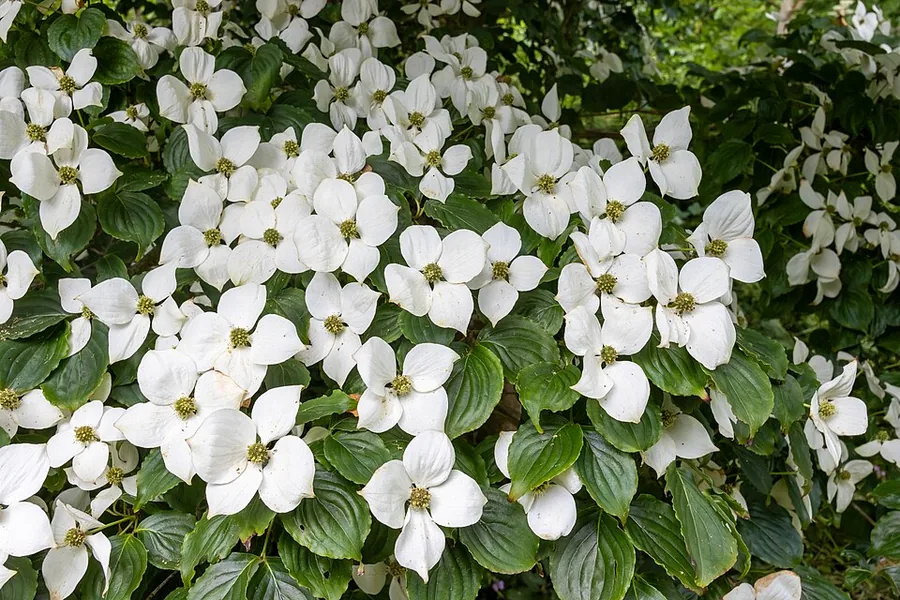
Kousa dogwood is the tree that gives a garden a sense of occasion in every season. Late spring stages a long show of pointed, star-shaped bracts, and because it flowers after the leaves have unfurled, unlike the native flowering dogwood, the blooms read against a settled green rather than bare wood, a quieter and more grown-up effect. By late summer it hangs with pinkish-red fruit that draws birds to the garden and comes edible for the table.
Its scale is one of its best manners. At 15 to 30 feet (4.6 to 9.1 m) tall and about as wide, it anchors a courtyard, a patio corner, or a small lawn without ever dominating the view, and its slow pace means the composition you plant is close to the one you keep. A young tree holds a poised, vase-like line that softens into a rounded canopy with age, and the maturing trunk sheds bark into a mottled pattern that gives the winter garden something worth looking out on.
For anyone building a low-maintenance, year-round scene, it earns its spot as a more dependable stand-in for Cornus florida. It shrugs off the anthracnose and borers that undo the native tree, asks little once it has settled into its place, and holds up to cold as low as -20°F (-29°C). Set it in decent soil with steady moisture and it keeps its composure with barely a hand from you.
Care
The short version: give it full sun to part shade in rich, slightly acidic, well-drained soil, and keep it evenly moist through summer's heat so the display stays fresh. Mulch the roots, prune almost never, and let this slow grower ease into the scene at its own pace.
Light
Kousa dogwood settles happily into full sun to part shade. Full sun brings the fullest bloom for the most striking show, though in hot regions a little afternoon shade keeps the leaves from scorching at the height of summer.
Water
Keep the soil at a steady, medium moisture, watering every 5 to 10 days and more often through a hot, dry spell so the canopy stays fresh rather than scorched. Once settled it copes with drought better than the native dogwood, though it never wants to stand in waterlogged ground.
Soil
Plant it in rich, humusy, well-drained loam on the acidic to neutral side, ideally a pH of 5.5 to 7.0. Folding in compost and finishing with an acidic organic mulch keeps the roots cool and fed, and gives the bed a tidy, cared-for look.
Temperature
It weathers a wide range, from -20°F to 95°F (-29°C to 35°C), spanning USDA zones 5 through 8. Hard winters leave it unfazed, and it falters only where summers turn relentlessly hot and dry.
Humidity
Ordinary outdoor humidity suits it, so there is no figure to fret over. What counts for the look of the planting is air movement, since crowded, stagnant growth is what invites powdery mildew to dull the leaves.
Feeding
A single feed in early spring with a balanced slow-release fertilizer is ample, or simply top-dress with acidic compost or mulch. This slow grower asks for little and looks its best when left to its own measured pace.
Pruning
Reach for the pruners rarely. Take out only dead, damaged, or crossing branches, doing it just after flowering in late spring to early summer so next year's display is never sacrificed.
Repotting
A kousa dogwood is seldom a long-term container piece, so repotting rarely enters the picture. Should one be potted and its roots begin circling or pressing through the drainage holes, move it to a larger vessel or, better still, into open ground where it can settle for good.
Size & spacing
Plan around a mature tree of 15 to 30 feet (4.6 to 9.1 m) tall with a spread to match. Give it that much open room so the broad, rounded crown can shape the space and air can drift through the branches.
When to plant
Kousa dogwood is a long-term resident, a woody tree planted once and lived with for decades. Set it out in spring or fall so the roots take hold before the next stretch of heat or hard frost, and look forward to the bloom in late spring and edible fruit ripening from late summer into early fall, a rhythm the garden comes to keep time by.
Northern hemisphere
Southern hemisphere
Typical months for a temperate climate: start earlier in warm zones, later where spring frosts linger.
- Plant: spring or fall
- Harvest: Blooms late spring to early summer (May to June), after leaves emerge; pinkish-red edible fruit ripens late summer to early fall.
Hardiness
USDA hardiness zones: 5–8
Temperature: down to -29°C
Troubleshooting
Most of what troubles a kousa dogwood is written on the leaves, and the cause is usually the setting or the season rather than any fault in the tree. Learn to read summer scorch apart from the two leaf-spotting fungi and you will know at a glance whether the answer is the hose or the rake. Match what you see below, then act before it dulls the display.
Browned leaf edges taking the shine off a summer display
When the edges crisp and brown in high summer, the culprit is leaf scorch, which sets in where a tree stands in a hot, sunny position and cannot draw up enough water to keep its canopy fresh. A young tree, still shallow-rooted, is the first to lose its polish. Keep the picture handsome by watering deeply through dry weeks, dressing the base with a 2 to 3 inch (5 to 8 cm) ring of mulch, and choosing a spot with afternoon shade wherever summers run hot.
Fix:
- Provide deep, regular watering during heat and drought
- Apply a 2-3 inch organic mulch layer to conserve soil moisture and keep roots cool
- Site in partial afternoon shade in hot climates
A pale film dulling the canopy's fresh green
A soft, chalky bloom over the leaves points to powdery mildew, a fungus at home in humid air, deep shade, and the still pockets of crowded growth. It can pucker the odd leaf and take the gloss off a planting, though it rarely does harm that lasts. Open the canopy and give the tree breathing room so air moves through, lift away the worst-marked leaves, and turn to a labeled fungicide only when an outbreak refuses to settle.
Fix:
- Improve air circulation by thinning and proper spacing
- Remove and dispose of affected foliage
- Apply a labeled fungicide if infection is severe
Angular flecks scattered across late-season foliage
Small, angular flecks edged in a darker tone are the signature of septoria leaf spot, a fungus that arrives late in the season once the foliage has stayed wet for a spell. Where scorch fades the whole margin, this one prints its mark right on the leaf. Keep the planting looking cared for by raking up and clearing the fallen leaves so spores cannot linger over winter, keeping water off the canopy, and reaching for a labeled fungicide only if the tree begins to shed in earnest.
Fix:
- Rake and dispose of fallen infected leaves
- Avoid overhead watering and wetting foliage
- Apply a labeled fungicide only if defoliation is significant
Toxicity
Here the news could hardly be better. Kousa dogwood is non-toxic to pets, livestock, and people, and its ripe pinkish-red fruit is genuinely good to eat. Nothing about this tree needs fencing off, and a curious pet passing beneath it is no cause for worry.
Safe for
People · Cats · Dogs · Horses · Rabbits · Livestock · Birds
Cats Safe
A cat that shares the garden has nothing to fear from this tree, since no part of it is toxic to them. A nibbled leaf might bring a brief, mild stomach upset, no different from any non-food plant, and it soon passes.
Dogs Safe
A dog can roam beneath it and chew the leaves, bark, or a dropped fruit without any real concern. At worst a greedy mouthful leaves a passing bit of upset that settles by itself.
Horses Safe
Horses come to no harm from the tree, foliage and fruit alike. It needs no fencing to keep it clear of a paddock.
Rabbits Safe
Rabbits can browse the leaves in safety. As with any fresh green, bring it into their diet gradually so a sudden change does not unsettle their digestion.
Livestock Safe
Cattle, goats, and sheep can graze around the tree untroubled, as it holds no toxin that would affect them.
Birds Safe
Birds gather to the ripe fruit and carry off the seed, turning the tree into a living part of the garden's life rather than any kind of hazard.
People Safe
The ripe pinkish-red fruit is a pleasure to eat, sweet and soft within, and nothing else on the tree poses any danger. The thin skin and gritty seeds are usually set aside.
No special handling required; ingestion of plant material may rarely cause mild, transient gastrointestinal upset as with any non-food plant.
Varieties
Most kousa dogwoods offered for sale are named selections, chosen for their flowers, their foliage, or their easy constitution. These are the ones worth knowing before you choose one for a space.
Milky Way
A generous bloomer, often listed under var. chinensis, that clothes itself in creamy-white bracts before setting a full crop of fruit, an easy choice for a garden meant to make a statement.
Wolf Eyes
A compact, unhurried grower with green leaves rimmed in clean white, tailor-made for the smaller garden or a courtyard that wants a lift of brightness.
Satomi
The romantic of the group, trading the usual white for warm deep pink to rose bracts.
Cornus × rutgersensis (Stellar series)
These Rutgers hybrids of Cornus florida and Cornus kousa, among them Aurora, Constellation, and Stellar Pink, were bred to shrug off anthracnose and borers for lower-fuss, longer-lasting good looks.
How to propagate
Kousa dogwood can be increased in several ways, from slow and variable seed to the effortless layering trick that asks next to nothing of you. The route you take depends on whether you need a faithful copy of a named tree.
SeedModerate
Sow cleaned seed in fall or after cold-moist stratification in late winter. · Several years to reach flowering size
Clean the pulp from the seed, then either sow it in fall or offer a cold-moist stratification before a late-winter sowing, which is what coaxes it into germinating. Patience is the price here, as a seedling wants several years to reach flowering size. Bear in mind, too, that seedlings come up variable, so a home-grown tree will not simply echo the parent.
Stem cuttingsModerate
Take softwood to semi-hardwood cuttings in late spring to summer. · One growing season to root and establish
Take softwood to semi-hardwood cuttings from late spring into summer, dip them in rooting hormone, and keep them under mist. They root across a single growing season, and kousa cuttings take more willingly than those of many other trees, which makes this a satisfying way to raise more.
GraftingDemanding
Graft named cultivars onto seedling rootstock in late winter or summer. · One to two seasons to establish union
The exacting route is grafting or budding a named cultivar onto seedling rootstock in late winter or summer. The union knits together over one to two seasons. It is how nurseries keep a cultivar true to type, since the offspring of seed never will be.
LayeringEasy
Layer low flexible branches in spring. · One to two growing seasons to root
The gentlest method for a home garden is to layer a low, supple branch in spring by pinning it to the soil until roots form. Rooting takes one to two growing seasons, after which the branch can be severed and the new plant set where it is wanted.
Myths
Kousa dogwood catches anthracnose and borers just as badly as the native flowering dogwood.
In truth, Cornus kousa stands up far better to both dogwood anthracnose and the dogwood borer than Cornus florida ever does. This is the tree to plant where anthracnose has spoiled the picture before, and that reliability is why it is so often chosen as the replacement.
The red raspberry-like fruit is poisonous and shouldn't be eaten.
Far from it. The pinkish-red fruit is perfectly edible, soft and sweet once fully ripe. Birds and wildlife enjoy it too, so it earns its keep as both a treat from the garden and a draw that brings the space to life.