Shrub · Berberidaceae
Oregon Grape
Mahonia aquifolium
Set it in shade with shelter from winter wind, and Oregon grape brings yellow spring flowers and blue-black berries to the garden.
Partial shade
Every 7–14 days
USDA 5–8
3–6 ft · 0.9–1.8 m
Overview
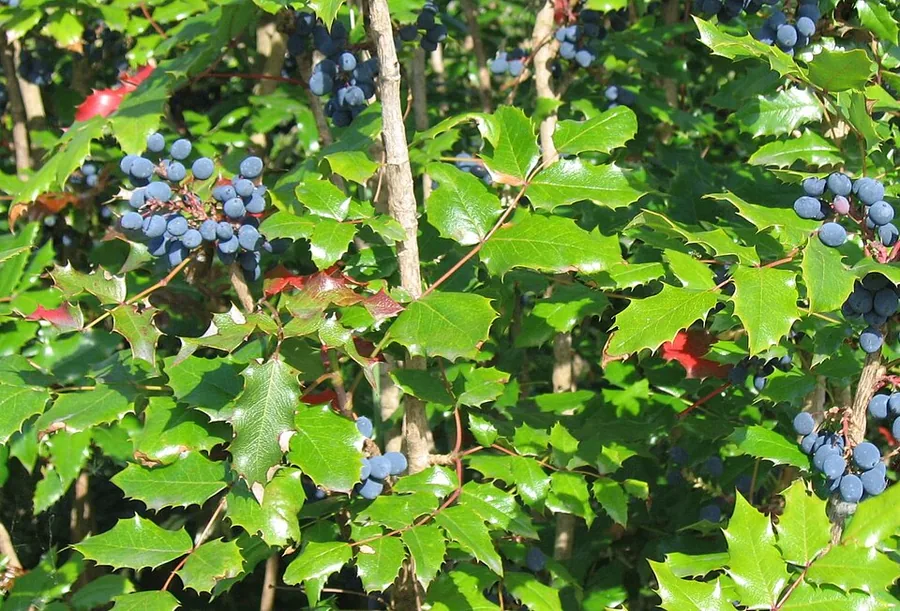
Oregon grape is the evergreen shrub for a shaded corner that needs presence all year, its glossy holly-like leaves turning bronze through the cold months before easing back to deep green in spring. A member of the barberry family rather than the grapes, it lends its name to the clusters of blue-black berries that ripen toward late summer. As an anchor for a woodland border or a shady entry bed, few plants carry the seasons with such quiet composure.
It grows slow and unhurried, drawing up to 3 to 6 feet tall across years, which makes it easy to place and easier to live with. Spreading underground by stolons, it sends up suckers that gather into a low, colonizing sweep, a habit tailor-made for softening a shaded bank or edging a path. Where a tidier line suits the setting, the odd stray shoot lifts out in a moment.
The garden year opens with dense clusters of bright yellow flowers that draw the first bees, followed by tart berries that pass to birds or to the kitchen for jelly. Hardy to -20°F (-29°C), it holds its poise through a demanding winter, asking only to stand out of the drying wind.
Care
The short version: give it a shaded spot with shelter from winter wind, moist, acidic, well-drained soil, and steady water until it settles in, and from then on it asks little beyond an easy spring tidy that folds into the season's routine.
Light
Oregon grape looks its best in partial to full shade, which keeps the foliage glossy and deep, a natural fit for the north side of a house or a shaded courtyard. It will take full sun, but the leaves bleach and scorch there, especially in winter, so a spot under some overhead cover flatters it most.
Water
Keep the soil evenly moist through the first season or two while it settles into its spot. Once established the shrub takes dry spells calmly, so you can let the top inch dry and water only every 7 to 14 days. Standing water is the one thing it will not abide.
Soil
Plant it in moist, rich, acidic, well-drained ground in the 5.0 to 7.0 pH range. It has little patience for alkaline, compacted, or soggy soil, and lime is the surest way to bring on the yellow leaves it is prone to.
Temperature
This is a genuinely cold-hardy shrub, at ease from about -20°F to 90°F (-29°C to 32°C). A hard winter leaves it unruffled so long as it stands out of biting wind, since it is the wind that scorches the leaves, not the cold on its own.
Humidity
Ordinary outdoor humidity suits it perfectly, so there is no reading to chase. What counts here is air moving freely around the plant, since crowded, still foliage is what invites leaf spot and rust.
Feeding
One feed in spring is ample. Reach for a balanced or acidifying shrub fertilizer, and move to an acidic formula if the leaves begin to yellow from high-pH chlorosis.
Pruning
Prune after flowering to refine the shape, or to cut a leggy plant back hard for fresh growth. Clear out any dead, damaged, or winter-burned stems at the same time, and lift the odd unwanted sucker as it appears to keep the sweep composed.
Repotting
In the ground it never needs repotting, and in a container it is content left alone for years. Move it up only when roots circle the pot or the soil dries out far too fast.
Size & spacing
Expect a mature plant of about 3 to 6 feet (91 to 183 cm) tall with a spread of 20 inches to 1.5 to 5 feet (51 to 152 cm) as the suckers fill the space. Allow room for it to colonize and read as a sweep, or trim the edges back each year for a crisper line.
When to plant
Oregon grape keeps a calm seasonal rhythm that is easy to plan a garden around. Plant it in spring or fall while the soil works kindly, look for yellow flowers to open the year in early spring, and let the blue-black berries ripen from late summer into early fall.
Northern hemisphere
Southern hemisphere
Typical months for a temperate climate: start earlier in warm zones, later where spring frosts linger.
- Plant: Spring or fall
- Harvest: Yellow flowers in early spring; blue-black berries ripen by late summer to early fall
Hardiness
USDA hardiness zones: 5–8
Temperature: down to -29°C
Troubleshooting
Nearly every concern with Oregon grape reads on the leaves, and more often than not it traces to placement rather than to a pest. The foliage tells you where the plant is unhappy. Match the look below, then adjust the setting before you reach for a spray.
Brown, scorched leaf edges that worsen over winter
When the handsome foliage frays to brown at the edges by late winter, the culprit is winter leaf burn rather than any disease. Bright winter sun and dry wind draw moisture from the leaves faster than frozen roots can restore it, and a harsh summer exposure works the same mischief. The fix doubles as good placement: settle the shrub in a shaded, sheltered corner of the garden, mulch and water it generously before the cold arrives, and tidy the spoiled foliage in spring as fresh growth takes over.
Fix:
- Site in partial to full shade with shelter from strong and drying winter wind
- Mulch and keep soil evenly moist going into winter
- Prune out badly burned foliage in spring as new growth emerges
Yellow leaves with veins that stay green
A leaf that pales to yellow while its veins stay green is showing iron chlorosis, the mark of soil that has turned too alkaline for the roots to draw iron. Begin with a soil test to confirm the reading. For a lasting correction, lower the pH with elemental sulfur or an acidifying fertilizer, and lean on chelated iron when you want the foliage back to its glossy green sooner.
Fix:
- Test soil pH
- Lower pH and acidify with elemental sulfur or an acidifying fertilizer
- Apply chelated iron for quick correction
Spots or orange rust pustules on the foliage
Neat spots or orange-to-brown pustules across the leaves are the signature of leaf spot and rust fungi, which settle in on crowded plantings held in humid, unmoving air. The remedy is simple housekeeping: strip away and discard the blemished leaves, then give the shrub room so air drifts through and the foliage dries after rain. A labeled fungicide belongs only to the rare season when an outbreak refuses to relent.
Fix:
- Remove and dispose of affected leaves
- Improve air circulation and avoid overhead watering
- Apply a labeled fungicide if infection is severe
Toxicity
This is an easy plant to welcome into a household, though a little discretion still helps. The cooked berries are good on the table, while the roots and stems hold berberine, a bitter compound that can unsettle a stomach if a pet or person takes much of it. Day to day, the spiny leaves ask for more care than the chemistry, so slip on gloves whenever you handle it.
Toxic to
Cats · Dogs · Horses · Rabbits · Livestock
Safe for
People · Birds
Cats Mild
Berberine sits in the roots and stems, so a cat that works away at them may drool, be sick, or run to loose stools. A passing taste of a leaf comes to little; the upset arrives only when a curious cat makes a real meal of the woody parts.
Dogs Mild
A dog that chews the stems or roots meets the same berberine and can come away with a sour stomach and a spell of diarrhea. The upset rises with the amount taken, and most dogs come right without any fuss.
Horses Caution
Horses generally give the spined foliage a wide berth, yet the berberine held in the woody parts can still trouble the gut if one grazes a fair helping. Keeping the shrub clear of a horse's reach settles the question.
Rabbits Caution
A rabbit's small frame means even a little of the bitter, berberine-laced foliage can unsettle its digestion. It is best kept off the menu entirely, never offered as forage.
Livestock Caution
Cattle, goats, and sheep usually turn from the prickly leaves, though a real mouthful of stem or root might leave them with mild digestive upset. Left to graze, they seldom choose it.
Birds Safe
Wild birds relish the ripe blue-black berries and carry the seed onward unharmed. That easy exchange is one of the ways the shrub finds fresh ground.
People Berries safe when cooked
Simmered into jelly or wine, the tart berries make fine eating, so the fruit is safe for the table. The roots and stems are another story, since their berberine can unsettle the stomach when eaten in any quantity.
The glossy, holly-like compound leaflets have stiff spine-tipped teeth that can prick or scratch skin; wear gloves and use care when pruning or handling.
Helpline numbers

United States
ASPCA Animal Poison Control: (888) 426-4435 (fee applies)
Poison Control: (800) 222-1222



Canada
Poison Centres: 1-844-764-7669
Varieties
The straight species carries most gardens beautifully, but a couple of named selections earn a place where the setting is snug or a fuller show of flower is wanted.
'Compacta'
A refined dwarf that holds to about 2 to 3 feet, ideal for a small courtyard bed or drawn in drifts as a low, unifying groundcover.
'Apollo'
A low, spreading selection that carries a generous flush of yellow flowers above a dense, well-composed habit.
How to propagate
Oregon grape offers three ways to make more of it, from quick to slow. Dividing the rooted suckers is the simplest and most immediate, while cuttings and seed suit a longer, more leisurely project.
Stem cuttingsModerate
Late fall to winter, after some cold exposure · Several weeks to months to root
Gather semi-hardwood cuttings in late fall or winter, once the wood has taken a little cold, and touch the cut ends with rooting hormone. Set them into a moist, well-drained medium and let time do the work, since roots may take several weeks to a few months to form.
DivisionEasy
Spring or fall · One growing season
Division is the graceful shortcut. Because the shrub travels by stolons into colonizing clumps, you can lift it in spring or fall, part the rooted suckers, and replant them where you please. Each division finds its footing over one growing season.
SeedModerate
Sow stratified seed in fall or after cold stratification · One or more years; seed is slow to germinate and reach size
Seed asks for patience above all. Clean the pulp from ripe berries and either sow in fall or give the seed a cold stratification first, since it will not stir without that chill. Count on a year or more before the young plants gather any real presence.
Myths
Oregon grape berries are poisonous because they look like holly or barberry fruit.
The resemblance to holly and barberry fruit is what starts the rumor. In truth the blue-black berries are simply too tart for eating fresh, yet cooked into jelly or wine they are a pleasure, and the plant is listed as non-toxic to cats, dogs, and horses. The fruit belongs on the table; only the bitter roots and stems call for keeping out of reach.