Ornamental · Convolvulaceae
Moonflower
Ipomoea alba
Set it in full sun and warm soil, and moonflower dresses the evening in fragrant white trumpets.
Full sun
Every 3–7 days
50–90°F · 10–32°C
60–120 days
Overview
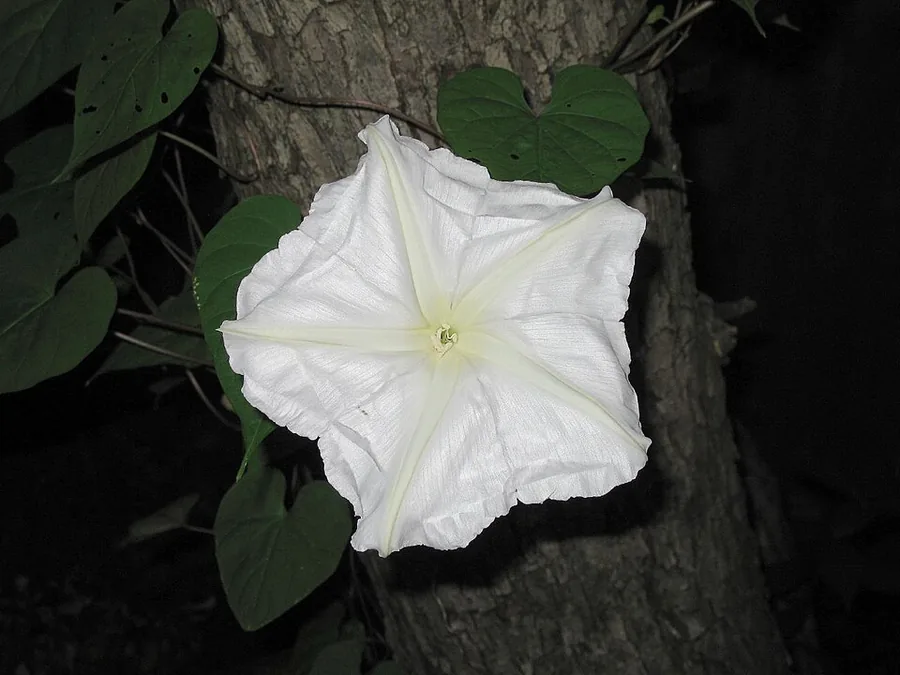
Moonflower is the vine to plant where evenings matter. As the light drops, its buds unwind into pure-white, fragrant trumpets wide as a saucer, calling in the sphinx and hawk moths, then closing by morning. A member of the morning glory family, it keeps the same easy manner as its daytime cousins while saving its whole performance for after dark, which makes it a natural centerpiece for the hours a home actually relaxes.
Give it heat and a support to hold, and it climbs fast enough to clear head height in a season, turning a bare fence or arbor into a living screen. It is a tender perennial in frost-free ground, though most gardens treat it as an annual and start fresh each spring. Trained over a porch or a dining pergola, its scent and pale flowers set the tone for a summer evening spent outside.
Its charm lies in how little it asks once settled, which suits a garden meant to be enjoyed rather than fussed over. Give it warmth and lean soil and it obliges, while a cold, short season or overly rich ground leaves you with foliage and few flowers to show at dusk. Beyond that, the work is mostly choosing where you want it to climb and letting the evenings do the rest.
Care
The short version: full sun, warm and average (not rich) well-drained soil, and steady moisture, with a strong trellis or fence for the vine to climb.
Light
Give moonflower full sun, ideally 6 or more hours a day, so choose the brightest wall or arbor you have. A little afternoon shade is tolerated, but anything short of full sun slows the vine and thins out the evening flowers.
Water
Keep the soil evenly moist without letting it sit wet, watering about every 3 to 7 days as heat and rain shift. Steady, medium moisture suits it, and well-drained ground under the planting keeps the roots content.
Soil
Average, well-drained soil is exactly right, be it loam, clay, or sand, at a pH from 6.0 to 7.8. Resist the urge to enrich the bed, since lush soil grows leaves and quietly withholds the flowers you planted it for.
Temperature
This is a heat lover, at ease from 50°F to 90°F (10°C to 32°C). It hits its stride in high summer and has no tolerance for frost, which closes the season on it.
Humidity
Ordinary outdoor air is all it wants, so there is no figure to chase. The vine takes typical garden humidity in stride and needs nothing extra on that count.
Feeding
A light, balanced fertilizer roughly once a month through the growing season keeps it in form. Go easy on nitrogen above all, since a heavy hand grows foliage and postpones the flowers that make the display.
Pruning
Pinch the young tips early to prompt the vine to branch and fill out across its support. After that, clear away any dead or stray growth and keep easing the stems along the structure as they climb.
Repotting
In a container, plan to repot once a year. Roots circling the pot, slipping out the drainage holes, or growth that stalls all signal that the plant has outgrown its place.
Size & spacing
This is a large vine, climbing 10 to 30 feet (3 to 9 m) in a strong season and spreading 3 to 6 feet (91 to 183 cm) wide, so scale it to a tall, sturdy trellis, fence, or arbor with room to stretch.
When to plant
Moonflower runs on a long, warm summer and bows out at the first frost, so its season is worth planning around. Nick and soak the hard seeds, start them indoors 6 to 8 weeks before your last frost, and set the plants out once the cold is gone. From there the evening flowers carry a garden from mid-summer into fall.
Northern hemisphere
Southern hemisphere
Typical months for a temperate climate: start earlier in warm zones, later where spring frosts linger.
- Sow: 6-8 weeks before last spring frost, after nicking and soaking the hard seed coat
- Plant: 1-2 weeks after last spring frost once soil is warm
- Harvest: Mid-summer into fall; flowers open at dusk and close by morning
Hardiness
USDA hardiness zones: 10–12
Temperature: down to -1°C
Troubleshooting
Moonflower rarely causes drama, and the little it does usually traces to weather or soil rather than neglect. The common disappointment is foliage without the evening flowers, with the odd pest turning up now and then. Match the symptom below and act early to keep the display intact.
A curtain of green, but no evening blooms
A moonflower meant to crown a summer terrace loses its whole appeal when it gives you leaves and no flowers. The culprit is usually a season too short and cool for it, or soil so rich that the plant favors foliage over buds. Set it in full sun, ease off the feeding, and start seed early so the vine reaches its evening display well before the season turns.
Fix:
- Site in full sun with a sturdy support
- Avoid rich soil and high-nitrogen fertilizer
- Start seed indoors early in short-season areas to extend the warm growing window
Puckered shoots and a dusting of fine webs
When the greenery that frames a doorway starts to twist or speckle, look to aphids and spider mites, along with the occasional caterpillar or leaf miner. They gather on the leaf undersides and the soft new tips, where mites drape a faint web across the paling, stippled foliage. A firm rinse of water clears most, insecticidal soap settles the soft-bodied ones, and caterpillars come off by hand. A well-tended vine shrugs off the lot.
Fix:
- Dislodge aphids and mites with a strong spray of water
- Treat soft-bodied pests with insecticidal soap
- Handpick caterpillars and remove mined leaves
Toxicity
Give the seeds a wide berth in a lived-in space. As with every morning glory, moonflower keeps LSA alkaloids in its seeds, which can sicken pets, livestock, and people and bring on a hallucinogenic reaction if eaten. The leaves are a far gentler matter, but site the vine so seeds and pods stay clear of animals and children.
Toxic to
Cats · Dogs · Horses · Rabbits · Livestock · Birds · People
Cats Mild
For a household cat, the seeds are the real concern, since they hold the LSA alkaloids. A small taste tends to bring drooling and vomiting, while a larger one can lead to tremors, an unsteady walk, and disorientation. The foliage stays a far gentler matter.
Dogs Mild
A dog that gets into the seeds usually ends up with an upset stomach and vomiting. In quantity, the same alkaloids can leave it agitated, trembling, and visibly spaced-out. The leaves alone seldom go beyond a mild bout of stomach upset.
Horses Caution
A horse is unlikely to seek out the vine, yet the seeds carry the alkaloids that trouble other animals. Keep the seed pods out of reach, and watch for colic or dullness should any be eaten.
Rabbits Caution
Moonflower has no place in a rabbit's diet. The seeds in particular can unsettle a delicate gut, so keep the plant and its pods clear of the hutch and run.
Livestock Caution
Cattle, goats, and sheep tend to bypass the bitter vine, though the seeds are still the point of concern. Fence grazing stock away from any plants in pod as a simple precaution.
Birds Caution
The seeds are the part to guard against here as well. Keep pet birds clear of any that fall, since eating them can bring on vomiting and a jittery, disoriented spell.
People Caution
No part of this vine belongs on the table, and the seeds are the danger. Eating them brings nausea, vomiting, and hallucinogenic effects from the LSA alkaloids, so keep seeds and pods well beyond a child's reach.
Keep seeds out of reach of pets and children; ingestion of large amounts of seeds can cause neurologic signs.
Helpline numbers

United States
ASPCA Animal Poison Control: (888) 426-4435 (fee applies)
Poison Control: (800) 222-1222



Canada
Poison Centres: 1-844-764-7669
Varieties
For all its presence, there is really just one moonflower, the species itself, often paired with a day-blooming relative for a fuller show. These are the two worth placing side by side.
Ipomoea alba (species moonflower / moonvine)
This is the true moonflower, the vine that opens fragrant, pure-white trumpets up to 4 to 6 inches across at dusk for the sphinx and hawk moths that pollinate it.
Day-blooming morning glory (Ipomoea purpurea / Ipomoea tricolor)
This close cousin is often set beside moonflower to keep a display going around the clock, its colorful flowers opening through the day rather than at night.
Companions
Moonflower pairs naturally with its day-blooming morning glory cousins, which fill the trellis with color while the moonflower sleeps and then hand the night shift back over at dusk.
Plant near
Day-blooming morning glory (Ipomoea purpurea/tricolor): Planted together they provide round-the-clock flowers, day and night.
How to propagate
Moonflower comes from seed, and the one thing to see to first is coaxing that stubborn seed coat to take in water.
SeedEasy
Start indoors 6-8 weeks before last frost or sow outdoors after frost when soil is warm · 1-3 weeks to germinate; rapid growth once weather warms
Moonflower rises easily from seed, and the single step worth attending to is that hard, water-resistant seed coat. Nick it with a knife or ease it over sandpaper, then let the seed soak overnight before it goes into the ground. Start it indoors 6 to 8 weeks before the last frost, or sow it directly once the soil has warmed, and it germinates in 1 to 3 weeks before climbing away in the heat.
Myths
The vining moonflower is the same deadly plant as the jimsonweed or thorn apple that shares its name.
These are two unrelated plants that happen to answer to the same name, moonflower. The vine in question is Ipomoea alba, a twining morning glory whose seeds hold mildly toxic LSA alkaloids. The perilous one is Datura, an upright nightshade whose tropane alkaloids, atropine, scopolamine, and hyoscyamine, can be fatal. Datura is by far the more poisonous of the two, so the shared name reveals nothing about the risk.