Ornamental · Asteraceae
African Daisy
Osteospermum ecklonis
Pair it with full sun, sharp drainage, and cool air, and the African daisy dresses itself in bloom.
Full sun
Every 3–7 days
50–75°F · 10–24°C
USDA 10–11
Overview
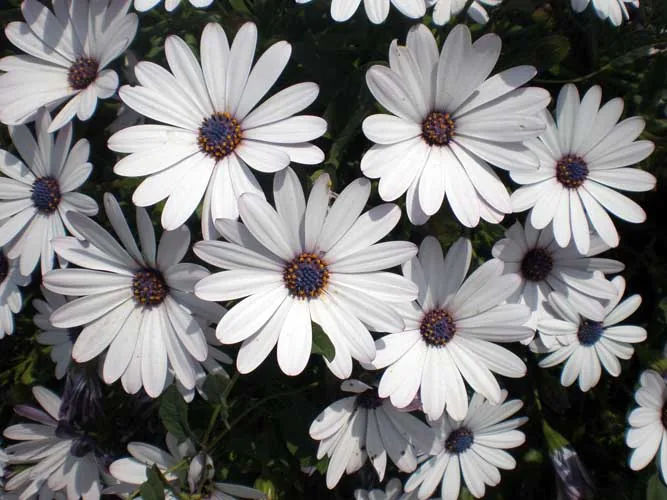
A member of the sunflower family, the African daisy traces its origins to southern Africa, the land that lent it the names Cape daisy and Cape marguerite. Through much of the country it lives as an outdoor flowering annual, gathering into a low cushion that mounds or spills, its gray-green leaves a soft backdrop for the daisy-shaped flowers raised above. Each bloom poises on a slender stem and opens to a luminous ring of rays around a center disk of a different tone.
One habit gives it a quiet drama that the common daisy lacks. The flowers fold shut at night and in dim light, then open again to the returning sun, so a border that read as bare at first light has filled with color by mid-morning. It is a tender perennial, holding through winter only in zones 10 and 11, and in cooler regions the gardener plants it anew each spring to enjoy it as an annual.
Its reputation for easy keeping is earned. Offered sun and soil that drains, and kept clear of its spent blooms, it carries flower from late spring deep into autumn. The single thing it resists is a hot, humid summer, which can hold the display in suspense until cooler weather releases it.
Care
The short version: full sun and a loose, well-drained soil are the two essentials that decide everything else. Hold the soil evenly moist without letting it grow sodden, feed with restraint, and lift away the faded flowers so new ones keep arriving.
Light
African daisies long for full sun, at least 6 hours of direct light a day, to flower at their fullest. They will accept partial sun, but shade trades bloom for loose, stretched growth. The brighter the spot, the drier the foliage, which keeps mildew at a distance.
Water
Keep the soil evenly moist yet never sodden, for standing water rots the roots in short order. An established plant rides out a brief dry spell, though steady moisture draws far better flower. Let the surface dry a touch between waterings, near every 3 to 7 days as the heat dictates.
Soil
Give it a loose bed that drains freely, eased with a measure of organic matter, since quick drainage decides whether this daisy thrives. Acidity troubles it little, and it sits comfortably across a pH of 5.5 to 7.5. The lone flaw worth correcting beforehand is dense, sodden clay.
Temperature
A cool-season plant at heart, it does its finest work between 50°F and 75°F (10°C to 24°C). Bloom eases as a hot, humid summer settles in and gathers again as the air cools. Frost closes the season in most regions.
Humidity
Plain outdoor air suits it, so there is no figure to chase. Movement of air matters more, for crowded, still conditions are exactly where powdery mildew finds its opening.
Feeding
Feed with a light touch. A balanced slow-release fertilizer or a little compost across the growing season, given seasonally, is ample. Lay it on heavily and the plant turns lush with leaf and spare with flower, as excess nitrogen tilts it toward foliage.
Pruning
Lift away the spent flowers as they fade and the plant answers with more. An early pinch of the tips draws a fuller, rounder shape. Cut back any rangy, trailing stems from late summer into autumn to settle the mound.
Size & spacing
At maturity it stands 12 to 35 inches (30 to 90 cm) tall and reaches 9 to 24 inches (23 to 61 cm) across. Grant each plant its full breadth so air can move and the leaves stay dry.
When to plant
This is a garden subject that wants a warm root zone beneath a cool sky. Begin the seed under shelter 6 to 8 weeks before the last frost, move the seedlings into the bed once cold has lifted and the earth has taken on warmth, and watch for color from late spring into fall, at its richest while the days hold cool.
Northern hemisphere
Southern hemisphere
Typical months for a temperate climate: start earlier in warm zones, later where spring frosts linger.
- Sow: 6 to 8 weeks before the last spring frost
- Plant: after the last spring frost when soil has warmed
- Harvest: late spring through fall, blooming most heavily in cool weather
Hardiness
USDA hardiness zones: 10–11
Temperature: down to -1°C
Troubleshooting
Nearly every difficulty an African daisy meets gathers around two themes: soil left too wet, or the press of summer heat. Read the first hints on the flowers and lower leaves and you can answer before the trouble spreads. Find the picture that fits below, then act while the moment still favors you.
A slump and fade rising from the soil
More often than not the trouble is root rot, the work of waterlogged soil that starves the roots until they turn brown and soft. A vascular disease called verticillium wilt can stage the same tired, yellowing decline. Let the soil breathe and dry between waterings, lift away any plant that has given out, and keep fresh daisies clear of ground that stayed infected.
Fix:
- Improve drainage and let soil dry between waterings
- Remove and discard severely affected plants
- Avoid replanting susceptible species in infected soil
New shoots warped and glazed with stickiness
The soft little culprits are aphids, gathering at the shoot tips and beneath the leaves to draw sap and leave a sticky sheen in their wake. A brisk jet of water clears most of the colony at once. Should they return, insecticidal soap brings them to heel, and a few resident ladybugs keep a quiet watch over the rest.
Fix:
- Spray off with a strong jet of water
- Apply insecticidal soap if populations persist
The display thins as summer turns hot
True to its nature as a cool-season bloomer, this daisy quiets through the heavy, humid weeks of summer, as many cultivars do. A generous hand with nitrogen only prolongs the pause, coaxing leaf at the expense of flower. Trim back the feeding, stay faithful to deadheading, and the show resumes once the air turns crisp again.
Fix:
- Site in a spot with cooler conditions and good air flow
- Reduce fertilizer and avoid high-nitrogen feeds
- Deadhead regularly to promote rebloom when cool weather returns
A pale veil settling over the leaves
That chalky bloom is powdery mildew, a fungus that arrives when damp, motionless air lingers among plants set too near one another, then drifts wider across the foliage. Loosen the spacing and let a breeze pass through. Water at the roots instead of overhead, and lift away the leaves that have taken the worst of it.
Fix:
- Improve air circulation and spacing
- Avoid overhead watering
- Remove affected foliage
Toxicity
In a household that includes animals or young ones, the news is welcome. The African daisy carries a non-toxic rating, with approved sources giving the nod for cats, dogs, and horses. Should a pet or a small child take a curious taste, no harm follows, so the plant deserves a spot wherever the family lives.
Safe for
People · Cats · Dogs · Horses · Rabbits · Livestock · Birds
Cats Safe
Listed as non-toxic to cats, it lets a wandering feline taste a leaf without the slightest harm.
Dogs Safe
A dog may rest in its shade or nibble a leaf in passing, and nothing in the plant will poison them.
Horses Safe
Cleared for horses by trusted sources, it holds no compounds that would give cause for concern.
Rabbits Safe
Gentle on rabbits, though any leafy green belongs as a modest accent in their daily fare.
Livestock Safe
Cattle, goats, and sheep may graze alongside it with no threat of poisoning.
Birds Safe
Pet birds and backyard hens are free to forage at its feet without coming to harm.
People Safe
Non-toxic to people, it suits a garden shared with toddlers and small children alike.
Varieties
Many different plants travel under the African daisy banner, though for the garden the story narrows to Osteospermum itself and a brief roster of named picks. The selections below are the ones to recognize.
Osteospermum ecklonis
The parent species behind most hybrids, it wears a woody base beneath a mounding or trailing form, its white rays framing a blue-purple eye.
Bright Lights series
A polished, compact hybrid line proven across university trial gardens, prized for daring flower color and a long arc of cool-season bloom.
Wildside
A named selection that plant-finder records single out for the uncommon coloring of its flowers.
How to propagate
An African daisy begins from cuttings or from seed, and the choice tends to follow the variety in hand. Most named hybrids hold true only when grown from cuttings.
Stem cuttingsModerate
During active growth in the growing season · Roots typically form in about 4 to 5 weeks under mist or a humidity tent
Cuttings carry the parent forward unchanged, which is why most named hybrids are raised from tips rather than seed. Take them while the plant is in growth, touch the cut end to rooting hormone, and settle them into a moist soilless mix. Under mist or a humidity tent, roots arrive over roughly 4 to 5 weeks.
SeedModerate
Sow indoors 6 to 8 weeks before the last spring frost · Several weeks to transplant size before moving outdoors after frost
A few cultivars take well to seed, even as most garden hybrids stay the path of cuttings. Sow under cover 6 to 8 weeks before the last spring frost, and allow the seedlings several weeks to gather size for transplant before they move outdoors once the cold has lifted.
Myths
African daisies bloom best in the heat of summer.
The truth turns the other way. Osteospermum flowers most freely in cool air, while a host of cultivars all but rest through a hot, humid summer. Grow it as a cool-season plant and the display unfolds far longer.
Every plant called African daisy is the same one, and it is toxic.
It is easy to see how the worry takes root, since several unrelated plants answer to this one name. The one in the garden is Osteospermum of the Asteraceae, and approved sources name it non-toxic to cats and dogs.