Tree · Moraceae
Mulberry
Morus rubra
Offer it sun and space to spread, and each early summer the mulberry delivers buckets of sweet fruit.
Full sun
Every 7–21 days
USDA 4–9
25–60 ft · 7.6–18.3 m
Overview
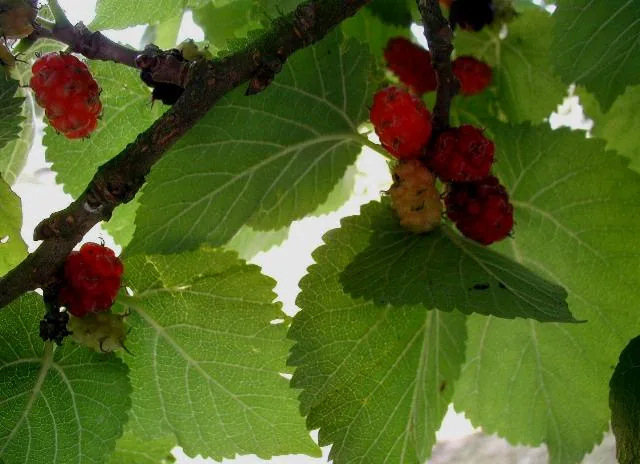
A mulberry is the tree that turns a plain back garden into a place people gather. It belongs to the fig family and grows into real presence, 25 to 60 feet (7.5 to 18 m) tall with a broad, spreading crown that throws generous shade over a lawn or seating area. The red mulberry is native to the eastern US while the white and black kinds arrived from Asia, and all of them bring sweet, blackberry-like fruit to the table in early summer.
This is a tree that shapes a whole corner of the property, so it rewards a bit of forethought. It stands up to cold as low as -29°F (-34°C), takes drought in its stride once grown, and crops so freely that birds carry seedlings well beyond the garden fence. The fallen fruit stains paving a deep purple, which makes the setting you choose as much a design decision as a horticultural one.
Placed thoughtfully, a mulberry asks for very little and quietly anchors a landscape for a lifetime. Give it sun, deep soil, and open ground clear of terraces and walkways, and it holds the space with ease. Do steer toward the native red mulberry or a named cultivar, since the white mulberry has become invasive across much of the US.
Care
The short version: open space, full sun, and deep soil with sharp drainage frame this tree at its best. Water it through youth, reserve pruning for the coldest weeks, and position it away from any surface its fruit might stain.
Light
A mulberry gives its best crop in full sun, though it accepts partial sun or light shade. More light means more fruit and an open, airy canopy that dries fast after rain, keeping the foliage clean of mildew.
Water
Water a young tree deeply about once a week as it settles into its spot. Once established, a mulberry is quite drought tolerant and asks for a drink only through a long dry spell, which suits an easygoing garden.
Soil
It thrives in deep, well-drained loam with plenty of organic matter. Clay or sand it tolerates, but it sulks in thin, poor ground, and it stays relaxed about pH anywhere from 5.5 to 7.5.
Temperature
A mulberry is impressively hardy, weathering cold to -29°F (-34°C) and heat up to 104°F (40°C). That range lets it settle comfortably into gardens across USDA zones 4 through 9.
Humidity
Ordinary outdoor humidity, around 30% to 70%, suits it without any attention from you. Good airflow through the canopy earns its keep more than any figure, since it keeps the leaves dry and the tree looking well.
Feeding
Mature mulberries rarely need feeding and often crop better left to their own devices. Should a young tree look sluggish, a light balanced fertilizer or compost in early spring is enough, since overfeeding only pushes weak, floppy growth.
Pruning
Prune only when the tree is fully dormant in late winter, or the cuts bleed sap heavily. Clear dead, crossing, or crowded branches, shape young trees to a pleasing frame, and keep your cuts under about 2 inches across.
Repotting
A mulberry is a landscape tree that lives in the ground, so repotting never enters the picture. Move a young or container-grown tree only while it is dormant, watching for roots circling the pot or growth that stalls come spring.
Size & spacing
Plan for a substantial tree, 25 to 60 feet (7.5 to 18 m) tall with a crown spreading 35 to 40 feet (10.5 to 12 m) wide. Give it that much open room, set well away from buildings, paths, and other plantings.
When to plant
A mulberry keeps a graceful seasonal calendar worth planning your year around. Set a young tree in the ground in spring once the frost has lifted, or plant it in fall while it rests. The blossom arrives across April and May, and the fruit comes in through May and June, drifting into summer on some types.
Northern hemisphere
Southern hemisphere
Typical months for a temperate climate: start earlier in warm zones, later where spring frosts linger.
- Plant: Spring after the last frost, or in fall while the tree is dormant
- Harvest: Blooms April-May; fruit ripens roughly May-June (into summer for some types)
Hardiness
USDA hardiness zones: 4–9
Temperature: down to -34°C
Troubleshooting
A mulberry is a hardy fixture, so most of what troubles it is mess and passing pests rather than real disease. Cast an eye over the trunk for borers, the leaves for mildew, and the ground for stains and stray seedlings. Match what you see below, then tend to it while the job is still small.
Failing branches over frass and pinholes at the base
When a limb over the patio starts to wilt and shed leaves, look low on the trunk for a borer at work, given away by round exit holes, oozing, and a scatter of powdery frass. Prune the affected branches away and burn them, then keep the tree in good heart with steady water and mulch so it can seal off any repeat visitor. The habit that saves the most grief is simple: keep mowers and trimmers clear of the trunk, since a fresh wound is an open invitation for the beetle to lay her eggs.
Fix:
- Prune out and destroy infested limbs
- Keep the tree vigorous with proper water and mulch
- Avoid bark wounds that invite egg-laying
A chalky pale veil across the foliage, late summer
By late summer a pale, dusty bloom can settle over the canopy, and it is only powdery mildew, a surface fungus that wipes off a leaf and appears on both faces. On a tree of this stature it does little more than dull the look for a season. Thin any crowded growth so air can move through, and clear the fallen leaves to lift the spores from the ground. A bright, open setting with dry foliage keeps the canopy looking clean.
Fix:
- Improve air circulation by thinning crowded growth
- Rake and remove fallen infected leaves
Purple-stained walkways and stray seedlings scattered about
The generous harvest that makes a mulberry so pleasant to sit under is the same one that colors the pavement below and sends birds off to sow seedlings across the garden. Lift the young volunteers before they root in, and sweep the fallen fruit before it presses into the stone. The graceful solution is placement, so set a fruiting tree well back from patios, driveways, and paths, and consider a fruitless cultivar only where local pollen-allergy rules allow it.
Fix:
- Hand-pull volunteer seedlings while young
- Site away from patios, driveways, and walkways
- Choose a fruitless cultivar only where allergy bans do not apply
Toxicity
The ripe fruit is sweet and safe for people and pets, and that generosity at the table is the whole charm of the tree. The rest of it calls for a little care. Unripe green berries and the milky sap of the leaves and stems can irritate skin and unsettle a stomach, so keep grazing animals and curious children clear of the green parts.
Safe for
People · Cats · Dogs · Horses · Rabbits · Livestock · Birds
Cats Mild
Ripe berries leave a cat perfectly well. The milky sap and the green unripe fruit are the only concern, and at most they bring on a little drooling or a passing bout of vomiting, so light nibbling keeps any upset minor.
Dogs Mild
A dog is welcome to the ripe fruit with no trouble at all. Only a helping of unripe berries or a chew on the sappy leaves might bring soft stools or a touch of vomiting, and that settles on its own.
Horses Mild
Ripe windfalls suit a horse in moderation. Grazing on sap-heavy leaves or green fruit is the one thing that can loosen the gut and dull the appetite for a day or so.
Rabbits Mild
A small serving of ripe fruit makes a safe treat for a rabbit, though its gut is a delicate thing, so unripe berries and sappy leaves can bring on soft stools. Offer it sparingly and keep a gentle watch for any upset.
Livestock Mild
Cattle, goats, and sheep take fallen mulberries with no harm. A large helping of green fruit or sap-laden leaves may cause passing diarrhea, and in real quantity the unripe berries can act as a mild intoxicant.
Birds Mild
Birds gather to ripe mulberries and come to no harm, which is half the reason the tree travels so far and wide. Only the green, unripe berries might unsettle a stomach.
People Ripe fruit safe
Ripe mulberries are a sweet, safe fruit for the table, lovely fresh or baked. Leave the unripe green berries and avoid the milky sap, which can irritate skin and, in quantity, upset the stomach or even cause hallucinations.
Ripe berries are safe, but unripe green or white berries and the milky sap of leaves and stems can cause mild gastrointestinal upset, and the sap is a mild skin and GI irritant.
Varieties
Three species and a handful of hybrids make up most of what you will find offered for sale. Telling them apart helps you choose the tree that suits your setting and pass over the invasive one.
Morus rubra (red mulberry)
The eastern US native wears dull, non-glossy leaves and ripens dark red-to-purple fruit.
Morus alba (white mulberry)
An Asian import once kept for silkworms, it shows glossy leaves and has turned invasive across much of the US, where it crosses with the native red mulberry.
Morus nigra (black mulberry)
It offers the largest, richest-flavored fruit of the three, though it takes cold the least well.
Illinois Everbearing
A productive cross of M. alba and M. rubra, this cultivar carries fruit through a long, heavy season.
Companions
A mulberry works best as a decoy for hungry birds and worst as a neighbor to anything that needs sun or clean ground beneath it.
Plant near
Cherries and blueberries: Birds strongly prefer mulberries, so a mulberry can act as a decoy that draws them away from other fruit crops.
Clover or other low groundcover: A living groundcover suppresses weed seedlings and adds organic matter under the canopy.
Keep apart
Vegetable and flower beds: Dense shade, greedy shallow roots, and staining fruit drop make underplanting and nearby beds difficult.
How to propagate
A mulberry can be raised from a cutting, a graft, or a seed, and the route you take depends on whether you want a faithful copy of a favorite tree or simply more of them for the garden.
Stem cuttingsEasy
Hardwood cuttings in late winter; softwood cuttings in early summer · About 4-8 weeks to root
Two easy windows open for cuttings: hardwood in late winter and softwood in early summer, with most rooting in about 4 to 8 weeks. White mulberry obliges without fuss, while red and black mulberry ask for more patience before they take.
GraftingModerate
Late winter to early spring (whip or bark graft) · One growing season
Grafting is the classic way to carry a prized named cultivar, or a species reluctant to root, onto sturdy seedling rootstock. Set the whip or bark graft from late winter into early spring, and the union settles over a single growing season.
SeedModerate
Sow after 1-3 months of cold stratification · Several years to first fruit
Give the seed 1 to 3 months of cold stratification, then plan for the long game, since a seedling needs several years to fruit. The results come out varied, and white mulberry in particular self-seeds freely wherever birds drop the fruit.
Myths
A fruitless male mulberry gives you a clean, problem-free shade tree.
Choosing fruitless simply exchanges one nuisance for another. The male trees, usually Morus alba, cast enormous clouds of allergenic pollen, and some cities such as Albuquerque restrict or ban them outright to protect air quality.
The mulberry is toxic through and through.
The reputation is unfair. The ASPCA lists mulberry as non-toxic, and the ripe fruit is a pleasure to eat. Only the unripe berries and the milky sap cause trouble, and even then it is a mild, short-lived stomach upset.