Houseplant · Moraceae
Rubber Plant
Ficus elastica
Settle it into bright indirect light and one steady corner, and the rubber plant rises into a glossy, unbothered indoor tree.
Bright indirect
60–80°F · 16–27°C
USDA 9–12
2–10 ft · 0.6–3 m
Overview
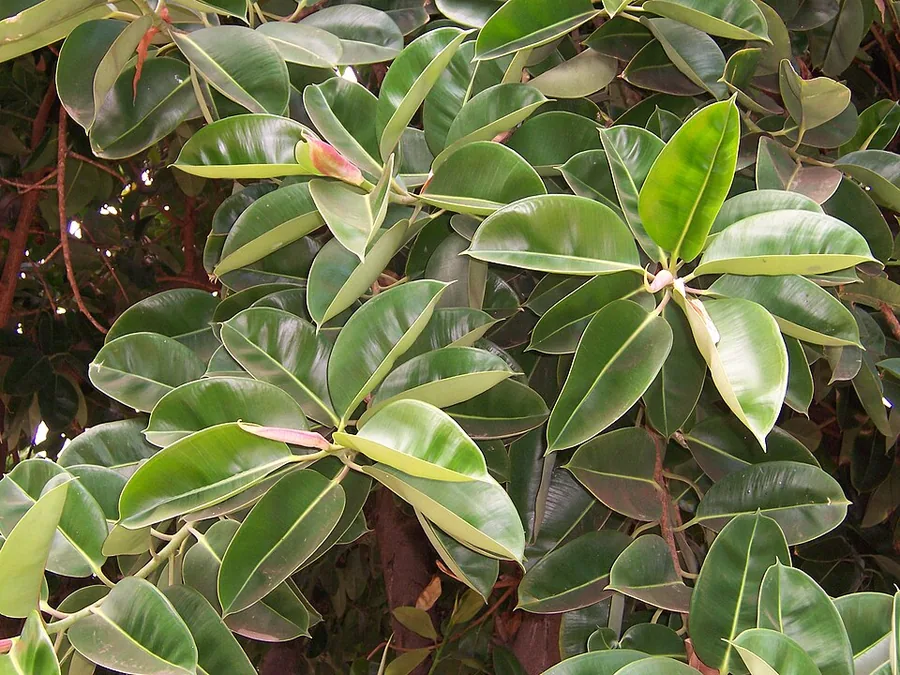
Few large houseplants ask so little while giving a room so much. A member of the fig family, the rubber plant hails from the forest belt that runs from Nepal through southern China and on into western Malesia, where it climbs into a soaring tree. Kept indoors it holds to a graceful 2 to 10 feet (60 cm to 3 m), its thick, lacquered leaves lending quiet architecture to a space.
Its easygoing nature comes down to how much it forgives. Bright indirect light brings out its best, yet it endures dimmer corners more gracefully than most sizeable foliage plants and forgives the occasional skipped watering. What it cannot abide is upheaval, so one steady position out of the draft keeps every leaf in place.
Cut any part of it and a milky latex sap wells up at the wound. That sap lends the plant its name and explains the gloves you slip on before pruning. Because it can redden skin and poses a mild hazard to cats and dogs, choose its place with the household, two-legged and four, in view.
Care
The short version: bright indirect light, a warm and settled corner, and one deep watering only after the surface has dried a little. Feed across spring and summer, and reach for gloves before every cut.
Light
Position it for bright indirect light beside a window that skips the scorching afternoon glare. It will persist in partial shade or low light, yet growth eases off there and the variegated forms surrender some of their patterning.
Water
Soak it well, then hold off until the soil surface has dried slightly before the next round. The pot must drain, and any water gathering in the saucer should go, because standing moisture rots roots faster than anything else. From fall into late winter, when growth pauses, water more sparingly.
Soil
Set it in a well drained, soil-based potting mix. Acidity barely concerns it, with anything from 6.0 to 8.0 acceptable, so the real aim is a blend that drains cleanly rather than one that holds on heavy and damp.
Temperature
Hold it within the 60°F to 80°F (16°C to 27°C) band it favors, warm by day and a shade cooler at night. Keep it above 55°F (13°C) and clear of cold drafts, since an abrupt chill is among the usual reasons leaves let go.
Humidity
Ordinary room humidity serves it well, and no target reading needs chasing. It inclines toward humid air yet rides out the dry warmth of indoor winters without complaint.
Feeding
Through spring and summer, while it is in active growth, offer a water-soluble houseplant fertilizer once a fortnight. Pull back in dimmer light and across the colder stretch, when its appetite drops sharply.
Pruning
Take the shears to it in spring to rein in height, renew leggy stems, or coax a fuller silhouette. Untouched, it climbs into a tall, tree-like form, so cutting it is a matter of taste rather than need. Keep your gloves on, since each cut bleeds irritating latex.
Repotting
Move it on in late winter or early spring once it has filled its current pot. Step up just a size or two into fresh, free-draining mix, and gloves earn their place at this job as well.
Size & spacing
Under a roof the rubber plant climbs to 2 to 10 feet (60 cm to 3 m), gaining height quickly where the light is generous. Allow it floor room and clearance overhead, because left unpruned it keeps reaching toward a tree-like form.
Troubleshooting
Nearly every rubber plant complaint comes back to watering or some abrupt shift in its surroundings. Notice what the leaves and roots are telling you early, and the remedy is usually straightforward. Find your symptom below, then act before a small fault widens.
Drooping while the soil sits wet
A specimen that sags in sodden soil is suffering root rot. Its roots have gone soft and blackened, lost the ability to draw water, and the canopy collapses even surrounded by moisture. Pull your watering back sharply, snip out the spent roots, and settle the plant into fresh, free-draining mix housed in a pot that truly sheds water.
Fix:
- Reduce watering
- Repot into a well-drained mix and a pot with drainage holes
- Remove affected roots
Yellowing creeping up from the base
When the foliage goes yellow, the cause is nearly always roots left sitting in damp soil. A stray yellow leaf or two right at the base is just the plant shedding its eldest growth, but once the color works upward, scale back your watering, confirm the pot can drain, and pour off anything pooled beneath it.
Fix:
- Reduce watering frequency
- Ensure the pot has drainage holes and empty the saucer
- Use a well-drained, soil-based mix
Falling foliage after a move or a chill
A rubber plant sheds when its world shifts under it. Dim corners, a cold draft, parched air, or waterlogged roots all prompt the same sulky response, and so does carrying it from room to room. Settle it into a single luminous, dependable spot clear of drafts and warm-air vents, hold it above 55°F (13°C), and revisit your watering rhythm.
Fix:
- Move to a brighter, stable location with bright indirect light
- Keep away from cold drafts and heat sources; keep above 55°F
- Avoid frequently relocating the plant
- Check and correct watering
Tacky leaves, fine webbing, or raised specks on the stems
A handful of sap-sucking pests are drawn to this fig, and every one signs its work differently. Look for the cottony white fluff of mealybugs, the firm little nubs of scale, the delicate webbing and pinprick mottling of spider mites, and a glossy tacky residue spread over the foliage. Sponge the leaves clean, dose them with insecticidal soap or horticultural oil, and quarantine the plant from its neighbors while it mends.
Fix:
- Wipe or wash insects off the foliage
- Treat with insecticidal soap or horticultural oil
- Isolate the plant until the infestation clears
Toxicity
This is not a houseplant to be casually chewed. Its milky latex sap holds ficin and a psoralen, enough to inflame the mouth and stomach of cats and dogs and to leave human skin sore where it lands. None of it is edible, so set it beyond the reach of pets and young children and handle it gloved.
Toxic to
Cats · Dogs · Horses · Rabbits · Livestock · Birds · People
Cats Mild
Bite into a leaf and a cat will usually drool and swipe a paw at its mouth, unsettled by the irritating latex, with a touch of queasiness and vomiting close behind. Wherever that sap meets fur or skin, expect a patch left red and tender.
Dogs Mild
After a chew, dogs commonly slobber and seem sore around the mouth, then turn nauseous or bring the meal back up before long. The episode stays minor, yet the gummy sap can redden skin on contact all the same.
Horses Caution
Horses appear on NC State's toxic roster too. That same latex would inflame the mouth and digestive tract, and while a horse seldom crosses paths with a houseplant fig, it pays to keep trimmings and shed leaves well clear.
Rabbits Caution
Carried in that milky sap are the very irritants that trouble cats and dogs, so a curious rabbit that nibbles risks a tender mouth and a roiling gut. Keep the leaves off the menu entirely.
Livestock Caution
Should grazing animals reach the foliage, the latex can leave their mouths and guts inflamed. This is no pasture species, so the genuine hazard lies in tossed prunings or a potted specimen left within range.
Birds Caution
A pet bird that chews the leaves can react to the irritating sap, so treat the plant as forbidden and keep perches and cages well away from any foliage.
People Caution
On skin and in the eyes, the milky latex acts as an irritant and can trigger contact dermatitis, above all in those carrying a natural-rubber latex allergy. Nothing on the plant is fit to eat, so pull on gloves before pruning or repotting and keep the sap from touching bare skin.
The milky latex sap can irritate skin and eyes and cause contact dermatitis in sensitive people (Ficus latex also cross-reacts with natural-rubber latex allergy); wear gloves when pruning or repotting
Helpline numbers

United States
ASPCA Animal Poison Control: (888) 426-4435 (fee applies)
Poison Control: (800) 222-1222



Canada
Poison Centres: 1-844-764-7669
Varieties
Almost every rubber plant on offer is one of a few named selections, spanning plain lustrous green to deep maroon and lively variegation. These are the forms worth recognizing.
Robusta
By far the most widely grown form, valued for broad, leathery foliage in deep glossy green.
Decora
A wide-leaved selection that has held its place as a household standard for decades.
Rubra
Wears reddish to rich maroon leaves for a darker, more brooding presence.
Tricolor
A variegated pick marbled in green and cream with a soft pink flush.
Doescheri
One more variegated selection ranked among the decorative rubber plants.
How to propagate
Multiplying a rubber plant rewards a slow hand, and both standard methods prove dependable once you make room for unhurried rooting and a little mess from the sap.
Stem cuttingsModerate
Spring to summer during active growth · Several weeks to a couple of months to root
Snip stem or tip cuttings across the growing season, spring through summer, while the plant is in active growth. Fresh cuts weep milky latex, so wash or dab it away before potting the piece up. Patience is the watchword here, with roots emerging anywhere from several weeks to a couple of months later.
Air layeringModerate
Spring to summer · Several weeks to root before separating from the parent
For a leggy, overgrown specimen, air layering is the method of choice. The stem puts down roots while still joined to its parent, a process that runs several weeks, and only then do you sever the young plant to stand on its own.
Myths
Rubber plants are a safe pick for homes with pets.
The ASPCA flags it as poisonous to both cats and dogs, and that milky latex can leave skin or the stomach irritated. The culprits are ficin, a proteolytic enzyme, paired with a psoralen carried in the sap, which is reason enough to set it beyond the reach of pets and children.
This plant's sting traces to calcium oxalate crystals, like so many irritating houseplants.
Those needle-like crystals explain the burn in philodendron and dieffenbachia, yet a rubber plant operates by another route. What irritates here is the milky latex itself, the enzyme ficin and the psoralen ficusin, with no oxalate crystals involved.
A rubber plant wants bright, direct sun.
Harsh rays, the fierce afternoon kind especially, will scorch the foliage. Bright indirect light or part shade suits it best, and it weathers dimmer corners better than most of its peers.