Ornamental · Ranunculaceae
Nigella
Nigella damascena
Sow it once and love-in-a-mist comes back on its own, threading airy blue flowers and horned pods through the spring border.
Full sun
USDA 2–11
18–30 in · 45–75 cm
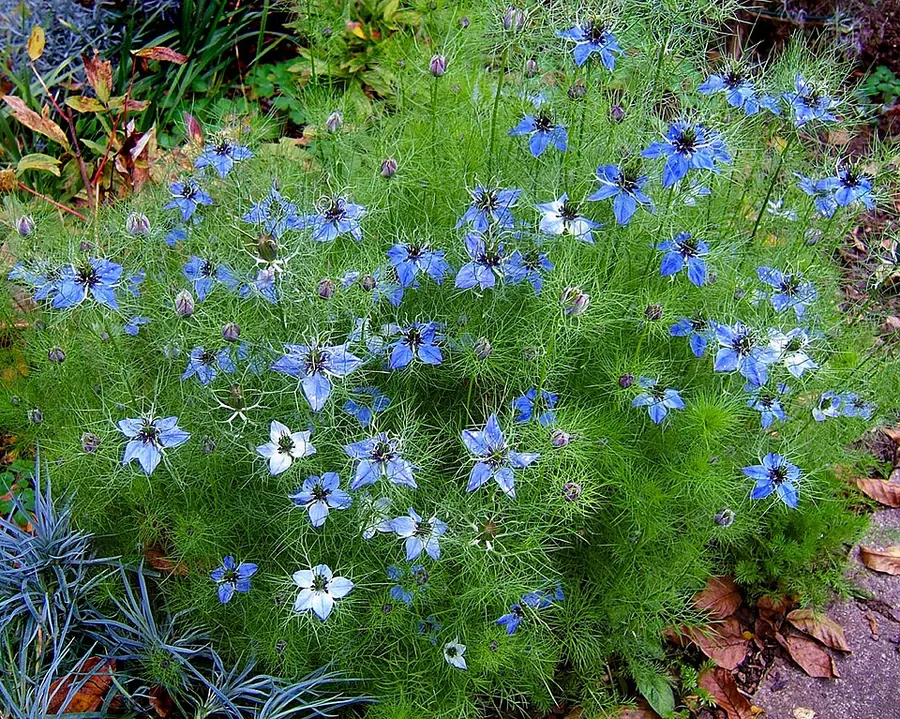
Overview
Love-in-a-mist is the kind of old cottage-garden plant that lends a border instant softness, its fine, feathery foliage wrapping every bloom in a gentle haze. The flowers come in tender blues, whites, and pinks, and the horned seed pods that follow give a planting a second life indoors, where they slip into arrangements long after the beds have moved on. A hardy annual in the buttercup family, it settles into most gardens with ease.
Its charm is how little it asks of a routine. Scatter the seed where it is to stand, offer it sun, and it comes to flower in a couple of months, filling gaps between more architectural neighbors. The one thing to honor is its long taproot, which resists a move, so this is a plant to sow in place rather than shop for in trays, a quiet argument for planning the look ahead of the season.
It follows the cool half of the year. The show runs from late spring into summer, then the planting eases off as the heat rises and settles into papery pods that read beautifully in a vase or a dried bunch. Leave a few to open and the plant reseeds itself, returning the next spring to furnish the same corner again.
Care
The short version: full sun and average, well-drained soil, sown straight into the ground in early spring. Keep it evenly moist, feed it little, and leave a few pods to drop seed so the display returns next year.
Light
Give nigella full sun and it settles into the border at its best, flowering most freely and standing tallest. It manages in part shade, but the plants stretch and the bloom thins, which softens the very effect you planted it for.
Water
Keep the soil evenly moist through the growing season and never let it dry out completely while the plants are in flower. Once settled, it carries on through ordinary garden conditions without asking much of your week.
Soil
Average, well-drained soil is all it wants, whether that is loam, clay, or sand. It is relaxed about pH across 6.0 to 8.0, so most gardens welcome it with no special preparation.
Humidity
Outdoor air suits it, so there is nothing to manage on that front. Good airflow does the real work, keeping the fine foliage dry and the planting looking fresh.
Feeding
This is a light feeder that thrives in plain soil, so feed it sparingly if at all. A rich diet only builds leaf at the expense of the flowers that make the display.
Pruning
Deadhead the spent blooms to keep the flowering going, or leave them to swell into the horned seed pods that carry the look into a vase. Left in place, those pods also let it self-sow for next year.
Size & spacing
Plants reach about 18 to 30 inches (45 to 75 cm) with a slim spread of 6 to 18 inches (15 to 45 cm), an easy scale to weave through a mixed border. Thin or space them so air moves freely between the feathery stems.
When to plant
Nigella keeps to cool weather and a short, elegant season. Sow it directly in early spring once the ground can be worked, repeat every few weeks into midsummer, and enjoy the display from roughly June through August before the heat draws it to a close.
Northern hemisphere
Southern hemisphere
Typical months for a temperate climate: start earlier in warm zones, later where spring frosts linger.
- Sow: 6 to 8 weeks before the last spring frost in individual peat pots; transplanting is often disappointing due to a long taproot.
- Plant: Direct sow in the garden as soon as the ground can be worked in early spring; make successive sowings every 3 to 4 weeks until midsummer for continuous bloom.
- Harvest: Blooms late spring through summer (roughly June to August); each plant blooms for only a month or two and declines in summer heat.
Hardiness
USDA hardiness zones: 2–11
Temperature: down to -46°C
Troubleshooting
Nigella asks little and rewards more, and the few things that unsettle it trace back to its taproot or to summer heat. The early cues below tell you when a light touch is called for and when the planting is simply keeping to its season.
Young seedlings collapse at the base or falter after a move
The plant that reads so effortlessly in the border has one firm preference: it wants to stay put. Love-in-a-mist sends down a long taproot and resents disturbance, so seedlings tend to stall or fail once lifted from a cell. Cool, wet seed-starting compounds it by inviting damping-off, a fungus that pinches the stem at the soil line. Sow where the display is to stand, or use peat pots that plant whole, and keep the mix clean and on the dry side.
Fix:
- Direct sow where plants are to grow, or start in individual peat pots and transplant with minimal root disturbance
- Use sterile potting media and clean containers, and avoid overwatering
The display winds down and browns as summer heat arrives
This is simply the plant keeping to its season. Nigella is a cool-weather annual that gives its best in spring and early summer, then steps back as the heat settles in. There is nothing to rescue, only a rhythm to plan around. Sow in waves every few weeks so the border stays furnished, and let the earliest plants retire gracefully into their seed pods.
Fix:
- Make successive sowings every 3 to 4 weeks so younger plants replace heat-spent ones
- Treat as a cool-season annual and enjoy the ornamental seed pods as bloom fades
A dense drift of weak volunteers returns the next spring
Left entirely to itself, nigella has a generous habit that can tip into excess. Seed shed from the horned pods brings it back the next spring in crowded mats that grow thin and leggy, blurring the airy look that recommends it. A firm thinning gives each plant its room and keeps the planting elegant. For a lighter hand still, remove a few pods before they split and scatter.
Fix:
- Thin volunteer seedlings to allow proper spacing and airflow
- Remove some seed capsules before they shatter to limit self-seeding
Toxicity
This is a low-risk plant, not a worrying one, which is part of why it sits so comfortably in a lived-in garden. The seeds hold a mild alkaloid called damascenine along with some saponins, enough that the ornamental seeds are not for eating and pets should not chew the pods, though a small taste is no cause for alarm. Keep the dried seed heads, so useful in arrangements, away from pets and small children who might gnaw on them.
Toxic to
Cats · Dogs · Horses · Rabbits · Livestock · Birds · People
Cats Caution
A passing nibble of foliage seldom amounts to anything worth noting. A cat that works through the seed pods may drool or bring up a meal, so those dried capsules are best kept off the sill and out of a curious paw's reach.
Dogs Caution
A mouthful of seeds usually brings nothing worse than a mild, passing stomach upset. With such a light alkaloid load, a stray taste of the plant hardly registers as a concern.
Horses Caution
Horses tend to pass it by, and the trace amounts met in a mixed pasture carry little weight. Even so, clearing it from paddocks is wise where a restless animal grazes the beds out of boredom.
Rabbits Caution
The seed heads are no treat to offer, since the saponins can unsettle a rabbit's sensitive gut. A single leaf, by contrast, rarely does more than soften the stomach.
Livestock Caution
Goats, sheep, and cattle generally graze on past, and difficulty arrives only when an animal takes in a large helping of the seed-laden tops. Dullness or loose droppings would be the signs to watch in that uncommon event.
Birds Caution
The seed carries alkaloid enough that it should never be offered to pet birds by design. Wild birds sampling a few in the garden come to no harm.
People Caution
These are not the culinary black cumin seeds, so the ornamental seed is not for casual eating, and a large quantity can unsettle the stomach. A child who swallows a pod or two will most likely be fine, though the dried heads belong well out of small hands.
Keep seeds and seed capsules away from pets and small children who might chew them, though significant poisoning is not well documented.
Helpline numbers

United States
ASPCA Animal Poison Control: (888) 426-4435 (fee applies)
Poison Control: (800) 222-1222



Canada
Poison Centres: 1-844-764-7669
Varieties
A handful of named selections come up again and again, distinguished mostly by flower color and the size of the seed pods they finish with. These are the ones that reward a place in the plan.
Miss Jekyll
The cottage-garden mainstay, its soft blue semi-double flowers holding beautifully once cut for the table.
Miss Jekyll Alba
The trusted Miss Jekyll form reimagined in pure white, an easy match for a paler, quieter scheme.
Persian Jewels
A seed mix that brings mauve, lavender, purple, rose, light blue, and white to a single planting for an effortless jewel-box drift.
Oxford Blue
A taller selection whose deep blue flowers and large dark pods carry the look straight into dried arrangements.
How to propagate
There is really only one way to bring nigella into a garden, and it could not be simpler: sow it from seed, exactly where you want the display to stand.
SeedEasy
Direct sow in early spring as soon as soil is workable, with successive sowings every 3 to 4 weeks until midsummer. · Germinates and develops quickly; reaches flowering within roughly 2 to 3 months of sowing.
One route serves the whole planting, and it asks very little. Sow the seed exactly where the display is to stand, since the long taproot will not accept a move, and repeat every 3 to 4 weeks from early spring through midsummer to keep the border in flower. Each sowing comes along quickly, reaching bloom in 2 to 3 months, then sheds seed and reappears on its own the following year.
Myths
Love-in-a-mist is the same plant as the black cumin you cook with.
The pantry spice belongs to Nigella sativa, a separate species raised for its seed. Ornamental Nigella damascena is a different plant, grown for the flowers and horned pods that earn it a place in the border, and its seed is not one for the spice rack.
Love-in-a-mist transplants as easily as any bedding annual.
Its long taproot makes it reluctant to be uprooted, so seedlings often sulk or fail after a move. Sow it straight into the garden where the display is wanted, or start it in peat pots that go in whole.