Houseplant · Arecaceae
Parlor Palm
Chamaedorea elegans
Give it low light and steady moisture, and the parlor palm thrives where fussier plants sulk.
Bright indirect
59–86°F · 15–30°C
USDA 10–12
2–7 ft · 0.6–2 m
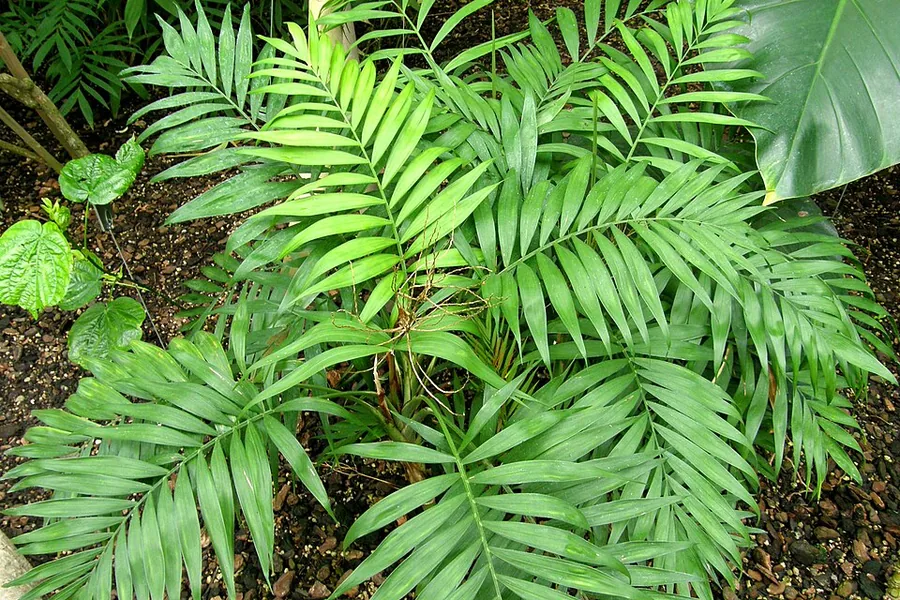
Overview
The parlor palm carries its name from the Victorian parlor, the room it made its own while it held its poise in dim corners and dry air that undid more demanding plants. A member of the palm family, it grows in the wild as an understory plant in the forests of Mexico and Guatemala, shaped by deep shade and soft, filtered light. That quiet forest pedigree is precisely what lets it live so gracefully indoors, at home in the low light of a hallway, a reading nook, or a shaded corner few other plants will accept.
This is a slow, compact palm that settles at around 2 to 6 feet (60 to 200 cm) over many unhurried years, an easy scale for a side table, a mantel, or a pedestal in a modest room. Each stem lifts a tuft of soft, arching fronds, and because a single stem reads sparse, it is usually sold as a clump of seedlings so it looks full and considered from the first day. Give it enough light and a mature plant may even offer sprays of small yellow flowers in spring, a discreet seasonal grace note.
Few plants slip so effortlessly into a daily routine. It takes low light, average humidity, and the occasional forgotten watering in its stride, and being non-toxic, it keeps calm company with cats, dogs, and small children. Only two things unsettle its composure: soggy soil and bone-dry air, both easily managed once a room finds its rhythm.
Care
The short version: it prefers bright indirect light yet lives happily in low light, wants water when the surface dries and never a saucer left standing, keeps to ordinary room warmth, and asks for only a light feed across spring and summer.
Light
The parlor palm looks its best in bright, indirect light, yet its quiet gift is thriving in the low light and shade that defeat most plants, which makes it the natural choice for a dim corner or a north-facing room. Keep it clear of direct sun, which scorches the soft fronds. A spot beside a north or east window frames it beautifully.
Water
Water it well once the soil surface dries, then pour off anything left standing in the saucer. Soggy soil and a poorly draining mix are the surest route to root rot, so lean toward slightly dry rather than wet. There is no set schedule to keep, only the soil to read, which suits a busy household.
Soil
Choose a porous, humus-rich potting mix that drains freely and lets the roots breathe. The organic matter holds enough moisture without ever turning heavy. A pH anywhere from 6.0 to 7.5 keeps it settled.
Temperature
Ordinary room warmth is all it asks, anywhere from 59°F to 86°F (15°C to 30°C), the comfortable range of most living spaces. Keep it away from cold drafts and the dry rush of heating vents. Frost is out of the question.
Humidity
Average household humidity suits it, so there is no figure to fuss over. Even so, dry winter air invites brown tips and spider mites, so a little added moisture in the coldest months keeps the display crisp. A gravel-and-water tray tucked beneath the pot, or an occasional misting, is all it takes.
Feeding
Feed only while the plant is actively growing in spring and summer, with a slow-release palm fertilizer offered two or three times across the season. Set the feeding aside entirely in winter. A light hand matters, since too much fertilizer builds up salts that scorch the leaf tips and spoil the line of the frond.
Pruning
Pruning barely enters the routine. Remove a whole dead or damaged frond at its base to keep the plant tidy, but never top a stem. Each stem grows from a single point, so cutting off the crown kills that stem rather than prompting it to branch.
Repotting
Repot only every few years, or once the plant is clearly crowded, since it is content to sit a little pot-bound, which happily suits a decorative container you would rather not disturb. Roots circling the pot or slipping out the drainage holes, soil that dries quickly, and stalled growth are the cues that it is time to move up.
Size & spacing
Expect a mature height of 2 to 6 feet (60 to 200 cm) and a spread of 2 to 3 feet (60 to 90 cm), reached slowly over the years, a restrained footprint that flatters a compact room. Grown in a pot, it needs no garden spacing, only enough clearance for its arching fronds to fall naturally.
Troubleshooting
A parlor palm rarely disturbs the calm of a room, and on the odd occasion it does, the foliage tells the story first. Two signs are worth recognizing: browning tips and a dull, speckled cast. Notice either early and the plant returns to form with little effort.
A tired, dusty cast that dulls the display
When a room turns warm and dry, spider mites settle in on the undersides of the fronds and quietly take the shine off the plant. The signs are subtle at first: a stippled, bronzed haze across the foliage, then the tiny mites and their fine webbing on closer study. A wipe of each frond with a damp cloth, regular misting, and a lift in humidity restore both the plant's health and its place in the room.
Fix:
- Rinse or wipe foliage with a damp cloth and mist regularly
- Raise humidity to discourage mites
- Move plants outdoors in summer for natural predator control or treat as needed
Brown tips that take the polish off the fronds
Dry indoor air is the usual reason the tips lose their finish, though a slow buildup of fertilizer salts or soil that lurches between parched and drenched can spoil the look just as easily. The very tip browns and crisps while the rest of the frond keeps its green, and the older leaves near the base tend to go first. Lift the humidity a little, feed with a lighter hand, flush the pot to clear the salts, and hold the soil evenly moist to bring the plant back to its composed best.
Fix:
- Raise humidity with a gravel-and-water saucer or room humidifier
- Reduce fertilizer rate and flush the pot with water to leach accumulated salts
- Maintain even soil moisture, watering thoroughly when the surface dries
Toxicity
For a home shared with pets, the verdict is reassuring: the parlor palm is non-toxic through and through. The ASPCA lists it as safe for cats and dogs, and no known toxins trouble other animals or people. The single caveat is a quiet one, that the fruit pulp can irritate skin, so gloves are worth having on hand if you ever process the seed.
Safe for
People · Cats · Dogs · Horses · Rabbits · Livestock · Birds
Cats None
A cat can share the room with it in peace. The ASPCA lists the parlor palm as non-toxic to cats, so a curious nibble at a frond leads to no poisoning.
Dogs None
Dogs belong in the same easy company. The plant holds no known toxins, though a dog that helps itself to a large helping of any greenery may sit through a brief upset stomach.
Horses Safe
The foliage carries no known toxic compounds, so a horse that grazes on this palm comes away unharmed.
Rabbits Safe
Rabbits can browse the fronds freely, as the plant holds nothing that would poison them.
Livestock Safe
Cattle, goats, and sheep run no poisoning risk beside it, since the parlor palm is not a toxic plant.
Birds Safe
Pet birds are at ease with both the fronds and the small black fruit, neither of which carries a known toxin.
People Safe
For people the plant is non-toxic, a genuinely fuss-free presence. The only aside is that the fruit pulp can irritate skin during seed processing, so gloves are wise for that task.
Gloves are advised when handling Chamaedorea fruits during seed processing because the fruit pulp can contain skin irritants.
Varieties
The parlor palm reaches the home almost entirely as the true species, untouched by the cultivar breeding that shapes so many other houseplants. In practice there is just one to know, which keeps the choosing simple.
Chamaedorea elegans (species)
This is the classic compact, single-stemmed parlor palm, usually sold as a cluster of several seedlings potted together so the plant arrives in the room looking full and generous.
How to propagate
Bringing on more parlor palms is a slow pleasure rather than a technical exercise. New plants come from seed or from dividing an established clump, and neither is a matter of a single afternoon.
SeedDemanding
Sow fresh seed in warmth; germination is slow and erratic · Seed may not begin germinating for several months and can continue sporadically for over a year
Seed is how these palms are chiefly raised, and it rewards a patient hand more than a hurried one. Sow fresh seed in warmth and expect a long quiet spell, since germination is slow and may keep arriving in ones and twos for over a year. Wear gloves as you clean the fruit, because the pulp can irritate skin.
DivisionModerate
When repotting a multi-stemmed clump · Several weeks to re-establish after separating clumps of seedlings
When a pot already holds several seedlings grown side by side, repotting is the moment to ease the clump apart into new plants. Allow the divisions a few weeks to find their feet again. A single-stemmed plant offers no such shortcut, since each stem grows from one point and will not multiply.
Myths
Parlor palms are poisonous to cats and dogs.
There is no cause for concern, since the ASPCA lists Chamaedorea elegans as non-toxic to both cats and dogs. A nibbling pet is in no danger from this palm, which is a large part of why it is welcomed into so many pet-friendly homes and features on pet-safe plant lists.
You can keep a leggy parlor palm short by cutting off the top of the stem.
Each stem grows from a single point at its tip, so shortening it never encourages branching. Cutting off the top simply kills that stem. To keep the silhouette lush, choose a multi-seedling clump from the outset rather than trimming the height down.